Article: Best Skin Boosters for Mature Skin: 2026 Professional Practitioner Roundup
Best Skin Boosters for Mature Skin: 2026 Professional Practitioner Roundup
Superficial hyaluronic acid hydration doesn't reverse true dermal thinning in patients over fifty. When clinics rely solely on standard linear formulations to treat atrophic tissue, clients inevitably see their deep elastosis and crepiness return within weeks. Identifying the best skin boosters for mature skin demands moving past surface-level water retention toward aggressive, multi-pathway tissue redensification.
You already know the frustration of seeing temporary plumpness mask an extracellular matrix that remains fundamentally depleted. Mature, senescent fibroblasts require direct mechanical tension, amino acid precursors, and regenerative signaling rather than fleeting volume that metabolises in days. You need active clinical protocols that deliver demonstrable neocollagenesis and long-term tensile strength.
Discover the top professional skin boosters and bio-remodellers engineered to restore extracellular matrix density in mature skin. Ahead, we evaluate high-yield polynucleotides, hybrid complexes, and structural biostimulators, alongside reliable supply strategies that keep your practice running without diary disruption.
Key Takeaways
- Overcome the limitations of standard linear hyaluronic acid by targeting cellular senescence and true extracellular matrix depletion with bioactive compounds.
- Select the best skin boosters for mature skin by evaluating clinical efficacy across high-yield polynucleotides, hybrid bio-remodellers, and structural biostimulators.
- Implement multi-depth injection protocols, pairing precise micro-papular delivery for fragile peri-orbital tissue with deep cannula fanning across atrophic planes.
- Protect clinic schedules and working capital through streamlined UK procurement channels offering verified authenticity and reliable next-day delivery.
Pathology of Mature Skin: Why Standard Hydration Boosters Fail
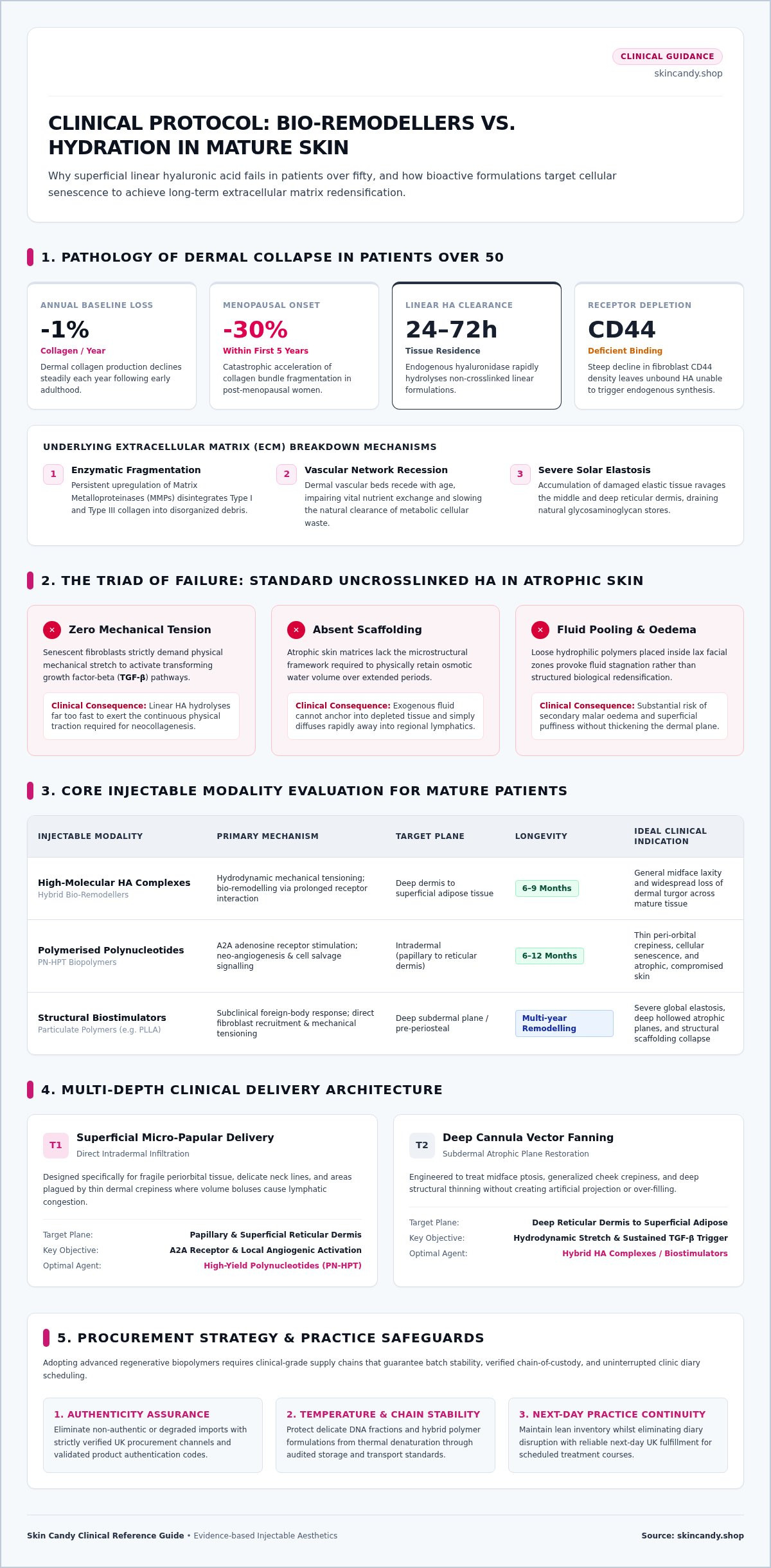
Administering standard non-crosslinked hyaluronic acid to patients over fifty often produces underwhelming clinical outcomes. Superficial hydration simply cannot address the cellular collapse driving mature facial ageing. True clinical redensification requires reversing deep structural atrophy rather than coating tissue in transient water-binding polymers. When searching for the best skin boosters for mature skin, practitioners must target cellular machinery rather than surface plumping.
Ageing tissue experiences a steep decline in CD44 receptor density on the surface of human fibroblasts. Without sufficient functional CD44 receptors, exogenous hyaluronic acid cannot effectively bind to cell membranes to trigger endogenous synthesis. Instead, the injected material sits unanchored within an unsupportive extracellular matrix (ECM). Dermal vascular networks also recede with age, slowing nutrient delivery and impairing the clearance of cellular debris. Injecting basic, non-reactive solutions into this microenvironment wastes chair time, frustrates patients, and fails to initiate true neocollagenesis.
Cellular Senescence and Extracellular Matrix Degradation
Fibroblast senescence shuts down natural structural repair. Dermal collagen production drops by roughly 1% each year after early adulthood, but post-menopausal women face a catastrophic loss of up to 30% of dermal collagen within just five years. Type I and Type III collagen bundles fragment into disorganized debris under persistent upregulation of matrix metalloproteinases (MMPs). Concurrently, solar elastosis ravages the middle and deep reticular dermis. Depleted endogenous glycosaminoglycans leave the matrix mechanically compromised, demanding potent bio-stimulatory signals rather than passive, unreactive hydration.
The Limitations of Low-Concentration Linear Hyaluronic Acid
Uncrosslinked linear hyaluronic acid metabolises rapidly in mature skin beds. Without chemical stabilization or regenerative co-factors, endogenous tissue hyaluronidase hydrolyses these low-density polymers within 24 to 72 hours of intradermal deposition. This creates several acute clinical challenges:
- No sustained mechanical tension: Senescent fibroblasts require mechanical stretch to activate transforming growth factor-beta (TGF-β) pathways and lay down new collagen. Linear HA clears too fast to exert that physical force.
- Zero structural scaffolding: Atrophic tissue lacks the extracellular framework required to retain osmotic water volume long term. Fluid simply diffuses out into regional lymphatics.
- Risk of fluid pooling: Injecting loose, hydrophilic polymers into lax peri-orbital or lower facial tissue frequently provokes malar oedema without improving true dermal thickness.
Deploying the best skin boosters for mature skin means shifting your inventory toward active, multi-modal regenerators. Patients over forty-five require advanced formulas, such as polynucleotides, hybrid complexes, and targeted biostimulators, that trigger durable, long-term matrix remodelling.
Comparing Core Injectable Modalities for Mature Facial Rejuvenation
Clinical success with mature patients requires choosing injectable classes based on their distinct physiological pathways. Uncrosslinked hyaluronic acid, highly purified polynucleotides, and Poly-L-Lactic Acid (PLLA) function via entirely different mechanisms. Practitioners must evaluate each modality by bio-stimulation potency, target tissue depth, neocollagenesis profile, and clinical longevity.
Recent reviews on injectable skin boosters in aging skin rejuvenation highlight that mature tissue benefits most when clinicians match specific polymer behaviours to individual anatomical defects. Selecting the best skin boosters for mature skin means moving away from a single-product approach.
| Modality | Primary Mechanism | Target Plane | Clinical Duration | Ideal Mature Indication |
|---|---|---|---|---|
| High-Molecular HA Complexes | Hydrodynamic mechanical tensioning; bio-remodelling | Deep dermis to superficial adipose tissue | 6-9 months | General midface laxity and lost dermal turgor |
| Polymerized Polynucleotides (PN-HPT) | A2A receptor stimulation; angiogenic signalling | Intradermal (papillary to reticular) | 6-12 months | Thin peri-orbital crepiness, neck elastosis, scar atrophy |
| PLLA Biostimulators | Sub-micron foreign body response; Type I neocollagenesis | Subdermal junction to supraperiosteal | 18-24 months | Deep structural hollowing and volumetric dermal collapse |
High-Molecular Hyaluronic Acid vs Polynucleotide Formulations
High-molecular-weight hybrid HA formulas deliver direct hydrodynamic expansion and cellular stretch. Polynucleotides, however, bypass osmotic volume completely. Extracted DNA polymers bind directly to adenosine A2A receptors, stimulating rapid fibroblast proliferation and the expression of collagen types I and III. Review our clinical breakdown of polynucleotide indications for aesthetic clinics to master these exact treatment pathways. These marine-derived chains also clear local free radicals and promote regional angiogenesis without drawing fluid into delicate tissue beds.
Poly-L-Lactic Acid and Hybrid Collagen Stimulators
PLLA works through a targeted biological response. Biodegradable micro-particles trigger sub-clinical tissue activation, recruiting macrophages that stimulate progressive, long-term de novo collagen synthesis over several months. Superficial placement of pure PLLA carries significant nodule risks in thin tissue, making deep subdermal cannula vectoring mandatory. Blending bio-stimulatory micro-particles with hyaluronic acid carriers provides immediate structural support while structural neocollagenesis matures.
Stocking the best skin boosters for mature skin requires partnering with a dependable supply line. Explore the wholesale regenerative catalogue at Skin Candy to secure verified bio-remodellers and consumables with prompt UK dispatch.
The Best Professional Skin Boosters to Stock for Mature Patients
Stocking the best skin boosters for mature skin means curating an inventory that tackles severe elastosis, localized thinning, and cellular lethargy simultaneously. Mature dermis demands predictable tissue integration and exceptional biocompatibility. Procuring verified medical injectables compliant with UK medical device regulations ensures clinical safety and therapeutic consistency across every treatment cycle.
Advanced Polynucleotide Solutions for Atrophic and Peri-Menopausal Skin
Highly purified polynucleotides excel in delicate zones where classic crosslinked fillers or high-spread hyaluronic acids risk unsightly water retention. For hollow under-eyes, radial perioral lines, and crepey neck bands, polynucleotides trigger robust tissue redensification. These formulations offer calibrated syringe viscosity, allowing smooth intradermal micro-papular delivery via 30G to 32G needles. Patient comfort remains high, downtime rarely exceeds twenty-four hours, and foreign-body reactivity is minimal in thin, post-menopausal skin.
Lumi Meso and High-Performance Mesotherapy Cocktails
When mature patients present with diffuse photoageing alongside generalized cellular dehydration, targeted mesotherapy complexes supply essential biochemical substrates. Lumi Meso combines non-crosslinked hyaluronic acid with amino acid precursors and micronutrients to kickstart cellular processes that senescent fibroblasts struggle to initiate alone. These amino acid clusters directly facilitate pro-collagen synthesis while uncrosslinked chains deliver immediate luminosity. For clinics looking to balance inventory between standalone biostimulators and multi-ingredient revitalisers, check our guide on mesotherapy products wholesale UK for practical procurement guidance.
PLLA and Long-Lasting Bio-Stimulatory Formulations
Suspensions of Poly-L-Lactic Acid (PLLA) restore lateral facial tension and deep structural tissue volume. Rather than offering transient surface hydration, reconstituted PLLA micro-particles establish a durable biological scaffold in the deep reticular dermis and subcutaneous plane. Strict adherence to reconstitution windows and aseptic handling prevents particle agglomeration and nodule formation. Managing patient expectations is vital; practitioners must clearly communicate that neocollagenesis develops progressively over twelve to twenty-four weeks rather than providing overnight results.
Equipping your treatment rooms with the best skin boosters for mature skin ensures your practice can address every stage of structural depletion with clinical confidence.
Advanced Clinical Administration: Layering Protocols for Ageing Skin
Treating mature patients successfully requires a disciplined, multi-depth injection strategy. Single-depth bolus patterns often fail to resolve pan-facial deflation accompanied by epidermal atrophy. Achieving natural redensification involves coordinating cellular primers, bio-remodellers, and structural volume across four distinct procedural steps:
- Dermal Evaluation and Skin Barrier Priming: Assess vascular compromise, local skin thickness, and dehydration severity to select appropriate molecular weights.
- Subdermal Vectoring and Mechanical Support: Fan bio-stimulatory suspensions across deep fascial lines to stimulate structural collagen vectors.
- Intradermal Micro-Papular Mesotherapy: Target focal surface zones, treating fine lines and peri-orbital crepiness directly within the papillary layer.
- Maintenance and Matrix Support: Re-evaluate cellular redensification at four to six weeks, scheduling ongoing stimulation cycles every six to nine months.
Delivery Techniques: Micro-Papular Mesotherapy vs Cannula Vectoring
Delivery mechanics must match tissue thickness. Fragile, post-menopausal capillary networks rupture easily under mechanical stress. When treating peri-orbital hollows or peri-oral lines, use 30G or 32G ultra-fine needles at a 10 to 15-degree angle. Form minute, 0.02 mL to 0.05 mL intradermal wheals within the papillary dermis. Placing material too deeply here wastes bio-active ingredients, while uneven superficial pooling creates visible irregularities.
Conversely, broad zones like the cheeks, preauricular hollows, and jawline call for blunt 25G or 27G cannulas. Sub-dermal fanning across the reticular-hypodermal interface eliminates multiple sharp entries, slashing haematoma risks in fragile vessels. This technique lays down an even matrix scaffold, ensuring the best skin boosters for mature skin spread predictably without localised lumps.
Combination Protocols: Pairing Boosters with Fillers and Exosomes
Optimal pan-facial rejuvenation coordinates bio-stimulation with deep structural augmentation. Mature facial frames often present deep fat pad deflation alongside surface crepiness. Address structural volume deficits first by deploying robust structural gels to secure the zygomatic arch and piriform aperture. Allow two to three weeks for deep tissue integration before layering superficial regenerators.
Where severe cellular exhaustion delays tissue repair, pairing bio-remodellers with acellular vesicles provides rapid growth factor signalling. Review our comparative technical analysis in exosomes vs polynucleotides for clinics to refine your clinic's sequence pathways. Combining receptor-stimulating nucleotides with concentrated vesicular signals provides senescent cells with the biochemical impetus required to produce fresh extracellular matrices.
Equip your treatment rooms with the industry's best skin boosters for mature skin alongside high-purity injectables. Visit Skin Candy to browse professional regenerative solutions and place your clinic order today.
Procurement Strategy: Sourcing Authentic Aesthetic Consumables in the UK
Administering advanced injection protocols demands an uncompromised supply chain. Sourcing the best skin boosters for mature skin means little if product integrity degrades during transit or grey-market counterfeits enter your stock room. UK aesthetic practitioners operate under intensifying regulatory oversight; clinical safety and commercial sustainability require verified, transparent procurement channels.
Adulterated, improperly stored, or counterfeit consumables introduce devastating risks, from granulomatous foreign-body reactions to severe tissue necrosis. Insurers routinely reject malpractice claims stemming from uncertified grey-market stock. Sourcing directly through verified UK wholesale channels guarantees manufacturer-compliant temperature controls, authentic formulations, and immediate traceability for every syringe you inject.
Verifying Product Authenticity and Batch Traceability
Clinics must implement strict verification checks upon intake of all medical injectables:
- Security Seals and Packaging Integrity: Inspect outer packaging for tamper-evident closures, holographic markers, and pristine lot codes.
- Regulatory Conformity: Confirm explicit UKCA or valid European CE marking on both outer cartons and primary blister packaging.
- Digital Traceability: Log serial numbers, manufacturing batch codes, and expiry dates directly into electronic health records (EHR) before procedural administration.
Maintaining auditable digital logs satisfies council health inspections and safeguards clinical licenses. Full batch traceability ensures rapid patient recall communication if a manufacturer issues an advisory notice.
Maximising Clinic Efficiency with Rapid UK Delivery
Lean inventory management separates thriving practices from struggling operations. Stacking clinical cupboards with slow-moving stock ties up essential cash flow and increases waste through product expiration. Conversely, delayed shipments disrupt scheduled patient appointments, forcing cancellations and causing direct revenue loss.
Skin Candy operates as a dedicated UK wholesale supply partner, delivering advanced regenerative consumables, including polynucleotides, PLLA biostimulators, and dermal fillers, nationwide. Guaranteed rapid order dispatch and dependable next-day delivery across the United Kingdom protect your appointment diary from stockouts. This agile fulfilment model enables clinics to order lean, responding dynamically to weekly patient bookings without holding unnecessary stock on shelves.
Purchasing core consumables in bulk directly improves operational margins. By securing verified, high-performance formulations in volume, practices reduce per-unit overheads while maintaining competitive treatment packages for ageing patients. Pairing robust procurement logistics with the best skin boosters for mature skin keeps your practice safe, compliant, and consistently profitable.
Upgrade Your Dermal Redensification Protocols Today
Achieving superior outcomes in patients over fifty requires looking past temporary hydration. Mastering the best skin boosters for mature skin means combining cellular receptor signalling via polynucleotides, nutrient-dense mesotherapy, and targeted structural biostimulators. When you layer precise intradermal micro-papules with deep cannula vectoring, you stimulate genuine extracellular matrix remodelling that restores dermal density for months.
Clinical excellence relies on an agile, uncompromised supply chain. As a trusted UK wholesale distributor of genuine aesthetic consumables, Skin Candy eliminates stockout anxieties and protects your diary bookings. Our comprehensive portfolio includes Lumi Meso, high-purity polynucleotides, PLLA biostimulators, and proven dermal fillers such as Lumifil and Regenovue. Order with guaranteed next-day delivery nationwide across the UK to keep your clinic cupboards lean and fully prepared. Explore professional skin boosters and secure next-day delivery at Skin Candy to deliver exceptional patient results with complete commercial confidence.
Frequently Asked Questions
How do polynucleotides compare to hyaluronic acid skin boosters for mature patients?
Polynucleotides activate adenosine A2A receptors to trigger cellular redensification and microvascular repair without pulling excess water into the tissue. Non-crosslinked hyaluronic acid focuses primarily on binding moisture and exerting hydrodynamic mechanical stretch. For thin, fluid-retentive areas like peri-orbital rims, polynucleotides remain the superior option, whereas hybrid HA matrices suit broad cheek laxity. Combining both modalities often provides the best skin boosters for mature skin treatment plans.
Can skin boosters replace dermal fillers when treating severe age-related facial volume loss?
No, skin boosters cannot replace structural dermal fillers for severe volume loss. Mature facial ageing involves deep fat compartment deflation and bone resorption that require high G-prime crosslinked gels. Skin boosters target dermal quality, restoring extracellular matrix density and elasticity. Clinicians should use deep fillers like Lumifil to restore skeletal projection, then layer bio-stimulators superficially to refine atrophic skin texture.
What is the optimal treatment interval when administering skin boosters to mature skin?
Mature skin requires an initial loading protocol of two to three sessions spaced two to four weeks apart. Senescent fibroblasts react more slowly than younger cells, demanding cumulative biochemical stimulation to initiate robust neocollagenesis. Once the extracellular matrix redensifies, maintenance treatments should occur every six to nine months. Sticking to structured schedules prevents newly synthesised collagen and elastin networks from declining back to atrophic baselines.
Are micro-cannulas or ultra-fine needles preferable for administering skin boosters to fragile skin?
Tool selection depends entirely on anatomical depth and local tissue fragility. Blunt 25G or 27G cannulas are ideal for subdermal fanning across the cheeks and jawline, as they navigate compromised capillary beds without causing extensive bruising. Conversely, 30G to 32G ultra-fine needles are essential for intradermal micro-papular delivery in delicate zones like the lower eyelids, perioral lines, and neck, where precise depth control is mandatory.
How should practitioners handle product layering when combining skin boosters with chemical peels?
Never administer injectable skin boosters through skin immediately after applying medium or deep chemical peels. Peels compromise the stratum corneum, substantially increasing the risk of intradermal infection and acute contact irritation. Practitioners should separate injectable sessions and chemical peels by at least ten to fourteen days. This interval allows the epidermal barrier to re-epithelialise completely before introducing needle or cannula trauma.
Why is next-day UK delivery critical when ordering wholesale skin boosters and consumables?
Aesthetic clinics operate on tight appointment diaries where delayed stock directly causes cancelled treatments and lost revenue. Sourcing the best skin boosters for mature skin with guaranteed next-day UK delivery allows practices to maintain lean inventory. You don't have to tie up working capital in static cupboard stock; you can order consumables dynamically to match confirmed weekly bookings with complete peace of mind.
What licensing or professional credentials are required to order professional skin boosters wholesale?
Ordering professional injectables requires verified trade account validation. Practitioners must provide proof of accredited aesthetics training, appropriate professional indemnity insurance, and relevant professional credentials. While CE-marked skin boosters are Class III medical devices, injectors must also operate compliant emergency protocols, including access to prescription-only reversal agents like hyaluronidase through a registered medical prescriber to ensure complete clinical safety.