Skin boosters with other treatments: how combinations work
Combining treatments doesn’t automatically mean better results. Combination treatments with skin boosters may include anti-wrinkle injections, mesotherapy or chemical peels, but the order and spacing matter. For another advanced treatment in the same area, a gap of approximately two weeks is commonly advised.
It’s understandable to want a plan that addresses more than one skin concern. The key is choosing treatments that complement each other and allowing the skin time to recover, rather than layering procedures too closely. Sensitive or compromised skin may need a different approach.
This guide explains which combinations may be considered, how timing and aftercare can affect recovery, and why practitioner qualifications matter. It also covers what to expect after treatment and how a practitioner assesses suitability, treatment areas and sequencing before creating a plan.
Key Takeaways
- Plan expectations around the treatment course: changes in skin texture and hydration may appear before collagen-stimulating effects become more noticeable.
- Choose combinations and sequencing according to the treatments involved, the area being treated and the skin’s condition.
- Understand the aftercare and recovery needs of each procedure, and seek an experienced, qualified practitioner to assess suitability.
- Explore how skin boosters such as Lumi Meso and polynucleotides may fit into a wider aesthetic treatment plan.
Can Skin Boosters Be Combined With Other Treatments?
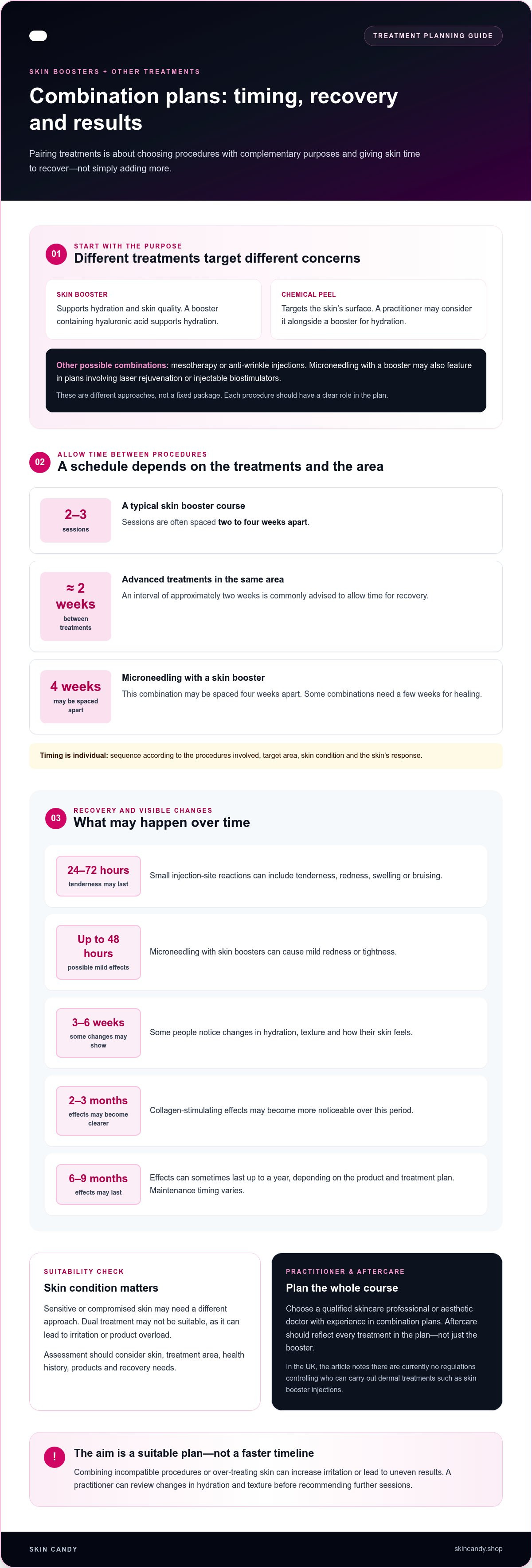
Yes. Skin boosters may be combined with anti-wrinkle injections, mesotherapy or chemical peels. The right order depends on the treatments, target area and skin condition. For another advanced treatment in the same area, approximately two weeks between procedures allows time for recovery.
A skin booster course typically involves 2-3 sessions, often spaced two to four weeks apart. The injectable treatment supports hydration and skin quality, while other procedures may address different concerns. For example, a peel targets the skin’s surface, whereas a booster containing hyaluronic acid supports hydration. Pigmentation, elasticity and deeper skin changes may call for different treatment approaches, rather than simply adding more procedures.
Results develop over time, not all at once. Some people notice changes in hydration, texture and skin feel after 3-6 weeks. Collagen-stimulating effects may become more noticeable after 2-3 months. These timelines help set expectations across a course, particularly when treatments are staged to give the skin time to recover between sessions.
There’s no single typical UK price for combination treatments. The total depends on the procedures included, the products used, the areas treated and whether sessions are combined or spaced apart.
Small injection-site reactions can include tenderness, redness, swelling or bruising. Tenderness may last through the first 24-72 hours. Combining incompatible procedures or over-treating the skin can increase irritation or lead to uneven results. Aftercare should reflect each treatment in the plan, not just the booster.
Effects may last 6-9 months, and can sometimes last up to a year, depending on the product and treatment plan. Maintenance timing therefore varies. A practitioner can review changes in hydration and texture before recommending further sessions. The aim is a suitable course, not adding procedures simply to shorten the timeline.
Combining skin boosters with other treatments
Skin boosters can be part of a wider plan that includes treatments such as mesotherapy, chemical peels or anti-wrinkle injections. The choice depends on the concern being addressed, the treatment area and how the procedures are sequenced.
Combining treatments may address different concerns, while a skin booster alone keeps the plan focused on skin quality and hydration. There’s no universal price comparison for UK combination plans: costs depend on the procedures, products, areas and number of sessions involved.
Combination treatments compared with skin boosters alone
A combined plan pairs a skin booster with another procedure, while a standalone session uses the booster on its own. The distinction matters because different procedures target different concerns, and combining them doesn’t automatically improve results.
For example, a practitioner may consider a chemical peel for surface concerns alongside a booster for hydration. The assessment should account for the ingredients, treatment area and recovery needs. People with sensitive or compromised skin may not be suited to dual treatment, as this can lead to irritation or product overload.
Skin boosters commonly used in combinations
There isn’t one booster suited to every combination: the product and its ingredients must match the treatment plan. Skin boosters may be paired with mesotherapy, peels or anti-wrinkle injections. Microneedling with a booster may also feature in plans involving laser rejuvenation or injectable biostimulators.
These are different approaches, not a fixed facial package. A practitioner considers the concern, skin condition and treatment area before selecting procedures. Each combination should have a clear purpose, such as addressing hydration alongside a separate surface concern, rather than adding treatments without a defined role.
Timing matters. Approximately two weeks between advanced treatments in the same area is commonly advised, while some combinations need a few weeks for healing. Microneedling with a skin booster may be spaced four weeks apart. Incompatible procedures or over-treatment can lead to redness or irritation, so sequencing should account for the skin’s response.
For clinics planning their product supply, explore professional aesthetic products relevant to treatment protocols. A clear schedule helps patients understand which procedure comes first, what recovery to expect and when the next session is planned.
Safety and practitioner qualifications
Safe planning starts with an assessment of the skin, treatment area and health history. Practitioner experience matters because combining treatments affects both sequencing and aftercare.
Risks and safety
Risk assessment covers the products, injection technique, treated area and recovery from each procedure. Microneedling with skin boosters can cause mild redness or tightness for up to 48 hours. Combining incompatible treatments or treating sensitive, compromised skin can trigger inflammatory reactions, irritation or uneven results. A practitioner experienced in combination plans can assess skin texture and overall skin quality, then decide whether one treatment should be postponed.
Common safety misconceptions
A common misconception is that a skin booster is risk-free because it aims to improve hydration, fine lines or skin quality. Injectable treatments still carry risks, and adding procedures doesn’t automatically restore skin faster. Another misconception is that prescribed medicines should be stopped before treatment. Patients shouldn’t stop medication unless advised to do so by the healthcare professional who prescribed it.
In the UK, there are currently no regulations controlling who can carry out dermal treatments such as skin booster injections. This makes practitioner competence especially important. Choose a qualified skincare professional or aesthetic doctor with experience in combining treatments. Their assessment should cover the planned products, treatment order, skin condition and what to do if an unexpected reaction occurs.
Disclose pregnancy, breastfeeding, allergies, medical conditions and current medicines during the suitability discussion. This gives the practitioner relevant information when assessing the proposed treatment and its effects. Before a session, ask for clear aftercare instructions, including how to manage redness and whom to contact if symptoms worsen.
After an injectable treatment, contact the practitioner urgently if you experience severe or increasing pain or unusual skin discolouration. These signs need prompt attention and shouldn’t be treated as routine recovery. Follow the specific aftercare plan, and don’t change prescribed medication without advice from its prescriber.
Which skin boosters are commonly combined with other aesthetic treatments?
Skin boosters aren’t one uniform product category: formulations and intended effects differ. Choosing combination treatments with skin boosters depends on the formulation, treatment area and skin concern. Hyaluronic acid boosters may be considered alongside chemical peels, mesotherapy or anti-wrinkle injections. Microneedling with a booster may also feature in plans involving laser rejuvenation or injectable biostimulators.
Hyaluronic acid formulations also vary. Non-cross-linked, non-thermally bonded hyaluronic acid is designed to disperse through tissue and support hydration, regeneration and skin revitalisation. A bio-remodelling formulation combines high- and low-molecular-weight hyaluronic acid, thermally bonded rather than chemically cross-linked. It is administered using standardised injections at specific Bio Aesthetic Points in the deep dermis.
These differences matter when clinics plan combination treatments with skin boosters. A practitioner considers whether the aim is hydration, bio-remodelling or addressing a separate concern. For example, a chemical peel focuses on the skin’s surface, while injectable hyaluronic acid products are delivered into tissue. Planning requires attention to the product, area and sequence, rather than assuming every booster behaves alike.
Some bio-remodelling treatments may be used on the neck, décolletage, backs of the hands, knees and arms. The treatment area can influence which companion procedure is relevant. A facial plan may differ from one targeting the neck or hands, particularly when procedures work at different skin depths. The practitioner matches each product to its intended area and purpose.
Polynucleotides are another injectable category used in aesthetic practice, but they aren’t interchangeable with hyaluronic acid. Before selecting combination treatments with skin boosters, ask the practitioner to explain the chosen ingredients, target concern and sequence. Clinics reviewing professional options can explore aesthetic treatment products and align selection with their protocols.
Skin Candy: Lumi Meso
Skin Candy supplies Lumi Meso, a product option for clinics planning skin-booster protocols. For practitioners sourcing products for their aesthetic offering, it can be considered alongside other professional aesthetic categories as part of a planned procurement approach.
Skin Candy also supplies polynucleotides, chemical peels and fat dissolving agents. These are distinct product categories, not a ready-made combination or a recommendation to use them together. The treating practitioner determines which products suit the intended treatment plan and how procedures should be sequenced.
Use the guidance on formulation, treatment area and recovery when planning stock for combination protocols. Matching product selection to the clinic’s intended treatments helps keep procurement focused, while clinical suitability remains the practitioner’s responsibility.
Contact Skin Candy to discuss its professional product range.
Plan your next protocol with purpose
Start with a clear treatment objective, then align product selection and scheduling with that plan. This keeps combination treatments with skin boosters focused on the concerns being addressed, rather than adding procedures without a defined role. For clinic teams, that rationale can also guide procurement and support consistent discussions about treatment protocols.
Skin Candy supplies Lumi Meso, Polynucleotides and professional dermal fillers for aesthetic use. Practitioners can consider these products when planning their clinic’s range. Product sourcing is separate from clinical decisions: a qualified practitioner determines suitability, treatment sequence and aftercare for each patient.
If you’re reviewing products for your clinic, identify the protocols you’re building and the categories that support them. Contact Skin Candy to discuss your options. A focused plan gives your team a practical starting point for confident, considered procurement.
Frequently Asked Questions
Results: When Will You See a Difference?
Changes in hydration, texture and skin feel may become noticeable after 3-6 weeks, while collagen-stimulating effects may emerge more clearly after 2-3 months. A course typically involves 2-3 sessions, so assess progress across the planned course rather than judging the outcome immediately. Keep a record of your concerns and review changes with your practitioner at follow-up.
What Results Can You Expect?
Skin boosters may improve hydration, texture and the feel of the skin. The outcome depends on the product and treatment plan, and a booster doesn’t address every concern in the same way. For example, a plan may target hydration while a separate procedure addresses another skin concern. Discuss the specific objective for each treatment before agreeing to a combined plan.
What treatments can be safely combined with skin boosters, such as Botox, fillers, microneedling or lasers?
Skin boosters may be combined with anti-wrinkle injections, mesotherapy or chemical peels. Microneedling with a skin booster may also be combined with laser rejuvenation or injectable biostimulators. Botox is an anti-wrinkle injectable, but fillers aren’t automatically suitable alongside every booster. The practitioner needs to assess the products, area and timing rather than assume any pairing is universally safe.
What are the benefits and evidence for combining skin boosters with other treatments?
A combined plan can address distinct concerns through different procedures, such as pairing a booster for hydration with a peel for a separate skin concern. That rationale doesn’t prove every combination produces better results than a booster alone. Evidence for one product or protocol shouldn’t be treated as evidence for all pairings. Ask which concern each procedure targets and how progress will be assessed.
What treatment order and spacing is recommended for skin boosters and other procedures?
The order depends on the procedures and treatment area. One approach is to begin with a foundational skin-booster course, then schedule mesotherapy weeks later to allow healing. Approximately two weeks between advanced treatments in the same area is commonly advised. For microneedling with skin boosters, sessions may be spaced four weeks apart. The plan should allow for recovery before another procedure is scheduled.
What are the risks and side effects of combining skin boosters with other treatments?
Possible reactions include tenderness, redness, irritation and bruising; tenderness can last through the first 24-72 hours. Combining incompatible procedures or treating sensitive, compromised skin can provoke inflammatory reactions or uneven results. After injectable treatment, seek urgent practitioner advice for severe or increasing pain or unusual skin discolouration. Follow the aftercare instructions for each procedure, not just the booster.