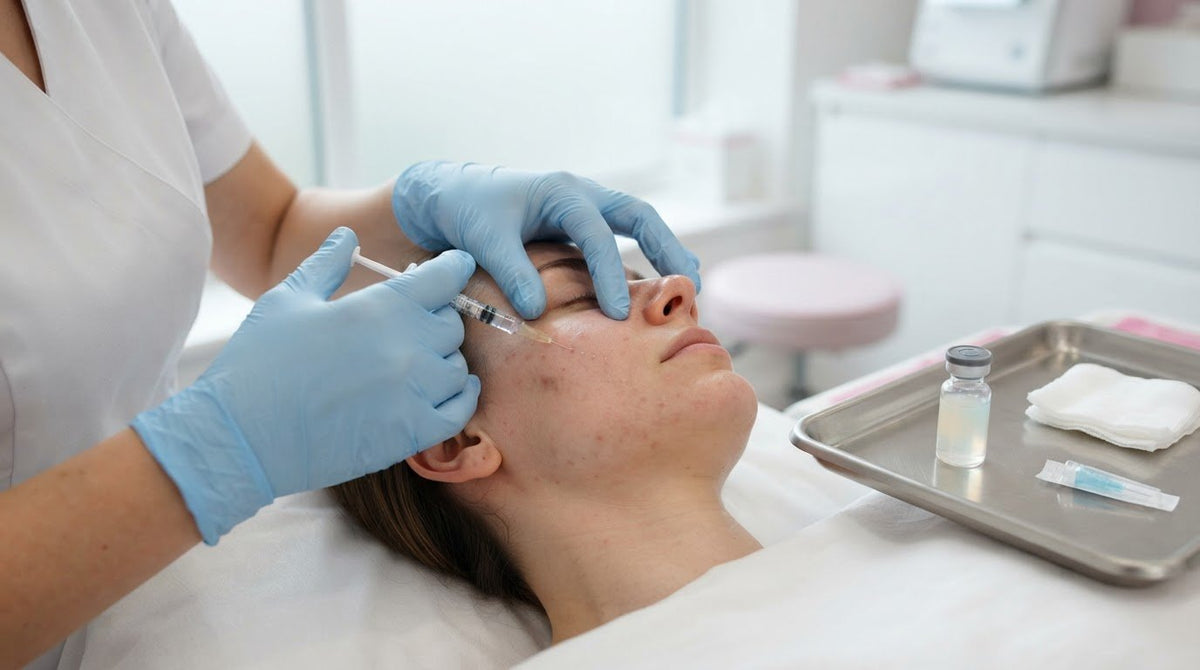
Polynucleotides: How Skin Boosters Work and Which Types Exist
Polynucleotide skin boosters use purified DNA fragments, typically sourced from salmon or trout, to support skin quality rather than add the volume associated with traditional fillers. With the different types of polynucleotides explained, it’s easier to understand how these products work and what distinguishes them.
The nickname “salmon sperm facial” can make the treatment sound more mysterious than it is. Polynucleotides are used in injectable skin boosters, whereas dermal fillers are designed to add volume. Polynucleotide products differ in formulation and intended use, so the category covers more than one product or treatment area.
This guide explains how polynucleotides are used, why salmon-derived DNA features in some formulations, and what to compare in product information. It also explains how they differ from fillers, helping make sense of the terminology and where each option fits in professional aesthetics.
Key Takeaways
- Understand how polynucleotide boosters support skin quality without working like volume-adding dermal fillers.
- Compare the main formulation and use differences to make sense of product categories.
- Learn why salmon-derived DNA is used and what the “salmon sperm facial” nickname refers to.
- See how product examples, including Lumi Meso, can help inform professional product selection.
How Do Polynucleotides Work as Skin Boosters?
Polynucleotide skin boosters are injectable treatments designed to support skin quality rather than add volume. Their role differs from products whose primary purpose is hydration or reshaping facial contours.
Comparisons with fillers and hyaluronic acid
Polynucleotides are DNA fragments used in skin boosters; dermal fillers add volume, while hyaluronic acid boosters focus on hydration. This distinction helps practitioners select an approach for a specific aesthetic concern. Polynucleotides are described as supporting skin regeneration, including processes associated with collagen. They do not physically add volume like traditional fillers, and they are not dissolvable or reversible. Hyaluronic acid can bind water, so its immediate focus differs from the regenerative role associated with polynucleotides.
DNA and RNA structure and function
DNA usually has a double-stranded structure and stores genetic instructions; RNA is usually single-stranded and helps use those instructions. In protein synthesis, messenger RNA carries a copied code, while transfer and ribosomal RNA help assemble amino acids into proteins. These are fundamental cell functions, not the same as injecting a skin booster. This distinction separates genetic material’s biological role from a product’s intended aesthetic use.
Polynucleotides are longer chains of linked nucleotides, while oligonucleotides are shorter chains. There is no universal length boundary separating the terms, so they are not interchangeable labels. For skin boosters, the relevant distinction is the formulation and intended use, not simply the name of the molecular building blocks.
Polynucleotide formulations are injected into dermal tissue and intended to support skin regeneration and quality. Ameela is a named polynucleotide range associated with this skin-booster category. Its focus is skin elasticity and regeneration, rather than adding facial volume. This distinguishes the product type from a filler, even though both may be injectable aesthetic products.
Reported outcomes include an average 22 percent increase in skin elasticity in just weeks; these treatments do not physically add volume and, unlike dermal fillers, are not dissolvable or reversible.
What polynucleotides are and how they work
Polynucleotides are chains of nucleotide building blocks; DNA and RNA are familiar biological examples. In aesthetics, the term describes purified DNA-based ingredients formulated for injectable skin boosters.
Nucleotide monomers and polynucleotide formation
A nucleotide monomer contains a sugar, a phosphate group and a nitrogen-containing base. Nucleotides join through bonds between their sugar and phosphate groups, forming a repeating backbone with bases attached. The order of those bases carries biological information in DNA and RNA. In aesthetics, this distinction matters because products use prepared ingredients, not strands that function as a person’s complete genetic code.
In biotechnology, nucleotide chains support laboratory methods that copy, detect or analyse genetic material. In medicine, nucleic-acid-based tools can be used in diagnostics and research; their purpose depends on the specific material and formulation.
DNA and RNA as polynucleotide types
DNA and RNA are the two main biological types of polynucleotide. DNA generally stores hereditary information, while RNA helps convey or use that information. Messenger RNA carries a code used in protein synthesis, and other RNA molecules help assemble proteins. The distinction matters because “polynucleotide” describes a broad molecular structure, not one specific ingredient or action.
In a cell, DNA can be transcribed into RNA, which helps guide protein production. This biological process explains the terminology, but it does not mean an injectable skin booster performs protein synthesis in the skin.
Biological and aesthetic meanings
Biologically, a polynucleotide is a chain of nucleotides, whether DNA or RNA. In aesthetic treatments, the term commonly refers to purified DNA fragments formulated for injection, often sourced from salmon or trout. The clinical product is a prepared ingredient, not a general description of every nucleic acid in a cell.
After injection, polynucleotide products are incorporated into polymerised gels that bind water molecules. Their aesthetic use is intended to support skin quality and regeneration, including processes associated with collagen production. This is distinct from the molecule’s role in genetics, where DNA stores instructions and RNA helps use them.

Salmon-derived DNA and the “salmon sperm facial” nickname
The nickname refers to the animal source of some polynucleotide ingredients. These products use purified DNA extracted from salmon or trout; they do not involve applying intact sperm. The phrase can sound sensational, but the useful distinction is the ingredient’s origin and preparation. In aesthetic products, DNA is processed into a formulation intended for injection, rather than used as food or as whole fish-derived material.
Salmon- and trout-derived polynucleotides are both used in aesthetic formulations. PhilArt is an example associated with trout-derived DNA. The species source may differ, but both belong to the broad category of animal-derived polynucleotide products. For concerns such as fine lines or skin elasticity, the source identifies the ingredient’s origin, not a guarantee of how skin will respond.
Some treatments are designed to support skin quality and regenerative processes associated with collagen and elastin. Their purpose is to help improve skin texture and elasticity, rather than create the volume of a filler. Results depend on the treatment and the skin concern being addressed. The source label alone does not describe the full formulation or establish that every product acts identically.
Because the DNA is animal-derived, its origin may be a consideration for people choosing whether to use these products. They are also unsuitable for people with fish allergies, according to the stated product category information. Ingredient origin is therefore a practical consideration alongside concerns such as fine lines and texture. A practitioner can consider product information and relevant patient history when assessing treatment suitability.
Naturally occurring polynucleotides include DNA and RNA found in living cells. Synthetic examples are nucleotide chains made through laboratory processes, with their sequence and intended use defined by the application. In aesthetic products, a salmon or trout source distinguishes animal-derived DNA from synthetic material. This difference helps readers interpret labels without assuming every polynucleotide formulation has the same origin or purpose.
Examples of polynucleotide products
Product labels offer a practical way to compare injectable options without relying on brand names alone. For example, one under-eye formulation lists PDRN, described as low-molecular-weight DNA, as its active ingredient. Another specifies PN at 5 mg/ml, DNA with a molecular weight of 250-350 kDa, and a 1 ml syringe. These are distinct product specifications, not interchangeable details.
Product information shows what to compare. Check whether the label identifies the active ingredient, concentration, molecular-weight range and presentation. These details help practitioners distinguish formulations and match product information to the intended procedure. When comparing different types of polynucleotides, focus on verifiable specifications rather than assumptions based on category names.
Read product claims individually. One under-eye product describes use for dark circles, while another lists dark circles, puffiness, fine lines and elasticity among its stated benefits. These claims apply to their respective products and should not be generalised to every polynucleotide formulation. The treatment area and stated product purpose make comparisons more relevant to a clinic’s planned use.
Use a consistent checklist when assessing options: note the active ingredient, concentration, molecular-weight information, pack presentation and stated intended use. Then distinguish measurable specifications from benefit claims. This gives clinics a clearer basis for comparing different types of polynucleotides through product information, while keeping each detail attached to the correct formulation.
For a practical next step, browse polynucleotide products and review the product information relevant to your clinic’s requirements.
Polynucleotide products are typically derived from purified DNA extracted from salmon or trout and are not suitable for vegetarians or vegans. They contain animal-derived ingredients and are unsuitable for vegetarians, vegans and people with fish allergies. These considerations are separate from the formulation details on a product label, so clinics should keep ingredient suitability in view when comparing products and considering intended use.
Polynucleotide products are not certified kosher and do not undergo kosher supervision or certification. These details give clinics and patients further information to consider alongside each product’s stated ingredients and specifications. Suitability should not be assumed from the product category alone: animal-derived origin and certification status are relevant considerations when reviewing these options.
Skin Candy: Lumi Meso
Skin Candy supplies Lumi Meso and polynucleotides for clinics sourcing professional aesthetic products. If you have compared formulations and are ready to procure products, explore these options. Skin Candy also supplies fat dissolving agents and chemical peels, offering adjacent professional product categories distinct from polynucleotide boosters.
Turn to Skin Candy when you’re ready to source products for your clinic, rather than seeking an in-clinic treatment or training. Review the product categories and choose the option that aligns with your clinic’s requirements. For product information or purchasing, contact Skin Candy or visit skincandy.shop.
Make your next product decision with confidence
For clinics comparing options, understanding the different types of polynucleotides explained alongside product information supports a more considered selection. Assess how the stated source, formulation and intended use align with your clinic’s treatment protocols. Apply the same criteria across products, so decisions rest on relevant details rather than a product name alone.
Once you’ve identified the category that fits your requirements, procurement is the practical next step. Skin Candy supplies Lumi Meso and advanced polynucleotides, giving clinics options across professional aesthetic products. Choose the category that meets your needs, then review the relevant product details before purchasing.
Contact Skin Candy to discuss your options and take the next step at a pace that works for your clinic.
Frequently Asked Questions
What Are Polynucleotides?
Polynucleotides are molecules made from nucleotide units linked into chains. In aesthetics, the term often appears on injectable skin-booster products, but the label alone does not identify a product’s source, concentration or intended treatment area. Compare the ingredient description and product instructions rather than treating every item labelled PN or PDRN as the same formulation.
Are Polynucleotides the answer for great skin - long term?
Polynucleotides can form part of a longer-term skin-quality plan, but they are not a permanent fix or a universal answer for every concern. Benefits can last six to twelve months. This timeframe helps set expectations: consider the concern being addressed and how a time-limited injectable approach fits alongside other aspects of skin care, rather than expecting one procedure to prevent future changes.
What is a polynucleotide in biology?
In biology, a polynucleotide is a chain of nucleotide units, the molecules that make up DNA and RNA. The sequence of bases along a chain carries biological information, while the sugar-phosphate backbone links its units. This definition applies broadly in genetics and cell biology; an aesthetic product uses a prepared ingredient described by its formulation and intended use.