The Practitioner’s 2026 Guide to Skin Boosters for Neck Rejuvenation: HA vs Polynucleotides
In 2026, relying solely on hyaluronic acid for the cervical region is no longer the clinical gold standard. You understand that the neck is notoriously difficult to treat because the dermis is thin and subject to constant mechanical stress. Many practitioners find it challenging to manage patient expectations when a standard "glow" treatment fails to provide the structural support required for deep horizontal rings. Using the wrong product leads to dissatisfied patients and wasted clinic time.
This practitioner's guide provides a definitive clinical framework for selecting skin boosters for neck rejuvenation to deliver superior structural results. You will master the selection between HA-driven deep hydration and the cellular repair offered by polynucleotides. We also address the logistical side of your business, ensuring you can secure medical-grade consumables like Lumi Meso and polynucleotides through a dependable UK wholesaler. By the end of this article, you will have a clear strategy to improve patient retention and maintain a high-performance inventory with reliable next-day dispatch.
Key Takeaways
- Identify why the rising prevalence of "tech-neck" in younger patients requires a shift towards non-volumising dermal injectables that target skin quality.
- Compare the technical mechanisms of high-concentration HA versus polynucleotides to understand how each signals fibroblast recovery and collagen synthesis.
- Use the Glogau skin ageing scale to determine when to prioritise immediate hydration over long-term structural repair during patient consultations.
- Optimise your treatment protocols using skin boosters for neck rejuvenation through the BAP technique and micro-wheal methods for maximum efficacy.
- Protect your clinic's commercial health with a just-in-time procurement model and authenticated products from a trusted UK distributor.
The 2026 Landscape of Skin Boosters for Neck Rejuvenation
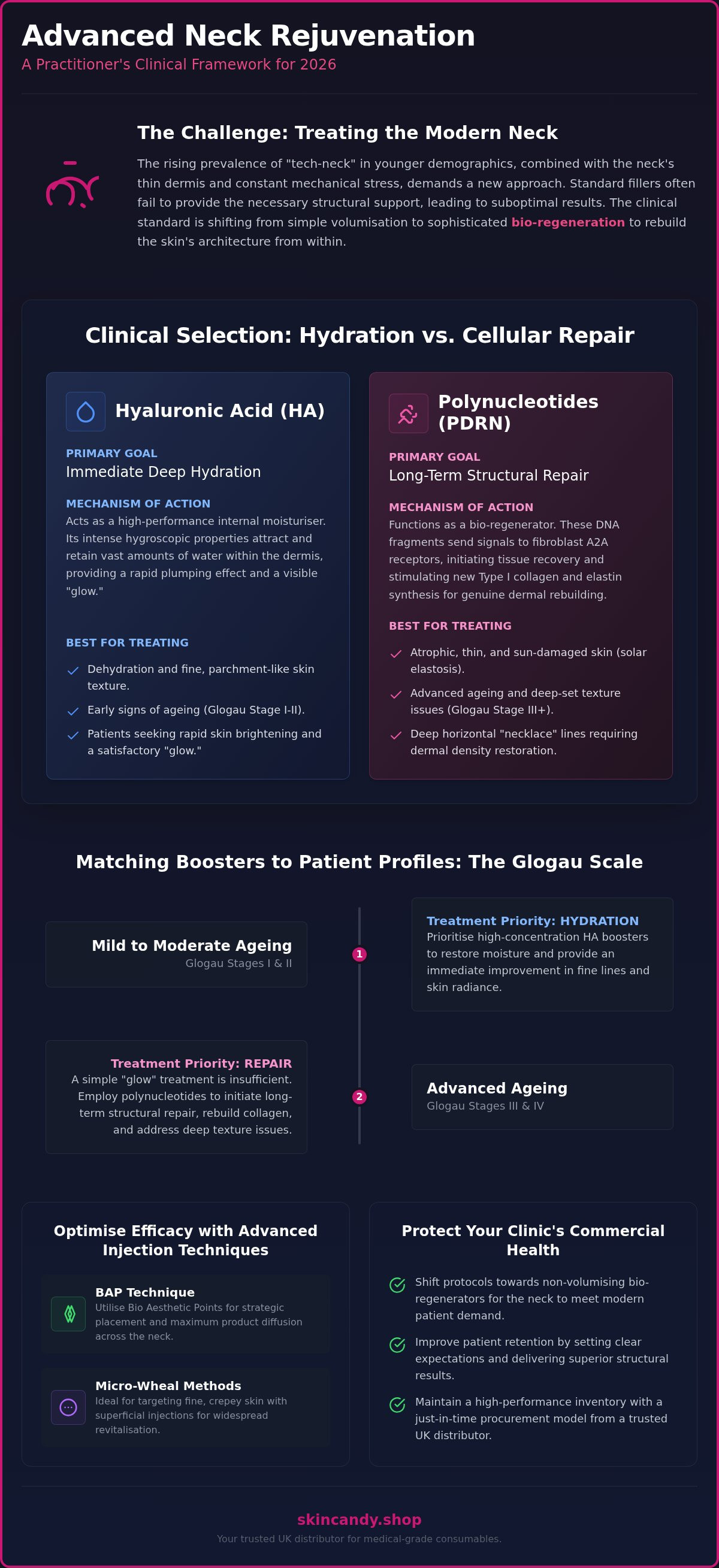
Skin boosters for neck rejuvenation are specialised dermal injectables engineered to enhance skin quality, elasticity, and hydration without adding the structural volume associated with traditional fillers. Demand for these treatments is rising rapidly in 2026, driven largely by "tech-neck" amongst younger demographics who spend hours looking down at digital devices. This repetitive movement accelerates the formation of horizontal creases even in patients in their late twenties. The neck presents unique physiological challenges; it features a significantly thinner dermis than the face and contains fewer sebaceous glands, making it prone to premature dehydration and sagging. A neck booster is an injectable biostimulator designed to restore the extracellular matrix of the cervical skin.
The Shift from Volumisation to Bio-Regeneration
Standard dermal fillers don't always work for the delicate neck area. Their high G-prime can lead to visible lumps or the Tyndall effect because the skin is so thin. Practitioners are moving away from masking imperfections and towards bio-regeneration. This shift has led to the evolution of mesotherapy products wholesale UK into advanced structural boosters that do more than just provide surface-level radiance. While Hyaluronic acid remains a cornerstone for moisture, the 2026 preference is for bio-remodelling agents that trigger the body's natural repair mechanisms. You aren't just filling a line; you're rebuilding the skin's architecture from within.
Key Indications for Professional Intervention
Successful neck rejuvenation requires precise patient assessment. You must differentiate between simple dehydration and true tissue laxity. Key indications for professional intervention include:
- Horizontal Necklace Lines: Deep-set rings caused by repetitive motion and loss of dermal density.
- Vertical Platysmal Banding: Muscle-related tension that requires a combination approach, often involving botulinum toxin alongside skin boosters for neck rejuvenation.
- Solar Elastosis: Sun-damaged, leathery texture often seen in the lower neck and décolletage.
- Crepey Texture: Fine, parchment-like skin resulting from depleted collagen and elastin levels.
Categorising these concerns early allows you to select the correct ingredient profile. If the patient presents with Glogau Stage II or III ageing, a simple "glow" booster won't suffice. You need a product that offers structural repair to meet the high expectations of a modern patient base. Efficient procurement of these medical-grade consumables is vital to ensure your clinic can meet this growing demand without delay.
Hyaluronic Acid vs Polynucleotides: A Technical Comparison
Selecting the right skin boosters for neck rejuvenation depends on whether the patient requires immediate hydration or long-term structural repair. High-concentration Hyaluronic Acid (HA) works through its intense hygroscopic properties, attracting and retaining moisture within the dermis to smooth fine lines. In contrast, polynucleotides (PDRN) function as bio-regenerators. They don't just hold water; they send specific signals to fibroblasts to initiate the recovery of damaged tissue and stimulate new collagen synthesis. While Hyaluronic Acid excels at massive water-binding capacity for instant hydration, polynucleotides leverage cellular signalling power to rebuild the dermal matrix over time.
HA-Based Boosters: The Hydration Standard
Non-cross-linked HA acts as a high-performance internal moisturiser. When injected into the neck, it provides a rapid "glow" that patients find highly satisfying. The June 2026 FDA approval of HA injectable for neck wrinkles has solidified HA's position as a primary tool for treating horizontal lines. Products like Lumi Meso and Regenovue are clinical favourites for this purpose, offering predictable results and rapid skin brightening. This reliability is why HA formulations consistently top the list for next day delivery skin boosters UK orders. Practitioners use HA to provide that immediate aesthetic win whilst the slower regenerative processes take hold.
Polynucleotides: DNA-Driven Tissue Repair
Polynucleotides represent a more sophisticated approach to ageing. These DNA fragments stimulate the production of Type I collagen and elastin by activating A2A receptors. This is particularly beneficial for the atrophic, thin skin of the neck where traditional hydration might not be enough to fix deep-seated texture issues. Understanding polynucleotide indications for aesthetic clinics is essential for treating Glogau Stage III patients who exhibit significant solar elastosis. By integrating PDRN into your protocols, you address the root cause of skin thinning rather than just the symptoms of dehydration. You can order medical-grade polynucleotides to expand your treatment menu and offer truly regenerative solutions. This technical distinction between the immediate radiance of HA and the delayed, structural repair of PDRN allows you to manage patient expectations effectively and deliver visible, lasting results.
Clinical Selection: Matching Boosters to Patient Profiles
Effective clinical selection requires a structured framework. You can't apply a one-size-fits-all approach to the cervical region. Modern patients in 2026 expect bespoke treatment plans that move beyond generic hydration. Use the Glogau skin ageing scale to categorise patients accurately. Stage I and II patients typically present with early-stage crepiness and require preventative hydration. Stage III and IV patients demonstrate wrinkles at rest and need deep structural repair. For these mature cases, the expert consensus on polynucleotide use highlights the neck and décolleté as primary treatment areas for tissue regeneration. Loading doses are non-negotiable for long-term success with skin boosters for neck rejuvenation. Most protocols require an initial course of three sessions spaced four weeks apart to achieve visible results. This cumulative approach ensures fibroblasts are consistently stimulated to produce new collagen.
Protocol for Early Signs of Ageing
Patients in their 30s usually present with early crepiness or "tech-neck" lines. Focus on preventative hydration and antioxidant protection here. Lumi Meso is a clinic favourite for these patients. It contains a blend of HA and essential nutrients that neutralise free radicals, protecting the delicate neck skin from environmental stressors whilst improving dermal density. It delivers subtle texture improvement and a healthy glow without over-treating the area. It's vital to manage your patient's expectations early. They won't see a dramatic "lift" from hydration alone, but they will notice improved skin quality and better resilience against future damage. This preventative phase is about maintaining dermal thickness before significant laxity sets in.
Restorative Protocol for Mature or Sun-Damaged Skin
Mature or sun-damaged skin requires a more aggressive, multi-layered strategy. In Glogau Stage III patients, you'll see deep horizontal rings even when the neck is at rest. This is where you must prioritise structural repair over simple moisture. The "sandwich" technique is highly effective for these profiles. This involves layering different types of skin boosters for neck rejuvenation over multiple sessions to address multiple dermal layers. You might start with a course of polynucleotides to rebuild the atrophic dermis and then follow up with Lumifil dermal filler UK for targeted correction of the deepest creases. When treating deep horizontal rings, use targeted micro-droplet injections at 1cm intervals along the line. This ensures the product stays localised to the area of highest concern. This dual-action approach satisfies the patient's desire for an instant result whilst the polynucleotides work on long-term cellular restoration.
Advanced Injection Techniques for the Neck Area
Mastering the application of skin boosters for neck rejuvenation requires a departure from facial injection protocols. You must account for the lack of underlying fat and the high mobility of the cervical skin. The BAP (Bio Aesthetic Points) technique is the most efficient method for global dispersal. By injecting 0.2ml per point across ten standardised locations, you achieve maximum coverage with minimal trauma. This technique relies on the product's ability to flow through the interstitial spaces. However, BAP alone is often insufficient for targeted correction. For superficial dermal hydration, the micro-wheal technique is superior. You place tiny deposits in the upper dermis to directly address parchment-like texture and fine crepiness.
Safety remains your primary concern in this region. Always avoid the thyroid gland and major cervical vessels. Stay lateral to the midline when performing deep injections. For specific horizontal "necklace" lines, the retrograde linear threading approach provides the best results. You insert the needle along the length of the wrinkle and deposit the product whilst withdrawing. This creates a physical scaffold that supports the line from beneath. It's a more precise method than bolus injections for patients with Glogau Stage III ageing who require structural support.
Anatomical Precision in Neck Injections
Success depends on identifying the safe planes for injection. You should target the mid-to-deep dermis to avoid visible lumps. The neck is highly vascular; manage the risk of bruising by using high-quality 30G or 32G needles. Advise patients that mild swelling and small papules are normal for 24 to 48 hours. Post-treatment care should include avoiding strenuous exercise and extreme heat to prevent product migration. Clear communication about these outcomes ensures higher patient satisfaction and clinical trust.
Maximising Product Efficacy
Consistent depth is vital for even collagen stimulation. If you inject too deeply, the product is lost to the subcutaneous space; too shallowly, and you risk persistent wheals. Use a 30 to 45-degree angle for micro-wheals and a flatter angle for linear threading. Your results are only as good as the tools you use. Sourcing high-quality consumables from a trusted skin booster supplier is vital for clinical safety and predictable dispersal. You can buy professional skin boosters online to ensure your clinic is always stocked with authenticated, medical-grade products. Maintaining a reliable supply chain allows you to focus on refining these advanced techniques without logistical interruptions.
Optimising Clinic Procurement with Skin Candy
Managing a high-volume aesthetic clinic in 2026 requires more than clinical expertise; it demands logistical precision. You can't afford to tie up significant capital in deep inventory that sits on a shelf for months. Adopting a "just-in-time" inventory strategy allows you to maintain healthy cash flow whilst ensuring you always have fresh stock for every skin boosters for neck rejuvenation appointment. This commercial model relies entirely on the speed and reliability of your wholesale partner. Skin Candy provides the logistical excellence needed to support this high-performance approach. We offer next-day delivery across the United Kingdom, allowing you to react to last-minute bookings or sudden surges in tech-neck consultations without stress.
Product authenticity is our baseline. In a professional wholesale environment, you need the absolute certainty that every vial of Lumi Meso or polynucleotide is medical-grade and fully authenticated. Using unverified products risks patient safety and your professional reputation. Our expert curation ensures that every item in our warehouse meets the highest industry standards for 2026. By choosing a dedicated wholesale partner, you eliminate the risks associated with fragmented supply chains and unreliable third-party sellers. This peace of mind allows you to focus on delivering superior structural results for your patients.
Reliable UK Wholesale for Professional Practitioners
Accessing leading brands like Lumifil, Regenovue, and Lumi Meso is essential for maintaining a competitive treatment menu. Your clinic needs to stay stocked with the latest 2026 innovations to meet the rising demand for regenerative neck treatments. Skin Candy acts as a strategic partner in your clinic's growth, providing a complete rejuvenation toolkit in one place. We understand the high-pressure environment of aesthetic medicine. Our rapid fulfilment system is designed to be the silent engine behind your business, ensuring your treatment rooms are always ready for the next patient. Whether you are prioritising deep hydration or cellular repair, we provide the specific tools required for every patient profile.
Streamlining Your Supply Chain
Efficiency isn't just about the injectables. It's about the entire consumable ecosystem. Bulk buying strategies for essentials like needles, syringes, and numbing creams can significantly reduce your operational overheads. Consolidated ordering through a single trusted source simplifies your administration and reduces delivery costs. By grouping your orders, you spend less time on procurement and more time on patient care. Reducing these hidden costs is vital for maintaining clinic profitability in a competitive market. Ready to upgrade your clinic's efficiency? Organise your 2026 neck rejuvenation stock with Skin Candy and experience the benefits of a streamlined, professional supply chain today.
Advancing Your Clinical Standards for 2026
Successful outcomes for the difficult-to-treat cervical area require a precise blend of technical skill and high-performance ingredients. You've learned to differentiate between simple hydration and true bio-regeneration. Matching the right skin boosters for neck rejuvenation to your patient’s Glogau stage is the only way to ensure visible, structural results. By combining advanced techniques like the BAP method with targeted linear threading, you can address both surface crepiness and deep horizontal rings effectively.
Your clinical success depends on a reliable supply chain that keeps pace with your patient volume. Skin Candy is a specialist supplier of polynucleotides and regenerative injectables, serving as an authorised UK distributor for brands like Lumifil and Regenovue. We guarantee next-day delivery across the United Kingdom to ensure your treatment rooms are always stocked. Secure your clinic’s neck rejuvenation supplies with Skin Candy’s next-day delivery and maintain your competitive edge in this high-growth market. Your patients deserve superior structural results. We provide the logistical certainty and medical-grade products to help you deliver them.
Frequently Asked Questions
What is the primary difference between a neck skin booster and a dermal filler?
A neck skin booster focuses on improving dermal density and hydration without adding the volume or "lift" associated with traditional dermal fillers. While fillers are designed to replace lost fat or bone structure, skin boosters for neck rejuvenation work within the dermis to enhance texture, elasticity, and overall skin quality.
How many sessions of skin boosters are required for visible neck rejuvenation?
Most patients require an initial course of three sessions spaced four weeks apart to achieve significant clinical results. This loading phase is essential to trigger cumulative collagen production and achieve the structural repair required for the thin skin of the cervical region. Maintenance sessions are typically recommended every six months.
Can I use polynucleotides and hyaluronic acid boosters in the same treatment plan?
Yes, combining these agents is a highly effective strategy for patients with complex ageing concerns. You can use polynucleotides to rebuild atrophic tissue at a cellular level and follow up with an HA-based booster like Lumi Meso to provide immediate surface hydration and radiance. This dual-action approach addresses both structural depletion and surface dehydration.
What is the typical downtime for a patient following neck booster injections?
Typical downtime lasts between 24 and 48 hours. Patients should expect small, visible papules at the injection sites and potential mild bruising, particularly because the neck skin is so thin and vascular. These effects generally resolve quickly as the product disperses into the surrounding tissue.
Are there specific contraindications for injecting boosters into the neck area?
Contraindications include active skin infections, history of hypertrophic scarring, and uncontrolled autoimmune conditions. Practitioners must be particularly cautious to avoid the thyroid gland and major cervical vessels. Always conduct a thorough medical history to rule out allergies to specific ingredients like fish-derived DNA in certain polynucleotides.
How should a practitioner choose between Lumi Meso and polynucleotides for a patient?
Choose Lumi Meso for younger patients or those with Glogau Stage I-II ageing who primarily need hydration and antioxidant protection. Prioritise polynucleotides for mature patients exhibiting significant skin thinning, solar elastosis, or deep-set horizontal creases. Polynucleotides are the superior choice when the patient requires true tissue regeneration rather than just moisture.
Is next-day delivery available for all skin booster brands in the UK?
Yes, Skin Candy provides guaranteed next-day delivery across the United Kingdom for our entire range of professional brands. This includes clinic favourites like Lumifil, Regenovue, and Lumi Meso. Our rapid fulfilment system ensures you can manage high patient volumes without the need for excessive on-site stock storage.
Can skin boosters effectively treat deep horizontal "necklace lines"?
Skin boosters can significantly soften horizontal "necklace lines" when administered using precise techniques like retrograde linear threading. While very deep creases might eventually require a combination approach with light-density fillers, skin boosters rebuild the dermal architecture. This improves the skin's resilience and prevents these dynamic lines from becoming permanent static folds.