Aesossa vs Regenovue: The Practitioner’s Guide to Aesossa Filler UK (2026)
What if the post-injection oedema your patients dread isn't an inevitable side effect, but a direct consequence of your filler's cross-linking technology? You've likely spent years refining your injection technique only to have patient satisfaction compromised by inflammatory swelling or the physical fatigue of extruding stubborn, high-viscosity gels. It's a persistent challenge for high-volume UK practitioners who need predictable results and seamless integration every time they pick up a syringe.
This guide explores the technical shift in Aesossa vs Regenovue to reveal why monophasic purity is rapidly replacing traditional biphasic structures. You'll discover how moving to a zero-residue safety profile can protect your business under the 2026 Amber-tier licensing regulations whilst providing the natural, swelling-free results your patients demand. We'll compare extrusion forces, structural longevity, and the logistical advantages of securing a reliable UK supply chain for your clinic's daily operations. By understanding these molecular differences, you can ensure your practice remains at the forefront of patient safety and aesthetic excellence.
Key Takeaways
- Understand the structural advantages of monophasic HA gels for achieving natural tissue integration and smoother extrusion compared to traditional granular textures.
- Examine the "zero BDDE residue" technology that minimises post-procedure inflammatory responses and late-onset oedema for enhanced patient safety.
- Evaluate the clinical performance of Aesossa vs Regenovue to determine which filler profile best suits specific indications, from superficial lines to deep structural contouring.
- Ensure your practice remains compliant with the 2026 UK aesthetics licensing overhaul by utilising CE-marked, Class III medical devices with high-purity profiles.
- Streamline your clinic’s inventory management with next-day fulfilment from an official UK distributor to maintain operational efficiency without tying up excess capital.
Understanding Aesossa Filler: The 2026 Standard for UK Clinics
Aesossa is a high-purity, monophasic hyaluronic acid (HA) injectable filler developed by Oreon Life Science. It's engineered to meet the rigorous demands of the 2026 UK aesthetics market. As the industry moves toward stricter oversight, practitioners are scrutinising product composition more than ever. This shift is driving the debate of Aesossa vs Regenovue, as clinicians move away from older biphasic technologies in favour of homogenous monophasic gels. These gels offer a single-phase structure that integrates seamlessly into facial tissue; this provides a natural look without the "particle" feel associated with traditional, granular fillers.
Compliance isn't optional. Every syringe in the Aesossa range carries mandatory CE certification, ensuring it meets the safety standards required for the English licensing scheme. Under the 2026 regulations, dermal fillers are classified as Amber-risk procedures. This means your choice of product directly impacts your ability to secure a local-authority license. Practitioners now prioritise fillers that offer reduced post-procedure oedema, allowing patients to return to their daily lives immediately without the social downtime caused by excessive swelling.
Why Practitioners are Favouring Aesossa in 2026
The "ultra-high purity" profile is the primary draw for modern clinicians. By eliminating unreacted cross-linkers, Aesossa significantly reduces the risk of late-onset inflammatory reactions. You'll notice a predictable degradation pattern because the gel is homogenous. It breaks down evenly rather than leaving behind small lumps of biphasic particles. Efficiency matters in a busy clinic. The ergonomic syringe design is a practical win, reducing hand fatigue during back-to-back sessions. It's built for smooth extrusion, giving you total control over the delivery rate. When comparing Aesossa vs Regenovue, many practitioners find the monophasic flow more intuitive for precision work.
The Significance of CE Marking in Professional Procurement
CE approval is the bedrock of clinic insurance. Without it, your indemnity cover is likely void. Aesossa undergoes rigorous testing for endotoxin levels and pH balance to ensure complete compatibility with human tissue. This level of quality control is essential for patient safety and your professional reputation. When you're refining your supply chain, look for products that offer this level of transparency. You can learn more about strategic stock selection in our guide on how to choose chemical peels for your clinic, which covers similar procurement standards for professional-grade consumables. Reliable procurement ensures you aren't just buying a product; you're buying peace of mind for your practice.
The Science of Monophasic HA: Purity and Zero BDDE Residue
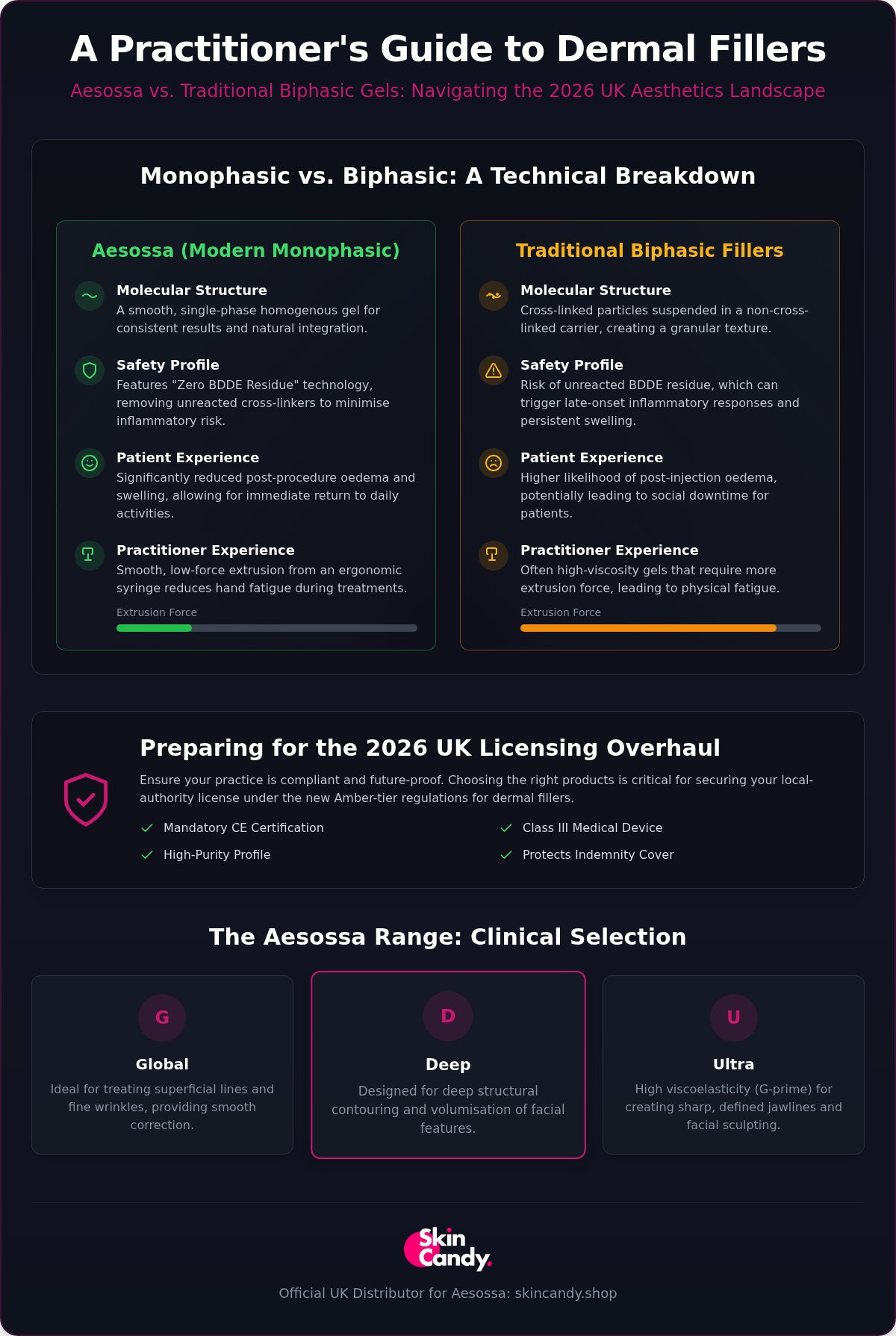
The molecular architecture of a filler determines its clinical behaviour. Monophasic HA involves a single-phase cross-linking process that creates a homogenous, uniform gel structure. Unlike biphasic fillers that suspend cross-linked particles within a non-cross-linked HA carrier, Aesossa is entirely consistent throughout the syringe. This results in a more stable implant that integrates into the tissue without the granular "foreign body" sensation often reported with older technologies. When clinicians evaluate Aesossa vs Regenovue, the primary technical distinction lies in this move from a multi-phase particle gel to a smooth, cohesive matrix.
Safety in 2026 is defined by chemical purity. The "zero BDDE residue" claim is a significant differentiator for practitioners prioritising patient health. BDDE is the industry standard cross-linking agent used in many FDA-approved dermal fillers. However, any unreacted BDDE that remains in the gel can trigger a persistent inflammatory response. Aesossa’s proprietary purification process removes these unreacted molecules, virtually eliminating the primary cause of late-onset swelling. This high level of purity ensures the body’s long-term immune response remains minimal, preventing the "puffy" look that can occur months after treatment.
Precision contouring requires a filler with high viscoelasticity, or G-prime. This technical property allows the gel to resist deformation under the pressure of facial expressions. Aesossa maintains a high G-prime whilst remaining easy to inject. This balance allows you to create sharp jawlines and defined cheekbones without the risk of gel migration. The purity of the raw hyaluronic acid material ensures that the integration is both biocompatible and durable, providing a predictable degradation timeline that clinics can rely on for follow-up scheduling.
Monophasic vs Biphasic: The Technical Divide
Aesossa’s smooth gel contrasts sharply with the "particle-based" biphasic structure found in many traditional fillers. Biphasic gels can feel granular and often exhibit "judder" during injection as particles pass through the needle. Aesossa provides a consistent, low-resistance extrusion force. This gives the practitioner superior control during delicate procedures like lip augmentations or tear trough filler. For a broader comparison of structural materials, you can read our PLLA vs HA fillers for clinics guide. Choosing a monophasic gel ensures the result is smooth to the touch and visually seamless.
Minimising Oedema with High-Purity HA
BDDE residue is the unreacted chemical cross-linker that must be purged from the final product to ensure maximum patient safety. Beyond BDDE, low endotoxin levels are critical for preventing immediate post-injection oedema. High endotoxin counts often cause the aggressive swelling that leads to patient dissatisfaction in the first 48 hours. Aesossa integrates into the dermis whilst maintaining its structural integrity, offering a refined lift with minimal trauma to the surrounding tissue. You can view the technical data sheets for the range to see how these purity standards compare to your current clinic stock.
Aesossa vs Regenovue: Deciding Between Monophasic and Biphasic Gels
Choosing between Aesossa vs Regenovue often comes down to the tactile feedback during injection and the specific aesthetic goal. Regenovue has long been a staple in UK clinics due to its biphasic, granular structure. This provides a familiar resistance when volumising deep tissue. However, Aesossa’s monophasic nature offers a homogenous flow that many modern practitioners find superior for precision work. Clinical data in the clinical comparison of monophasic and biphasic fillers suggests that monophasic gels may provide better structural longevity by resisting the premature breakdown caused by natural hyaluronidase. This resistance is due to the uniform cross-linking that protects the HA chains from enzymatic degradation more effectively than the multi-phase structure of biphasic alternatives.
The price-to-performance ratio for UK clinics in 2026 is a vital consideration. Whilst Regenovue remains a cost-effective entry point for bulk volumising, Aesossa’s higher purity profile can reduce the hidden costs of practice management. Fewer patient complaints regarding late-onset swelling mean fewer unpaid follow-up consultations. Investing in a monophasic gel with a zero-residue profile protects your clinic’s reputation and ensures a more predictable result across your entire patient database. It's a strategic choice that balances immediate procurement costs against long-term operational efficiency.
Performance Metrics: Extrusion and Integration
Aesossa is engineered for ultra-smooth delivery. It requires significantly less extrusion force than biphasic gels, which can sometimes exhibit a "judder" effect as particles pass through the needle. This consistency is a game-changer for the "Russian Lip" technique. It allows for the micro-droplet precision needed to create vertical lift without adding unnecessary bulk. Aesossa’s superior tissue integration also reduces the risk of palpable lumps. The gel integrates into the surrounding tissue matrix seamlessly, making it ideal for areas with thin skin where biphasic particles might become visible or felt by the patient.
Patient Profiles: Who Gets Which Filler?
Identify patients with a history of sensitivity or significant post-injection swelling; these are the primary candidates for Aesossa. Its high-purity profile minimises the inflammatory triggers that lead to patient dissatisfaction. You might still recommend Regenovue for practitioners who prefer the traditional, firmer feel of biphasic particles for deep supraperiosteal volumising in the cheeks or chin. Both brands feature integrated 0.3% lidocaine to ensure immediate patient comfort during the procedure. However, for those seeking the most natural facial integration and minimal next-day oedema, the monophasic structure of Aesossa is the modern standard.
Clinical Selection: Navigating Global, Deep, and Ultra Variants
Successful full-face rejuvenation requires a systematic approach to G-prime selection. Using the Aesossa ecosystem allows you to address multiple layers of facial ageing with a consistent monophasic technology. This predictability is often why clinicians choosing between Aesossa vs Regenovue opt for the former; it simplifies the transition between superficial hydration and deep structural support. When you maintain a single-brand ecosystem, you ensure that tissue integration and degradation patterns remain uniform across different anatomical zones. This reduces the risk of "product clash," where different filler technologies interact poorly within the dermis.
Aesossa Global and Deep: Fine Lines to Lip Artistry
Aesossa Global is the most fluid variant in the range. It's specifically engineered for injection into the superficial dermis. This makes it the ideal choice for periorbital lines, fine forehead wrinkles, and superficial hydration. Its low extrusion force allows for the micro-droplet precision required in delicate areas without causing visible lumps or over-correction. Practitioners often use Global for subtle "tweakments" where the goal is refinement rather than volume.
Aesossa Deep acts as the versatile workhorse for mid-dermal work. It's widely considered the gold standard for vermillion border definition and nasolabial fold correction. The monophasic gel provides a smooth, elastic feel that mimics natural lip tissue, avoiding the "shelf" look that can occur with stiffer products. Aesossa’s specific cross-linking profile is tailored for those who prioritise maximum tissue integration and a soft, palpable finish, establishing its position as a premium choice for mid-dermal applications.
Aesossa Ultra: Structural Lifting and Jawline Contouring
Aesossa Ultra handles the heavy lifting in your clinic. Its high viscosity and G-prime are essential for supraperiosteal placement, providing the projection needed for chin augmentation, jawline contouring, and malar support. This variant is the foundation of any "liquid facelift" protocol. It resists the downward pressure of the skin envelope, maintaining its shape whilst the monophasic structure ensures it doesn't migrate from the injection site.
When performing deep structural work, the choice of Aesossa vs Regenovue in this category is particularly stark; Ultra provides a homogenous lift that integrates better than the granular particles found in many biphasic volumisers. This leads to a more contoured, natural appearance that feels like the patient's own bone structure rather than an artificial implant. To upgrade your clinic's structural results, order the full Aesossa range from Skin Candy for your next clinic day.
Wholesale Procurement: Partnering with Skin Candy for UK Fulfilment
Skin Candy acts as the essential logistical backbone for modern UK aesthetic clinics. We understand that tying up significant capital in shelf-stock is inefficient for a growing business. Our just-in-time procurement model allows you to order exactly what you need for your upcoming treatment schedule. It prevents cash flow bottlenecks. This lean approach to inventory management ensures you always have fresh, high-purity stock available for every patient. You can focus on clinical excellence whilst we handle the complexities of the supply chain.
Security is a non-negotiable priority in the 2026 UK market. Buying from a verified UK wholesaler like Skin Candy eliminates the grey market risks that can lead to insurance complications or patient safety incidents. Whether your clinic prefers the monophasic purity of Aesossa vs Regenovue, we provide the certainty of a fully audited supply chain. Every product we stock is vetted for authenticity. For high-volume clinics, we offer structured bulk-buy discounts. These improve your margins whilst maintaining the highest clinical standards required for professional practice.
Next-Day Delivery and Operational Reliability
Stockouts lead to cancelled appointments and lost revenue. We provide a reliable next-day delivery service across the United Kingdom to keep your clinic running smoothly. Our professional portal is designed for rapid re-ordering; it takes seconds to secure your consumables and get back to your patients. This speed is vital for maintaining a competitive edge in a fast-paced industry. You can find more strategies for efficient stock management in our guide to mastering aesthetic clinic procurement UK. Reliable delivery means you never have to turn a patient away.
Authenticity and Clinical Support
Every syringe of Aesossa we supply is 100% genuine and carries the mandatory CE marking for the UK market. We don't just shift boxes. We act as your professional partner. We provide full clinical data sheets and technical support to ensure you have complete confidence in the products you inject. This support is essential for meeting the 2026 Amber-tier safety standards. If you require a bespoke solution for a multi-site practice or high-volume clinic, contact Skin Candy today for tailored clinic pricing and dedicated account management. We are the silent engine behind your business success.
Elevate Your Clinic Standards with High-Purity Monophasic Gels
The decision between Aesossa vs Regenovue represents a fundamental shift in how UK practitioners approach patient safety and aesthetic results in 2026. By prioritising monophasic purity and a zero-residue safety profile, you effectively eliminate the primary triggers for late-onset oedema and inflammatory responses. This technological leap ensures your patients enjoy natural facial integration whilst your practice benefits from the predictable degradation patterns of high-purity HA.
Maintaining a reliable supply chain is equally critical for operational success. Skin Candy provides the logistical infrastructure your business needs to stay ahead of regulatory changes and patient demands. As an official UK wholesale supplier, we guarantee 100% genuine, CE-marked products with next-day fulfilment as standard. This allows you to manage your inventory with precision and confidence, ensuring you never have to turn a patient away due to stockouts.
Shop the Aesossa Filler Range at Skin Candy for Next-Day UK Delivery and secure the future of your aesthetic practice today. We look forward to supporting your clinic's growth and ongoing clinical excellence.
Frequently Asked Questions
How long does Aesossa filler typically last compared to Regenovue?
Aesossa typically lasts between 12 and 18 months, depending on the specific variant used and the patient's individual metabolism. When evaluating Aesossa vs Regenovue, practitioners often find that Aesossa’s monophasic structure provides more predictable degradation. The homogenous gel resists enzymatic breakdown more uniformly than the multi-phase particles found in traditional biphasic fillers, leading to sustained structural results.
Is Aesossa filler CE approved for use in the UK?
Yes, Aesossa is fully CE marked for use within the United Kingdom. It is classified as a Class III medical device, which is the highest risk category and requires the most rigorous safety assessments. This certification ensures the product meets all current UK safety standards, making it a compliant choice for clinics operating under the 2026 licensing regulations.
Can I use Aesossa Ultra for non-surgical rhinoplasty?
Aesossa Ultra is highly suitable for non-surgical rhinoplasty because of its high G-prime and superior structural viscosity. It provides the necessary projection and lift required for supraperiosteal placement. Its monophasic nature ensures that the gel maintains its shape and stays precisely where it is injected, reducing the risk of migration in high-pressure anatomical zones.
What is the main difference between monophasic and biphasic fillers?
The primary difference lies in the gel's physical consistency and molecular structure. Monophasic fillers are homogenous, single-phase gels that integrate seamlessly into the tissue with a smooth, uniform flow. Biphasic fillers are granular, consisting of cross-linked particles suspended in a non-cross-linked HA carrier, which can sometimes result in a less natural feel or "judder" during extrusion.
Does Aesossa filler contain lidocaine?
Yes, every syringe in the range contains 0.3% lidocaine to maximise patient comfort during the procedure. This integrated local anaesthetic ensures that the injection process is relatively painless. It allows practitioners to work with precision whilst the patient remains relaxed, which is essential for achieving the best possible aesthetic outcome in sensitive areas.
Why is Aesossa considered a "zero-residue" filler?
Aesossa is described as "zero-residue" because it undergoes a proprietary purification process that removes unreacted BDDE cross-linkers. By purging these chemical residues, the filler significantly reduces the triggers for late-onset inflammatory responses. This high level of purity leads to a safer clinical profile with a drastically reduced risk of post-injection oedema or palpable lumps.
Where can I buy Aesossa filler wholesale with next-day delivery in the UK?
You can purchase the full range of Aesossa vs Regenovue products directly from Skin Candy, the premier UK wholesaler. We offer next-day delivery across the United Kingdom as standard for all professional accounts. Our just-in-time logistics model ensures that your clinic remains operational without the need to tie up excessive capital in inventory.
Is Aesossa filler suitable for lip augmentation?
Yes, Aesossa is an excellent choice for lip augmentation protocols. Aesossa Deep is the preferred variant for defining the vermillion border and adding structural volume, whilst Aesossa Global is ideal for subtle hydration and treating fine perioral lines. The monophasic gel provides a soft, natural palpable finish that integrates perfectly with the movement of the lips.