Polynucleotides vs Skin Boosters: A 2026 Practitioner’s Procurement Guide
The practitioner who treats polynucleotides and skin boosters as interchangeable in 2026 will quickly lose their competitive edge. While both categories target rejuvenation, their biological mechanisms and commercial profiles are fundamentally different. You have likely felt the frustration of explaining a significant price gap to a patient who only sees "hydration" on your treatment menu. Mastering the nuances of polynucleotides vs skin boosters is now a requirement for any clinic looking to lead the regenerative market.
We agree that your clinical results are only as good as your product selection and your ability to source them reliably. This guide will help you master the technical and commercial differences between these two powerhouses to optimise your procurement strategy. We will examine the cellular science, compare the profit margins of various premium brands, and provide a framework for rapid stock replenishment that keeps your treatment room running at full capacity. You will gain the logistical confidence needed to refine your menu and satisfy even your most demanding patients.
Key Takeaways
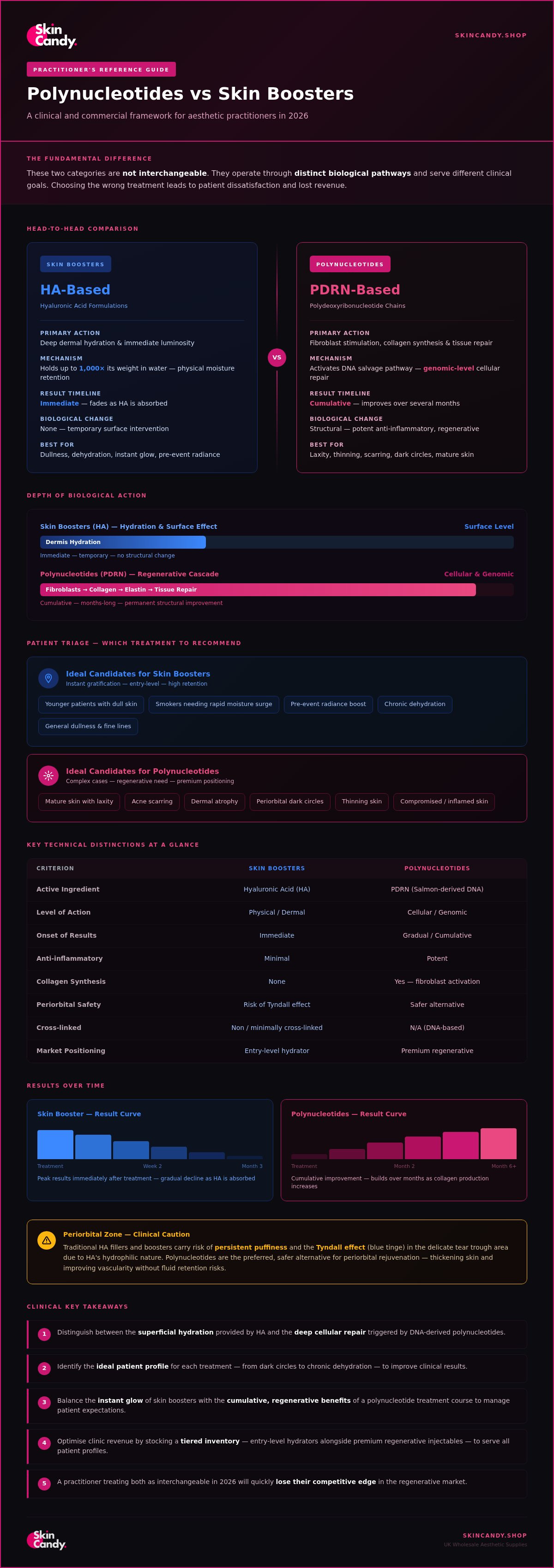
- Distinguish between the superficial hydration provided by Hyaluronic Acid and the deep cellular repair triggered by DNA-derived polynucleotides.
- Identify the ideal patient profile for polynucleotides vs skin boosters to improve clinical results for concerns ranging from dark circles to chronic dehydration.
- Manage patient expectations by balancing the instant glow of skin boosters with the cumulative, regenerative benefits of a polynucleotide treatment course.
- Optimise your clinic’s revenue by strategically stocking a tiered inventory that includes both entry-level hydrators and premium regenerative injectables.
- Streamline your procurement process with a reliable UK wholesale partner to ensure next-day delivery and avoid costly gaps in your treatment schedule.
The Science of Biostimulation: How Polynucleotides and Skin Boosters Differ
Understanding the molecular hierarchy of injectables is the first step in building a high-performance treatment menu. While the industry often groups them together, the debate of polynucleotides vs skin boosters is actually a comparison of two distinct biological pathways. Skin boosters are primarily Hyaluronic Acid (HA) based formulations. Their role is to provide deep, dermal hydration and immediate luminosity. In contrast, polynucleotides are DNA fractions derived from salmon sperm. They don't just occupy space; they signal for cellular repair and structural regeneration. The choice between them depends on whether your patient needs a temporary moisture surge or a fundamental change in skin quality.
Hyaluronic Acid Mechanisms in Skin Boosters
The efficacy of a skin booster relies on the hydrophilic nature of Hyaluronic Acid. This molecule can hold up to 1000 times its own weight in water, creating a reservoir of moisture within the dermis. Most formulations, such as Lumi Meso, utilise non-cross-linked or minimally cross-linked HA to ensure high spreadability. This ensures the product integrates smoothly without creating the volume or projection associated with traditional dermal fillers. The result is an immediate plumping effect that satisfies patients looking for instant gratification. It's a physical intervention that addresses dehydration and fine lines through moisture retention rather than biological change.
Polynucleotide Chain Reactions and Cellular Repair
Polynucleotides operate through a more complex, regenerative mechanism. These Polydeoxyribonucleotide (PDRN) chains increase the metabolic activity of fibroblasts, which are the cells responsible for producing collagen and elastin. Unlike HA, which provides a temporary moisture boost, polynucleotides possess potent anti-inflammatory properties that calm the skin environment. They facilitate the salvage pathway for DNA synthesis, which accelerates tissue repair and improves the skin's overall resilience. Polynucleotides are bio-stimulators that repair skin at a genomic level rather than just masking dehydration. This makes them indispensable for treating compromised skin that requires more than just a surface-level glow.
When comparing the primary actions of polynucleotides vs skin boosters, practitioners should consider these key technical distinctions:
- Skin Boosters: Focus on moisture retention, immediate radiance, and temporary smoothing of superficial lines.
- Polynucleotides: Focus on fibroblast stimulation, collagen synthesis, and long-term tissue repair.
- Duration: Boosters offer instant results that fade as the HA is absorbed; polynucleotides offer cumulative benefits that improve over several months.
- Application: HA is ideal for general dullness; polynucleotides are superior for targeted repair of thinning or scarred tissue.
Clinical Indications: When to Recommend Polynucleotides vs Skin Boosters
Successful patient outcomes depend on precise triage. You don't want to over-promise structural repair to someone who just needs a pre-wedding glow. Conversely, treating chronic thinning with simple Hyaluronic Acid (HA) will lead to patient dissatisfaction. The debate of polynucleotides vs skin boosters is best settled by looking at the patient's primary concern. If the goal is superficial hydration and immediate luminosity, boosters are the logical choice. If the patient presents with structural issues like laxity, thinning, or chronic dark circles, polynucleotides are required.
Ideal candidates for skin boosters include younger patients with dull skin or smokers who need a rapid moisture surge. These treatments provide the "instant gratification" that keeps entry-level patients returning. However, for patients with mature skin, acne scarring, or dermal atrophy, you must pivot to regenerative medicine. Polynucleotides are the workhorse for these complex cases, providing the biological foundation that HA simply cannot build.
Addressing Periorbital Ageing and Dark Circles
Traditional HA fillers and boosters can be problematic in the tear trough. Because HA is hydrophilic, it can lead to persistent puffiness or the blue-tinged Tyndall effect in the delicate eye area. Polynucleotides offer a safer, more effective alternative for periorbital rejuvenation. They thicken the skin and improve vascularity without attracting excess water. For a detailed breakdown of treatment maps, consult our guide on polynucleotide indications for aesthetic clinics. This approach reduces the risk of post-treatment swelling and delivers a more natural, refreshed appearance.
Hydration and Radiance: The Skin Booster Advantage
When the goal is "event-ready" skin, boosters are the superior choice. Products like Lumi Meso deliver high concentrations of HA and essential nutrients that provide instant luminosity. They're perfect for the patient who wants to look refreshed within 48 hours. If the skin's barrier is intact and there's no underlying structural damage, a booster provides the most efficient ROI for the patient. It's a high-volume, reliable treatment that forms the backbone of many successful clinic menus.
The most advanced practitioners now use a layered strategy. You can use polynucleotides to build the dermal foundation over several months, then finish with a skin booster for that final glass-skin finish. This ensures the patient gets both biological repair and immediate aesthetic reward. To maintain this level of service, ensure you have the necessary professional injectables in stock for immediate dispatch.
Treatment Protocols and Patient Comfort: Managing Clinical Expectations
Managing patient expectations is a critical skill when discussing polynucleotides vs skin boosters. Patients often expect immediate results from any injectable treatment. While skin boosters provide that sought-after "instant gratification" through rapid dermal hydration, polynucleotides are a "slow burn" investment in cellular health. You must communicate these differences clearly during the consultation to ensure high patient retention and satisfaction. Misalignment on the timeline of results is the most common reason for perceived treatment failure.
Course requirements differ significantly between the two categories. A standard skin booster protocol typically involves 2 to 3 sessions spaced 4 weeks apart. In contrast, polynucleotides usually require 3 to 4 sessions to achieve optimal biological repair. Practitioners must also prepare patients for the physical reality of the procedure. Skin boosters often result in visible papules that can last up to 48 hours, especially when using high-molecular-weight HA. Polynucleotides may cause slight swelling or bruising, but the product integrates into the tissue differently, often leaving less visible surface disruption.
The Timeline of Results
The biological peak for these treatments follows two distinct paths. Skin boosters peak at approximately 2 weeks, as the Hyaluronic Acid fully integrates and binds with water. Polynucleotides peak much later, typically around the 2 to 3 month mark. This delay occurs because the body requires time to complete the 90-day collagen cycle. For patients seeking a comprehensive transformation, you can combine both in a single treatment plan. Start with polynucleotides to repair the dermal foundation, then follow with a booster for a surface-level finish. Sourcing your stock from a reliable skin booster supplier UK ensures you always have CE-marked products ready for these dual-action protocols.
Injection Techniques: Bolus vs Retrograde
Injection depth is the primary technical variable that determines efficacy. Skin boosters are typically administered into the mid-to-deep dermis using a retrograde linear thread or a 5-point BAP technique. This ensures even distribution of the HA across the treatment area. Polynucleotides require a more versatile approach. They are often delivered via a series of small bolus injections or using a cannula for retrograde fanning in larger areas like the cheeks or neck. Whether you prefer needles for precision or cannulas for comfort, always prioritise medical-grade consumables. Consistent technique combined with high-quality products is the only way to guarantee the results your clinic promises.
Strategic Procurement: Balancing Your Inventory for Optimal Clinic Revenue
Procurement is the silent engine of your clinic’s profitability. When evaluating polynucleotides vs skin boosters from a commercial perspective, you must look beyond clinical results to the actual bottom line. Polynucleotides represent the high-margin, regenerative tier of your menu. UK patients are increasingly willing to pay a premium for biological repair that exceeds standard hydration. Conversely, skin boosters are your high-volume workhorses. They ensure a steady cash flow and serve as an accessible entry point for new patients. Balancing these two categories allows you to capture both the budget-conscious and the results-driven segments of the market. You should aim for a menu that offers a clear hierarchy to simplify the patient’s decision-making process.
The Recommended Retail Price (RRP) for a polynucleotide course is typically 30% to 50% higher than a standard hydration booster. This reflects the specialised nature of the product and the longer-term results it promises. However, the cost-per-treatment remains manageable if you source effectively. By positioning polynucleotides as a premium structural intervention, you can increase your average patient spend whilst maintaining the high-frequency bookings associated with traditional skin boosters. This dual-track strategy ensures your clinic remains resilient against shifting consumer trends.
Maximising Profit Margins with Bulk Purchasing
Buying in volume from a dedicated UK wholesaler significantly reduces your overheads. Stocking a range of brands, such as Lumifil dermal filler UK alongside Lumi Meso, enables you to offer tiered pricing. You can position entry-level boosters for younger demographics whilst reserving premium polynucleotide formats for mature patients seeking structural restoration. This tiered approach protects your margins and ensures your clinic remains competitive. Popular formats in 2026 focus on high-concentration PDRN for targeted areas, allowing for precise stock allocation and minimal waste.
Inventory Management and Shelf Life
Cash flow is often tied up in slow-moving stock. Implementing just-in-time inventory strategies reduces these overheads and minimises the risk of expired products. Maintaining a diverse menu shouldn't mean holding thousands of pounds in stagnant boxes. You need a partner that offers rapid fulfilment for last-minute patient bookings. Skin Candy supports clinic growth by acting as your external warehouse, providing the stock you need only when you need it. This agility allows you to respond to sudden shifts in patient demand without financial overexposure. To keep your treatment rooms fully operational, order your professional injectables online for next-day delivery.
Reliable Aesthetic Supply: Securing High-Quality Consumables with Skin Candy
Skin Candy acts as the silent engine behind the UK's most successful aesthetic practices. We understand that your clinic's reputation depends entirely on the reliability of your supply chain. When you are navigating the clinical nuances of polynucleotides vs skin boosters, you cannot afford to be let down by a stockout. We provide a streamlined procurement experience that allows you to focus on patient outcomes rather than tracking delayed shipments. By consolidating your orders through a single trusted source, you reduce administrative friction and ensure your treatment menu remains fully operational at all times. Practitioners who lead the market in 2026 understand that clinical expertise must be matched by logistical precision.
Whether you are expanding your range of Lumi Meso or introducing advanced DNA-repair protocols, your wholesaler must be as reliable as your technique. Skin Candy provides that certainty. We position ourselves as a vital partner in your commercial success, offering the logistical confidence required to scale your business. Our role is to ensure that the high-performance products you rely on are always available for immediate dispatch.
Next-Day Delivery and Operational Efficiency
Time is your most valuable asset in a high-volume clinic environment. Our logistics infrastructure is built for speed, offering same-day dispatch to ensure next-day delivery across the UK. This rapid turnaround is essential for maintaining a just-in-time inventory model. It prevents the lost revenue that occurs when you have to turn away a patient because a specific product is out of stock. We act as your external warehouse, providing the agility needed to respond to sudden spikes in demand for regenerative treatments. Our commitment to logistical excellence means your clinic never misses a booking due to supply chain delays. You can plan your treatment schedule with the total confidence that your consumables will arrive exactly when needed.
Quality Assurance and Professional Standards
We only supply medical-grade, professional products to ensure the highest standards of patient safety and clinical results. Our extensive inventory includes premium brands like Lumifil, Regenovue, and a diverse range of polynucleotides tailored for specific indications. Every item in our catalogue is selected for its clinical efficacy and strict regulatory compliance. The online ordering process is designed for busy practitioners who need to replenish stock in seconds. You can manage your entire procurement cycle through our intuitive portal, which provides real-time stock levels and transparent tracking. This level of professional oversight ensures you are always working with authentic, high-performance injectables that deliver the results your patients expect.
Explore our full range of polynucleotides and skin boosters at Skin Candy and secure the consumables your clinic needs to maintain its competitive edge.
Future-Proof Your Clinic with Strategic Procurement
Mastering the technical and commercial balance of polynucleotides vs skin boosters is the key to maintaining a high-performance treatment menu in 2026. You now have the framework to distinguish between superficial hydration and genomic repair. Use this knowledge to triage patients effectively and manage their expectations regarding the 90-day collagen cycle. By implementing a tiered pricing strategy and a just-in-time inventory model, you can maximise your profit margins whilst offering the cutting-edge regenerative results that your patients demand. Don't let supply chain delays or overlapping marketing claims hinder your clinic's growth.
Your clinical success depends on a supply chain that is as efficient as your practice. Skin Candy is trusted by leading UK practitioners for our reliable delivery and professional standards. We provide wholesale prices for medical-grade aesthetic consumables to ensure your business remains profitable and agile. We act as the silent engine behind your operations, allowing you to focus on delivering exceptional results. Shop Professional Polynucleotides and Skin Boosters at Skin Candy and benefit from next-day delivery across the UK. Start optimising your inventory today to secure your position as an industry leader.
Frequently Asked Questions
Can polynucleotides and skin boosters be used in the same treatment session?
You can combine these treatments in a single session to achieve multi-layer rejuvenation. Practitioners often inject polynucleotides into the deeper dermis for structural repair whilst using a skin booster like Lumi Meso in the superficial layers for immediate hydration. This hybrid approach to polynucleotides vs skin boosters addresses both cellular health and surface luminosity. Always ensure you don't over-inject a single anatomical plane to maintain optimal tissue integration and patient comfort.
Which treatment is more effective for dark circles under the eyes?
Polynucleotides are significantly more effective for the periorbital region. Unlike Hyaluronic Acid boosters, they don't attract excess water, which reduces the risk of post-treatment puffiness or the Tyndall effect. They work by thickening the delicate skin and improving vascularity to diminish the appearance of dark circles. This makes them a safer, more predictable choice for tear trough rejuvenation compared to traditional skin boosters that can sometimes lead to persistent lymphatic congestion.
How long do the results of polynucleotides last compared to skin boosters?
Results from a full course of polynucleotides typically last between six and nine months due to the genuine biological repair they trigger. Skin boosters generally provide a visible glow for three to six months, depending on the product's cross-linking and the patient's lifestyle. Whilst boosters offer faster results, the longevity of polynucleotides vs skin boosters is superior because the former creates a structural improvement in the skin's collagen matrix that persists over time.
Are polynucleotides safe for patients with fish allergies?
You should avoid using polynucleotides on patients with a known severe allergy to fish or trout. These products are derived from salmon DNA and, whilst highly purified, they may still trigger a reaction in sensitive individuals. Always conduct a thorough medical history before treatment. If a patient is allergic to shellfish but not specifically fish, proceed with caution. For these patients, an HA-based skin booster like Lumi Meso is a safer alternative.
What is the typical downtime for a polynucleotide injection?
Downtime is usually minimal, with most patients returning to normal activities within 24 to 48 hours. You might observe slight swelling, redness, or small injection site papules immediately after the procedure. These typically resolve much faster than the papules seen with high-molecular-weight skin boosters. Advise your patients to avoid strenuous exercise or heat treatments for the first day to minimise the risk of bruising and ensure the regenerative product integrates properly into the tissue.
Why are polynucleotides more expensive to procure than basic skin boosters?
The higher procurement cost reflects the complex manufacturing process required to extract and purify ultra-pure DNA fractions from salmon. Polynucleotides are advanced bio-stimulators rather than simple hydrators. The technology involved in creating a stable, medical-grade PDRN solution is more intensive than standard Hyaluronic Acid production. Practitioners find that the increased cost is justified by the premium results and the ability to charge a higher RRP for these specialised regenerative treatments.
Can I use a skin booster on a patient who has recently had dermal fillers?
It's safe to use a skin booster on a patient with existing dermal fillers, provided the filler has fully integrated. These treatments are complementary; fillers provide volume and structure, whilst boosters improve the quality and hydration of the overlying skin. You should wait at least two weeks after a filler treatment before administering a skin booster. This ensures any initial swelling has subsided and allows for precise placement of the hydration treatment for optimal results.
How do polynucleotides compare to exosomes in regenerative aesthetics?
Polynucleotides focus on providing the building blocks for DNA repair and fibroblast stimulation. Exosomes are extracellular vesicles that carry a complex payload of proteins and growth factors to signal specific cellular behaviours. Whilst both fall under regenerative aesthetics, polynucleotides are currently more established for injectable use in the UK. Many clinics use polynucleotides to build structural foundations and reserve exosomes for advanced topical applications or specific skin barrier repair protocols to maximise patient results.