PLLA vs Polynucleotides: A 2026 Practitioner’s Guide
The obvious choice between structural volume and cellular repair might actually be the wrong way to approach your treatment menu. Most practitioners find themselves caught in the confusion of "biostimulator" versus "regenerative" labels while trying to decide on PLLA vs polynucleotides for skin rejuvenation. It's a common challenge to manage patient expectations for results timelines whilst navigating the technical nuances of injection depths and downtime. You need clinical clarity to ensure your practice remains competitive in a skin booster market projected to reach $3.7 billion by 2032.
This guide helps you master the clinical and logistical differences between these two powerhouses to optimise your clinic’s regenerative offerings. You'll gain a clear protocol for both product types, including precise sequencing to achieve superior patient outcomes. We'll also cover how to secure high-quality consumables like AesPlla from a reliable UK wholesale source to keep your clinic running without delays. By the end, you'll know exactly how to integrate these treatments into a high-performance practice that prioritises both clinical efficacy and logistical efficiency.
Key Takeaways
- Understand the functional distinction between PLLA’s structural scaffolding and the cellular repair signals triggered by polynucleotides.
- Identify the best indications for PLLA vs polynucleotides for skin rejuvenation, targeting volume loss with polymers and delicate tissue repair with DNA fragments.
- Reduce patient risk by utilising advanced formulations like AesPlla and implementing the essential "5-5-5" post-treatment massage rule.
- Achieve global facial rejuvenation by sequencing treatments correctly, using polynucleotides to prime the skin’s regenerative capacity before adding structural PLLA.
- Streamline your clinic operations through strategic wholesale procurement, ensuring next-day delivery of high-performance consumables to maintain treatment momentum.
Understanding Biostimulation: Defining PLLA and Polynucleotides
The term "biostimulator" is frequently used as a catch-all in modern aesthetics, yet it masks a fundamental divide in clinical methodology. Practitioners must distinguish between structural induction and cellular regeneration to achieve predictable results. When evaluating PLLA vs polynucleotides for skin rejuvenation, you aren't comparing similar products; you're comparing two entirely different biological pathways. PLLA is a synthetic polymer designed for volume. Polynucleotides are biological molecules designed for repair. Success in a 2026 clinic requires a precise understanding of how these substances interact with human tissue at varying depths.
The Molecular Mechanism of PLLA
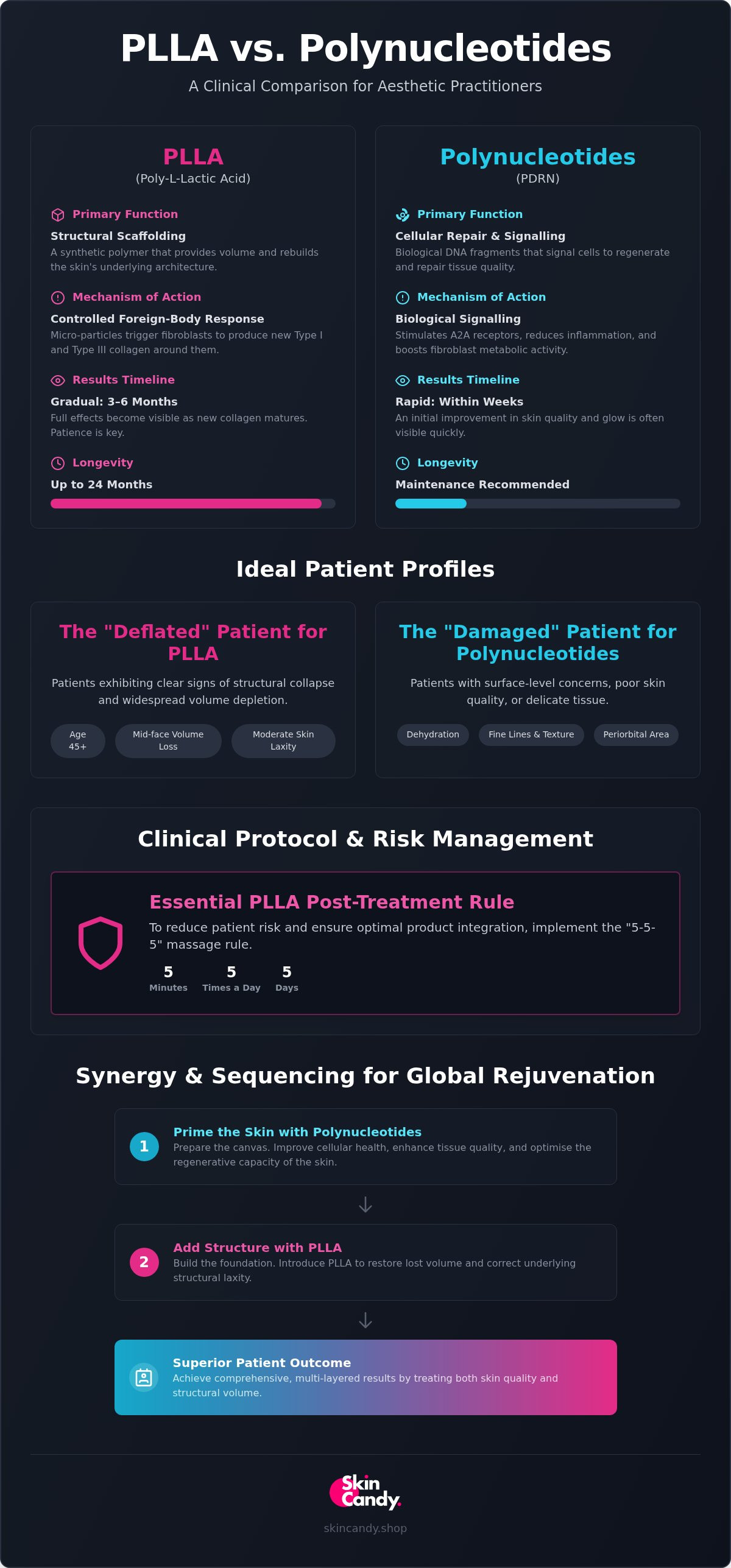
PLLA, or Poly-L-Lactic Acid, acts as a structural scaffold. It's a biocompatible polymer that works by initiating a controlled foreign-body response. Once injected, the PLLA micro-particles trigger fibroblasts to produce collagen around the material. This process isn't immediate. It takes between 3 and 6 months for the initial Type III collagen to mature into resilient Type I collagen. High-performance formulations like AesPlla require meticulous handling. You must adhere to strict reconstitution and hydration protocols to ensure the suspension is stable. This structural approach is the gold standard for treating diffuse volume loss and correcting the underlying architecture of the face.
The Biological Signalling of Polynucleotides
Polynucleotides operate through a more subtle, regenerative mechanism. These DNA fragments, technically known as Polydeoxyribonucleotide (PDRN), are typically purified from salmonid DNA. Unlike PLLA, they don't rely on a foreign-body response. Instead, they stimulate A2A receptors on the cell surface. This activation reduces local inflammation and enhances the metabolic activity of fibroblasts. The result is an increase in myofibroblasts and improved extracellular matrix quality without the inflammatory bulk of traditional fillers.
This biological signalling makes polynucleotides exceptionally versatile for improving skin texture and treating thin, damaged tissue. They excel in areas where PLLA might be too aggressive, such as the periorbital zone or the neck. If you're looking for specific treatment areas, you can explore our Polynucleotide Indications for Aesthetic Clinics for more clinical insights. Differentiating these two categories allows you to move beyond basic filler work and offer sophisticated, multi-layered rejuvenation.
Understanding the mechanics of PLLA vs polynucleotides for skin rejuvenation is the first step in building a 2026 treatment menu. One builds the house, whilst the other repairs the paintwork. Both are essential for a comprehensive aesthetic practice that values results and safety.
Mechanism vs. Result: Comparing Clinical Outcomes
Choosing between PLLA vs polynucleotides for skin rejuvenation depends entirely on the clinical objective. PLLA is the superior choice for diffuse volume loss. It corrects structural facial laxity by reinforcing the skin's foundation. Conversely, polynucleotides excel in treating delicate areas where traditional fillers or heavy biostimulators might fail. They are the gold standard for periorbital regions and fine texture issues. Clinical evidence, such as the PLLA and Polynucleotide Composite Filler Study, suggests that both materials offer high safety profiles when used for their intended indications.
The timeline for these results varies significantly. PLLA requires patience; patients won't see the full effect for several months as collagen matures. However, the longevity is impressive, often persisting for up to 24 months. Polynucleotides offer a quicker win. An initial glow is often visible within weeks, though maintenance every 6 months is standard to sustain cellular health. To ensure your clinic is ready for either patient profile, you can browse our range of wholesale regenerative injectables for next-day delivery.
Patient Selection: Who Gets Which Treatment?
Identify the "deflated" patient for PLLA. These individuals show clear signs of structural collapse and volume depletion. The "damaged or dull" patient needs polynucleotides. Their concerns are surface-level: dehydration, fine lines, or a lack of radiance. The ideal PLLA candidate is typically aged 45 or over with moderate skin laxity and noticeable mid-face volume loss. Matching the product to the patient's biological age and tissue quality is vital for satisfaction.
Injection Depth and Technique
Technical execution is where these products diverge most. PLLA requires deep dermal to subdermal placement. Superficial injection increases the risk of palpable nodules. Polynucleotides target the extracellular matrix via intradermal "bap" or retrograde techniques. This superficial placement ensures the DNA fragments interact directly with the fibroblasts. For practitioners exploring other regenerative tools, our Polynucleotides vs Exosomes: 2026 Practitioner Guide offers a deeper comparison of surface-level treatments. Precision in depth is non-negotiable for safety and efficacy.
The Safety Profile and Risk Management in Clinic
Safety protocols define the clinical reputation and longevity of your practice. When weighing PLLA vs polynucleotides for skin rejuvenation, you must account for the distinct risk profiles and post-treatment requirements of each material. PLLA has historically faced stigma regarding late-onset nodules; however, modern formulations like AesPlla have refined particle uniformity to minimise these issues significantly. Success with PLLA remains dependent on the "5-5-5" massage rule. Patients must massage the treated area for five minutes, five times a day, for five days to ensure even particle distribution.
Polynucleotides offer a broader safety margin. They pose minimal risk of granulomas or vascular occlusion, which makes them an excellent choice for practitioners prioritising regenerative outcomes with low complexity. As detailed in this Review of Polynucleotides in Aesthetic Medicine, their biological nature ensures high biocompatibility. Managing downtime is equally important for patient satisfaction. Polynucleotide treatments typically result in small, temporary papules that resolve within 48 hours, whilst PLLA procedures involve more pronounced initial swelling due to the volume of diluent required for reconstitution.
Preventing Complications with PLLA
Success with PLLA starts before the needle enters the skin. Appropriate dilution and vigorous shaking of the vial are critical to creating a homogenous suspension. Superficial injection is the primary cause of adverse events, as placing micro-particles too high in the dermis leads to palpable lumps. Maintaining a consistent supply of genuine, high-performance products from a trusted aesthetic clinic procurement UK partner is the first step in clinical risk management. Consistency in your supply chain ensures that every vial meets the expected hydration and suspension standards.
Allergy and Sensitisation in PN Treatments
Highly purified polynucleotides are known for their low immunogenicity. Despite this, practitioners must screen for fish allergies because the DNA fragments are salmon-derived. The highly controlled purification process of salmon-derived DNA removes all protein components to ensure a hypoallergenic final product. This level of purification allows for the safe treatment of patients with various skin sensitivities. Always verify the source and purification standards of your PN products to maintain these high safety margins within your clinic.
Synergy and Sequencing: Can You Use Both?
Global facial rejuvenation is the new standard for 2026. You don't have to choose one over the other. Combining PLLA and PN allows you to address structural volume loss and surface-level cellular repair simultaneously. When planning a long-term protocol, the debate of PLLA vs polynucleotides for skin rejuvenation shifts from competition to collaboration. This dual approach ensures that the underlying architecture is supported whilst the skin’s texture and radiance are optimised. Stocking both allows you to capture a wider patient demographic whilst delivering superior clinical results.
Sequencing is the key to clinical success. You should start with polynucleotides to "prime" the skin’s regenerative capacity. Healthy, hydrated tissue responds more effectively to the collagen induction triggered by PLLA. We recommend a minimum 4-week gap between different biostimulatory agents to allow the initial cellular response to stabilise. You can also use PN for finishing touches in areas where PLLA is traditionally contraindicated, such as the forehead or the delicate infraorbital region. This ensures a truly "global" result that dermal fillers alone cannot replicate.
The 12-Month Regenerative Roadmap
Creating a structured timeline ensures patient compliance and predictable outcomes. Start with a polynucleotide loading phase during months one and two to reset skin quality. Between months three and six, introduce PLLA sessions for structural lifting and mid-face volume. By month twelve, transition the patient into a maintenance phase. This can involve further PN boosters or a high-quality HA like Lumifil dermal filler UK to refine contours and maintain hydration levels.
Economic Benefits of Combination Therapy
Offering tiered regenerative packages increases clinic revenue and boosts patient retention. Patients invested in a 12-month roadmap are less likely to seek one-off treatments elsewhere. Intelligent inventory management also reduces product waste. You can supplement these high-value protocols with skin-priming tools found in our mesotherapy products wholesale UK guide. This comprehensive approach builds a more resilient business model whilst providing patients with the best possible aesthetic journey.
Ensure your clinic is fully prepared for high-demand combination treatments. Order your PLLA and polynucleotide supplies from Skin Candy for reliable next-day UK delivery.
Procurement Strategy: Stocking Your Clinic for 2026
Strategic procurement is the operational engine of a high-performance aesthetic practice. High-value consumables like PLLA and polynucleotides represent a significant capital investment. You don't want thousands of pounds in stock sitting on a shelf for months. A "Just-in-Time" delivery model allows you to maintain lean inventory levels without risking treatment delays. This approach is essential when balancing PLLA vs polynucleotides for skin rejuvenation, as it preserves your clinic’s cash flow whilst meeting immediate patient demand.
Authenticity is your primary safeguard in a crowded wholesale market. Always verify CE marking and batch traceability for every injectable you purchase. Skin Candy serves as a logistical partner for UK practitioners, providing rapid fulfilment and guaranteed product integrity. We ensure that every vial of PLLA or PN arrives with the necessary certification to protect your professional registration and patient safety. Choosing a reliable wholesaler means you can focus on clinical excellence rather than tracking delayed parcels.
Maximising Clinic Efficiency with Next-Day Delivery
Reliability is everything. A cancelled appointment due to stock shortages represents lost revenue and damaged patient trust. You need a supply chain that responds as fast as your clinic moves. Skin Candy provides next-day UK delivery to ensure your treatment room stays active. Our UK-based support team is available to handle technical product enquiries, providing a level of service that international shippers cannot match. We act as the silent partner in your clinic’s growth, handling the logistics so you can handle the patients.
Choosing Between Brands: AesPlla, Plinest, and Beyond
Product selection should be based on clinical data and ease of use. AesPlla has become a practitioner favourite for PLLA treatments due to its high concentration and predictable results in structural lifting. When selecting polynucleotides, you must match the brand to the specific indication. Some formulations are specifically engineered for the delicate periorbital region, whilst others have the viscosity required for full-face rejuvenation. Diversifying your stock allows you to tailor every protocol to the individual's needs.
Don't let logistical hurdles slow your practice down. Stock your clinic with professional PLLA and Polynucleotides today to ensure you're ready for the 2026 regenerative boom.
Future-Proofing Your Regenerative Menu
Modern aesthetics has moved beyond simple filling. You now have the tools to rebuild facial architecture whilst simultaneously repairing cellular damage. Mastering the clinical application of PLLA vs polynucleotides for skin rejuvenation allows you to offer the sophisticated, multi-layered protocols that patients in 2026 demand. Use polynucleotides to prime the tissue before introducing the structural support of PLLA. This sequencing ensures your results are both predictable and transformative.
Your clinical success depends on a reliable supply chain. Don't let stock shortages interrupt your treatment roadmap. Skin Candy provides the logistical engine you need to scale your practice with confidence. We offer next-day UK delivery on all orders and provide dedicated support for aesthetic practitioners across the country. As an authorised distributor of high-performance brands like AesPlla and Lumifil, we guarantee product authenticity and logistical excellence.
Order professional PLLA and Polynucleotides from Skin Candy to secure your clinic's inventory. Take the next step in advancing your regenerative menu today.
Frequently Asked Questions
Is PLLA better than polynucleotides for sagging skin?
PLLA is superior for treating sagging skin caused by structural volume loss and deep tissue laxity. It creates a synthetic scaffold that supports the facial architecture over several months. When evaluating PLLA vs polynucleotides for skin rejuvenation, PLLA is the choice for lifting "deflated" tissue, whilst polynucleotides are better suited for improving skin elasticity and surface texture.
Can I inject polynucleotides and PLLA in the same session?
Injecting both materials in the same session is generally not recommended. It's best practice to maintain a four-week interval between different biostimulatory treatments. This gap allows the initial inflammatory response to stabilise and enables you to monitor the patient’s progress accurately. Spacing treatments ensures you don't overwhelm the skin’s regenerative capacity.
What is the downtime for PLLA vs polynucleotides?
Downtime differs based on the injection technique and product volume. PLLA involves significant initial swelling because of the sterile water used for reconstitution. Polynucleotide treatments typically result in small, visible papules at the injection sites. These papules usually resolve within 24 to 48 hours as the DNA fragments integrate into the tissue.
How many sessions of polynucleotides are needed to see results?
Most clinical protocols require a course of three sessions to achieve optimal regenerative outcomes. These sessions should be spaced approximately three to four weeks apart. Whilst patients often report an improved "glow" after the first treatment, the full effect on collagen density and elastin production becomes visible after the third session.
Are polynucleotides safe for patients with fish allergies?
Polynucleotides are contraindicated for any patient with a known fish or salmonid allergy. Although the DNA fragments are highly purified to remove protein components, the source material remains salmon-derived. You must perform a rigorous medical screening before every treatment to avoid potential sensitisation or allergic reactions in your clinic.
Which treatment is more cost-effective for a clinic to stock?
Stocking both products is the most commercially viable strategy for a 2026 clinic. PLLA serves patients needing long-term structural lifting, whilst polynucleotides provide a high-turnover option for skin quality and delicate areas. Using a wholesaler like Skin Candy allows you to maintain lean inventory levels with next-day delivery, preventing capital from being tied up in stock.
Can PLLA be used for under-eye rejuvenation?
PLLA must never be injected into the periorbital region. The skin in this area is too thin to accommodate the micro-particles, which leads to a very high risk of visible nodules. Polynucleotides are the gold standard for under-eye rejuvenation. They safely thicken the skin and reduce fine lines without the risk of lumps or migration.
Do polynucleotides provide immediate volume like dermal fillers?
Polynucleotides do not provide immediate volume or contouring. They act as biological signals that trigger cellular repair and extracellular matrix remodelling over time. If your patient requires instant volume replacement or structural lifting, you should consider traditional dermal fillers or a PLLA protocol instead of a primary polynucleotide treatment.