PLLA vs HA Fillers for Practitioners: The 2026 Clinical and Procurement Guide
What if the most profitable product in your 2026 inventory isn't the one that provides immediate results? You already know the delicate balance of managing clinic stock whilst meeting diverse patient expectations. It is often a challenge to explain the merits of gradual bio-stimulation when a client is focused on instant volume. Choosing between PLLA vs HA fillers for practitioners requires a strategic approach that weighs clinical outcomes against logistical efficiency.
This guide provides a definitive framework to help you master the clinical and commercial differences between these two essential categories. You'll learn how to optimise your patient selection and clinic inventory to ensure maximum turnover and long-term retention. We will examine the latest 2026 reconstitution protocols, compare longevity profiles, and show you how reliable next-day delivery can transform your procurement strategy. By the end of this article, you will have the tools to streamline your supplies and deliver the superior results your patients demand.
Key Takeaways
- Contrast immediate HA volumisation with the gradual neocollagenesis of PLLA to manage long-term patient expectations effectively.
- Evaluate the commercial advantages of multi-session PLLA protocols versus the high-turnover model of traditional HA fillers.
- Understand the distinct logistical requirements of PLLA vs HA fillers for practitioners, focusing on the 24-72 hour reconstitution window.
- Optimise clinic inventory and cash flow by leveraging reliable next-day UK delivery for high-value bio-stimulators.
- Implement a strategic patient selection framework that balances instant results with the foundational support of PLLA.
Understanding the 2026 Shift: PLLA Bio-stimulation vs HA Volumisation
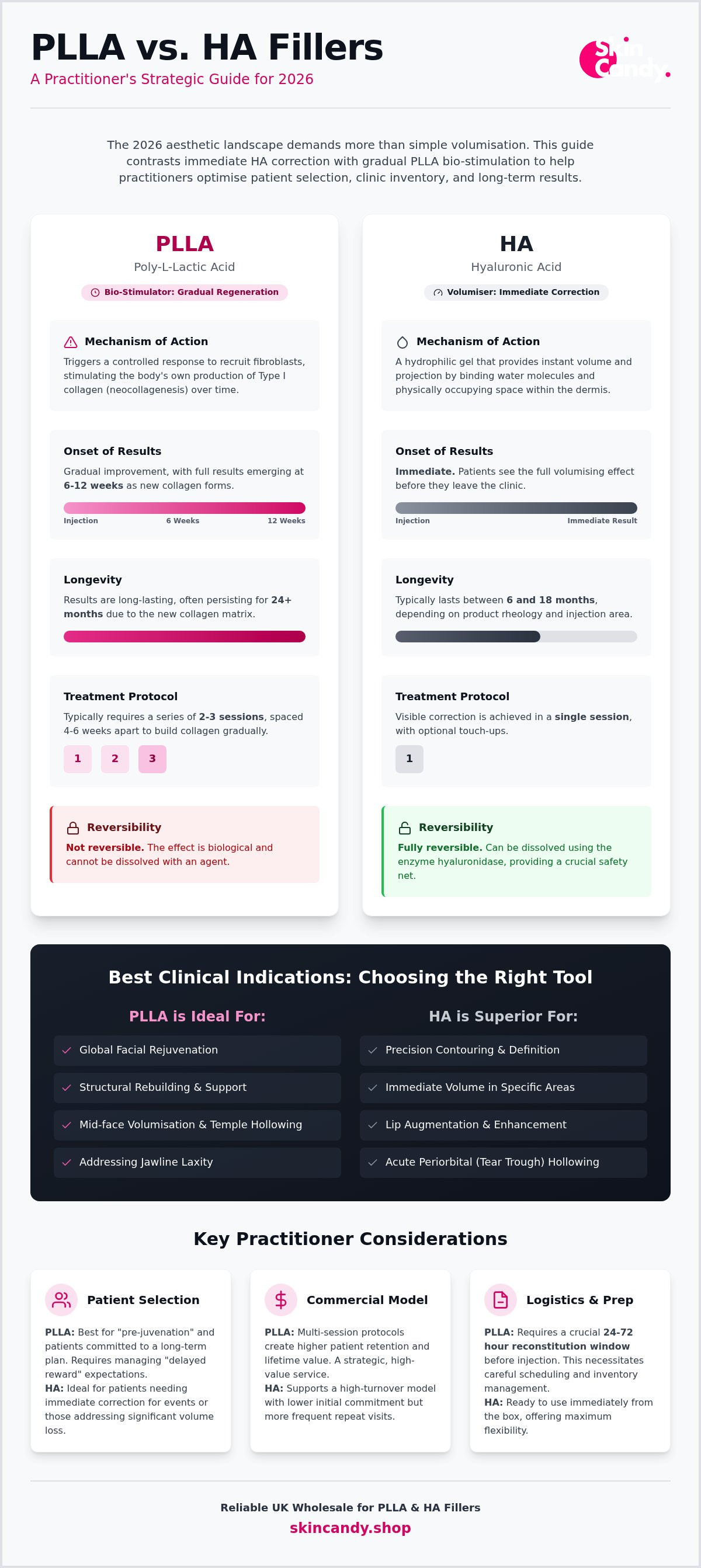
The 2026 aesthetic landscape has moved decisively beyond simple volumisation. Modern patients now prioritise "collagen banking" and tissue health over the obvious, over-filled results seen in previous years. For the clinician, this requires a fundamental understanding of PLLA vs HA fillers for practitioners to ensure every treatment plan aligns with these evolving expectations. While Hyaluronic Acid (HA) remains the gold standard for immediate correction, Poly-L-lactic acid (PLLA) offers a biological solution through neocollagenesis. Practitioners must now distinguish between filling a deficit and regenerating the underlying tissue architecture.
The Mechanism of Action: How PLLA Differs from HA
HA fillers are hydrophilic gels that provide instant projection by binding water molecules. Products like Lumifil dermal filler UK utilise advanced cross-linking technology to integrate into the dermis, offering immediate structural support. Conversely, PLLA is a synthetic, biodegradable polymer. It doesn't provide volume upon injection. Instead, the microparticles trigger a controlled subclinical inflammatory response. This process recruits fibroblasts to produce new Type I collagen over several months. You can find a more detailed Injectable filler overview to understand these varying chemical compositions. Both materials eventually degrade, but PLLA leaves behind a reinforced collagen matrix that outlasts the material itself.
Patient Demographics: Who is Sourcing Bio-stimulators in 2026?
Patient profiles are shifting rapidly. In 2026, we see a significant rise in younger patients seeking "pre-juvenation." These individuals aren't looking to change their features. They want to preserve their skin's structural integrity using PLLA. It's a proactive approach to ageing. Mature patients, however, often require the immediate lift provided by HA fillers to address deep fat pad loss or bone resorption. They need the instant gratification of HA whilst the PLLA works in the background.
Success with PLLA relies on managing the "delayed reward" expectation. You must educate patients that the initial volume from the sterile water carrier will subside within 48 hours, leaving them looking as they did before. The real results emerge at the 6 to 12-week mark. Mastering the conversation around PLLA vs HA fillers for practitioners helps you build trust. You're positioning yourself as a partner in their long-term skin health rather than a provider of temporary fixes.
Comparative Clinical Efficacy: Treatment Timelines and Patient Selection
The clinical choice between PLLA vs HA fillers for practitioners often comes down to the patient's timeline for results. Hyaluronic Acid (HA) fillers are the industry standard for instant gratification. They provide an immediate mechanical lift that patients can see before they leave the chair. In contrast, Poly-L-lactic acid (PLLA) is a "delayed reward" treatment. While HA typically requires only a single session for visible correction, PLLA protocols generally involve a series of 2-3 sessions spaced 4-6 weeks apart. This requires a higher level of patient commitment and clinical planning.
The longevity profiles justify this additional investment. HA fillers typically last between 6 and 18 months depending on the rheology and injection site. PLLA results often persist for 24 months or more. For patients seeking multi-layered rejuvenation, practitioners are increasingly looking at polynucleotide indications for aesthetic clinics to enhance skin quality alongside these structural fillers. This combination addresses both cellular repair and volume loss simultaneously. Understanding the nuances of PLLA vs HA fillers for practitioners allows you to design these sophisticated, high-value treatment plans.
Mapping the Face: When to Reach for HA vs PLLA
Indications for these materials are distinct and should be selected based on the specific anatomical deficit. Use HA for areas requiring precision and immediate volume. It's the superior choice for lip augmentation, contouring, and acute periorbital hollowing. PLLA is better suited for global facial rejuvenation and structural rebuilding. It's the preferred choice for mid-face volumisation, temple hollowing, and addressing jawline laxity. Safety remains a key differentiator. HA fillers offer the safety net of reversibility via hyaluronidase. PLLA is not reversible, making precise placement and expert patient selection critical for clinical success.
Complementary Protocols: Can You Use Both?
The "Hybrid Approach" is a dominant trend in 2026 clinics. This strategy uses HA for immediate structural lift whilst PLLA builds a long-term collagen foundation. An in-vivo study on collagen synthesis confirms that these materials work through different biological pathways to improve dermal thickness. Sequencing is vital. Many practitioners prefer to establish the PLLA foundation first, allowing the initial inflammatory response to settle before refining with HA. This prevents product displacement and ensures a natural, blended result. If you need to restock these essential supplies, you can browse our full range of CE-marked fillers to ensure your clinic is prepared for every patient profile.
Strategic Stocking for Clinic ROI: PLLA vs HA Financial Analysis
Profitability in 2026 depends on more than just clinical skill. It requires a sharp understanding of the financial nuances between PLLA vs HA fillers for practitioners. HA fillers generally offer a lower entry cost per treatment. However, PLLA presents a unique commercial opportunity through multi-vial protocols. While a single syringe of a premium product like Lumifil dermal filler UK provides immediate revenue, a PLLA course guarantees multiple return visits. This structural difference in treatment planning significantly alters your clinic’s cash flow and retention metrics.
Strategic procurement is the key to maintaining healthy margins. Buying wholesale bundles allows you to reduce the cost-per-vial for bio-stimulators, lowering the financial barrier for patients. This makes advanced treatments more accessible without eroding your profit. You should view PLLA as a long-term investment in your patient base. HA fillers remain your high-frequency revenue drivers, but PLLA builds the high-value, loyal foundation your business needs to scale.
The Business Case for PLLA in 2026
Offering PLLA elevates your brand. It positions your clinic as an advanced aesthetics centre capable of delivering sophisticated, regenerative results. Mastering the commercial balance of PLLA vs HA fillers for practitioners helps you target high-spending clients who prioritise longevity over price. Because PLLA results emerge gradually and last over 24 months, these patients often become your most vocal advocates. The lifetime value (LTV) of a PLLA patient is typically higher than an HA patient. They are committed to a journey, not just a quick fix. This commitment leads to better word-of-mouth referrals and sustainable organic growth.
Managing HA Inventory for High-Volume Turnover
HA fillers are the engine of daily clinic operations. You must maintain a diverse stock of densities to meet immediate demand. Ensure you have adequate supplies of specialised variants like Kiss for lips, Deep for contouring, and Max for structural support. To maximise the ROI of these treatments, many practitioners are now using mesotherapy products wholesale UK as an upsell. Integrating meso-boosters with HA fillers improves overall skin radiance and patient satisfaction. Efficient inventory management ensures you never miss a booking due to stockouts. Reliable procurement keeps your treatment rooms busy and your revenue consistent.
Logistics of Reconstitution and Supply Chain Management
Operational efficiency hinges on how you manage the physical preparation of your products. The logistical burden of PLLA vs HA fillers for practitioners represents a major workflow divide. While HA fillers are ready for immediate use, PLLA requires a disciplined preparation cycle. Failing to account for these timelines can lead to clinical delays or wasted product. To maintain a high-performance clinic, you must implement a structured logistics framework.
- Step 1: Forecast demand accurately. Ensure PLLA vials are reconstituted 24 to 72 hours prior to the appointment to allow for complete hydration.
- Step 2: Implement a robust clinical diary. This system must flag PLLA appointments three days in advance to trigger the preparation phase.
- Step 3: Organise secure storage. High-value consumables require climate-controlled environments to maintain stability.
- Step 4: Leverage a just-in-time inventory aesthetic clinic model. This reduces the capital tied up in sitting stock and improves your cash flow.
- Step 5: Review wastage protocols. Establish clear rules for unused reconstituted PLLA to prevent financial loss from "no-show" appointments.
The Critical Nature of Rapid UK Fulfilment
Next-day delivery is a non-negotiable requirement for modern clinics. When you offer bespoke bio-stimulator plans, you cannot afford supply chain delays. If a patient cancels after you've already prepared a high-cost vial, your inventory management must be agile enough to replace that stock instantly for the next booking. Skin Candy’s logistical network provides the reliability needed to support national UK clinics. We ensure your stock levels remain consistent, acting as the silent engine behind your treatment room. This logistical certainty allows you to focus on the patient whilst we handle the fulfilment.
Best Practices for PLLA Reconstitution and Storage
Technical precision during reconstitution is vital for a smooth suspension. Use sterile water for injection (SWFI) at the correct ratios specified by the manufacturer. Avoid aggressive shaking; instead, use gentle agitation techniques to ensure the microparticles are evenly distributed. This reduces the risk of needle clogging and ensures a predictable clinical result. Storage requirements also differ. While HA syringes are stable in their packaging, reconstituted PLLA vials must be stored according to strict medical-grade standards. Train your clinical team to manage the "prep-station" with military efficiency to maximise your daily throughput. To keep your clinic running at peak capacity, order your clinic supplies for next-day delivery today.
Sourcing Premium PLLA and HA Fillers: Why Reliable UK Wholesale Matters
Procurement is the silent engine of a successful aesthetic business. When deciding between PLLA vs HA fillers for practitioners, the clinical choice is only half the battle. The other half is ensuring a reliable supply of CE-marked, authentic formulations that guarantee patient safety and clinical predictable results. In the 2026 UK market, where regulatory scrutiny is at an all-time high, your choice of wholesale partner defines your professional reputation. Sourcing from a specialist like Skin Candy ensures you receive medical-grade consumables that meet every conformity standard, including the ongoing acceptance of CE marking in Great Britain.
A dedicated wholesale partner does more than just ship boxes. We reduce the administrative overhead that often bogs down busy practitioners. By consolidating your orders for HA fillers like Lumifil and Regenovue with specialist bio-stimulators like Aesossa dermal filler, you simplify your accounting and inventory tracking. This efficiency allows you to spend less time on spreadsheets and more time with patients. Reliability in the supply chain means you never have to turn away a client or postpone a treatment due to a missing delivery.
The Skin Candy Advantage: Speed, Quality, and Support
Efficiency is our core value. We provide next-day delivery across the UK to ensure your clinic remains operational without requiring you to hold massive amounts of expensive overhead. This is particularly vital for PLLA treatments that require careful scheduling and preparation. Our curated range features professional-only brands that give you a competitive edge. We act as an industry insider, providing the logistical confidence you need to scale your business. Our procurement process is designed by professionals for professionals, focusing on speed and the certainty of service.
Building Your Clinic’s 2026 Aesthetic Menu
A modern aesthetic menu must be diverse to remain profitable. You need a range of HA fillers to suit various budgets and indications, alongside high-performance PLLA bio-stimulators for structural rejuvenation. Integrating adjacent technologies like exosomes and polynucleotides alongside your core filler stock creates a comprehensive rejuvenation strategy. This multi-layered approach is what patients expect in 2026. Trusting Skin Candy for your end-to-end supply chain needs means you always have access to the latest innovations. We ensure your shelves are stocked with the right products at the right time, allowing you to deliver the superior results that drive patient retention.
Future-Proof Your Clinic Inventory for 2026
Success in the modern aesthetics market requires a dual approach to volumisation and regeneration. Balancing PLLA vs HA fillers for practitioners isn't just a clinical choice; it's a commercial strategy that dictates your clinic's ROI and patient retention rates. By integrating the immediate results of hyaluronic acid with the long-term collagen synthesis of bio-stimulators, you provide a comprehensive service that meets the sophisticated demands of today's patients. Efficiently managing your stock levels and reconstitution timelines ensures your treatment rooms remain productive and profitable throughout the year.
Reliable procurement is the foundation of this strategy. As an official supplier of Lumifil and Aesossa, Skin Candy provides the medical-grade consumables you need to maintain professional standards. Our specialist UK-wide rapid fulfilment network eliminates the need for large, capital-heavy overheads. Order your PLLA and HA fillers with next-day UK delivery at Skin Candy to streamline your operations and focus on delivering exceptional patient outcomes. We're here to act as the silent engine behind your business success, ensuring you're always prepared for your next appointment.
Frequently Asked Questions
Is PLLA more effective than HA for mid-facial volume loss?
PLLA is often considered more effective for global mid-facial volumisation due to its regenerative nature. While HA provides an immediate physical fill, PLLA stimulates the body's own collagen production to rebuild structural support. This results in a natural look that can last over 24 months. For practitioners, the choice depends on whether the patient requires acute correction or long-term foundation building in the mid-face area.
How long does PLLA take to show results compared to HA fillers?
HA fillers provide instant results, whereas PLLA requires 6 to 12 weeks for the initial effects of neocollagenesis to become visible. Patients must understand that the initial volume from the sterile water carrier will dissipate within 48 hours. The true results emerge gradually over a series of 2-3 sessions. Managing these expectations is a critical part of the consultation process for PLLA vs HA fillers for practitioners in 2026.
Can I buy PLLA wholesale in the UK without a medical prescription?
Dermal fillers are currently classified as medical devices rather than prescription-only medicines in the UK. However, you must be a qualified professional to purchase from a specialist wholesaler like Skin Candy. Understanding the legal requirements for PLLA vs HA fillers for practitioners is essential as the UK moves toward a more medicalised model in July 2026. We verify all accounts to ensure our medical-grade products are used by registered professionals only.
What are the main risks of improper PLLA reconstitution for practitioners?
Improper reconstitution carries a high risk of nodule formation and clumping of the product. If the microparticles aren't evenly suspended in sterile water for the required 24-72 hours, they can create uneven collagen stimulation. This results in palpable or visible lumps under the skin. Additionally, a poor suspension can clog needles during injection, causing delivery issues. Following strict agitation protocols and allowing for proper hydration time is essential for clinical safety.
How does the cost-per-treatment compare between PLLA and HA fillers?
The initial cost-per-vial for PLLA is typically higher than a single syringe of HA, and a full course usually requires multiple vials. However, the long-term ROI is often better for PLLA due to the extended longevity of results. Patients may pay more upfront for a PLLA course, but they require fewer maintenance visits over a two-year period compared to the 6-12 month cycle associated with standard hyaluronic acid filler treatments.
Is next-day delivery available for both PLLA and HA fillers at Skin Candy?
We provide rapid next-day delivery across the UK for all stocked items, including PLLA and HA fillers. This logistical reliability is vital for managing the complex reconstitution timelines of bio-stimulators. By using a just-in-time inventory model, you can order exactly what you need for your upcoming clinical diary without tying up excessive capital in sitting stock. Skin Candy acts as your dependable partner for high-volume aesthetic clinic procurement.
Can PLLA be used for lip augmentation in the same way as HA?
No, PLLA is generally contraindicated for use in the lips and the immediate periorbital area. The skin in these regions is too thin, and the high mobility of the mouth increases the risk of nodule formation. HA fillers remain the gold standard for lip augmentation because they provide soft, reversible, and precise volumisation. Using PLLA in these areas is a significant clinical error that can lead to permanent, non-reversible complications.
What is the shelf-life of PLLA vials when purchased in bulk?
Unopened PLLA vials typically have a shelf-life of 2 to 3 years when stored in a cool, dry environment. This makes them an excellent candidate for bulk wholesale purchasing to improve your clinic's profit margins. Once the product is reconstituted, it must be used within the timeframe specified by the manufacturer, usually between 72 hours and 7 days. Always check the individual expiry dates on your Skin Candy delivery to ensure product integrity.