Mastering Skin Booster Injection Techniques: A Professional Practitioner Guide
Relying on a single injection protocol for every patient is the quickest way to compromise your clinical outcomes and waste expensive product. Whilst the industry often treats the Bio Aesthetic Points (BAP) method as a universal solution, true mastery requires a more nuanced approach. Mastering the correct skin booster injection technique for practitioners is the essential difference between a standard treatment and a transformative result that keeps your clinic's diary full.
You likely recognise the frustration of managing inconsistent hydration levels or addressing patient concerns regarding prolonged bruising and papules. It's a common hurdle in a fast-paced environment where efficiency is as vital as efficacy. We're here to help you eliminate those variables and sharpen your delivery through technical precision.
This guide provides a professional breakdown of the BAP, Grid, and Blanching techniques to help you optimise delivery for every skin type. We'll examine how to match the specific rheology of boosters like Lumi Meso or Aesossa to the most effective protocol. You'll gain a clear framework to reduce complication rates, minimise wastage, and deliver the superior, long-lasting glow your patients expect.
Key Takeaways
- Understand how rheology and viscosity dictate product selection for non-cross-linked and lightly cross-linked HA treatments.
- Refine your clinical results by mastering the most effective skin booster injection technique for practitioners, including the BAP and micro-puncture grid methods.
- Learn to choose the correct needle gauge and injection angles to ensure superficial placement and prevent the Tyndall effect.
- Identify strategies to minimise product wastage and reduce patient downtime by troubleshooting common issues like persistent papules.
- Discover how to align your procurement strategy with your technical protocols using high-performance brands like Lumi Meso and Aesossa.
Fundamentals of Skin Booster Rheology and Practitioner Selection
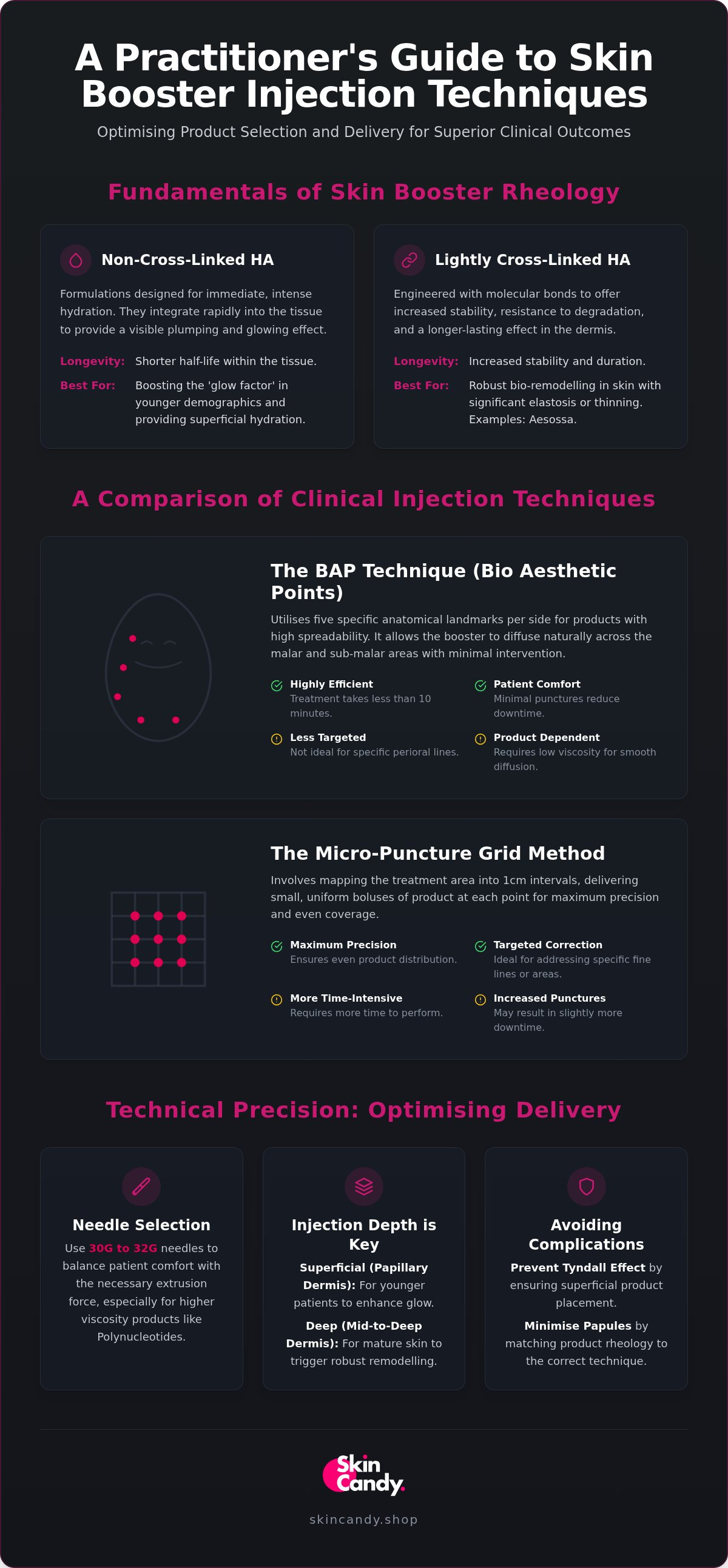
Successful clinical outcomes depend on your ability to match product rheology with the patient's specific anatomical needs. Skin boosters are generally categorised as non-cross-linked Hyaluronic Acid (HA) or lightly cross-linked formulations. Non-cross-linked variants provide immediate, intense hydration but have a shorter half-life within the tissue. Lightly cross-linked options, such as Aesossa or certain Lumifil products, offer increased stability and longevity. Understanding viscosity and flow rate is paramount; these rheological properties determine how the product diffuses through the dermal layers after injection. High-viscosity products require a specific skin booster injection technique for practitioners to ensure they don't create visible lumps or persistent papules in superficial tissue.
The history of intradermal delivery, rooted in the Fundamentals of Mesotherapy, informs how we approach modern bio-remodelling. Your primary objective isn't to add volume, but to improve skin quality and cellular health. For younger demographics, focus on superficial hydration within the papillary dermis to boost the "glow" factor. For older patients with significant elastosis or thinning, target the mid-to-deep dermis to trigger more robust remodelling. Assessing skin thickness and laxity before treatment ensures you select the correct depth for optimal product integration and patient satisfaction.
Skin Boosters vs. Traditional Dermal Fillers
The fundamental difference lies in G-prime, which measures the elastic modulus of a gel. Traditional fillers possess a high G-prime to resist deformation and provide structural lift. In contrast, boosters have a low G-prime, allowing them to flow easily and integrate seamlessly into the surrounding tissue. This requires a shift in your clinical mindset. You'll use lower volumes per injection point but a significantly higher frequency of points across the treatment area. Bio-stimulation triggers fibroblast activity within the extracellular matrix to synthesise new collagen and elastin fibres, resulting in long-term physiological improvement rather than mere mechanical filling.
The Role of Polynucleotides and Exosomes
Regenerative injectables represent a shift from replacement to restoration. Polynucleotides (PN) and exosomes operate through different cellular pathways compared to pure HA boosters. When reviewing polynucleotide indications for aesthetic clinics, practitioners must adjust their delivery to account for the DNA-fraction's higher viscosity. These regenerative products often require 30G to 32G needles to balance patient comfort with the force needed for extrusion. Mastering the skin booster injection technique for practitioners involves recognising that these bioactive substances need precise placement to activate regenerative signals effectively without wasting expensive product.
Comparing Clinical Injection Techniques: BAP, Grid, and Blanching
Selecting the correct skin booster injection technique for practitioners depends entirely on the specific product rheology and the patient's desired outcome. Whilst some patients prioritises immediate results with minimal downtime, others require intensive correction of superficial fine lines. A Clinical Overview of Skin Boosters confirms that technique selection significantly impacts product distribution and safety. You must match the delivery method to the product's spreadability to avoid localised "blobs" or uneven hydration.
The BAP Technique: Efficiency and Diffusion
The Bio Aesthetic Points (BAP) technique utilises five specific anatomical landmarks: the malar protrusion, nasal base, tragus, chin, and mandibular angle. This protocol is designed for high-spreadability Hyaluronic Acid boosters like Aesossa. It allows the product to diffuse naturally across the malar and sub-malar areas without the need for multiple punctures. Treatment time is efficient, often taking less than ten minutes. This makes it an ideal option for high-volume clinics. However, it's less effective for targeting specific perioral lines and requires a product with low enough viscosity to ensure smooth integration into the surrounding tissue.
The Micro-Puncture Grid Method
The grid method involves mapping the treatment area into 1cm intervals for maximum precision. You deliver small, uniform boluses of approximately 0.05ml to 0.1ml into the mid-dermis. This is the gold standard for areas requiring meticulous coverage, such as the forehead or the neck. It's the preferred choice for mesotherapy products wholesale UK users who work with specialised serums like Lumi Meso. Whilst this method takes longer to perform, it ensures total saturation of the treatment area. Results are consistently more uniform, though patients should be prepared for visible papules that may last 24 to 48 hours.
The flat blanching technique targets the most superficial dermal layers to treat fine "etching" lines. You must maintain a shallow 10 to 15 degree angle until a pale wheal appears. This technique requires patience and precise pressure control to avoid the Tyndall effect. When choosing your method, always discuss downtime expectations. The BAP technique offers the lowest downtime, whereas the grid method provides more comprehensive rejuvenation. If you need to restock your clinic for these various protocols, you can browse our professional range here.
Advanced Delivery: Depth, Angles, and Needle Selection
Precision in delivery distinguishes a master injector from a novice. Your choice of hardware and the angle of entry directly influence product integration and patient comfort. Mastering the skin booster injection technique for practitioners requires a deep understanding of how needle gauge impacts both extrusion force and the patient's sensory experience during the procedure.
30G and 32G needles are the industry standard for most skin booster protocols. These ultra-fine gauges minimise tissue trauma and significantly reduce the risk of post-procedural bruising. Whilst 13mm needles offer versatility for deeper work, 4mm needles are often safer for practitioners targeting the superficial dermis. They provide a physical stop against over-penetration, ensuring the product stays exactly where it's intended.
Use a 15 to 30-degree angle for superficial papillary dermis placement. For structural work in the mid-to-deep dermis, a 45-degree angle is usually required. Adopting a verified FDA-Approved Injection Protocol helps maintain this consistency across different facial zones, ensuring uniform hydration levels without the risk of creating unnatural contours.
Always orient the bevel upwards to facilitate smooth entry and better visualisation of the needle tip. Use bolus delivery for standardised points like the BAP method to ensure a concentrated deposit of HA. For larger areas of laxity, retrograde linear threading is often more effective. This involves injecting whilst withdrawing the needle, allowing for a more even distribution of high-viscosity boosters across the treatment area.
The Dual Plane Approach
Mature skin with significant elastosis often requires a layered strategy. The dual plane approach involves placing deeper boluses to provide a structural scaffold, followed by superficial micro-droplets to address surface texture and luminosity. This creates a multidimensional result that addresses both volume loss and dermal thinning simultaneously. To achieve the specific "whitening" effect required for fine lines, maintain an angle of exactly 10 to 15 degrees for the flat blanching technique. This ensures the product remains within the upper dermis without migrating into deeper, less effective planes.
Cannula vs. Needle Delivery
Switching to a 25G or 27G cannula is a superior skin booster injection technique for practitioners when treating large surface areas or high-risk zones. Cannulas significantly reduce the number of entry points, often allowing full-face coverage from just two or three lateral insertions. This "single entry" strategy minimises trauma to the sub-dermal plane and virtually eliminates the risk of intravascular injection in the mid-face. Use a fanning motion to distribute the product evenly, ensuring you stay within the correct dermal plane to avoid visible ridges or product migration.
Troubleshooting Complications and Optimising Patient Aftercare
Even with a refined skin booster injection technique for practitioners, managing post-procedural expectations and potential complications is a clinical necessity. Persistent papules are the most frequent patient concern. Whilst small wheals are expected with the grid technique, they should typically resolve within 24 to 48 hours. If they persist beyond 72 hours, the product was likely placed too superficially for its specific molecular weight. This often occurs when using high-viscosity boosters in the periorbital region where the skin is thinnest.
Preventing the Tyndall effect is entirely dependent on depth control. This bluish hue occurs when Hyaluronic Acid is injected into the upper papillary dermis, causing light to scatter. It's a hallmark of incorrect placement during the blanching technique. Vascular safety remains a priority, even with low-G prime products. Avoid high-pressure injections near the angular artery or supraorbital notch. Maintain a strict aseptic technique throughout the procedure to prevent biofilm formation; this is the primary cause of delayed-onset nodules and chronic inflammation.
Immediate Post-Injection Management
Your post-injection protocol should vary based on the technique used. For the BAP method, a gentle massage helps distribute the product across the anatomical planes. Conversely, avoid massaging areas treated with the blanching technique, as this can displace the product from the intended fine lines. Instruct patients to avoid strenuous exercise, saunas, and excessive heat for at least 48 hours to minimise swelling. If you are combining treatments, such as using the best professional fat dissolving agents UK alongside skin boosters, ensure you leave adequate time between procedures to monitor the inflammatory response effectively.
Identifying and Treating Adverse Reactions
Distinguishing between a normal inflammatory response and true hypersensitivity is crucial for clinic safety. Normal swelling and erythema should subside within three days. Prolonged heat, itching, or worsening pain may indicate an allergic reaction to the HA or the lidocaine component. Whilst rare with boosters, keep hyaluronidase on hand as part of your emergency protocol. For bruising in high-vascularity areas, recommend arnica or topical vitamin K to accelerate resolution. Maintaining a reliable supply of emergency consumables is vital for any professional practice. You can order your clinical essentials and boosters here for next-day delivery.
Procurement Strategy: Selecting Professional Booster Brands
Clinical excellence requires more than just a refined skin booster injection technique for practitioners; it demands the right consumables at the right time. Your choice of product must align with the specific delivery method you've selected for your patient. Using a high-viscosity filler for a superficial blanching technique leads to visible lumps, whilst using a low-viscosity booster for structural work yields negligible results. Precision in procurement is the silent engine of a successful aesthetic practice.
Match your inventory to your treatment menu with technical accuracy. Lumi Meso is the superior choice for the grid and blanching techniques due to its exceptional spreadability and low G-prime. If your clinical objective is structural bio-remodelling or deep dermal hydration, products like Volifil or Aesossa provide the stability required for those deeper planes. Implementing a strategy of just-in-time inventory for aesthetic clinics allows you to maintain high margins without tying up excessive capital in stock. This logistical efficiency ensures your clinic remains agile and responsive to patient demand.
Relying on UK-based distribution is critical for clinical continuity. International shipping delays can disrupt your treatment schedules and damage patient trust. Partnering with a dedicated wholesaler ensures you receive authentic, medical-grade products with the speed required to keep your clinic operational. Wholesale procurement isn't just about cost; it's about the certainty of supply and the reliability of batch consistency.
Spotlight on Lumi Meso and Lumifil
The rheological properties of Lumifil dermal filler UK make it a versatile staple for any professional practitioner. The range offers varying degrees of cross-linking, allowing you to transition seamlessly between structural filling and dermal boosting. Lumi Meso remains a primary choice for practitioners using the blanching technique, as its formulation allows for effortless extrusion through 32G needles. Stocking a diverse range, including Aesossa and Hyaron, ensures you can tailor your skin booster injection technique for practitioners to suit everyone from younger patients seeking a preventative glow to mature clients requiring intensive restoration.
Streamlining Clinic Logistics with Skin Candy
High-volume clinics require a logistical partner that understands the fast-paced nature of the aesthetics industry. Skin Candy provides the infrastructure needed to support your growth. Our next-day delivery service eliminates the need for massive on-site storage, allowing you to order exactly what you need for the coming week's diary. We focus on batch consistency and authorised distribution, giving you peace of mind that every syringe meets professional standards. Streamline your procurement and focus on delivering exceptional clinical results. Register for a professional account at Skin Candy for next-day delivery and ensure your clinic is always prepared for the next appointment.
Elevating Clinical Standards through Technical Precision
Mastering the correct skin booster injection technique for practitioners is a continuous process of refinement and adaptation. You've explored how matching product rheology to specific anatomical planes ensures uniform hydration and long-term bio-remodelling. By differentiating between the rapid diffusion of the BAP method and the meticulous coverage of the micro-puncture grid, you can now offer bespoke treatment plans that meet diverse patient expectations. Precision in depth and angle remains your best defence against complications like persistent papules or the Tyndall effect.
A successful practice relies on the synergy between clinical skill and logistical reliability. As an authorised UK distributor for Lumifil and Volifil, we provide the medical-grade consumables you need to maintain these high standards. Take advantage of our bulk-buy discounts to support your clinic's growth while ensuring you never face a stock shortage. Browse our professional range of skin boosters with next-day UK delivery as standard for aesthetic professionals. We're committed to being the silent engine behind your commercial success. Keep refining your craft and delivering the exceptional results your patients deserve.
Frequently Asked Questions
What is the best needle size for skin booster injections?
The industry standard for most skin booster protocols is a 30G or 32G needle. A 32G gauge is particularly effective for reducing patient discomfort and minimising trauma in the superficial dermis. For practitioners using the blanching technique, a 4mm needle length provides greater control over depth. High-viscosity regenerative products like polynucleotides may require a 30G needle to ensure a consistent flow rate during the procedure.
How deep should I inject skin boosters for the best results?
Your target depth depends entirely on the desired clinical outcome and the product's rheology. For superficial hydration and "glow", target the papillary dermis at a depth of approximately 1mm to 2mm. If your objective is structural bio-remodelling, you must reach the mid-to-deep dermis. Correct depth is a critical component of the skin booster injection technique for practitioners to ensure the Hyaluronic Acid integrates without creating visible surface irregularities.
Can I use the BAP technique for all skin booster brands?
No, the Bio Aesthetic Points (BAP) technique is specifically designed for products with high spreadability and low viscosity, such as Aesossa. Using this method with high-G prime fillers or thick polynucleotides will likely result in localised lumps rather than uniform diffusion. Always review the manufacturer’s rheological data before selecting a protocol. For products that don't spread easily, a micro-puncture grid remains the more reliable choice for achieving even distribution.
How do I avoid the Tyndall effect when injecting superficially?
To prevent the Tyndall effect, ensure the product is placed deep enough to avoid light scattering, which causes a bluish tint. This complication usually occurs when non-cross-linked HA is injected too superficially in areas with thin skin, such as the periocular region. If you are performing the blanching technique, maintain a precise 10 to 15-degree angle. Always avoid over-correcting fine lines, as excessive product volume in the upper dermis increases this risk.
How many injection points are required for a full-face skin booster treatment?
The number of injection points varies significantly based on the chosen protocol. The BAP technique requires exactly ten points, with five specific anatomical landmarks on each side of the lower face. In contrast, a comprehensive micro-puncture grid treatment can involve 30 to 50 individual points spaced at 1cm intervals. The total volume delivered typically ranges from 2ml to 3ml per session, depending on the patient’s skin laxity and the areas being treated.
What is the difference between the Grid and BAP techniques?
The primary difference lies in the mechanism of distribution and treatment time. The BAP technique relies on the product's natural spreadability across five points to cover the malar and sub-malar regions efficiently. The grid technique involves manual placement of micro-boluses across the entire surface area for uniform saturation. Whilst BAP is faster and involves less downtime, the grid method is a superior skin booster injection technique for practitioners treating specific areas like the forehead or neck.
How long should skin booster papules last after a session?
Visible papules or wheals are a normal post-procedural response, particularly following the micro-puncture grid technique. These typically resolve within 24 to 48 hours as the product integrates into the dermal tissue. If papules persist beyond 72 hours, it may indicate that the product was placed too superficially or that the volume per bolus was too high. Advise patients to stay hydrated and avoid excessive heat to facilitate a faster resolution of these temporary marks.
Can I combine skin boosters with dermal fillers in the same appointment?
Yes, you can combine these treatments in a single session to achieve a "liquid facelift" effect. Practitioners often use dermal fillers like Volifil for deep structural support and follow with skin boosters for superficial texture improvement. This dual-plane approach addresses both volume loss and dermal thinning simultaneously. However, you must monitor the total volume of Hyaluronic Acid injected to manage the inflammatory response and ensure the patient's lymphatic system can process the products effectively.