
Facial Contouring Fillers for UK Clinic Wholesale Buyers
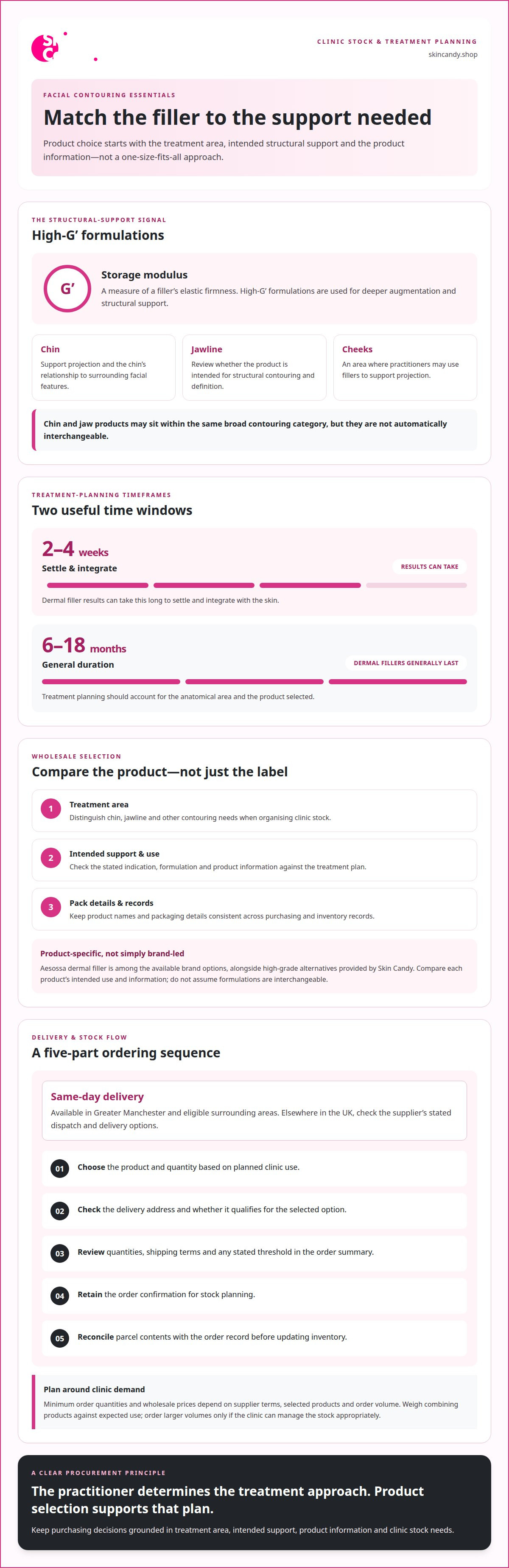
The right contour starts with structural support, not a one-size-fits-all filler. Facial contouring uses high-G’ formulations to augment the chin, jawline and cheek projection; G’ is the storage modulus, a measure of a filler’s elastic firmness. For UK clinics sourcing facial contouring filler wholesale, this distinction helps guide product selection by treatment area and intended support.
It’s understandable to focus first on which filler suits a defined chin or sharper jawline. Reliable procurement also depends on supplier confidence, product authenticity and delivery that fits clinic operations. These checks matter just as much as the product category.
This guide explains facial contouring, outlines factors to consider when selecting chin and jaw fillers, and sets out practical checks for product authenticity, documentation and delivery on arrival. Use it to plan stock and understand how wholesale supply can support your clinic’s ordering needs.
Key Takeaways
- Match hyaluronic acid filler selection to the treatment area and the structural support the practitioner intends to achieve.
- Compare chin and jaw filler options by their intended use and product information, rather than treating all formulations as interchangeable.
- Build delivery planning around clinic location, order timing and any shipping thresholds that affect restocking.
- Use a consistent receiving process to review supplier credentials, product documentation and authenticity details before stock enters inventory.
How Does Facial Contouring Work?
Hyaluronic acid dermal fillers add volume beneath the skin to refine facial contours. Practitioners use them to support projection in areas such as the chin, jawline and cheeks. Product choice depends on the treatment area and the structural support required.
High-G’ formulations are used for deeper augmentation and structural support. G’ means storage modulus, a measure of a filler’s elastic firmness. A firmer formulation may suit a different contouring goal from one intended for softer tissue integration.
Professional dermal filler selection should be product-specific, not simply brand-led. Aesossa dermal filler is among the available brand options, alongside high-grade alternatives provided by Skin Candy. Compare each product’s intended use and information with the treatment plan; don’t assume formulations are interchangeable.
Allow time for the treated area to settle. Dermal filler results can take two to four weeks to settle and integrate with the skin, and dermal fillers generally last between 6 and 18 months. Treatment planning should account for the anatomical area and the product selected.
Hyaluronic acid fillers are not automatically prescription-only medicines in the UK. Classification depends on the specific product, not the ingredient alone. For clinic procurement, distinguish the product’s regulatory classification from the practitioner’s authority to administer it.
UK requirements for advertising, importing and supplying dermal fillers depend on product classification and the supply route. When organising promotion and procurement, clinics should consider applicable medical-device requirements and advertising standards.
Risks include local reactions and potentially serious complications. Management starts with prompt clinical assessment and an established complications protocol; purchasing decisions should not replace clinical preparedness. For facial contouring, match the filler to the treatment area, intended support and product information.
Chin and jaw contouring products
Chin and jawline augmentation calls for product selection based on the treatment area and desired structural support. High-G’ fillers are used to provide support in both areas.
Jawline Contouring Products
For jawline augmentation, assess whether the product is intended for structural contouring and review its product information. High-G’ formulations are used to support jawline definition. Let the treatment plan guide the choice, including the area and contour sought. When buying wholesale, compare product documentation and formulation details rather than assuming products with similar labels are interchangeable.
Chin Augmentation Products
Chin augmentation focuses on adding projection or improving the chin’s relationship to surrounding facial features. High-G’ fillers are used to provide structural support in this area. Selection should follow the practitioner’s assessment and intended aesthetic result. For stock planning, distinguish chin products from general dermal filler inventory and consult each product’s instructions for its stated purpose.
Chin and jaw products may fall under the broad contouring category, but they are not automatically interchangeable. Organise the clinic’s range by treatment area, intended support and the information supplied with each formulation. This makes it easier to compare options for different augmentation plans.
Before ordering, compare each filler’s stated indication, formulation and pack details. Record the product against its intended clinic use so staff can identify the correct stock during preparation. Keep product names and packaging details consistent across purchasing and inventory records.
Injection planning remains a clinical decision, not a wholesale purchasing shortcut. The practitioner determines the treatment approach; product selection supports that plan. For procurement, explore professional dermal filler options and compare the details relevant to your clinic’s chin and jaw requirements.
Delivery options and shipping thresholds
Delivery planning affects stock availability, treatment scheduling and clinic purchasing decisions. Same-day delivery is available in Greater Manchester and eligible surrounding areas. For clinics elsewhere in the UK, build orders around the supplier’s stated dispatch and delivery options, rather than assuming every destination follows the same schedule.
Minimum order quantities and wholesale prices depend on the supplier’s terms, selected products and order volume. Compare the order with clinic demand: a larger quantity may affect the price structure, while a mixed basket may suit a different stock plan. When the decision is about logistics, focus on order size, delivery and stock needs, not claims about volume, definition or wrinkles.
Use a consistent ordering sequence to reduce avoidable delays:
- Choose the product and quantity based on planned clinic use.
- Enter the delivery address and check whether the destination qualifies for the selected delivery option.
- Review the order summary, including product quantities, shipping terms and any stated threshold.
- Submit the order and retain its confirmation for stock planning.
- On arrival, compare the parcel contents with the order record before updating inventory.
Shipping thresholds can affect how clinics consolidate purchases. Weigh the cost and practicality of combining products against when they are expected to be used. Ordering a larger volume to meet a threshold makes sense only if the clinic can manage the stock appropriately. Base the order on actual demand, not an assumed saving.
Align delivery timing with stock requirements and planned treatments. A defined ordering process helps staff track what was requested, where it is going and what to check on receipt. This makes wholesale purchasing easier to coordinate without confusing delivery planning with decisions about treatment or aesthetic outcomes.
Wholesale supplier credentials and product authenticity
Start with the supplier’s legal business identity and a clear product trail. For each filler, match the product name on the order, invoice and packaging. Review the supplied instructions, expiry information and batch identifier before adding stock to clinic inventory. These checks can flag mismatches, but they do not establish clinical suitability.
Qualifications and registration requirements depend on the product, practitioner role and applicable UK rules. Separate permission to purchase from professional authority to administer: a wholesale account alone doesn’t demonstrate that a practitioner is qualified for treatment. Clinics should align their procedures with the product’s classification and the requirements applying to their UK location.
Check authenticity systematically when a delivery arrives:
- Compare the product name and pack details with the order record.
- Inspect the packaging for damage, tampering or inconsistencies.
- Match batch and expiry details against the accompanying documentation.
- Record the supplier, delivery date and product details in inventory.
Keep the paperwork together. A traceable record helps staff connect a product to its supplier and delivery if questions arise. For example, an invoice and batch detail filed against the same inventory entry are easier to review than separate, unlabelled documents.
Training, insurance support and returns are separate supplier or professional terms, not automatic parts of wholesale purchasing. Read the supplier’s written terms for order issues, and maintain appropriate clinical competence and insurance arrangements independently. Don’t confuse products used for facial contouring with surgical services; fine lines and ageing concerns also require distinct product selection and treatment planning.
Use these checks to make supplier review part of routine procurement, not an afterthought. Compare product records and purchasing terms before placing an order, then retain the documents with the stock record. Review professional filler supply as part of your clinic’s sourcing process.
Skin Candy: Lumi Meso
Skin Candy supplies Lumi Meso for clinics sourcing professional aesthetic products. Consider it when your purchasing plan includes this product alongside contouring filler stock. Skin Candy also supplies polynucleotides, fat dissolving agents and chemical peels, allowing clinics to source these product categories from the same wholesale supplier.
Link each product category to its intended clinical use and stock plan. Lumi Meso is a separate purchasing choice from chin and jawline fillers, so assess it against your clinic’s product requirements rather than treating it as a contouring substitute. This keeps purchasing decisions clear across treatment categories.
For your next stock order, visit skincandy.shop.
Make your next sourcing decision with confidence
Turn your product research into a purchasing process that fits your clinic’s treatment plans and stock requirements. A clear facial contouring filler wholesale approach keeps product selection, supplier records and ordering decisions aligned, without treating every filler as suitable for every use.
Skin Candy supplies Lumifil Dermal Fillers, Lumi Meso and polynucleotides for professional clinic use. Consider which products fit your planned requirements, then place your next order accordingly.
Contact Skin Candy about wholesale to discuss your clinic’s purchasing needs. Take the next step at a pace that works for your business, with a clearer plan for sourcing ahead.
Frequently Asked Questions
What facial contouring dermal fillers are available wholesale in the UK?
UK wholesale options include hyaluronic acid fillers intended for structural contouring, with product choice guided by the treatment area and formulation. Available brand ranges include Lumifil, Regenovue, Aesossa, Teofil and Volifil. For example, LUMIFIL Max is described for deep tissue augmentation, including the chin and jawline. Compare each product’s intended use and instructions rather than relying on its brand name alone.
Which UK suppliers sell facial contouring filler wholesale to clinics and practitioners?
Skin Candy supplies dermal fillers to UK clinics and practitioners, including Lumifil, Regenovue and Aesossa options. For facial contouring filler wholesale, begin by matching the range to your clinic’s stock requirements. Review the product details and ordering information for the specific variant you need. Since a range can include different formulations, compare product-level information before selecting stock.
How can clinics verify that wholesale facial fillers are genuine, UK-compliant and safely stored?
Use a documented receiving process: compare the delivery with its invoice, record batch and expiry details, and retain the product instructions and conformity information. Check that packaging is intact and that details match across the pack and paperwork. Follow the storage conditions in the product’s instructions. If a pack is damaged or records conflict, segregate it from usable stock and document the discrepancy before deciding what to do next.
How do popular facial contouring filler brands compare by ingredients, longevity and price?
Compare named variants, not brands alone. LUMIFIL KISS with Lidocaine contains cross-linked hyaluronic acid and lidocaine; results typically last 9-12 months. LUMIFIL Max is a high-viscosity hyaluronic acid filler for deep tissue augmentation; results last approx. 9-15 months. For other ranges, assess each product’s own details.
What are the minimum order quantities and wholesale prices for facial contouring fillers in the UK?
Minimum order quantities depend on the supplier’s terms, products and order volume.