Exosomes vs Stem Cells in Aesthetics: The 2026 UK Practitioner’s Procurement Guide
The most expensive cell in your clinic isn't always the most effective. Understanding the technical debate of exosomes vs stem cells aesthetics is no longer optional for UK practitioners looking to lead the regenerative market in 2026. You're likely balancing the growing demand for cellular rejuvenation with the headache of strict MHRA regulations and the logistical nightmare of short-lived consumables that eat into your margins.
This procurement guide will help you master the technical distinctions between these two powerhouses so you can refine your treatment portfolio with confidence. We'll examine the legalities of topical application, the science behind a 700% increase in collagen production, and how to secure a reliable UK supply chain for just-in-time delivery. You'll gain the precise language needed to explain higher price points to patients whilst ensuring your clinic remains compliant and profitable. We've built this framework to help you move from procurement confusion to clinical excellence without the typical downtime associated with traditional stem cell therapies.
Key Takeaways
- Understand why the acellular revolution prioritises precise paracrine signalling over traditional live cell replacement for faster, more predictable results.
- Master the technical distinctions of exosomes vs stem cells aesthetics to choose between human-derived messengers and stable plant-based alternatives.
- Navigate the 2026 UK regulatory landscape to ensure your clinic remains compliant whilst using high-purity, topical regenerative products.
- Learn how to integrate exosomes into your existing microneedling and laser protocols to significantly reduce patient downtime.
- Optimise your clinic’s inventory with just-in-time procurement strategies and next-day delivery from a trusted UK wholesale partner.
The Evolution of Regenerative Aesthetics: From Stem Cells to Exosome Therapy
Regenerative medicine has transitioned from laboratory theory to high-street reality. In 2026, the UK aesthetic market is witnessing a definitive move toward biostimulation as patients move away from the overfilled look. They want skin that behaves younger, not just skin that looks fuller. This demand has placed the debate of exosomes vs stem cells aesthetics at the centre of clinical procurement. Practitioners are now prioritising products that offer cellular communication over simple volume replacement.
To understand this evolution, we must ask: What are exosomes? These extracellular vesicles (EVs) act as the body's internal postal system. They facilitate paracrine signalling, which is the process of cells communicating with their neighbours to trigger repair. While stem cells were once the gold standard for regeneration, the modern preference has shifted toward these acellular messengers. 2026 marks the tipping point where exosome adoption has become the standard for clinics seeking high-performance results with lower risk profiles.
Understanding the Acellular Shift
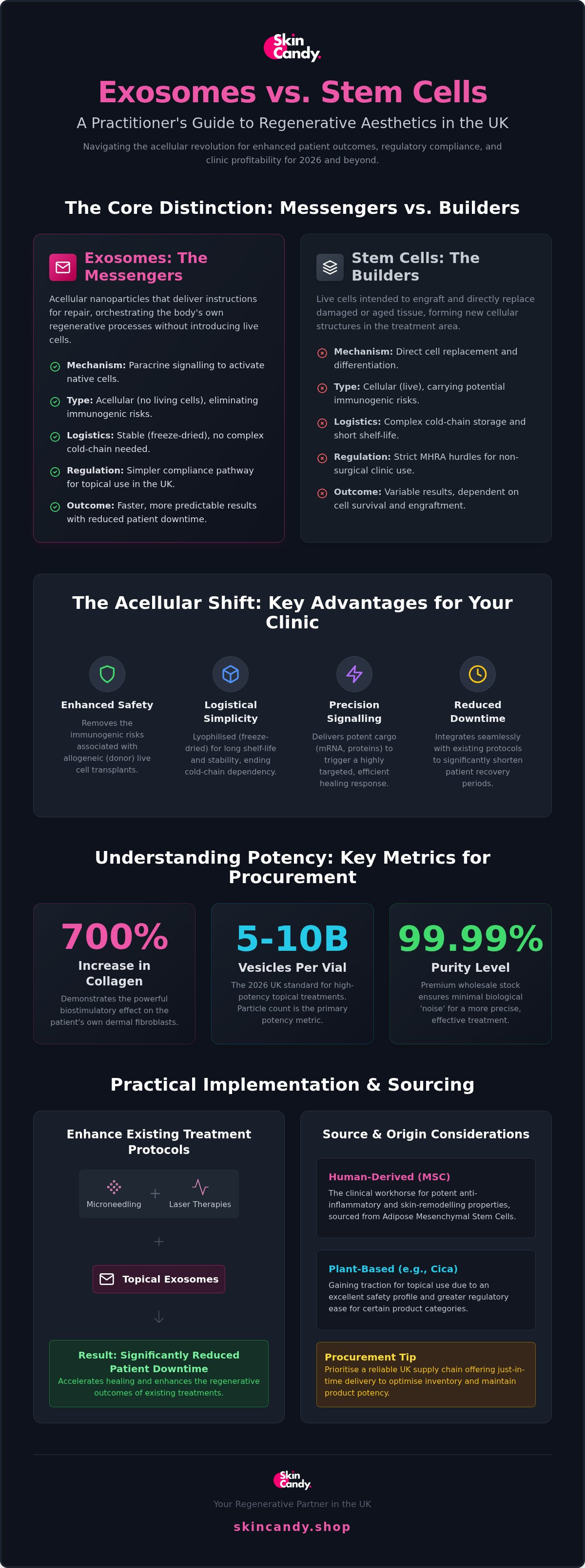
Acellular therapy represents a major leap in patient safety and logistical efficiency. By removing the living cell itself, you eliminate the primary immunogenic risks associated with cellular transplants. Exosomes are nano-sized signal carriers that orchestrate tissue repair without the need for cell engraftment. They carry a potent cargo of mRNA, miRNAs, and proteins directly to target cells. This allows for a precision-engineered healing response that living cells often struggle to maintain in a clinical environment. For the practitioner, this means a more stable product with a longer shelf-life and fewer adverse reactions.
Stem Cells: The Cellular Ancestors
Mesenchymal stem cells (MSCs) paved the way for every regenerative breakthrough we see today. They were the original builders of the tissue engineering world. However, their use in daily aesthetic practice remains limited by several factors. Live cells require complex cold-chain storage and face rigorous UK regulatory hurdles that make them impractical for most non-surgical clinics. Choosing between exosomes vs stem cells aesthetics often comes down to this practical reality. Exosomes provide the benefits of MSC signalling without the operational baggage of keeping a living culture alive. If you are comparing these to other regenerative options, you should also read our Exosomes vs Polynucleotides: 2026 Procurement Guide to see how they fit into a wider treatment portfolio.
Technical Breakdown: Comparing Functional Mechanisms and Origins
The core of the debate regarding exosomes vs stem cells aesthetics lies in the 'Builder vs Messenger' dynamic. Stem cells act as the builders; they are live units intended to replace damaged tissue. In contrast, exosomes are the messengers. They don't replace cells but instead deliver the precise instructions required for the body to repair itself. This signalling approach is often more effective in aesthetic settings. It bypasses the complexities of ensuring foreign cell survival and focuses entirely on activating the patient's endogenous regenerative capacity. It's a more efficient way to trigger dermal remodeling without the biological 'noise' of live cell transplantation.
Origin matters. Most high-performance exosomes are derived from Human Adipose Mesenchymal Stem Cells (MSCs), known for their potent anti-inflammatory and skin-remodelling properties. However, plant-based alternatives like Cica (Centella Asiatica) are gaining traction for topical applications due to their excellent safety profile and regulatory ease. When choosing a product, particle count is your primary metric of potency. 2026 standards typically range from 5 billion to 10 billion vesicles per vial. Purity is equally critical; premium wholesale stock now achieves 99.99% purity levels. To maintain this potency during transit, lyophilisation (freeze-drying) is essential. This process ensures that the delicate vesicles remain stable without the need for extreme cryogenic storage, making them a practical choice for busy UK clinics. You can browse our stabilised regenerative range to see these technical standards in practice.
MSC-Derived vs. iPSC-Derived Exosomes
Mesenchymal Stem Cell (MSC) exosomes are the current clinical workhorse for skin rejuvenation. They excel at stimulating fibroblast activity and increasing collagen production. Emerging Induced Pluripotent Stem Cell (iPSC) exosomes offer even greater proliferative potential, often marketed for advanced anti-ageing in older demographics. Whilst the UK Regulatory Landscape for Exosome Therapies requires practitioners to stay informed on classification, MSC-derived options remain the most accessible and proven choice for general dermal repair. Choose MSCs for standard rejuvenation and iPSCs for clinics specialising in intensive geriatric aesthetics.
The Role of PDRN and Hyaluronic Acid
Modern exosome 'cocktails' rarely contain just vesicles. Many formulations include PDRN (Polydeoxyribonucleotide) to provide a synergistic boost to DNA repair and cellular metabolism. Using Hyaluronic Acid (HA) as a carrier improves the immediate 'glow' and hydration levels, giving patients the instant gratification they expect whilst the exosomes work on long-term structural repair. This synergy is a key reason why understanding polynucleotide indications for aesthetic clinics is essential for any practitioner building a modern regenerative menu. Combining these technologies allows you to address both surface-level texture and deep-seated cellular health in a single session.
Exosomes vs Stem Cells: Safety, ROI, and UK Regulation
The safety profile of exosomes vs stem cells aesthetics is a primary driver for the current market shift. Live stem cells pose inherent risks; they can differentiate in uncontrolled ways or trigger an immune rejection if not perfectly matched to the host. Exosomes are acellular. They don't contain a nucleus and cannot replicate. This biological stability eliminates the risk of tumourigenesis or graft-versus-host responses. In the UK, the regulatory framework is precise. The MHRA classifies injected human-derived exosomes as medicinal products, making their use in standard aesthetic clinics unlawful. However, plant-derived and bio-identical exosomes are fully compliant for topical use, providing a safe, legal pathway for non-surgical practitioners to deliver regenerative results.
Logistically, exosomes outperform cellular therapies on every metric. Stem cells require cryogenic storage at temperatures as low as -150°C. This necessitates specialised equipment and carries a high risk of thaw failure, which can render an expensive treatment useless. Exosomes are typically lyophilised. They remain stable at room temperature or in standard refrigeration. This stability allows for a just-in-time procurement model. You don't need to hold thousands of pounds in fragile, live inventory. You order what you need for the week ahead, knowing the product will arrive ready for immediate use.
The Safety Advantage of Acellular Therapy
Exosomes offer a significant safety advantage because of their low immunogenicity. They lack the Major Histocompatibility Complex (MHC) proteins that usually trigger an immune attack. This means you can use them across a diverse patient base without fear of allergic reactions. Sourcing is the only variable. You must ensure your supply comes from a reputable aesthetic clinic procurement UK partner. Using grey-market products with unverified particle counts or purity levels introduces unnecessary clinical risk to your practice and your patients.
ROI and Clinic Profitability
Introducing exosomes is one of the fastest ways to increase your average patient spend. They are a high-value add-on for microneedling, RF, and laser treatments. Industry data suggests exosome sessions in the UK range from £195 to £580, representing a significant margin over the base treatment cost. Beyond the initial sale, the real ROI comes from reduced downtime. Exosomes can reduce post-procedure erythema and inflammation rapidly. This leads to higher patient satisfaction scores and more frequent re-bookings. When patients see significant increases in collagen production with minimal recovery time, your clinic's reputation for results becomes your strongest marketing tool.
Practical Implementation: Integrating Exosomes into Your Treatment Menu
Successful implementation of regenerative vesicles depends entirely on your delivery method. Unlike autologous stem cell treatments that often involve surgical extraction, the commercial appeal of exosomes vs stem cells aesthetics lies in their ease of topical application. Because exosomes are acellular, they cannot be injected under current UK cosmetic regulations. Instead, they require 'channel-opening' techniques to bypass the stratum corneum. Creating these pathways ensures the nano-sized vesicles reach the target fibroblasts in the dermis to trigger repair. This makes them the perfect partner for devices already sitting in your clinic, such as microneedling pens and Radiofrequency (RF) platforms.
Post-laser application is another high-growth area for UK practitioners in 2026. Ablative and non-ablative lasers generate controlled heat, which often leads to prolonged erythema and patient discomfort. Applying a high-purity exosome solution immediately after a laser session can mitigate this heat-related inflammation rapidly. Beyond facial rejuvenation, hair restoration has emerged as a dominant trend. Clinics are using exosomes to revitalise dormant follicles, often seeing a visible improvement in hair density over a six-month course. A standard 'Regenerative Skin Programme' typically follows a three-session arc, spaced four weeks apart, to align with the natural cellular turnover cycle.
Microneedling and RF Synergy
Micro-channels are the gold standard for exosome penetration. For practitioners, needle depth is the primary variable. Use a 0.5mm depth for general skin brightening and 'glow' protocols. Increase this to 1.5mm when treating acne scarring or deep structural rejuvenation. This mechanical trauma, combined with professional exosome applications, creates a synergistic effect that far outperforms standalone microneedling. The trauma triggers the wound-healing response, whilst the exosomes provide the precise instructions needed to optimise that healing. Order your regenerative consumables today to start building these high-margin combination protocols.
Post-Treatment Aftercare and Recovery
The clinical experience doesn't end when the device is switched off. Applying an exosome-infused mask immediately post-procedure provides an instant cooling effect and begins the signalling process whilst the channels are still patent. Educate your patients on the difference between 'cellular healing' and 'filling'. Whilst dermal fillers provide instant volume, exosomes work on long-term structural integrity. You can also package these vesicles with chemical peels for your clinic to address surface pigmentation whilst simultaneously repairing the deeper dermal layers. This total skin rejuvenation approach justifies a premium price point and secures superior patient outcomes.
Sourcing and Logistics: Why Skin Candy is Your Regenerative Partner
The technical debate of exosomes vs stem cells aesthetics often overlooks the most critical factor for a busy clinic: reliable procurement. Sourcing regenerative products from international 'grey market' suppliers is a high-risk strategy. Shipping delays can disrupt your treatment schedule, and products often lack the necessary documentation required for UK compliance. Skin Candy eliminates these variables. We act as your dedicated logistics partner, ensuring your clinic has access to high-purity, medical-grade consumables without the logistical headaches of international trade.
Efficiency is the backbone of a profitable practice. By consolidating your orders, you can manage your entire regenerative and injectable portfolio through a single portal. Whether you need exosomes, polynucleotides, or fillers, receiving them in one shipment reduces administrative overhead and simplifies your inventory tracking. We don't just supply products; we act as a technical resource for practitioners. Our team understands the high-pressure environment of aesthetic clinics and the absolute necessity of a dependable supply chain that supports clinical excellence.
The Power of Next-Day Delivery
Rapid fulfilment is essential for maintaining a just-in-time inventory model. You don't need to tie up significant capital in stock that sits on a shelf. Our UK-wide shipping network ensures next-day delivery for all orders, allowing you to respond to patient demand as it happens. This reliability is particularly vital for time-sensitive regenerative products where stability is key. Our logistical expertise matches the quality of our portfolio, which you can explore further on our website.
Professional-Only Support and Pricing
Skin Candy operates exclusively for verified, trained aesthetic professionals. This B2B focus ensures that the latest 2026 regenerative brands remain in the hands of those qualified to use them. By stocking cutting-edge technologies like high-particle count exosomes, you gain a clear competitive edge in a crowded market. Our pricing structure is designed to support your clinic's growth whilst maintaining the highest professional standards. Register for a professional account and browse our exosome range today.
Future-Proofing Your Regenerative Portfolio
The transition to acellular technology is the defining shift of the 2026 aesthetic market. By mastering the nuances of exosomes vs stem cells aesthetics, you position your clinic at the forefront of cellular skin health. You've seen how the 'messenger' dynamic of vesicles provides a safer, more predictable alternative to the 'builder' role of live cells. These acellular solutions don't just improve patient results; they protect your margins through easier storage and significantly reduced downtime across your treatment menu.
Successful integration relies on a reliable supply chain that respects your time and your clinical standards. As a specialist UK B2B wholesaler, Skin Candy provides a curated range of 2026 regenerative brands with next-day delivery as standard. This allows you to maintain a lean, just-in-time inventory whilst offering the most advanced biostimulation treatments available. We're here to ensure your procurement is as precise as your clinical work.
Secure Your Clinic's Exosome Supplies with Next-Day UK Delivery
It's time to lead the regenerative revolution in your local market with confidence and clinical excellence.
Frequently Asked Questions
Are exosomes legal for use in UK aesthetic clinics in 2026?
Yes, but their legal application depends on the delivery method and origin. Human-derived exosomes are classified as medicinal products by the MHRA when injected, making their use in standard aesthetic procedures unlawful. However, topical application of plant-derived or bio-identical exosomes is fully compliant with UK cosmetic regulations, provided they are used following professional skin-breaking treatments like microneedling.
How do I explain the difference between exosomes and stem cells to my patients?
Use the "Builder vs Messenger" analogy to simplify the technical debate of exosomes vs stem cells aesthetics. Explain that stem cells act as the builders trying to repair tissue, whilst exosomes are the messengers carrying the blueprints. Exosomes don't try to do the work themselves; they deliver precise instructions to the patient's own cells to trigger a natural, high-speed healing response.
Do exosomes require cold-chain shipping or special storage?
Most high-performance exosomes in 2026 are lyophilised, meaning they are freeze-dried into a stable powder. This eliminates the need for the cryogenic storage required for live stem cells. You can store these vials in a standard medical refrigerator or even at room temperature depending on the brand's specific instructions, which simplifies your clinic's logistics and reduces the risk of product failure.
Can exosomes be used as a standalone injectable treatment?
No. Injecting exosomes for cosmetic purposes is currently a major regulatory red flag in the UK. They must be delivered topically through micro-channels created by devices such as microneedling pens, Radiofrequency (RF) platforms, or lasers. This "channel-opening" requirement ensures the vesicles reach the dermis safely and legally whilst staying within the scope of non-surgical aesthetic practice.
What is the typical downtime for a patient after an exosome-enhanced microneedling session?
Downtime is significantly reduced compared to standalone treatments. Most patients report that post-procedure redness and heat resolve within 12 to 24 hours, whereas traditional microneedling can leave the skin erythematous for several days. The rapid signalling provided by the vesicles accelerates the inflammatory phase of wound healing, allowing patients to return to their normal routine much faster.
How many sessions of exosome therapy are required to see significant results?
A standard regenerative programme typically consists of three to five sessions spaced four weeks apart. Whilst some patients notice an immediate "glow" due to the hyaluronic acid carriers, the structural improvements in skin density and collagen production manifest over three to six months. This timeline aligns with the natural cellular turnover and dermal remodelling process.
What is the difference between human-derived and plant-derived exosomes?
Human-derived exosomes are usually harvested from Mesenchymal Stem Cells (MSCs) and offer potent signalling for skin repair. Plant-derived exosomes, often sourced from Centella Asiatica (Cica), are excellent for reducing inflammation and are often easier to navigate from a UK regulatory standpoint. Both types provide high-purity signalling, but MSC-derived options are generally preferred for intensive anti-ageing protocols.
Why should I buy exosomes from a UK wholesaler like Skin Candy instead of importing them?
Sourcing locally ensures product stability and legal compliance. Importing from international "grey market" suppliers often leads to customs delays, shipping damage, and a lack of verified CE marking. Skin Candy provides next-day delivery across the UK, allowing you to maintain a just-in-time inventory model without tying up capital in expensive, fragile stock that might not meet UK safety standards.