
Exosome therapy protocols for clinics and session planning
There is no fixed session count for exosome therapy: treatment plans depend on the product, intended use and delivery method. Developing exosome therapy protocols for clinics means considering potential skin or tissue effects alongside the evidence, product quality and UK rules on professional scope. For most indications, exosome therapy remains investigational.
It’s understandable to want a clear session number before considering treatment. But a schedule only makes sense when the intended outcome, application method and supporting evidence are considered together. Exosomes are cell-derived vesicles that carry signalling molecules. They are not stem cells, and proposed regenerative effects should not be mistaken for established clinical benefits.
This guide covers what exosome treatment involves, the potential benefits and risks under discussion, and why protocols need to account for UK regulation and practitioner scope. It also explains how clinics can approach session planning without assuming one timetable suits every product or indication. The focus is practical: understand the rationale, recognise the limits of the evidence and keep clinical governance in view.
Key Takeaways
- Plan sessions around the treatment goal, product and method of application rather than relying on a single timetable.
- Understand how exosomes may influence cell signalling, while distinguishing promising biological mechanisms from proven treatment outcomes.
- Factor UK regulation, product quality and professional scope into clinical decisions before considering an exosome intervention.
- Explore Skin Candy’s exosomes as a wholesale product option when sourcing professional aesthetic consumables for your clinic.
What is Exosome treatment?
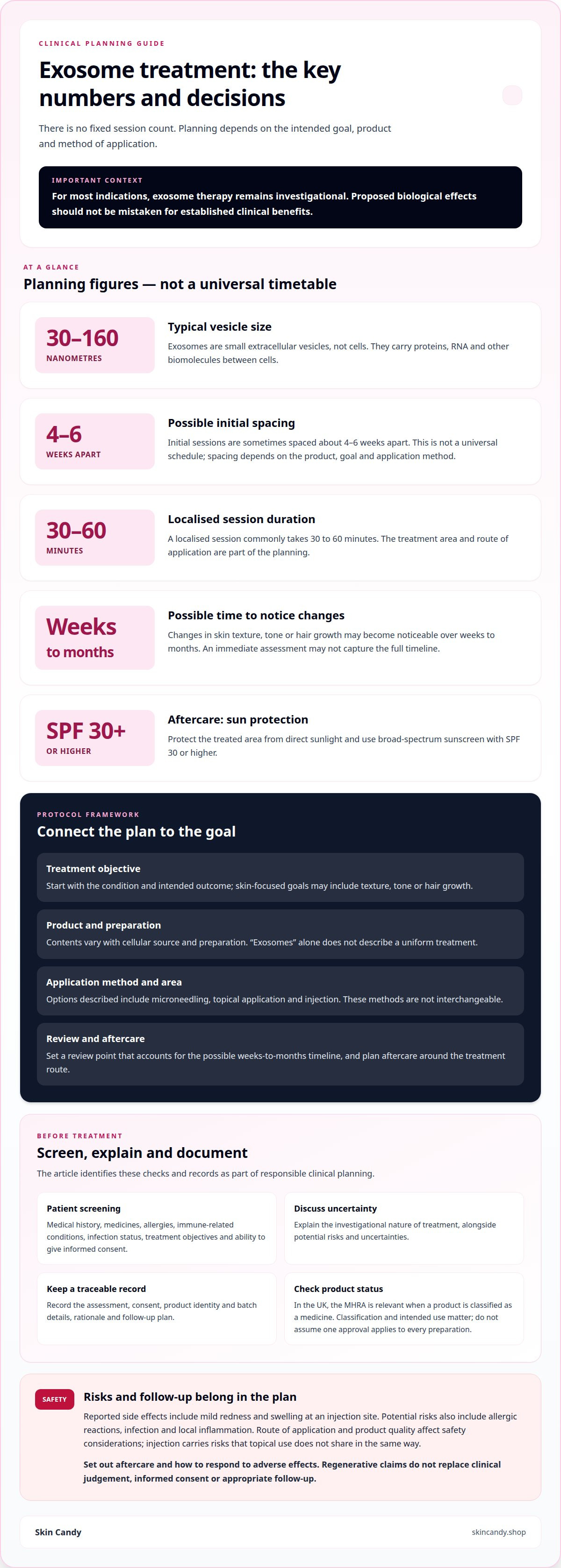
Exosomes are small extracellular vesicles, not cells. Typically 30-160 nm in size, they carry proteins, RNA and other biomolecules between cells. This cell communication may influence how nearby cells respond, including processes associated with repair. Their contents vary with their cellular source and how they are prepared, so the term “exosomes” alone doesn’t describe a uniform treatment.
Plan around the condition and the intended goal, then consider the application method. For a skin-focused objective, treatment may involve microneedling or topical application; injection is another route, depending on the area and product. These methods aren’t interchangeable. A clinic’s protocol needs to connect the selected product, treatment area and intended outcome, rather than assume one approach suits every concern. Initial sessions are sometimes spaced about 4-6 weeks apart, but that interval isn’t a universal schedule.
Session planning also means setting a review point. Changes in skin texture, tone or hair growth may become noticeable within weeks to months, so an immediate assessment won’t capture the full timeline. A localised session commonly takes 30 to 60 minutes. Before proceeding, a specialist should consider the treatment objective and relevant health information. Patients can look for a practitioner registered with a recognised medical body, such as the General Medical Council (GMC).
After treatment, protect the area from direct sunlight and use broad-spectrum sunscreen with SPF 30 or higher. This is a practical part of aftercare planning, especially when the treated area is exposed outdoors. The treatment route, session spacing, review timing and aftercare should all fit the same goal. That gives the clinic a clear framework for discussing what the intervention involves and tracking changes over time, without presenting one session count as suitable for every patient.
Potential anti-inflammatory and regenerative effects
Exosomes may affect inflammation and tissue responses by carrying bioactive molecules between cells. Stem cells can signal through a paracrine mechanism, releasing a secretome that includes exosomes. In laboratory settings, these vesicles can influence how other cells behave. That mechanism helps explain interest in regenerative medicine, but laboratory effects don’t establish that a treatment will produce the same result in people.
Potential applications vary with the source cell and the vesicles’ molecular cargo. Osteoblast-derived exosomes, for example, can deliver growth factors and signalling molecules to nearby cells involved in bone regeneration. Oligodendrocyte-derived exosomes have been studied for their role in supporting axon regeneration. Other exosomes may modulate inflammation through molecules such as prostaglandin E2. These examples describe biological activity, not a standard clinical indication or a proven outcome for every product.
In aesthetic use, proposed benefits include improvements in skin texture and tone, as well as possible effects on hair growth. Changes may become noticeable over weeks to months, depending on the treatment objective and the preparation’s biological activity. Research into extracellular vesicles for skin renewal, tissue repair and inflammation remains at an early stage. Clinics should distinguish promising science from established clinical evidence.
Safety planning matters too. Reported side effects include mild redness and swelling at an injection site; potential risks also include allergic reactions, infection and local inflammation. The route of application and product quality affect safety considerations. Injection carries risks that topical use does not share in the same way. A clinic’s protocol should set out aftercare and how to respond to adverse effects. Regenerative claims do not remove the need for careful clinical judgement, informed consent and appropriate follow-up.
Regulatory status and professional scope of practice
In the UK, the Medicines and Healthcare products Regulatory Agency (MHRA) is relevant when a product is classified as a medicine. Classification and intended use matter, and no single approval should be assumed for every exosome preparation. Exosome therapy protocols for clinics should therefore make the product’s regulatory position part of the decision to use it.
Regulatory Status and Approval Processes
Regulatory status describes a product’s classification and the requirements that apply to its intended use. A preparation labelled “exosomes” is not, on that basis alone, proof of approval or adequate characterisation. The MHRA’s role depends on the product’s classification. Preparations can differ in source, isolation and testing, so a decision about one product cannot automatically be applied to another.
Investigational Status and Limitations
Exosome therapy remains investigational for most indications, and human studies vary in their manufacturing methods and design. This limits firm conclusions about therapeutic safety and effectiveness. Standardisation is still developing, so findings from one preparation cannot automatically be applied to another. A study of one defined product, for example, does not establish the biological effects of every preparation marketed as containing exosomes.
Screening, Consent and Documentation
Screen patients for medical history, medicines, allergies, immune-related conditions, infection status, treatment objectives and ability to give informed consent. Before administration, explain the investigational nature of the treatment and its potential risks and uncertainties. Record the assessment, consent, product identity and batch details, rationale and follow-up plan. These records make the clinical decision and product used traceable if questions arise later.
Staff Training and Professional Scope
Training can support understanding of scientific foundations and safety, but completing a course does not itself authorise a professional to purchase, prescribe or administer a product. Practitioners must work within their professional scope. GMC registration identifies a recognised medical body, but does not by itself establish competence for every intervention. Effective exosome therapy protocols for clinics should define staff responsibilities, escalation routes and adverse-event records.
Benefits of exosome therapy
The main proposed benefit is targeted cell signalling. Exosomes carry molecules that may influence cellular activity, including processes associated with collagen formation and tissue repair. Unlike stem cell treatments, exosome preparations contain vesicles rather than intact cells. This cell-free approach is scientifically interesting, but it does not establish equivalent effects or mean every product is suitable for the same purpose.
Some reports on facial rejuvenation describe collagen levels in treated skin increasing by up to six-fold, and elastin levels by up to 300%. These figures are reported outcomes, not a guarantee for an individual or every preparation. They also need context: exosomes differ by source, isolation and characterisation. A result linked with one product or study can’t be assumed for another.
Potential benefits under investigation include supporting skin quality and tissue responses through molecules carried by vesicles. Researchers have also explored stem cell-derived exosomes as possible alternatives to cellular treatments, without the intact-cell component. This distinction may help explain how a treatment works, but it does not prove that exosomes can replace stem cell medicine or produce predictable clinical benefits.
UK clinic costs depend on the product, preparation, delivery route and clinical time involved. Setup and product costs also reflect factors such as storage, quality controls, staff competency, patient assessment and follow-up. These variables shape the overall service, so one figure would not represent every clinic’s protocol or product. For planning, separate product procurement from staffing and operational costs.
The practical takeaway is to assess any claimed benefit against the specific product, intended target and quality evidence. Keep promotional claims distinct from demonstrated outcomes, especially where studies concern early-stage regenerative medicine. For clinics sourcing products, explore exosomes for clinic supply as part of a considered procurement plan.
Skin Candy: Exosomes
Skin Candy supplies exosomes for clinics sourcing professional aesthetic products. Consider this product range once your procurement planning is complete and you are assessing supplies for your clinic’s intended use. Product selection should sit within your clinical governance, regulatory responsibilities and professional scope. Purchasing a product does not establish that it is suitable for every indication or practitioner.
Skin Candy also supplies polynucleotides and fat dissolving agents, giving clinics access to related professional aesthetic product categories through one supplier. Keep each product’s intended purpose distinct when planning procurement and clinical protocols. Exosomes remain investigational for many uses, so sourcing a product is separate from deciding whether or how to administer a treatment.
For information about Skin Candy’s exosomes and professional product supply, contact Skin Candy.
Make your next clinic decision with clarity
Use your findings to shape a clinical pathway before considering a new product: define the intended use, assign responsibility and document how outcomes will be reviewed. This helps keep procurement decisions separate from decisions about administration. Developing exosome therapy protocols for clinics is an ongoing governance task, not simply a session-planning exercise.
For clinics reviewing their professional product range, Skin Candy offers Exosomes, Advanced Dermal Fillers and Specialised Meso. Match each category to your clinic’s requirements and professional scope, and ground treatment decisions in appropriate evidence and governance.
Take the next step at a pace that suits your planning. Contact Skin Candy to discuss product options for your clinic, including Exosomes, Advanced Dermal Fillers and Specialised Meso. A clear, considered approach can help you move forward with confidence.
Frequently Asked Questions
How many exosome sessions do you need?
There isn’t one session count that applies to every exosome treatment. The plan depends on the product, intended use, application method and response being assessed. Some treatment schedules space initial sessions around 4-6 weeks apart, but that interval isn’t a universal prescription. Clinics should set review points around the treatment goal and avoid promising a fixed course or outcome.
Are Exosome Products Approved for Clinical Use?
There is no blanket approval to assume for every exosome product or use in the UK. Regulatory status depends on the product’s classification, intended use and claims. A product marketed as containing exosomes is not automatically authorised for clinical administration. Before including a product in a clinical pathway, establish the requirements that apply to that specific product and proposed use.
How does it work?
Exosomes act as messengers, carrying molecules between cells that can affect how recipient cells behave. For example, cargo such as RNA and proteins may influence cell signalling and gene expression. The effect depends on the vesicles’ source and contents, and on how they were isolated and characterised. This describes the proposed mechanism, not proof of a clinical result.
What are Exosomes and Why Are They Important?
Exosomes are small, membrane-enclosed extracellular vesicles released by cells. They are not stem cells, but can carry biological cargo, including RNA and proteins, to other cells. Researchers study them because this transport role may help explain how cells communicate and coordinate responses. Source matters: different parent cells can produce vesicles with different molecular contents and biological activity.
What are the Risks?
Potential risks include redness or swelling after injection, allergic reactions, infection and inflammation at the treatment site. Before administration, clinics should consider the patient’s health history, medicines, allergies and infection status. If an unexpected reaction occurs, document the symptoms, product and batch details, and clinical response. Follow-up arrangements and clear escalation procedures help clinics manage safety concerns consistently.
What are exosome therapies and what clinical uses have evidence?
Exosome therapies use extracellular vesicle preparations for proposed effects such as tissue repair or inflammation modulation. Research includes laboratory studies and early-stage investigations into skin renewal, neurological function and other areas. Laboratory findings show biological activity, but do not by themselves establish clinical effectiveness. Evidence varies by product and study design, so a finding for one preparation may not apply to another.