
Exosome Therapy for Hair Loss: A UK Supplier Buying Guide
What if the biggest risk in choosing an exosome therapy for hair loss supplier isn’t the product itself, but the assumptions behind its evidence, documentation and intended use? For clinics, “exosomes” can describe products with different sources and levels of characterisation. A sound purchasing decision needs more than a compelling claim.
It’s understandable to want clear answers before adding a product to your professional offering. Evidence for hair-loss applications is still developing, so product documentation, traceability and UK regulatory considerations all matter. This guide gives you a practical framework for assessing those factors and deciding whether a supplier fits your clinic’s procurement needs.
You’ll learn what to review in the evidence and product documents, how to assess claims responsibly, and which supply-chain details can support stock planning. Skin Candy supplies professional aesthetic products, including exosomes, to clinics and trained professionals across the UK, with same-day and next-day delivery options.
Key Takeaways
- Assess an exosome therapy for hair loss supplier as a procurement decision, not a promise of regrowth.
- Use a focused checklist to review product identity, intended use and supporting documentation.
- Compare suppliers on evidence relevance, traceability and fulfilment, rather than relying on bold efficacy claims.
- Follow a clear review process before ordering, aligned with your clinic’s governance and professional responsibilities.
- Explore Skin Candy as a UK-wide wholesale source of exosomes and other professional aesthetic products.
What should a hair-loss exosome therapy supplier help your clinic assess?
Searching for an exosome therapy for hair loss supplier is a professional procurement decision, not a promise of regrowth. A supplier should make product and purchasing information clear enough for your clinic to assess. Suitability depends on the product’s documentation, stated intended use and the requirements that apply to that product and use.
Supplier due diligence is a structured review before purchase. It covers product identity, intended use, supporting documentation, traceability and operational fit.
What does exosome therapy for hair loss mean in a professional context?
Exosomes are extracellular vesicles involved in communication between cells. The Exosome overview provides biological background, but a general description doesn’t establish that a particular product is suitable for hair loss. Products described as exosomes may differ in source, composition, processing and stated use. Assess each product on its own documentation rather than treating products as interchangeable because they share a category label.
There is research interest in exosomes for hair-related applications, but interest is not established evidence for a specific product or hair-loss condition. Check whether the evidence relates to the product and intended application under consideration. Findings about one source or formulation cannot automatically support claims about another.
Why does the supplier matter beyond product availability?
Availability tells you whether a product can be purchased. It doesn’t tell you what the product is, how it is intended to be used or which records accompany it. Clear product information and traceability help your clinic maintain accurate stock records and identify what was ordered.
Assess supplier information alongside your clinic’s own procedures. Keep responsibilities distinct: a supplier provides product and procurement information, while diagnosis, patient selection and treatment planning remain clinical responsibilities. A purchasing decision is not a clinical recommendation or a substitute for professional judgement.
Operational fit matters too. Consider whether ordering and fulfilment arrangements work with your stock-planning process and record-keeping needs. Skin Candy is a UK-wide wholesale supplier serving clinics and trained professionals, with exosomes among its professional aesthetic products. Reliable procurement supports clinic operations; it doesn’t establish a treatment outcome.
Which evidence and product documents should an exosome supplier provide?
Review product information and evidence as separate but connected parts of procurement. The documents should help your clinic identify what is being supplied, understand its stated intended use and maintain clear records. Don’t assume that general information about exosomes substantiates claims for a particular product.
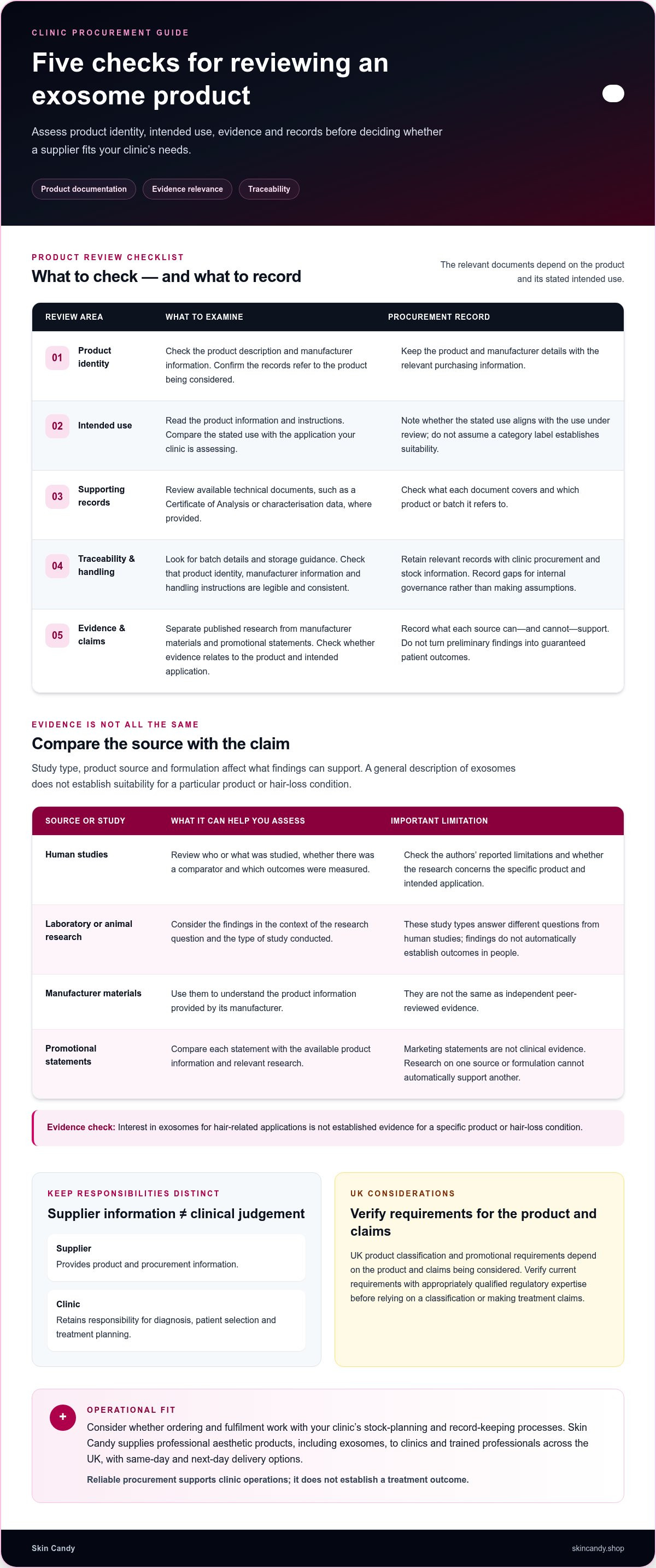
Use this checklist as a practical starting point. Which documents are relevant depends on the product and its intended use.
- Product identity: Check the product description and manufacturer information. Confirm that the records refer to the product you’re considering.
- Intended use: Read the product information and instructions carefully. Compare the stated use with the application your clinic is assessing.
- Supporting records: Review available technical documents, such as a Certificate of Analysis or characterisation data, where provided. Check what each document covers and which product or batch it refers to.
- Traceability and handling: Look for batch details and storage guidance. Retain relevant records with your clinic’s procurement and stock information.
- Evidence and claims: Distinguish published research from manufacturer materials and promotional statements. Note what each source can, and cannot, support.
How to assess evidence for hair-loss applications
Start with the study design. Ask who or what was studied, whether there was a comparator, which outcomes were measured and what limitations the authors reported. Human studies, laboratory research and animal studies answer different questions. A finding about one exosome source or formulation doesn’t automatically apply to another product or every hair-loss condition.
Check whether the research concerns the specific product and intended application, or exosomes as a broad research category. Manufacturer materials can explain a product, but they are not the same as independent peer-reviewed evidence. Marketing statements are not clinical evidence. Don’t turn preliminary findings into guaranteed patient outcomes.
Which traceability and product records support procurement?
Check that product identity, manufacturer information, batch traceability and storage instructions are legible and consistent across the materials supplied. If a batch document doesn’t appear to match the product, or handling guidance is unclear, record the gap for internal governance rather than making assumptions. Your clinic can assess the significance of that gap within its own procedures.
UK product classification and promotional requirements depend on the product and claims being considered. Verify current requirements with appropriately qualified regulatory expertise before relying on a classification or making treatment claims. For professional procurement, Skin Candy’s exosome supply is part of its wholesale range of aesthetic products.
How can clinics compare exosome suppliers without relying on bold claims?
A polished brochure can’t replace evidence you can assess. Emerging research may justify further investigation, but it doesn’t support unsubstantiated clinical promises or guaranteed results. Compare suppliers against the same criteria, and separate documented facts from claims that need substantiation.
How should a clinic distinguish evidence from marketing language?
Trace each efficacy statement to its cited source. Check whether the study’s product, population, method and measured outcomes match the claim. Note limitations, including a small or narrowly defined study population. A proposed biological mechanism may explain a research hypothesis, but it doesn’t prove that patients will experience a clinical benefit.
Be cautious with phrases such as “proven regrowth” or guaranteed outcomes unless robust evidence supports the precise claim. Before using patient-facing wording, verify current UK classification and advertising requirements with appropriate expertise. Claims should be substantiated and suitable for the product’s intended use.
What belongs in a practical supplier comparison?
Use the same framework for every exosome therapy for hair loss supplier. Record evidence gaps for internal review instead of treating confident sales language as a substitute for documentation.
| Comparison area | What to assess | Useful signal |
|---|---|---|
| Documentation | Are product identity, manufacturer information and intended use clearly described? | Records refer consistently to the product being considered. |
| Evidence relevance | Does the cited research relate to that product and hair-loss application? | Claims reflect the study design, population, outcomes and limitations. |
| Traceability | Can product and batch details be followed through the supplied records? | Information is legible, consistent and usable in clinic stock records. |
| Fulfilment | Do ordering and delivery options fit your stock-planning process? | Supply arrangements support routine procurement without implying a clinical result. |
Compare like with like. A study about a different formulation shouldn’t be treated as direct evidence for the product under review. Delivery convenience matters operationally, but it says nothing about efficacy, suitability or regulatory status. Keep these judgements separate.
If you’re comparing adjacent product categories for procurement, see the exosomes versus polynucleotides procurement guide. Apply the same approach throughout: assess documents, evidence, traceability, fulfilment and current UK requirements before drawing conclusions.
How should a clinic evaluate exosome supplier fit before ordering?
A clear review process keeps procurement separate from clinical decision-making. Assess the product against your clinic’s intended professional use, governance procedures and stock needs. A suitable exosome therapy for hair loss supplier should fit your purchasing process, but supplier fit alone doesn’t establish clinical suitability or an outcome.
- Define your requirements. Set out the intended professional use you’re assessing, the product information your clinic needs and the records required for internal review. Estimate potential stock needs using actual appointment demand and a realistic replenishment plan, not assumed interest.
- Review the documents. Check product identity, stated intended use, available supporting records, batch information and handling guidance. Record gaps or inconsistencies for your governance process. Don’t try to resolve missing information through marketing claims.
- Assess operational fit. Consider whether ordering arrangements, fulfilment options and product information work with your clinic’s stock-control practices. Keep procurement assessment distinct from diagnosis, treatment planning and other professional responsibilities.
- Plan the order. Agree who approves purchasing, who maintains stock records and how the clinic will review replenishment needs. Set an ordering cadence that reflects actual use and the time your team needs to manage incoming stock.
What should a clinic define before assessing a supplier?
Write down the intended professional use and your clinic’s documentation requirements before comparing options. Identify who is responsible for review and approval, and decide how you’ll retain purchase and batch records. This gives the assessment a consistent basis and helps document why a purchasing decision fits your internal process.
How can delivery options fit a clinic’s stock plan?
Skin Candy serves clinics and trained professionals across the UK, with same-day and next-day delivery options. Factor these options into replenishment planning, but don’t treat them as a guaranteed arrival time or fixed service level. Build your stock plan around actual demand, order timing and your clinic’s procedures rather than an assumed delivery date.
For a broader approach to stock control, use the 2026 clinic procurement and logistics guide to review inventory planning and ordering cadence. A structured process can help keep purchasing decisions clear and records organised.
Ready to include exosomes in your professional procurement review? Explore professional exosome supply from Skin Candy.
Why consider Skin Candy for professional exosome supply?
Skin Candy offers clinics and trained professionals a UK-wide wholesale source for aesthetic products, including exosomes. Its professional catalogue also includes other aesthetic product categories, supporting clinic purchasing through a wholesale supplier rather than a consumer treatment service.
Skin Candy offers same-day and next-day delivery options across the United Kingdom. These can inform replenishment plans and help clinics consider how ordering fits their stock routines, but they don’t guarantee a particular delivery outcome or establish clinical suitability. Keep product decisions, fulfilment planning and treatment claims as separate parts of your review.
What makes a wholesale partner useful to a busy clinic?
A professional supplier can make purchasing more straightforward by bringing relevant product categories together in a wholesale catalogue. For a clinic, this can support a consistent procurement process: select the category needed, review its product information and manage purchasing through established stock procedures.
Delivery options matter operationally too. Consider them alongside appointment demand, current stock and replenishment cadence, rather than assuming an order will arrive by a fixed time. Separating product information from promotional claims helps keep purchasing decisions grounded in what the documentation supports.
What are the next steps for professional buyers?
Before ordering, return to the product and evidence checklist. Confirm that product identity and intended use are clear, review the supporting records, and assess whether the available evidence applies to the specific product and application. Record any gaps through your clinic’s governance process.
Then align the decision with internal approval steps and current professional responsibilities. Product supply doesn’t establish that a product is suitable for a particular patient or hair-loss condition, and it isn’t a guarantee of results. Keep proposed patient-facing claims within substantiated evidence and applicable requirements.
Skin Candy supplies exosomes among its professional aesthetic products for clinics and trained professionals across the UK. To include the category in your procurement planning, browse professional exosome supplies and assess how the available product information fits your clinic’s process. A considered approach helps keep purchasing practical, traceable and aligned with your professional governance.
Make your next procurement decision with confidence
Choosing an exosome therapy for hair loss supplier calls for a clear review of product identity, intended use, supporting evidence and traceability. Match research to the specific product and application, and keep clinical decisions and patient-facing claims aligned with your clinic’s governance and professional responsibilities.
Skin Candy is a UK-wide wholesale supplier of professional aesthetic products, including exosomes. Same-day and next-day delivery options can support stock planning, without guaranteeing a particular delivery time or treatment outcome.
Ready to explore the professional range? Browse Skin Candy’s professional exosome supplies and take your next procurement step with a considered, evidence-aware approach.
Frequently Asked Questions
Is exosome therapy for hair loss supported by strong clinical evidence?
Evidence for exosomes in hair-loss applications is still developing, and its strength varies by product, study design and intended use. General research interest doesn’t prove that a specific product is effective for a particular hair-loss condition. Review relevant studies, including their populations, methods and limitations, alongside product-specific documentation. Don’t turn preliminary findings into guaranteed patient outcomes or promotional claims that the evidence doesn’t support.
Can clinics buy exosome products for professional hair-loss applications from a UK supplier?
Clinics can source professional aesthetic products through UK wholesale suppliers, but availability alone doesn’t establish suitability for a particular application. Review product documentation, stated intended use and applicable requirements before making a purchasing or treatment decision. Skin Candy supplies exosomes within its professional aesthetic product range to clinics and trained professionals across the United Kingdom. Keep procurement decisions aligned with your clinic’s governance and professional responsibilities.
What should an exosome supplier provide to a clinic?
Review clear product identification, manufacturer information, batch traceability, storage guidance and documents describing intended use. Supporting evidence should relate to the product and application being assessed, rather than exosomes as a broad category. Check that product instructions and records are legible and consistent, then document gaps for internal review. Requirements can depend on product classification and use, so verify current UK regulatory and advertising requirements before relying on a classification or making claims.
How can I compare suppliers of exosome therapy for hair loss?
Compare each exosome therapy for hair loss supplier against the same criteria: evidence relevance, document completeness, traceability, clarity of intended use and fulfilment fit. Check whether cited research concerns the product and application under consideration, and note its limitations. Don’t rank suppliers by bold efficacy claims alone. Consider whether ordering options suit your stock-planning process, and keep product procurement separate from clinical decisions and governance responsibilities.
Are exosomes the same as polynucleotides for hair-loss applications?
No. Exosomes and polynucleotides are distinct product categories with different compositions and evidence bases. Don’t treat them as interchangeable because both are discussed in aesthetic or hair-related contexts. Compare product-specific documentation and research, and assess each category against its own intended use. Base the decision on evidence and procurement fit rather than assuming either category delivers a particular clinical outcome.
How much does professional exosome therapy for hair loss cost?
Costs vary by product, supplier and purchasing arrangement, so a general figure may not reflect your clinic’s procurement cost. Review the product information and ordering terms relevant to your requirements, then consider how stock planning and documentation fit your purchasing process. Avoid relying on broad industry estimates when assessing commercial fit. Cost alone doesn’t establish product suitability or indicate a treatment result.
What claims can a clinic make about exosomes for hair loss in the UK?
Claims should be supported by relevant evidence and comply with requirements applicable to the product and its intended use. Don’t promise hair regrowth or present emerging research as established proof for a specific product. Before using clinical or promotional wording in patient communications or marketing, verify current UK classification and advertising requirements with appropriate expertise. Keep claims precise, product-specific and within the limits of the evidence you can substantiate.