
Best Chin Augmentation Fillers: Practitioner’s 2026 Guide
What if the “best” filler is the wrong choice for the face in front of you? The best dermal filler for chin augmentation depends on anatomy, treatment goals and product characteristics, not a universal ranking. A product that may suit a goal of adding projection may not be the right fit for subtle contour refinement.
Practitioners often want a clear comparison, but search results can offer little chin-specific detail. Product claims can also be difficult to weigh against clinical suitability, supporting evidence and UK supply considerations. This guide provides a consistent framework for assessing those factors, so you can compare options without treating any product as the automatic winner.
We’ll look at formulation and structural characteristics, how intended outcomes shape selection, and what to consider when reviewing product evidence and safety. We’ll also cover professional sourcing in the UK, including Skin Candy’s wholesale catalogue options from trusted industry brands. A brand’s inclusion in the catalogue doesn’t establish a product’s suitability for chin augmentation: product-specific intended use and evidence matter. Use this framework to make a more informed assessment in each clinical context.
Key Takeaways
- Assess the best dermal filler for chin augmentation as a patient-specific decision, not a universal product ranking.
- Compare formulation, rheology, cohesivity and tissue integration alongside intended use and available product evidence.
- Separate verifiable product information from marketing claims when building a chin filler comparison.
- Use a structured pre-treatment assessment covering goals, relevant history, anatomy, product documentation and informed consent.
- Explore Skin Candy’s UK wholesale catalogue, including dermal fillers from Lumifil, Regenovue and Aesossa, as professional procurement options.
What does ‘best dermal filler for chin augmentation’ mean in practice?
The best dermal filler for chin augmentation is the product a suitably qualified practitioner considers appropriate for an individual’s anatomy, treatment objective and the product’s documented intended use. There is no single winner for every patient. A consultation may clarify whether the aim is to refine contour, add projection or improve perceived profile balance, then assess whether an injectable approach is clinically suitable.
Dermal fillers are injectable products, but they aren’t interchangeable. Their composition and characteristics vary, as do their documented uses and supporting evidence. The general Dermal filler overview provides background on filler categories. For a chin-specific decision, review the current manufacturer information and relevant evidence for the individual product.
Injectable augmentation is generally a temporary option, while surgical approaches such as a chin implant or genioplasty involve a different type of intervention. These shouldn’t be treated as equivalent choices or compared on the assumption that either will deliver a particular result. The discussion depends on the person’s goals, anatomy, clinical suitability and understanding of each option’s considerations.
Which chin concerns might lead to a filler consultation?
A person may want to discuss how their chin relates to the rest of their profile, whether more projection is an aesthetic goal, or whether they’d like to explore contour refinement. These are consultation objectives, not diagnoses or promises about what filler can achieve. Photographs can’t establish suitability on their own, and individuals shouldn’t choose a treatment or product based on an image comparison.
The practitioner’s assessment separates the desired change from clinical suitability. A stated goal may not be achievable or appropriate with an injectable approach. Anatomy, relevant history and professional evaluation all inform that distinction. A focused discussion covers what the person hopes to address, what can be assessed clinically and whether filler is a suitable option to consider.
Why ‘best filler’ is not a universal product category
Two people seeking more chin definition may have different anatomy and priorities. One may be exploring projection, while another is focused on contour. Those differences affect which product characteristics merit consideration, but they don’t identify a product automatically. Brand recognition alone doesn’t establish suitability for a particular facial area or indication.
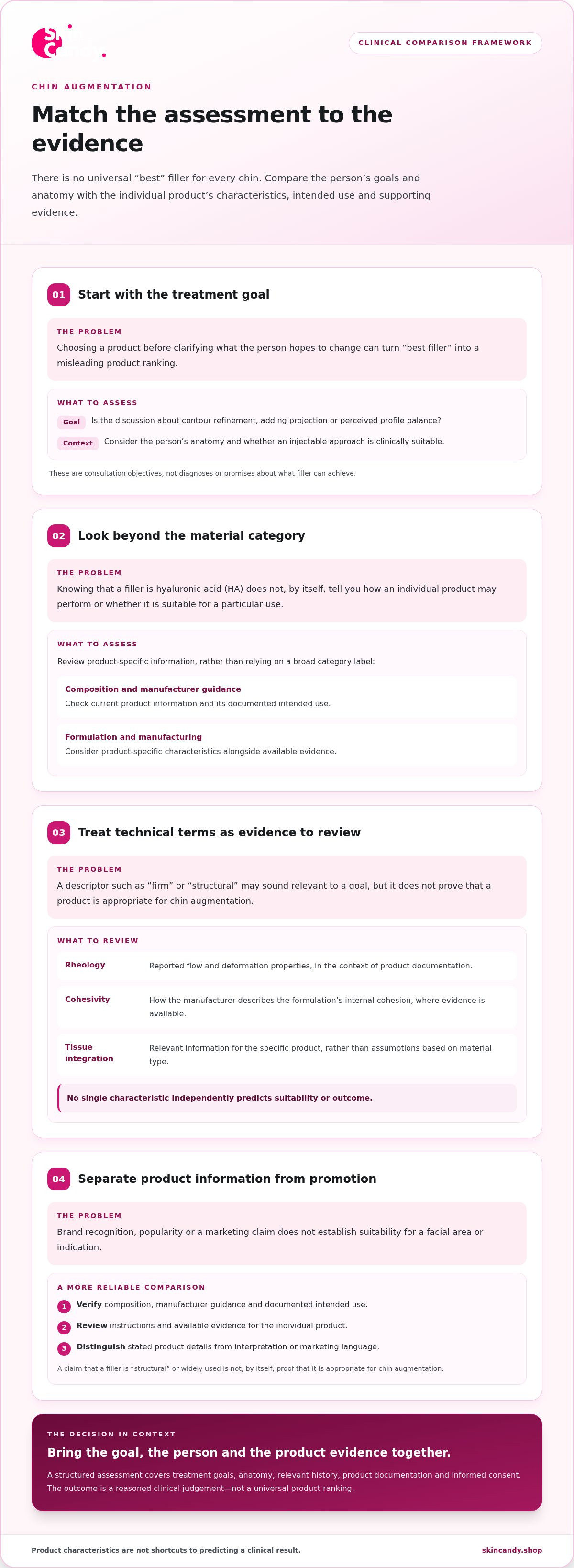
For a useful comparison, separate verifiable details from interpretation. Check the product’s composition, manufacturer guidance and documented intended use, alongside the evidence for the proposed application. A claim that a filler is “structural” or widely used doesn’t, by itself, prove it is appropriate for chin augmentation. Product-specific claims should be supported by current manufacturer documentation and relevant evidence. “Best” is a reasoned clinical judgement, not a popularity contest.
How dermal filler characteristics relate to chin augmentation
Hyaluronic acid (HA) is a commonly discussed category of dermal filler, but the category alone says little about how an individual product may perform. Formulation, manufacturing and product-specific evidence all matter. Material category describes what a filler is made from; it doesn’t establish a particular product’s performance, intended use or clinical evidence.
For chin assessment, practitioners may review technical properties alongside the person’s anatomy and goals. Terms such as rheology, cohesivity and tissue integration can help describe how a filler behaves, but they aren’t shortcuts to predicting a clinical result. Interpretation depends on reliable evidence for the specific product and its documented characteristics.
What product characteristics should a practitioner assess?
Start with the product’s composition and current manufacturer guidance. Review its documented intended use, instructions and available evidence rather than relying on a broad category label or promotional description. Rheological terms are useful only when product-specific information explains what was measured and how it relates to the proposed use.
- Rheology: consider reported flow and deformation properties in the context of the product documentation.
- Cohesivity: review how the manufacturer describes the formulation’s internal cohesion, where evidence is available.
- Tissue integration: look for relevant product-specific information rather than making assumptions based on material type.
- Documentation: distinguish stated composition and intended use from interpretation or marketing language.
No single characteristic independently predicts suitability or outcome. A descriptor such as “firm” may sound relevant to a structural goal, but it doesn’t prove that a product is appropriate for chin augmentation. Interpret technical details against the product’s documentation and clinical context.
How treatment goals shape the product discussion
A discussion about contour refinement may raise different considerations from one centred on projection. These are assessment goals, not promises that filler can achieve a particular change. The practitioner weighs the desired effect alongside anatomy, relevant history and the information available for each product. If the intended use or evidence doesn’t support the proposed application, a familiar brand name can’t fill that gap.
Duration and reversibility also require product-specific consideration. Don’t assume all HA fillers have identical longevity or that a category-level description explains how a particular product can be managed. Review current manufacturer information and relevant evidence before making comparative claims. If evidence is unclear, qualify the claim rather than presenting an estimate as a guarantee.
For clinic procurement, use reliable catalogue information as part of the product review. Skin Candy supplies professional dermal fillers wholesale across the UK, including options from Lumifil, Regenovue and Aesossa. Brand availability alone doesn’t establish chin suitability; use product documentation to guide that assessment. Browse professional dermal fillers for catalogue options.
How to compare dermal fillers for chin augmentation
A structured comparison turns a broad search for the best dermal filler for chin augmentation into a review of evidence, not a league table of brand names. Apply the same criteria to each product. Record what its documentation actually says, then keep clinical interpretation separate. If a detail can’t be verified, mark it as unknown rather than filling the gap with an assumption.
| Comparison point | What to record | If evidence is missing |
|---|---|---|
| Composition | Material category and composition stated in current product documentation. | Not established from available evidence. |
| Intended use | Manufacturer-specified purpose and any stated area of use. | Not established from available evidence. |
| Manufacturer guidance | Relevant instructions, limitations and product-specific characteristics. | Not established from available evidence. |
| Evidence availability | Relevant studies or other supporting material, including the application they address. | Not established from available evidence. |
This format makes gaps visible and prevents a claim about one product, formulation or application from being carried across to another. Marketing terms may prompt further review, but they aren’t substitutes for manufacturer guidance or evidence. Record practitioner interpretation separately, with its rationale and clinical context.
A practical product-evaluation checklist
Before using product information in a comparison or clinic materials, follow a consistent document check. Review the current instructions for use and manufacturer-specified intended purpose. Match the information to the product’s packaging and available identifiers, such as batch or lot details, where provided. Record the source and date of each claim so it can be reviewed if documentation changes.
- Record composition and intended use from current product documentation.
- Check packaging details against the accompanying product information.
- Note the source and date for evidence and manufacturer claims.
- Label promotional language separately from verifiable attributes.
- Use “not established from available evidence” where information is absent or unclear.
That last entry is useful: it stops a missing chin-specific claim becoming an implied indication through repetition. Keep comparisons precise, and don’t present clinic interpretation as a manufacturer statement.
Compare brands without assuming equivalent indications
Skin Candy’s professional filler catalogue includes Lumifil, Regenovue and Aesossa. These names identify catalogue brands, not proof of suitability for chin augmentation. Assess each product against its own current documentation and evidence. For separate brand-level context, the Lumifil dermal filler overview discusses Lumifil without replacing product-specific assessment.
Once your comparison criteria are clear, explore Skin Candy’s professional dermal filler range as part of your wholesale procurement review.
Clinical assessment and safety considerations before selecting a chin filler
Product comparison is only one part of the decision. Before considering the best dermal filler for chin augmentation, an appropriately qualified practitioner needs to assess the individual, proposed treatment and product documentation together. This is a clinical judgement, not a choice made from a brand list or photograph. It also includes discussing whether injectable treatment is suitable at all.
A clear assessment sequence grounds the decision in the patient’s needs and available evidence. It can also identify when expectations, anatomy or product information need further discussion before a treatment decision is made.
A structured pre-treatment assessment
Begin with the person’s objectives. Clarify what they hope to change, how they describe their desired result and what they understand about the limits of injectable treatment. Record relevant medical and treatment history, including information that may affect suitability or risk. A stated preference doesn’t establish that a particular product or approach is appropriate.
Next, assess facial anatomy through appropriate professional practice. Consider whether the requested change aligns with the person’s features and whether an injectable option is clinically suitable. Then compare the product’s current documentation and intended use with the proposed application. If the evidence or guidance doesn’t support a clear decision, pause rather than relying on familiarity or marketing language.
Informed consent should follow a balanced discussion, not a sales pitch. Explain the proposed option, material risks, relevant limitations and alternatives in language the patient can understand. Allow time for questions and ensure consent reflects the individual’s decision. Risk assessment is specific to the person and treatment; no injectable procedure is free from risk.
UK product and professional standards to verify
For UK practice, check current Medicines and Healthcare products Regulatory Agency (MHRA) guidance and applicable UK medical-device requirements before making regulatory statements or relying on device-status claims. Requirements and guidance can change, so use authoritative, up-to-date sources rather than older summaries. Don’t infer that a product is appropriate for chin augmentation simply because it is available or familiar.
Review current manufacturer materials for product identity, instructions, intended purpose and any limitations relevant to the proposed use. Keep packaging and product documentation available for traceability, and ensure claims in patient-facing materials match what the manufacturer’s information and supporting evidence establish. If the evidence doesn’t establish a chin-specific use, state that clearly in internal comparisons rather than implying it.
- Document goals, relevant history, anatomy and the clinical rationale.
- Match the proposed use to current product documentation and evidence.
- Discuss risks, limitations, alternatives and consent in clear language.
- Check current UK guidance; don’t assume a credential, certification or registration is mandatory without verifying the applicable requirements.
For professional procurement, Skin Candy supplies dermal fillers wholesale across the UK. Explore Skin Candy’s professional dermal fillers as part of a documented product review.
How Skin Candy supports professional dermal filler procurement
Clinical selection and purchasing serve different purposes. A practitioner determines whether a product is appropriate for an individual case; procurement supports the clinic in sourcing professional products for its practice. Skin Candy is a UK-wide wholesale supplier of professional aesthetic products, including dermal fillers from Lumifil, Regenovue and Aesossa.
These brand names identify catalogue options, not a claim that a particular filler is indicated for chin augmentation. Keep clinical decisions anchored to the product’s current documentation, intended use and available evidence. A clear procurement process helps a clinic organise product information and stock planning without confusing supply with treatment suitability.
Build a product shortlist around documented requirements
Start with the clinic’s verified requirements, then compare products using their own manufacturer materials. Record composition, stated intended use and relevant product documentation. Practitioner experience with a product may inform the review, but it doesn’t replace evidence or patient-specific assessment.
Keep the shortlist focused. If a clinic is reviewing a filler for a particular treatment context, record the product’s documented purpose and evidence separately from the practitioner’s interpretation. Use brand-specific material only for claims it supports. Don’t transfer a property or indication from one product to another simply because they share a brand or broad material category.
Procurement shouldn’t determine the treatment plan. The practitioner’s assessment remains separate, and a product’s presence in a wholesale catalogue doesn’t establish its suitability for a patient or facial area. This distinction supports clear records and responsible product selection.
Keep clinic procurement clear and dependable
Skin Candy supplies professional aesthetic consumables wholesale across the UK. Same-day and next-day delivery options are available across the UK, supporting clinics with different stock-planning needs. These are delivery options, not a promise of a particular dispatch or arrival date.
Planned stock management can help teams align purchasing with documented requirements. Maintain a clear view of products held, review product information as part of routine ordering and avoid relying on assumptions or unsupported claims. Clear records help keep procurement organised while preserving the separation between ordering decisions and clinical judgement.
For clinics assessing the best dermal filler for chin augmentation, the practical sequence is straightforward: define the clinical requirements, review product-specific evidence, then source products that meet the practice’s verified procurement needs. Skin Candy’s wholesale focus and UK-wide delivery options support the ordering process, while suitability remains a professional clinical decision.
Browse professional dermal fillers at Skin Candy to review catalogue options for your clinic’s procurement planning.
Make your next product review evidence-led
Use your next formulary review to turn the question of the best dermal filler for chin augmentation into a clear, repeatable decision process. Set out the clinical requirements, identify what the product documentation supports and record any evidence gaps before a product enters consideration. This gives your team a practical reference for future reviews and helps keep procurement decisions distinct from individual treatment planning.
Keep the standard consistent: product claims should be traceable to their source, and clinical suitability should remain a practitioner-led judgement. A confident decision doesn’t come from choosing the most familiar name. It comes from understanding why an option is being considered and what information supports that choice.
When your review is ready, explore the professional catalogue and make your next ordering decision with the same care you bring to product assessment. Browse professional dermal fillers at Skin Candy and take the next step towards an organised, evidence-led clinic workflow.
Frequently Asked Questions
Which dermal filler is best for chin augmentation?
There’s no single filler that’s best for every patient or clinical objective. The best dermal filler for chin augmentation depends on the case, so compare the specific product’s composition and manufacturer guidance with the proposed use rather than relying on brand reputation. A practitioner can document why an option is being considered and what evidence supports it. Catalogue inclusion alone doesn’t establish that a product is indicated for chin augmentation.
Are hyaluronic acid fillers used for chin augmentation?
Hyaluronic acid fillers are used in aesthetic practice for a range of facial concerns, but the category doesn’t establish that every product is appropriate for the chin. Before considering a specific filler, compare its current instructions for use with the proposed indication and review product-specific evidence. Don’t transfer claims from another HA product, even if the composition category or brand family appears similar.
How long does chin filler last?
There’s no reliable universal duration for chin filler. The timeframe can vary with the formulation, treatment area, individual factors and evidence behind a product-specific claim. For a useful discussion, identify which product and source an estimate refers to, then explain uncertainty rather than presenting a general figure as a personal forecast. Follow-up records can help distinguish observed experience from broad product claims.
Can dermal filler correct an asymmetrical chin?
Filler may be discussed as one possible approach to some contour concerns, but it can’t be assumed to address every type or degree of asymmetry. The cause and clinical context need individual assessment. A practitioner should explain what injectable treatment may and may not address, along with relevant alternatives and risks. Don’t promise perfect symmetry or use photographs alone to decide whether treatment is suitable.
Can hyaluronic acid chin filler be dissolved?
Some hyaluronic acid fillers may be treated with hyaluronidase, but this isn’t a guaranteed reversal or a substitute for careful product selection. Suitability, response and risks depend on the product and clinical circumstances. Any discussion should be based on current product information and authoritative clinical guidance, and managed by an appropriately qualified professional. Avoid assuming that all HA products respond in the same way.
Is chin augmentation with dermal filler a permanent treatment?
No. Dermal filler shouldn’t be described as a permanent chin augmentation solution. How long a particular product may remain depends on product characteristics, individual factors and relevant evidence, so avoid promising a fixed timeframe. Injectable treatment is also different from surgical options, and comparisons should reflect their distinct considerations. A practitioner can explain the available information without presenting duration estimates as a guaranteed outcome.
What should practitioners check before choosing a chin filler?
Review the product’s composition, current instructions for use, intended purpose, traceability and supporting evidence. As a practical record-keeping step, note the document version or date reviewed and match product information to the packaging details. Separately, assess the patient’s goals, history and anatomy through appropriate professional practice. Check current UK sources for applicable regulatory and professional requirements; don’t rely on a brand name or marketing description alone.
Browse Skin Candy’s professional dermal filler range for your clinic’s wholesale procurement review.