Combining Polynucleotides and Exosomes: The 2026 Clinical Synergy Guide
Professional demand for exosome therapy has surged by 340% year-over-year, yet many practitioners still struggle to move beyond traditional hyaluronic acid fillers. You've likely seen patients plateau with standard treatments and felt the frustration of managing increasingly complex regenerative protocols. Combining polynucleotides and exosomes offers a definitive solution to these clinical bottlenecks. It isn't just about adding another step. It's about shifting from masking age to actively reprogramming the skin's cellular behaviour.
This 2026 clinical guide simplifies that transition. You'll discover how to integrate these advanced biologics into a high-performance protocol that ensures safety whilst prioritising superior patient outcomes. We'll break down the "Scaffold and Signal" effect, provide a practical framework for clinical application, and show you how to secure a reliable supply of specialised consumables. It's time to move past the uncertainty and lead the shift toward true regenerative excellence. This guide provides the clarity you need to deliver results that traditional mono-therapies simply cannot match.
Key Takeaways
- Master the "Scaffold and Signal" concept to understand why combining polynucleotides and exosomes delivers superior regenerative results compared to mono-therapies.
- Identify the specific role of PDRN in establishing a structural foundation for DNA repair and deep dermal hydration.
- Learn how exosomes function as cellular messengers to reprogramme aged cells and trigger rapid rejuvenation.
- Access a practical 2026 framework for the "Simultaneous Synergy" protocol to integrate these biologics safely into your clinic.
- Prioritise clinical safety by sourcing medical-grade consumables through reliable, next-day distribution channels.
The Science of Regenerative Synergy: Why Combine Polynucleotides and Exosomes?
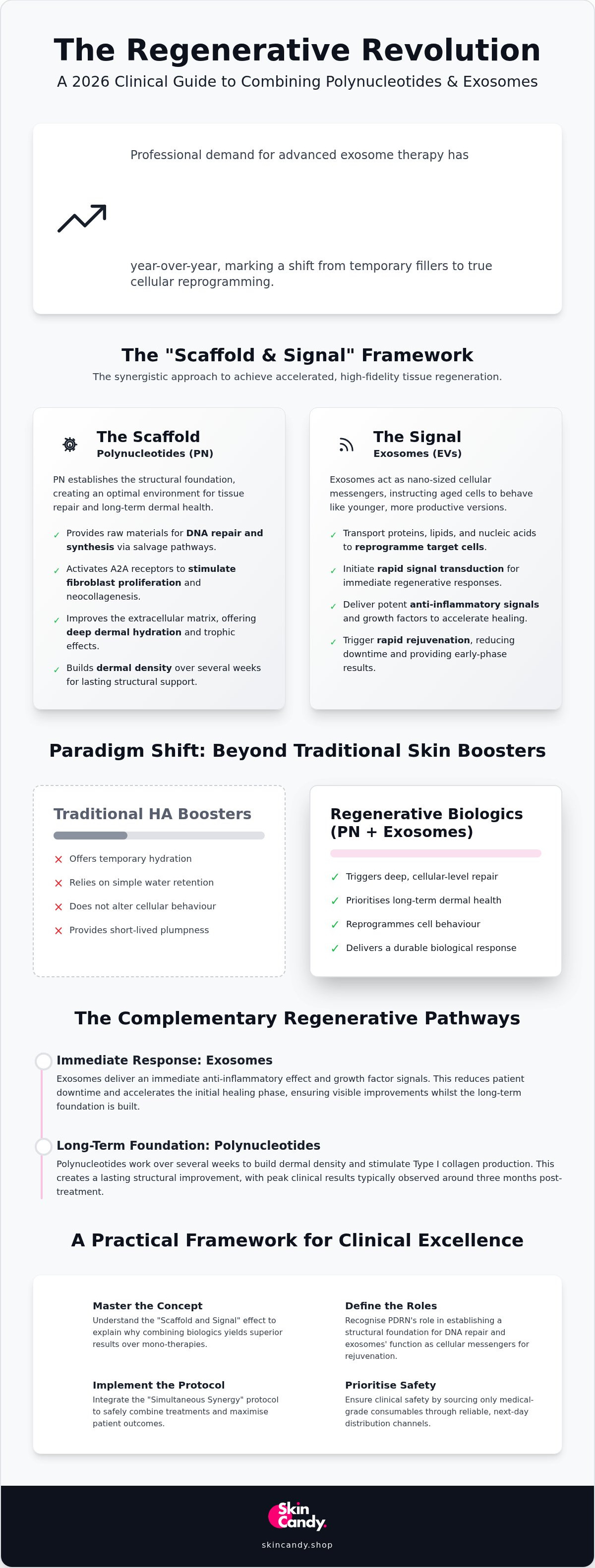
The aesthetic industry has moved beyond simple volumisation. By 2026, the clinical focus has shifted entirely to the "Scaffold and Signal" framework. This approach relies on combining polynucleotides and exosomes to address skin ageing at both a chromosomal and cellular level. Polynucleotides (PN) serve as the structural scaffold. They provide the raw materials for DNA synthesis and create a physical environment conducive to tissue repair. Without this foundation, cellular signals lack the necessary infrastructure to produce lasting results.
Exosomes act as the essential signal. These Extracellular vesicles (EVs) are nano-sized messengers that transport proteins, lipids, and nucleic acids directly to target cells. They initiate rapid signal transduction, instructing aged fibroblasts to behave like younger, more productive cells. When you use these modalities together, you achieve concurrent biostimulation. You aren't just building a structure; you're ensuring the "workers" inside that structure are operating at peak efficiency.
Biostimulation 2.0: Beyond Traditional Skin Boosters
Traditional hyaluronic acid (HA) boosters primarily offer temporary hydration through water retention. They don't alter the underlying biological behaviour of the skin. In contrast, regenerative biologics like PN and exosomes trigger a paradigm shift toward cellular-level repair. Clinical standards in 2026 prioritise long-term dermal health over short-lived plumpness. This combined therapy is the gold standard for patients experiencing age-related plateaus, severe elastosis, or chronic inflammation. It provides a durable biological response that traditional boosters cannot replicate.
The Complementary Pathways of PN and Extracellular Vesicles
The synergy between these two agents lies in their timing and mechanism. Polynucleotides focus on the long game. They stimulate fibroblast proliferation and increase the production of Type I collagen over several weeks. This builds the dermal density required for youthful skin. Exosomes provide the immediate response. They deliver potent anti-inflammatory signals and growth factors that reduce downtime and accelerate the initial regenerative phase. This ensures the patient sees early improvements whilst the PN builds a lasting foundation.
Synergistic biostimulation is the concurrent application of DNA-derived structural scaffolds and cellular signalling vesicles to achieve accelerated, high-fidelity tissue regeneration. By leveraging these complementary pathways, practitioners can deliver superior outcomes that address both the structural and functional deficits of ageing skin.
Polynucleotides: Establishing the Structural Foundation
Polynucleotides are the bio-equivalent of building a solid foundation before decorating a house. In the context of combining polynucleotides and exosomes, the PN provides the essential structural support. These DNA fragments, specifically PDRN, facilitate salvage pathways for nucleotide synthesis. This process is energy-efficient for the cell, allowing aged or damaged tissue to focus on repair rather than metabolic waste. The Molecular Mechanisms of Polynucleotides involve the activation of A2A adenosine receptors, which triggers a cascade of regenerative events including anti-inflammatory responses and increased vascularisation.
Molecular weight plays a pivotal role in clinical choice. High molecular weight chains offer superior trophic effects and intense hydration, making them suitable for deep dermal thickening. Conversely, lower molecular weight variants are better suited for delicate areas like the periorbital region. For a detailed breakdown of patient-specific protocols, refer to our guide on polynucleotide indications for aesthetic clinics.
Fibroblast Activation and Collagen Synthesis
The interaction with A2A receptors is the primary driver of neocollagenesis. Once injected, PN stimulates the proliferation of fibroblasts, the cells responsible for collagen and elastin production. This isn't an overnight change. Most practitioners observe the peak clinical result approximately three months after a full treatment cycle. Because PN improves the biological "soil" of the skin, it acts as the perfect primer. It prepares the extracellular matrix to receive the rapid signalling instructions provided by exosomes, ensuring the tissue is ready to respond.
Selecting the Right Polynucleotide for Your Clinic
Choosing the correct product depends on the desired outcome. High-viscosity polynucleotides are excellent for structural rejuvenation and lifting, whilst low-viscosity options prioritise fine line reduction and texture improvement. Safety remains the highest priority. You must ensure every product in your inventory is CE-marked and professional-grade. Sourcing from a reliable skin booster supplier UK guarantees that you are receiving purified, medical-grade biologics with full traceability.
When combining polynucleotides and exosomes, the quality of your consumables directly dictates the safety and efficacy of the protocol. Using unverified or grey-market supplies introduces unnecessary risk into a high-performance clinical environment. For clinics looking to upgrade their regenerative offerings, you can view our range of professional polynucleotides to find the ideal foundation for your next patient protocol.
Exosomes: The Cellular Messengers of Rapid Rejuvenation
Exosomes are the high-speed data packets of regenerative medicine. These nano-sized extracellular vesicles, typically ranging from 30 to 150 nanometres, act as the primary drivers of paracrine signalling. They carry a specialised cargo of proteins, lipids, and nucleic acids directly into target cells. Unlike traditional treatments that provide external hydration, exosomes instruct aged fibroblasts to reset their behaviour. They effectively reprogramme the skin to produce youthful levels of elastin and collagen by delivering functional instructions to the nucleus.
In a clinical setting, combining polynucleotides and exosomes significantly mitigates the inflammatory response. This synergy reduces patient downtime following more aggressive treatments like microneedling or radiofrequency. You have a choice between plant-derived, animal-derived, and synthetic exosomes. By 2026, many practitioners favour plant-derived vesicles for their stability and lower risk of immunogenic reactions, ensuring a safer profile for high-volume clinics.
Signal Transduction and Skin Quality Improvement
Aesthetic-grade exosomes deliver a potent cocktail of growth factors, including TGF-β3 and VEGF. These molecules accelerate the healing phase of invasive procedures by promoting rapid re-epithelialisation. The exosomal signalling window is the critical 72-hour period following application where cellular receptors are most receptive to vesicle-mediated cargo delivery. Utilising this window ensures that the signalling instructions are received whilst the skin's regenerative capacity is heightened, leading to visible improvements in skin texture and luminosity.
Exosomes vs Polynucleotides: Choosing or Combining?
Practitioners often ask whether they should select one modality over the other. Our exosomes vs polynucleotides 2026 guide explores these differences in depth. Whilst polynucleotides provide the structural foundation, exosomes provide the immediate functional signal. Combining polynucleotides and exosomes is the superior choice for patients with advanced photo-ageing or those with compromised skin barriers.
This dual-action approach targets two distinct biological failures: the loss of physical dermal density and the decline in cellular communication. Patients with thin, parchment-like skin or those undergoing peri-menopausal changes benefit most from this combined protocol. It provides a comprehensive solution that a single-agent treatment cannot achieve, moving the patient beyond the plateau of traditional HA fillers.
Clinical Protocols: How to Combine These Treatments Safely
The 2026 standard for combining polynucleotides and exosomes follows a "Simultaneous Synergy" framework. This protocol ensures that the structural scaffold is established before the signalling messengers are applied. Safety is the primary concern when mixing advanced biologics. You must never mix PN and exosomes in the same syringe. Their differing pH levels and molecular weights can lead to product degradation or unpredictable inflammatory responses. Instead, practitioners should prioritise a layered approach that respects the biological window of each agent.
Skin preparation is vital. A compromised barrier can lead to uneven absorption and increased sensitivity. Ensure the patient's skin is thoroughly cleansed and prepped with a pH-neutral solution to maintain the integrity of the exosomes. Post-treatment care should focus on occlusive protection for the first 24 hours. This maximises the regenerative window by preventing trans-epidermal water loss whilst the cellular signals are being processed.
Layering Techniques: Injections and Microneedling
The most effective method is the "Injectable Base" technique. Start by administering polynucleotides into the deep dermis using a bolus or retrograde linear threading technique. This places the structural DNA fragments exactly where they are needed to support the extracellular matrix. Once the foundation is set, move to the "Topical Delivery" phase. Use microneedling or radiofrequency to create controlled micro-channels across the treatment area. Apply the exosomes topically immediately after. This sequence ensures the signalling vesicles can penetrate the dermis through the channels whilst the PN provides the internal support structure. It's a systematic approach to high-performance rejuvenation.
Timing and Treatment Cycles
Results require consistency. An ideal protocol consists of three to four sessions spaced at four-week intervals. This timing aligns with the natural cellular turnover cycle and allows the PN-stimulated collagen to begin maturing before the next signal is delivered. For mature or severely photo-damaged skin, you may need to extend the cycle to six sessions. If treating sensitive skin, reduce the microneedling depth but maintain the injectable PN volume to ensure structural repair without excessive surface irritation. Adjusting these variables allows you to customise the protocol for diverse patient needs whilst maintaining a high safety margin.
To implement these advanced protocols with confidence, you need a supply chain that guarantees product purity and temperature-controlled logistics. You can view our professional regenerative range to secure the high-quality consumables required for these Simultaneous Synergy treatments.
Procurement for High-Performance Clinics: Sourcing Quality Consumables
High-performance regenerative aesthetics requires more than clinical skill. It demands a sophisticated procurement strategy. When combining polynucleotides and exosomes, you are dealing with sensitive biological materials that require strict environmental controls. Exosomes, in particular, often rely on cold-chain logistics to maintain the integrity of their lipid vesicles and cargo. If these products are exposed to temperature fluctuations during transit, their signalling efficacy drops significantly. You can't risk your patient results or clinic reputation on unreliable delivery methods.
Avoid grey-market supplies at all costs. These products often bypass the necessary regulatory checks and lack a verifiable chain of custody. Implementing a just-in-time inventory model allows your clinic to maintain fresh stock without tying up excessive capital in long-term storage. Skin Candy facilitates this by acting as your dedicated distribution partner. We ensure that medical-grade biologics are available exactly when your treatment schedule requires them.
Ensuring Product Purity and Safety Standards
Safety standards in 2026 are non-negotiable. Every product you purchase must carry the CE marking or UKCA standard to ensure it meets rigorous safety and quality benchmarks. Batch tracking is another essential component of professional procurement. In the rare event of an adverse reaction, you must be able to trace the specific lot of polynucleotides or exosomes back to the manufacturer. Always verify your wholesale partner's credentials. A reliable partner will provide full transparency regarding their sourcing and storage protocols.
Streamlining Your Supply Chain with Skin Candy
Efficiency is the engine of a successful aesthetic business. Skin Candy supports UK practitioners with reliable next-day delivery. This ensures your clinic never faces downtime due to stock shortages. Our catalogue extends beyond regenerative biologics to include essential treatments like professional fat dissolving agents. This allows you to consolidate your ordering process and maintain a consistent standard of care across your entire treatment menu. Prioritising logistical excellence is the final step in successfully combining polynucleotides and exosomes for your patients. Trust a specialist wholesaler to handle the complexities of the supply chain whilst you focus on delivering superior clinical results.
Leading the Regenerative Shift in 2026
The shift toward regenerative aesthetics is no longer a future projection. It's the current clinical standard. By combining polynucleotides and exosomes, you provide a dual-action treatment that addresses both structural dermal loss and cellular communication. This protocol moves your patients beyond the plateau of traditional fillers, delivering high-fidelity results through the "Scaffold and Signal" framework. Success in this high-performance field relies on more than just technique. It requires a reliable supply chain that ensures product purity and logistical excellence.
Securing professional-grade, CE-marked consumables is essential for maintaining your clinic's reputation and patient safety. Skin Candy acts as your dedicated partner, providing specialised regenerative products with dependable next-day UK delivery. You shouldn't let supply chain delays or unverified products hinder your clinical performance. Reliability in procurement is the engine that drives consistent patient satisfaction.
Stock your clinic with professional-grade polynucleotides and exosomes at Skin Candy to ensure your practice remains at the forefront of medical aesthetics. It's time to elevate your results and lead the industry with confidence.
Frequently Asked Questions
Can I mix polynucleotides and exosomes in the same syringe?
No, you should never mix polynucleotides and exosomes in the same syringe. Their distinct pH levels and molecular structures can lead to product instability or unpredictable inflammatory reactions. The safest clinical approach involves layering the treatments. You should inject the polynucleotides into the deep dermis first to establish a structural foundation before applying exosomes topically through microneedling or radiofrequency channels to ensure maximum efficacy.
What is the primary difference between polynucleotides and exosomes?
The primary difference lies in their biological function: polynucleotides provide the structural scaffold, whilst exosomes deliver the cellular instructions. PN consists of DNA fragments that stimulate fibroblast proliferation over time. Exosomes are nano-sized vesicles that trigger immediate signal transduction to reprogramme aged cells. Combining polynucleotides and exosomes allows you to address both the physical architecture of the dermis and the functional behaviour of the skin cells simultaneously.
Is there any downtime when combining these two regenerative treatments?
There is very little downtime associated with this combination protocol. In fact, the anti-inflammatory properties of exosomes often reduce the redness and swelling typically seen with polynucleotide injections or microneedling alone. Most patients experience mild erythema that resolves within 24 to 48 hours. This makes the dual-action approach an excellent choice for busy patients who require high-performance results without the long recovery periods associated with more aggressive surgical interventions.
How many sessions of the combined protocol are needed for visible results?
Visible structural changes typically require three to four sessions spaced four weeks apart. Whilst some patients notice an immediate "glow" from the exosomal signalling, the true regenerative effects of the polynucleotides take longer to manifest. You'll usually see the peak results approximately three months after the final session. This timeline allows the neocollagenesis process to mature and the dermal density to increase significantly through the cumulative effect of the treatments.
Are there any contraindications specific to combining PN and exosomes?
There are no specific contraindications unique to the combination, but standard regenerative exclusion criteria apply. You should avoid treating patients who are pregnant, breastfeeding, or have active skin infections in the target area. Patients with certain autoimmune conditions or known sensitivities to fish-derived products should be thoroughly screened. Always verify the specific origin of your biologics to ensure they align with the patient’s medical history and avoid adverse reactions.
Which should be applied first: the polynucleotide or the exosome?
You should always apply the polynucleotide as the injectable base first. This establishes the structural DNA scaffold within the deep dermis where it can begin the repair process. The exosomes should follow as a topical application, ideally delivered through micro-channels created by microneedling or radiofrequency. This specific sequence ensures maximum absorption of the signalling vesicles whilst the skin’s regenerative capacity is heightened by the initial injectable foundation and controlled trauma.
Can this combination be used for hair restoration as well as facial rejuvenation?
Yes, this combination is highly effective for hair restoration protocols. Polynucleotides improve the health of the scalp and provide the necessary hydration to the follicular environment. Exosomes then deliver potent growth factors that signal dormant follicles to enter the anagen growth phase. Combining polynucleotides and exosomes for the scalp can significantly improve hair density and quality, offering a sophisticated non-surgical alternative to traditional hair loss treatments for both men and women.
Do I need special training to use exosomes in my clinic?
Yes, you should seek specialised training before integrating these advanced biologics into your practice. Handling exosomes requires specific knowledge of cold-chain logistics and precise application techniques to maintain product efficacy. Whilst Skin Candy provides the medical-grade consumables, we recommend that practitioners consult with professional aesthetic bodies to ensure they are fully competent in the protocols required for safe and effective patient outcomes. Proper handling is essential for maintaining your clinic's professional reputation.