
Choosing the Right Filler Viscosity for Lip Treatments
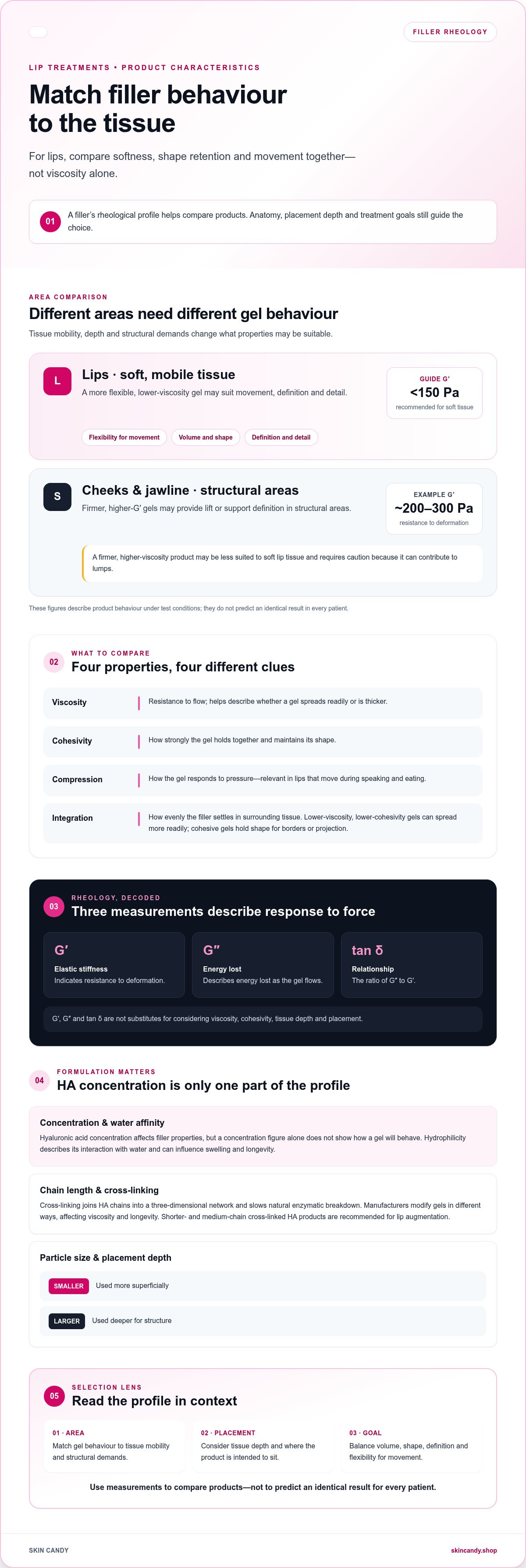
For lips, softer is often the more suitable choice. Choosing the right filler viscosity means matching a flexible, lower-viscosity gel to the movement and soft tissue of the lips; the guide recommends a G′ below 150 Pa for soft-tissue areas such as the lips. A firmer, higher-viscosity product may be less suited to this area and requires caution because it can contribute to lumps.
Choosing the right filler viscosity involves more than softness alone. A product must balance volume and shape with enough flexibility for definition, detail and natural movement. Hyaluronic acid concentration and gel structure also influence how a filler behaves, so viscosity is one part of a broader rheological profile.
This guide explains how G′, viscosity and cohesivity relate to lip treatments, how hyaluronic acid concentration and cross-linking affect product behaviour, and why facial areas call for different filler characteristics. Firmer gels may suit structural areas such as the cheeks or jawline, while softer options may better suit mobile tissue. Use anatomy, treatment goals and placement to compare fillers and understand how to select a product.
Key Takeaways
- Use rheological measurements to compare filler behaviour, but interpret them alongside anatomy and treatment goals rather than as a forecast of individual results.
- Consider cohesivity and resistance to compression when assessing how a gel may hold its shape and respond to movement in the lips.
- Compare hyaluronic acid concentration with cross-linking and particle characteristics; concentration alone doesn’t determine how a filler behaves.
- Match filler properties to the treatment area, tissue depth and desired outcome instead of selecting one gel for every indication.
Why Does Dermal Filler Rheology Matter?
A filler that is too thick may create lumps or visible irregularities in soft tissue. One that is too thin may provide insufficient support in a structural area.
Limits of Rheological Data
Rheological data describe how a gel behaves under test conditions, not the exact result in a patient’s tissue. A G′ of approximately 200-300 Pa indicates resistance to deformation, which can suit structural areas such as cheeks and jawline. However, anatomy, injection depth, facial movement and treatment goals also influence outcomes. Use measurements to compare products, not to predict an identical result for every patient.
Rheology in Brand Selection
Choose a brand by comparing the specific filler’s rheological profile with its intended treatment area. A brand name alone cannot show how a gel will perform. For example, assess Revanesse Versa using product-specific data, including G′, viscosity and cohesivity, alongside the manufacturer’s intended indications. This helps distinguish products designed for projection from gels intended to spread through more superficial tissue.
Matching Rheology to Facial Areas
Facial areas need different gel behaviour because tissue depth, mobility and structural demands vary. Higher-G′ fillers can provide lift in the cheeks, while firmer, more cohesive gels can support jawline definition. Softer, lower-viscosity options may suit mobile areas such as the lips. For superficial planes, spreadable gels may integrate more smoothly. Let the treatment area and placement depth guide your comparison instead of choosing one filler for every facial treatment.
Rheology and Product Selection
Rheology helps match a gel’s behaviour with the intended effect. G′ indicates elastic stiffness, G″ describes energy lost as the gel flows, and tan δ is the ratio of G″ to G′. Together, these measures describe how a filler responds to force. Also consider cohesivity, viscosity, tissue depth and placement. A higher-G′ filler may suit deep structural work, while a more flexible gel may better suit a mobile or superficial area.
Which properties of dermal fillers are best suited to lip treatments?
Lip filler properties need to balance volume and projection with flexibility for movement and detail. Cohesivity, compression response and integration help describe how a gel may behave in lip tissue.
Cohesivity and Compression Resistance
Cohesivity describes how strongly a filler gel holds together, while compression resistance describes how it responds to pressure. Repeated movement from speaking and eating makes both properties relevant to lip filler selection. A cohesive gel can maintain shape, but too much firmness may feel or look pronounced in soft tissue. Compare the product’s intended use with the required volume, definition and flexibility.
Tissue Integration and Cohesivity
Tissue integration describes how evenly a filler settles within surrounding tissue. Lower-viscosity, lower-cohesivity gels can spread more readily, supporting smooth integration and potentially reducing the risk of nodules. A more cohesive gel holds its shape, which may help when defined borders or projection are treatment goals. Assess these product-specific properties alongside the area being treated and the desired finish.
Viscosity, Cohesivity and G′
Viscosity, cohesivity and G′ describe different aspects of gel behaviour; they are not interchangeable measures. Viscosity is resistance to flow, cohesivity describes how the gel holds together, and G′ indicates elastic stiffness and resistance to deformation. Together, they help compare how a filler may spread, retain shape or respond to compression. For lips, selection balances support for volume and shape with flexibility for natural movement, definition and detail.
Hyaluronic acid concentration and product structure also influence behaviour, swelling and longevity, so concentration alone doesn’t settle the choice. Compare these characteristics with the treatment objective and the product’s intended use. Review filler selection considerations alongside the clinical requirements of each lip treatment.
How does hyaluronic acid concentration impact filler products?
Hyaluronic acid concentration shapes filler behaviour, but it is not a stand-alone measure of firmness, spread or suitability. Cross-linking, chain length and gel structure also matter.
Concentration and Filler Behaviour
Hyaluronic acid concentration affects a filler’s properties and hydrophilicity over time. Hydrophilicity describes the gel’s interaction with water, which can influence post-treatment swelling and longevity. A concentration figure alone doesn’t show how a filler will behave after injection. Practitioners should consider it alongside viscosity, cohesivity and the treatment area. For lip augmentation, the desired balance includes volume and shape, with flexibility for movement.
Chain Length and Cross-Linking
Hyaluronic acid chain length and cross-linking help determine how a gel holds together and resists breakdown. Cross-linking joins HA chains into a three-dimensional network, slowing natural enzymatic breakdown. Manufacturers modify gels in different ways, which affects viscosity and longevity. Shorter- and medium-chain cross-linked HA products are recommended for lip augmentation. Particle size is another consideration: smaller-particle products are used more superficially, while larger particles are used deeper for structure.
Properties of Hyaluronic Acid Fillers
Hyaluronic acid fillers vary in elasticity, cohesivity, viscosity and water affinity. These properties influence whether a gel spreads, maintains projection or integrates into tissue. Compare the product profile with the facial area and intended placement, rather than treating concentration as a complete guide. Hyaluronic acid filler is fully reversible with hyaluronidase. This distinguishes it from non-HA filler materials, while cross-linking and gel design still shape its behaviour after injection.
Choosing dermal fillers
Choose a dermal filler by matching its rheology and formulation to the facial area, placement depth and treatment goal. A gel suited to cheek projection may not suit a mobile area such as the lips or a superficial tear trough.
Before treatment, ask the UK practitioner:
- Which product properties suit my treatment area, and why? Ask how viscosity, cohesivity and G′ relate to the planned result.
- At what tissue depth will the filler be placed? A deep structural placement has different demands from a superficial treatment.
- How do my skin quality, thickness, elasticity, medical history and previous treatments affect the plan?
- What volume is appropriate for my goals? First-time patients often start with smaller volumes and build up as needed.
- How will you assess changes over time? Review appointments and comparable photographs can help track the result.
Next, compare the product’s intended use with the facial area. Higher-viscosity gels can maintain shape in deeper planes, while lower-viscosity options spread more easily. For cheeks, lift and volume may guide selection; for jawline contouring, a firmer gel can support definition against muscular forces. Fine lines and superficial planes call for different handling and integration. Do not treat one filler as a universal option for every indication.
Use product data as a comparison tool, not a stand-alone selection rule. G′ describes elastic stiffness and resistance to deformation; cohesivity describes how well the gel holds together. A product’s ability to spread, resist compression or maintain projection depends on its full formulation and placement. Skin thickness, elasticity, facial movement and treatment history also shape the clinical plan.
For a first treatment, align the intended result with the smallest suitable volume, then review how the tissue responds before considering further correction. For a structural goal such as jawline definition, discuss how the selected gel supports projection and placement depth. Explore dermal filler options for product selection aligned with treatment requirements.
Skin Candy: Lumi Meso
Skin Candy offers Lumi Meso as a separate option for clinics sourcing professional aesthetic products. It is not a dermal filler, so it should not be selected as a substitute for lip filler or judged by the same viscosity criteria. Keep treatment objectives distinct: use rheological properties to compare fillers, and consider Lumi Meso as a separate product category.
Skin Candy also offers polynucleotides, fat dissolving agents and chemical peels. These categories serve different product needs, so match procurement to the treatments your clinic provides rather than treating them as interchangeable. Explore Skin Candy’s range of professional aesthetic products and choose the categories that fit your clinic’s requirements.
Make your next product decision with purpose
Use your next procurement review to connect each product choice with a defined clinical requirement. A clear rationale for choosing the right filler viscosity helps align product selection with treatment area, placement and intended effect, instead of relying on one characteristic in isolation.
For clinics reviewing their professional product range, Skin Candy offers premium dermal fillers, meso solutions and polynucleotides. Match each category to its intended role in your clinic’s offering, and base purchasing decisions on the treatments you provide.
Ready to discuss your options? Contact Skin Candy to discuss your options and take the next step with a clear plan for your product requirements. A focused decision today helps keep your future selection process organised and purposeful.
Frequently Asked Questions
How Do Rheologic Properties Affect Filler Function?
Rheological properties describe how a filler deforms, flows and holds together under force. They help explain why two hyaluronic acid gels can behave differently despite sharing an ingredient. A gel that resists deformation may maintain projection under pressure, while one that spreads readily may suit more superficial placement. Read the product profile, including cohesivity and elasticity, rather than relying on viscosity alone.
How do I know which filler product to use from the range I have in my clinic, for each treatment?
To choose the right filler viscosity from your clinic’s range, match each product’s stated indication and properties to the planned area, depth and goal. LUMIFIL KISS is indicated for lip augmentation and can also be used on cheeks, chin and nasolabial folds. LUMIFIL Max is intended for deep tissue augmentation, including subcutaneous applications on the nose, cheeks, chin and jawline. Keep a product reference sheet with indications and specifications.
Why does molecular weight matter for hyaluronic acid fillers?
Molecular weight describes the size of hyaluronic acid molecules and contributes to how a gel is formulated and behaves. It is not a stand-alone measure of firmness or suitability: cross-linking and other manufacturer modifications also affect viscosity and longevity. Particle size can inform placement, with smaller-particle HA products used more superficially and larger particles used deeper for structure. Compare these details with the product’s intended use.
What are the different filler viscosities and what are they used for?
Filler viscosity is commonly described as lower, medium or higher, rather than measured on one universal scale across brands. Lower-viscosity gels flow and spread more readily, while higher-viscosity gels resist flow and maintain shape more effectively. Softer gels may suit fine lines or mobile tissue, while firmer gels may suit structural areas. Compare product specifications and intended indications, since category labels alone do not establish equivalence between brands.
How does filler viscosity affect results and longevity?
Viscosity affects how a gel flows and retains shape after placement, influencing projection, spread and integration in the treated area. It doesn’t determine longevity by itself. Hyaluronic acid concentration, cross-linking, hydrophilicity, placement depth and facial movement also shape how a product behaves over time. Most types of dermal fillers last approximately 6-12 months, while HA gels can last many months and sometimes years.
Which filler viscosity is best for lips, cheeks, chin, jawline, and under-eyes?
Choosing the right filler viscosity means matching the gel to each area’s tissue and treatment objective. Soft, flexible, lower-viscosity fillers may suit lips; higher-G′ products can provide lift in cheeks. Chin projection and jawline definition generally call for firmer, cohesive gels placed deeply. Under-eye treatment uses low-viscosity, highly cohesive HA filler with low G′ to minimise Tyndall effect or irregularities. These principles guide selection, not a single brand ranking.