
CE Marked Skin Boosters for UK Professionals
Skin boosters are designed to support skin hydration and quality, not add facial volume or structure. For professionals sourcing CE-marked skin boosters in the UK, the key considerations are the product’s intended purpose, its marking and whether it is suitable for professional use. Visible changes may appear within one to two weeks, with full results taking up to four weeks.
It’s reasonable to want clear information about a product and its likely treatment timeline before adding a skin booster to your clinic’s offering. This guide explains how hyaluronic acid skin boosters differ from dermal fillers, what to consider about CE and UKCA marking, and why qualified, trained professional use matters. It also covers common mild effects, how results may develop and the UK brands and product categories available through Skin Candy. Use these points to inform your sourcing decision and set treatment expectations with clients.
Key Takeaways
- Skin boosters target hydration and skin quality rather than the volume or structural changes associated with dermal fillers.
- Visible changes may emerge within one to two weeks, while full results can take up to four weeks.
- Understand what CE or UKCA marking indicates, and keep professional qualifications, training and product instructions central to safe use.
- Redness, swelling and bruising are common mild, temporary effects to consider when discussing treatment expectations.
- Explore Lumi Meso and polynucleotides when reviewing professional skin booster products supplied in the UK.
Expected timing of visible results
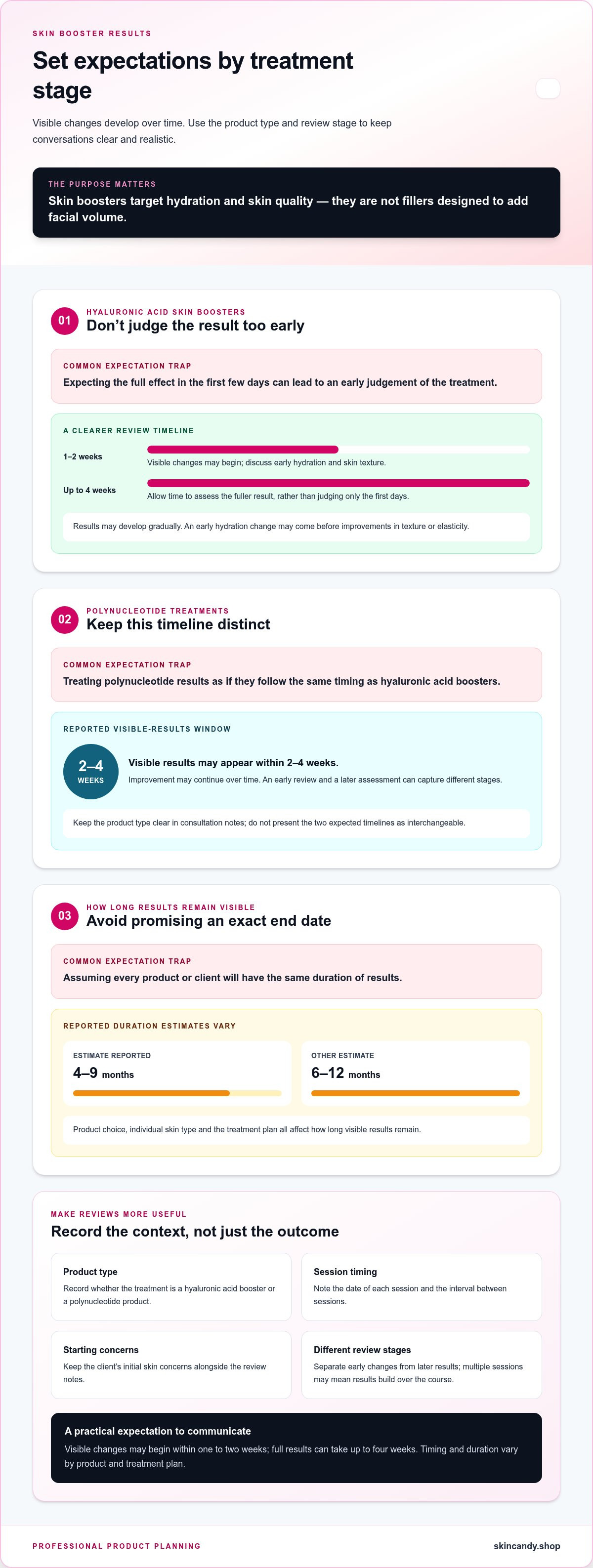
Visible changes after skin booster treatment may emerge within one to two weeks, while the full effect can take up to four weeks. These timelines can help you set realistic review points, but the product and treatment plan influence the outcome. Typical goals include hydration, smoother-looking fine lines and improved skin quality. Skin boosters are not fillers designed to add facial volume.
Results tend to develop over time rather than appear all at once. The treatment delivers ingredients into the skin, where their intended effects may become more noticeable gradually. An early change in hydration may come before improvements in texture or elasticity. Elastin is associated with skin elasticity, but no single visible change should be taken as a measure of every treatment’s outcome.
Polynucleotide treatment has a separate reported timeline: visible results may appear within 2-4 weeks, with continued improvement over time. This means an early review and a later assessment can capture different stages. Keep the product type clear in consultation notes, especially when comparing polynucleotides with hyaluronic acid boosters. Their expected timelines should not be presented as interchangeable.
Duration estimates also vary across skin booster products. Reported results typically last 4-9 months, while other estimates give 6-12 months. These ranges show why an exact end date should not be promised. Product choice, individual skin type and the treatment plan all affect how long visible results remain.
Use a practical review schedule to communicate timing clearly:
- At one to two weeks: discuss early visible changes, including hydration and skin texture.
- At up to four weeks: assess the fuller result, rather than judging only the first days.
- At 2-4 weeks for polynucleotides: consider the reported visible-results window and note that improvement may continue.
- At later reviews: record how long results remain visible, using the product’s reported duration range as context.
For a course of treatment, record the date of each session and the interval between sessions. Skin booster plans commonly involve multiple sessions, so results may build over the course rather than reflect one appointment alone. Clear records help distinguish an early response from later changes and support consistent conversations with clients. When comparing outcomes, note the product type, session timing and the client’s starting skin concerns.
In aesthetics, useful expectations are specific but not overstated. Explain that visible results may begin within one to two weeks, full results can take up to four weeks, and reported duration ranges from 4-9 months to 6-12 months. For polynucleotides, set the 2-4-week window separately. This gives clients a clear timeline without implying identical outcomes for every product or treatment plan.
Hyaluronic acid skin boosters
Hyaluronic acid skin boosters are injectable products intended to support hydration and skin quality, rather than add volume. The distinction matters: dermal fillers are used for volume, while skin boosters aim to improve the skin’s appearance. Treatment goals may include smoother texture, improved elasticity and a fresher-looking radiance. Let the product’s intended use and instructions for use guide professional selection.
Hyaluronic acid occurs naturally in the body and helps retain water in the skin. Its levels decline with age: after age 30, people lose approximately 1% of their hyaluronic acid stores per year. A booster is intended to support skin hydration, but it doesn’t replace a broader assessment of skin quality, concerns and treatment suitability.
Profhilo is a recognised name in the injectable hyaluronic acid category. Compare it with other boosters by intended purpose, product instructions and treatment plan, rather than assuming all formulations or protocols are identical. For example, the course schedule for Seventy Hyal 2000 initially spaces sessions four weeks apart. That schedule is product-specific, not a universal rule for every hyaluronic acid booster.
UK skin booster treatment prices are quoted by product and session, so compare like-for-like treatment plans rather than relying on a single average. Product choice, session number and the clinic’s treatment plan all affect the quoted cost. Understand a package price in relation to the sessions and products it includes.
Course planning can also differ. An initial skin booster course may involve 2-3 treatments, with most sessions spaced 2-4 weeks apart. Maintenance sessions may be recommended every 6-12 months. These are general planning ranges, not a schedule to apply automatically. The product’s instructions for use and the individual treatment plan determine the appropriate interval.
For a practical comparison, record these details for each product:
- Intended purpose: distinguish hydration and skin quality from volume enhancement.
- Course structure: note the recommended number of sessions and spacing.
- Maintenance plan: record the stated interval and what factors affect it.
- Product instructions: use the relevant instructions for use when planning treatment.
Hyaluronic acid boosters suit discussions focused on hydration and skin quality. Profhilo and Seventy Hyal 2000 illustrate why product names alone aren’t enough for planning: protocols can differ. Match the treatment plan to the product’s intended use, then explain the course and maintenance schedule clearly. This helps keep expectations, session planning and product selection aligned.
CE/UKCA marking and professional use
Skin boosters supplied for professional use are stated to carry CE/UKCA marking. The marking is one consideration when assessing a product, not a substitute for reading its instructions for use. Those instructions set out product-specific handling and use information. Before treatment, check that the product, packaging and accompanying instructions correspond. A marking alone does not establish that an injectable suits every patient or treatment goal.
Professional use matters because skin boosters are injectable products. Their intended purpose may be hydration or skin rejuvenation, rather than adding volume. Select a product to address the patient’s concern and follow its instructions for use. Discuss claims about stimulating collagen and elastin in the context of that product’s stated purpose, rather than assuming they apply to every booster.
Training and professional judgement remain central. The Scottish Government says healthcare professionals should be properly trained and qualified, and follow codes of practice and ethics. The Chartered Trading Standards Institute (CTSI) says consumers should only consider needle-based aesthetic treatments carried out by a qualified medical professional. These principles help patients distinguish a qualified consultation from a product-led sales conversation.
Before choosing a treatment, patients can ask which product is proposed, what it is intended to target and why it suits their concern. They can also ask about the practitioner’s qualifications and relevant training, the product instructions, the expected course and possible side effects. Clear answers help patients understand both the injectable and the person administering it.
For a UK clinic, a practical product review can follow these steps:
- Identify the marking: check whether the product is CE or UKCA marked, as applicable to its packaging.
- Read the instructions: use the product-specific instructions for use, including when considering treatment combinations.
- Match purpose to concern: distinguish hydration and skin quality goals from volume enhancement with dermal fillers.
- Document the rationale: record the selected product, its intended purpose and the treatment plan.
- Explain professional oversight: make the practitioner’s role, qualifications and relevant training clear to the patient.
For patients, the mark is a useful part of the conversation, but not the whole decision. Ask the clinic to explain how the product’s stated purpose relates to the planned treatment and what rejuvenation outcome it aims to support. For practitioners sourcing CE-marked skin boosters in the UK, consider the marking, product instructions and professional-use requirements together. This gives you a clearer basis for product selection and patient discussions without treating one mark as proof of individual suitability.
Common side effects
Redness, swelling and bruising are common, mild and temporary side effects of skin booster treatment. These are local changes to record after an injectable appointment, not evidence of improved texture or hydration. Explain these expected effects before treatment, then document the patient’s experience afterwards. Clear notes help distinguish a reported side effect from the intended treatment outcome.
Set expectations using the product and treatment plan as reference points. Seventy Hyal 2000, for example, has a product-specific course schedule; that schedule does not establish how an individual will respond. Avoid describing redness, swelling or bruising as signs that collagen production has increased. The reported effects are separate from the intended aims of skin quality treatments.
Structured records make follow-up conversations more useful. Note the product name, treatment date, injection areas and the patient’s description of each effect. Record redness, swelling and bruising separately rather than grouping them under a general label. This gives the practitioner a clearer account to review alongside the product instructions and treatment plan.
Keep comparisons with dermal fillers precise. Both are injectable aesthetic products, but their purposes differ: skin boosters focus on hydration and skin quality, while dermal fillers are associated with volume enhancement. Don’t imply that one category has the same side-effect profile as another. Discuss the product selected and the effects reported for skin boosters.
Use a consistent discussion and documentation process:
- Before treatment: explain that redness, swelling and bruising are common mild, temporary effects.
- Identify the product: record its name, such as Seventy Hyal 2000, and refer to its instructions for use.
- After treatment: note which effects the patient reports and where they occurred.
- At follow-up: compare the account with the original record and treatment plan.
Keep intended benefits separate from immediate observations. Terms such as “stimulate”, “collagen production” and “improve texture” describe treatment aims, not proof that a particular response has occurred. For example, record a patient’s report of swelling as a side effect. Don’t present it as evidence of rejuvenation or increased collagen and elastin.
Consistent wording also supports informed conversations throughout a course of treatment. Use the same categories at each appointment, whether discussing a hyaluronic acid booster or another injectable. This helps clinics record what the patient reports without overstating what caused it. Keep the discussion factual: redness, swelling and bruising are common, mild and temporary, while treatment goals concern hydration and skin quality.
Skin booster brands supplied in the UK
Popular skin boosters differ in their ingredients, intended effects and treatment schedules. Hyaluronic acid products focus on hydration and skin quality, while polynucleotides are DNA fragments derived from salmon or trout. Product instructions and clinical judgement should guide selection; brand names alone don’t show that two treatments are interchangeable.
Seventy Hyal 2000 provides a schedule example: initial treatments are spaced four weeks apart. Other skin booster courses commonly involve 2-3 treatments, with most sessions spaced 2-4 weeks apart. These are planning examples, not one protocol for every product. Follow the relevant instructions for use and base the course on the product selected.
NCTF 135 HA is described as containing over 50 ingredients. Its formulation therefore differs from a product based on hyaluronic acid alone. The ingredient list is only one comparison point. A clinic should also assess the product’s intended purpose, instructions and the concern being treated, such as hydration or skin texture.
Polynucleotides provide a different ingredient category. They are purified DNA fragments originally derived from salmon or trout. Their stated treatment aims include stimulating collagen, elastin and tissue repair. Visible results are reported within 2-4 weeks, with continued improvement over time. This timeline differs from the initial course spacing used for some hyaluronic acid products, so don’t treat result timing and session intervals as the same measure.
Compare products against practical criteria before selecting a treatment for your clinic:
- Ingredients: distinguish hyaluronic acid formulations from polynucleotide products and multi-ingredient formulations such as NCTF 135 HA.
- Intended outcome: clarify whether the treatment aims to support hydration, skin quality or another stated concern, rather than volume.
- Schedule: record the product-specific session interval; Seventy Hyal 2000 uses four-week spacing initially.
- Instructions: use each product’s instructions for use when choosing a product or considering combinations.
- Review timing: separate the treatment interval from the period in which results may become visible.
For a clinic, the useful comparison is not a simple ranking. It is a match between ingredients, intended results and a workable treatment course. Assess skin firmness or quality goals against the product’s stated purpose, rather than making assumptions based on its name. Don’t present a treatment intended to improve hydration as a volume treatment like dermal fillers.
Use clinical judgement, appropriate training and the relevant instructions for use when selecting a skin booster or considering combinations. This keeps decisions grounded in the product, rather than assumptions about a whole generation of treatments. Compare product details and treatment schedules to identify options that fit your clinic’s treatment plans.
Skin Candy: Lumi Meso
Skin Candy supplies Lumi Meso as a skin booster option for UK professionals sourcing products for clinic use. Review its intended purpose and product instructions alongside your treatment plans, as you would with any injectable. Skin Candy also supplies polynucleotides, chemical peels and fat dissolving agents, giving practitioners related product categories to consider for different aesthetic needs.
Choose products according to their stated use and your professional judgement. For a closer look at Lumi Meso and other professional aesthetic products, visit Skin Candy’s online shop.
Plan your next product selection
Make your next step a focused product review. Match each option to your clinic’s treatment approach, patient needs and product instructions, then organise procurement around the products you intend to use. For professionals sourcing CE marked skin boosters UK, a clear selection process helps align clinical planning with product choice.
Skin Candy supplies Lumi Meso, polynucleotides and professional dermal fillers for aesthetic use. Explore the range when you’re reviewing options for your clinic, or contact Skin Candy about skin boosters to discuss your product requirements. A considered choice supports confident planning and a more streamlined purchasing process.
Frequently Asked Questions
What Are Skin Boosters?
Skin boosters are injectable treatments used to support hydration and skin quality, rather than create the volume associated with dermal fillers. Formulations vary, so the term covers more than one ingredient type. For example, hyaluronic acid boosters and polynucleotide treatments have different compositions and stated purposes. When comparing options, check the specific product’s instructions for use rather than assuming every treatment called a skin booster works in the same way.
What does the CE mark mean for skin boosters sold in the UK?
A supplier may describe skin boosters as CE-marked or CE/UKCA-marked and intended for professional use. Assess the marking alongside the product’s intended purpose, packaging and instructions for use. It doesn’t tell you whether a product suits a particular patient or treatment plan. Identify the exact product and review its documentation rather than relying on the category name alone.
Which skin booster products are CE marked and available in the UK?
Products and markings vary, so assess each product individually. Skin Candy supplies Lumi Meso and polynucleotides as professional aesthetic products. Don’t assume every product in either category has identical marking or instructions. For a specific product, compare the name and identifiers on its packaging with its accompanying documentation, then use the instructions for use to assess its intended purpose.
Are CE-marked skin boosters regulated as medical devices in Great Britain and Northern Ireland?
Don’t infer a product’s regulatory status from the words “skin booster” alone. Great Britain and Northern Ireland are distinct markets, and the applicable product route depends on the specific product and its intended purpose. To assess a product, first identify it and its intended use, then review its conformity documentation and relevant market information. A CE mark alone doesn’t establish that the product is appropriate for every clinical use.
What UK rules apply to importing and selling CE-marked skin boosters after Brexit?
Importing and selling requirements depend on the product and whether it is intended for Great Britain or Northern Ireland. Before supply, organise a product file with its identifiers, manufacturer details, conformity documentation, instructions for use and intended market. These records support a consistent assessment and help avoid treating every booster as interchangeable. Don’t rely on a CE mark alone to resolve market-specific import or sale requirements.
How can patients check whether a skin booster is genuinely CE marked and registered with the MHRA?
Patients can ask the clinic for the exact product name and look at its packaging and accompanying documentation. Compare the manufacturer and product identifiers across those materials, then ask how the product’s MHRA registration information relates to the treatment being offered. A mark printed on packaging alone may not answer every question about the specific product. Clear identification makes the discussion more useful and helps avoid confusion between similarly named treatments.
Who is legally qualified to administer skin booster injections in the UK?
The Chartered Trading Standards Institute (CTSI) advises consumers to consider needle-based aesthetic treatments only when they are carried out by a qualified medical professional. The Scottish Government says healthcare professionals should be properly trained and qualified, and follow codes of practice and ethics. These statements can guide patient decisions, but they don’t provide a complete legal list of every eligible profession. Ask who will perform the injection and what relevant qualifications and training they hold.
What are the risks, side effects, and contraindications of skin booster injections?
Common mild, temporary effects include redness, swelling and bruising. The product’s instructions for use provide relevant product-specific information, including precautions and contraindications. Before proceeding, patients should discuss their medical history, current medicines, allergies and the proposed product with the treating professional. Ask what symptoms need follow-up and how to report them. This keeps the conversation focused on the chosen injectable, rather than assuming every booster carries identical risks.