
Can You Combine Polynucleotides and Fillers for Facial Ageing?
Yes, you can combine polynucleotides and fillers. They address different signs of facial ageing: polynucleotides support skin quality, while hyaluronic acid fillers restore volume and contour. They can be planned as part of the same treatment journey, either in selected same-day combinations or separate sessions, depending on the area and treatment goals.
It’s easy to assume one injectable treatment must replace the other. In practice, fillers provide immediate structural change, while polynucleotide results develop progressively as skin hydration, texture and elasticity improve. Used thoughtfully, they can complement rather than cancel each other out.
This guide explains what polynucleotides are, how they differ from fillers, and why treatment order and timing matter. You’ll also learn which facial areas may benefit from both, how results develop, and what maintenance can involve. This provides a clearer basis for understanding a combined approach to facial ageing.
Key Takeaways
- Polynucleotides support skin quality, while hyaluronic acid fillers restore volume and contour. Understanding this difference helps clarify what each treatment may contribute.
- The under-eye area, neck and area around the mouth may be considered for polynucleotide treatment, with the plan tailored to the concern and facial area.
- Tear-trough filler and polynucleotide treatments are commonly staggered by 2-4 weeks, allowing the filler result and initial response to be assessed.
- Results develop on different timelines: filler provides immediate volume, while polynucleotide effects emerge progressively. Maintenance depends on the treatment and the area.
- Explore how treatment order, spacing and review can shape a combined plan before considering further treatment.
Q3) What areas of the face can be treated with both polynucleotides and fillers?
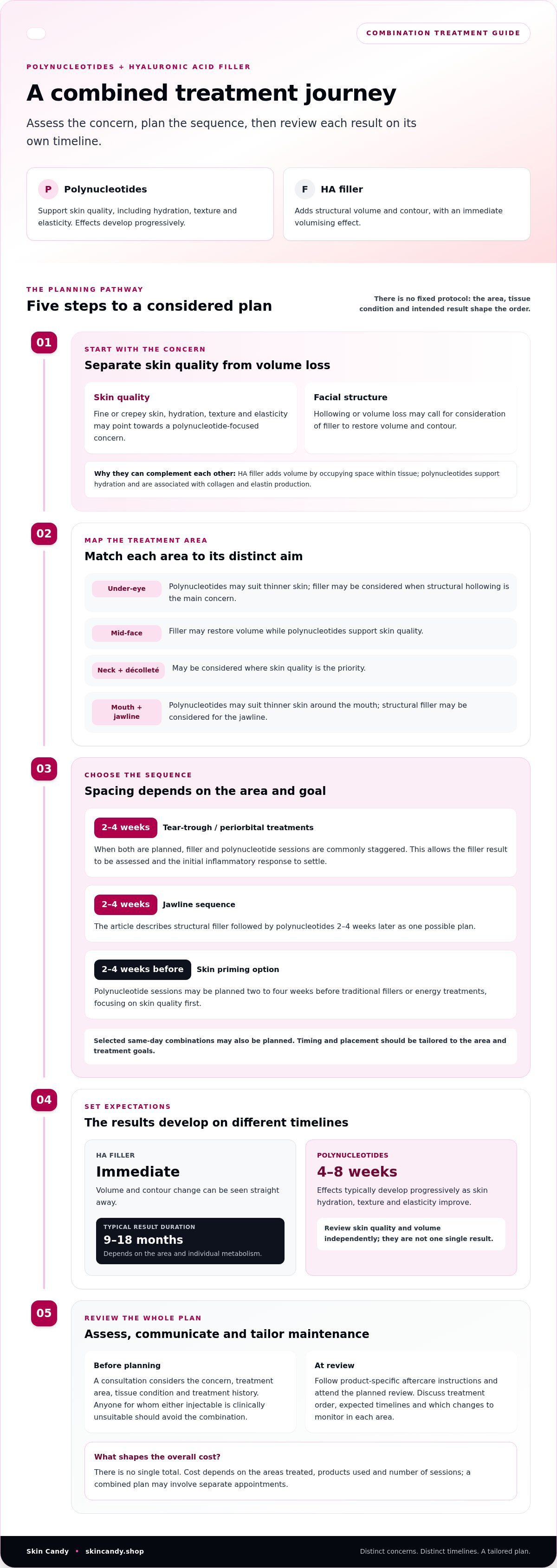
Yes, you can combine polynucleotides and fillers in selected facial areas. The under-eye region, mid-face, neck and décolleté may be considered, but each treatment addresses a different concern. Polynucleotides target skin quality, while filler adds structural volume. A consultation assesses the concern, tissue condition and treatment area before planning the sequence.
The tear trough needs particular care. For an extremely hollow under-eye area, filler may be considered first to address the structural deficit, with polynucleotides added later as a complementary treatment. Separating periorbital filler and polynucleotide sessions by 2-4 weeks allows the filler result to be assessed and the initial inflammatory response to settle. Staggering also makes it easier to review each treatment’s contribution.
Other areas call for a different plan. Polynucleotides may suit thinner skin around the eyes or mouth, and the neck and décolleté may benefit where skin quality is the priority. In the mid-face, filler can restore volume while polynucleotides support skin quality. The jawline may also be considered for structural filler, followed by polynucleotides 2-4 weeks later.
Skin priming can be another part of the sequence. Polynucleotide sessions may be planned two to four weeks before traditional fillers or energy treatments. This approach focuses on skin quality first, then introduces structural treatment where volume loss remains. It isn’t a fixed protocol: the area, tissue response and intended result shape the order.
Combined treatment may address skin hydration and texture alongside volume and contour. Polynucleotide effects typically develop over 4-8 weeks, while filler results are immediate. Dermal filler results typically last 9-18 months, depending on the area and individual metabolism. These separate timelines mean follow-up should assess skin quality and volume independently, rather than treating the face as one result.
How much do polynucleotide and filler combination treatments cost in the UK? There is no single total: the cost depends on the areas treated, products used and number of sessions. A combined plan may involve separate appointments, so these factors determine the overall cost.
Are polynucleotides and hyaluronic acid fillers compatible in the same facial area? Yes, they can complement each other when planned for distinct concerns and appropriately sequenced. Who should avoid combining them? Anyone for whom either injectable is clinically unsuitable should avoid the combination. Treatment history, tissue condition and the area being treated inform that assessment.
What aftercare is recommended when combining polynucleotides and fillers? Follow the treating clinician’s product-specific aftercare instructions and attend the planned review. Clear patient communication should cover treatment order, expected timelines and which changes to monitor in each treated area.
Q4) Do polynucleotides and fillers cancel each other out if used close together?
No. Polynucleotides and hyaluronic acid (HA) fillers work through different mechanisms, so one does not simply cancel the other. HA filler adds volume by occupying space within tissue. Polynucleotides act through A2AR receptor agonism and support hydration, collagen and elastin production. Their distinct roles can address skin quality and facial structure within one treatment plan.
This difference matters when planning aesthetic treatment. A patient concerned about fine, crepey under-eye skin may need attention to skin quality, while hollowing reflects a loss of structural volume. Polynucleotides may support thinner skin in that area; filler can address volume loss. The aim is to match each product to the concern, rather than asking one treatment to perform both roles.
Polynucleotides are long chains of nucleotides, the building blocks of DNA and RNA. Injected into the skin, they attract water and support tissue hydration. Their cellular activity is associated with collagen and elastin production, which can improve elasticity, texture and tone over time. This is progressive regeneration, not the immediate contour change associated with HA filler.
That distinction explains why close timing does not automatically create a conflict. PDRN does not dissolve HA filler, and filler does not suppress the A2AR mechanism. A clinician can therefore consider both treatments for related concerns, while planning placement and timing for the specific facial area. The treatments remain complementary, rather than interchangeable.
For under-eye concerns, assessment should distinguish skin quality from structural hollowing. Polynucleotides may suit thin skin, while filler may be considered when volume loss is the main issue. If both are planned, spacing the sessions can make each response easier to assess. The patient should understand that skin-quality changes develop progressively, unlike filler’s immediate volumisation.
What UK qualifications should a practitioner have to administer polynucleotides and fillers? Look for relevant clinical qualifications, injectable-specific training, and competence in facial anatomy and complication management. The practitioner’s experience with the treatment area and product should also inform the discussion. No single credential, on its own, demonstrates competence in every injectable procedure.
Combining treatments can make sense when a plan addresses both tissue quality and volume loss. It is less useful when the concern relates to only one of these aims, or when either injectable is unsuitable for the patient. A clear consultation should explain each product’s intended role, why the sequence is appropriate, and how progress will be reviewed.
How polynucleotides and dermal fillers address different signs of ageing
Polynucleotides and dermal fillers target different changes associated with facial ageing. Polynucleotides support hydration, elasticity, texture and tone. Hyaluronic acid (HA) dermal fillers restore volume, soften wrinkles and enhance facial contours. Matching treatment to the concern helps distinguish skin-quality changes from structural volume loss.
Common HA fillers are gels made from cross-linked hyaluronic acid. Their effect is mechanical: the gel occupies space to restore volume or contour immediately. For example, a clinician may consider filler when mid-face volume loss affects facial proportions. Filler placement differs from that of polynucleotides, which are placed in the mid-to-deep dermis.
Polynucleotides attract water in the skin and support tissue hydration. They also promote collagen production and can progressively improve skin elasticity, texture and tone. This makes them relevant when the concern is skin quality rather than a hollow area needing volume. Their effects typically become noticeable after a few weeks, not immediately.
Using both treatments can address separate concerns within the same overall plan. A patient with cheek volume loss and changes in skin texture may have structural support considered alongside regenerative treatment. The distinction matters: adding filler doesn’t replace a skin-quality approach, and polynucleotides don’t provide the same physical volumisation as HA gel.
Can polynucleotides and fillers be injected at the same appointment? They may be used on the same day in selected circumstances, but separate sessions are also an option. The area, product placement and treatment aims shape the sequence. Planning should keep structural correction distinct from progressive skin-quality treatment.
Some clinicians introduce polynucleotides before fillers. One approach uses 2-3 polynucleotide sessions, spaced 2-4 weeks apart, before adding dermal filler. A suggested skin-preparation schedule places polynucleotide sessions in weeks 1-3 and filler placement in week 4. This gives the regenerative treatment a defined place in the plan before volume is addressed.
That sequence isn’t the only option. Filler may be placed first, with polynucleotides introduced afterwards as a complementary treatment. HA filler creates an immediate change, while polynucleotide results develop progressively. The plan should account for these different timelines and assess the facial concern each treatment is intended to address.
For a clear comparison, the patient should understand which concerns each injectable targets: HA filler for volume and contour, polynucleotides for hydration and skin quality. A consultation can map the areas, placement planes and sequence before treatment. This helps set realistic expectations for the immediate structural effect and slower regenerative response.
Duration of results and maintenance
Dermal filler results typically last 9-18 months, depending on the treated area and individual metabolism. Polynucleotide results develop over 4-8 weeks, so their timeline differs from filler’s immediate volume change. Plan reviews around the distinct effects: assess facial structure and skin quality separately, rather than expecting both treatments to fade together.
The timing of maintenance can vary, so review the skin response before deciding whether another session is needed. Products can continue working during the first 12 weeks after treatment, so reviewing too early may not show the full skin response. A planned review can consider hydration, texture and collagen-related changes before scheduling another session.
For maintenance, polynucleotide top-ups are commonly recommended every 6-9 months to maintain skin quality. Dermal filler top-ups are typically considered every 9-18 months, depending on the treated area. These intervals are not interchangeable: a patient may need to review under-eye skin quality separately from cheek volume or jawline definition.
A full-face plan should track each area and treatment date. For example, record the dates of polynucleotide sessions, filler placement, treated zones and changes noted at review. This provides a clearer basis for deciding whether fine lines, skin texture or volume loss need attention, rather than adding treatment automatically across the whole face.
One combined-treatment schedule introduces filler around 10-12 weeks into the treatment journey, with a skin review at 10-12 weeks. In that plan, polynucleotide sessions are spaced 4 weeks apart. This is an example of sequencing, not a universal timetable. The interval between intensive sessions also gives the skin time to respond without overloading it.
Filler may fade within months for some patients and remain detectable years later for others. Appearance alone cannot confirm that all previous filler has gone. Reassess the treated area before adding more, especially if repeated volume restoration could change facial proportions. Review the original concern, current tissue and existing filler together.
At each appointment, compare the treatment goal with the current result. If the aim was to restore cheek volume, assess contour and support; if it was to improve skin quality, review texture and hydration. Base maintenance decisions on those outcomes. A calendar interval is a prompt to review, not an automatic instruction to repeat treatment.
Combining fillers with polynucleotides
A combined plan works best when each injectable has a defined role. Polynucleotides support skin quality, while filler addresses structural volume. The clinic first maps the ageing concern, treatment area and existing filler. This assessment guides whether treatments are separated, performed together or planned in sequence.
One approach uses 3-4 polynucleotide sessions spaced 2-3 weeks apart, with filler planned between or after them. Another common sequence begins polynucleotide treatment 2-4 weeks after filler. That interval allows the filler result to be assessed and the initial inflammatory response to resolve. These are planning options, not a single timetable for every face.
Area matters. For structural filler around the eyes, separating polynucleotide treatment by 2-4 weeks supports assessment of each response. In the lower face and jawline, treatment order should be chosen according to the area and individual plan. For the mid-face and cheeks, a same-session combination may be considered, or filler may precede polynucleotides by 2-4 weeks.
Same-day treatment is possible in selected circumstances. The decision depends on the area, injection planes and whether each product has a distinct purpose. For example, a clinic may plan low-volume filler for structure and a separate polynucleotide course for skin quality. Keeping those aims clear helps explain what each injectable is intended to achieve.
Order also affects how progress is reviewed. Filler creates an immediate structural change, while polynucleotide effects develop progressively. A staged plan lets the practitioner assess the filler outcome before adding another treatment. It also helps the patient understand which changes relate to volume and which to skin quality.
Before treatment, the consultation should establish the main concern, such as cheek volume loss, under-eye skin quality or lower-face definition. It should also record previous injectables and their locations. Product selection and placement matter because filler can take on water or spread beyond its original placement. Existing filler should be reassessed before planning additional volume.
For combined treatments, use CE-marked, high-quality products and allow sufficient time between intensive sessions. The practical takeaway is to plan by area and treatment goal, not to assume both injectables belong in one appointment. To support your clinic’s treatment planning, browse professional aesthetic products.
Skin Candy: Lumi Meso
Skin Candy supplies Lumi Meso and professional aesthetic products for clinics planning injectable treatment ranges. Practices can explore the relevant product categories and select stock that fits their clinical protocols. Skin Candy also supplies Polynucleotides, Fat Dissolving Agents and Chemical Peels.
Use product information to support procurement decisions and align stock choices with the treatments your clinic provides. This is a supply option for practitioners, not an in-clinic treatment or training service. For details on the available range, visit Skin Candy’s website.
Plan your next treatment decision
If you're asking whether you can combine polynucleotides and fillers, focus your next discussion on the concern each treatment is meant to address. A clear plan starts with your priorities, the areas involved and any previous injectable treatment. This gives the practitioner a practical basis for discussing sequence and review.
For clinics sourcing products for these treatment plans, Skin Candy offers professional dermal fillers, meso products and polynucleotides. These products support practitioners planning professional aesthetic stock around their clinic's approach. Skin Candy supplies products rather than providing in-clinic treatments, so clinical decisions remain part of the practitioner's care planning.
Skin Candy can help you explore its relevant product range for your clinic's procurement needs. Contact Skin Candy to discuss your options. Take the next step with a clear view of your treatment goals and the products your practice needs.
Frequently Asked Questions
What are polynucleotides?
Polynucleotides are chains of nucleotides, the building blocks of DNA and RNA. Injectable products may contain DNA fragments derived from wild salmon. In the skin, they attract water and support hydration, while their biological activity is associated with collagen and elastin production. Unlike filler, which creates immediate volume, their visible effects develop progressively. Their role is to support skin quality, not replace lost facial structure.
Who is the right candidate for combining both treatments?
A suitable candidate has distinct concerns that each injectable may address, such as skin-quality changes alongside facial volume loss. Age alone doesn’t determine suitability: combining treatments may become more relevant from the mid to late 30s as structural volume loss begins, whilst significant volume loss can still make fillers important for people in their 60s and above. Previous injectables, treatment area and tissue condition also shape the plan.
Can polynucleotides replace fillers as I get older?
No. Polynucleotides don’t provide the structural volume restoration that fillers offer, so they aren’t a direct substitute when facial hollowing or contour loss is the concern. Instead, they may support skin hydration, elasticity and texture. For example, someone noticing both thinner skin and cheek volume loss may have different treatment goals for each issue. The appropriate approach depends on the concern, not age alone.
Can polynucleotide injections be combined with dermal fillers in the same treatment plan?
Yes, you can combine polynucleotides and fillers in one treatment plan when each has a clear purpose. A plan might address skin quality with polynucleotides and structural volume with filler, using separate sessions or selected same-day treatment. The facial area and injection placement influence the sequence. A practitioner should also review previous treatment and existing filler before planning further injections.
How long should you wait between polynucleotide treatment and dermal fillers?
A common approach begins polynucleotide treatment 2-4 weeks after filler, allowing time to assess the filler result and initial response. For skin priming before filler, a plan may use 2-3 polynucleotide sessions spaced 2-4 weeks apart. The interval depends on the area and sequence. Around the eyes, separating structural filler and polynucleotides by 2-4 weeks is recommended in the treatment guidance.
Which should be done first, polynucleotides or dermal fillers?
There isn’t one order for every treatment plan. Polynucleotides may come first when the aim is to prepare skin before adding structural volume; filler may come first when volume loss is the primary concern. For example, a skin-preparation schedule places polynucleotide sessions in weeks 1-3 and filler in week 4. The area, treatment goal and previous injectable history guide the sequence.
What are the risks of combining polynucleotides and dermal fillers?
Combining treatments means considering the response to each injectable, including swelling after filler, which usually resolves within 24-48 hours. Polynucleotide products cannot be dissolved or reversed in the way hyaluronic acid fillers can; HA filler can be reversed with hyaluronidase. This difference matters when discussing treatment choices and complications. The practitioner should explain product-specific risks, placement and the plan for managing an adverse response before treatment.