Best Tear Trough Fillers: A Practitioner's Guide (2026)
The periorbital region is the most unforgiving zone in aesthetic medicine. A single millimetre of depth or a slight rheological mismatch determines the difference between a refreshed gaze and persistent malar oedema. You know that patient satisfaction in this delicate area relies on more than just steady hands. It requires a product that integrates seamlessly without the dreaded Tyndall effect or long-term migration. Finding the best filler for tear trough correction shouldn't feel like a gamble with your clinic's reputation or your monthly margins.
This guide provides the technical clarity needed to master periorbital injectables. We compare the rheology of premium HA fillers like Lumifil and Regenovue against the regenerative benefits of polynucleotides. You'll learn how to select the right viscosity for every tissue type, reduce post-procedure complications, and optimise your clinic procurement for maximum efficiency. By matching the right injectable to the specific anatomical requirements of the tear trough, you can ensure clinical excellence and predictable results every time. We've analysed the latest data to help you make informed, confident decisions for your patients.
Key Takeaways
- Understand how the unique anatomy of the nasojugal groove dictates the need for specific product rheology to avoid malar oedema and lumps.
- Learn to evaluate G-prime and cohesivity to identify the best filler for tear trough correction that ensures seamless tissue integration without migration.
- Compare the immediate structural support provided by HA fillers with the regenerative, skin-thickening benefits of polynucleotides for long-term results.
- Discover why high-purity brands like Lumifil and Regenovue are preferred for reducing the risk of the Tyndall effect in thin periorbital skin.
- Optimise your clinic's procurement strategy by leveraging reliable UK distribution for next-day delivery of high-demand aesthetic consumables.
Understanding the Challenges of Periorbital Rejuvenation
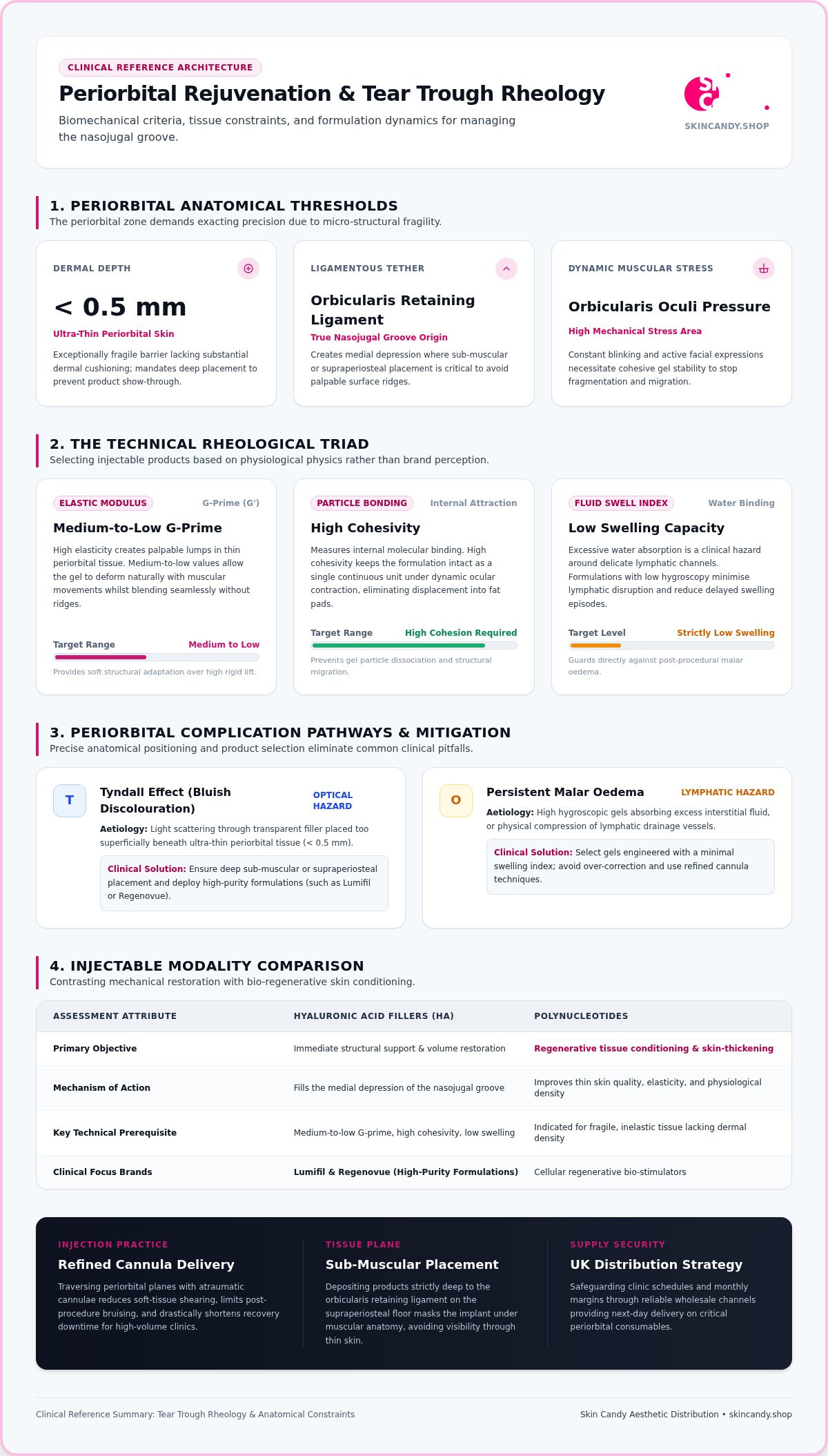
The periorbital region presents a unique set of clinical hurdles. Unlike the mid-face or lips, the under-eye skin is exceptionally thin, often measuring less than 0.5mm. This fragility, combined with dense vascularity and complex lymphatic pathways, makes it a high-risk zone for any aesthetic practitioner. Choosing the best filler for tear trough correction requires a deep understanding of these anatomical constraints to avoid common pitfalls like the Tyndall effect or persistent malar oedema.
The Anatomy of the Tear Trough
Correct identification is the first step toward clinical success. The true tear trough, or nasojugal groove, is a medial depression caused by the tethering of the orbicularis retaining ligament. Practitioners must distinguish this from the palpebromalar groove, which extends laterally. Successful placement usually occurs sub-muscularly, deep to the ligament, to prevent the product from being visible through the thin dermis. If the patient's skin quality is poor or lacks elasticity, the filler rheology must be even more precise to prevent surface irregularities or visible lumps.
The choice of injectable dermal fillers for this area hinges on three technical factors: cohesivity, G-prime, and hygroscopy. High water-binding capacity is a significant liability in the periorbital zone; it leads to delayed swelling and patient dissatisfaction. Malar oedema is perhaps the most frustrating complication. It occurs when filler obstructs lymphatic drainage or absorbs excessive interstitial fluid. This is why the best filler for tear trough correction must have a low swelling index and stay exactly where it is placed whilst integrating with the surrounding tissue.
Practitioner Goals for Correction
Your primary objective is a seamless blend. A successful result eliminates the shadow of the nasojugal groove without creating a palpable ridge or an overfilled appearance. Stability is also vital. Because the periorbital area is highly mobile due to constant blinking and facial expressions, the filler must withstand muscular contraction without fragmenting or migrating.
Minimising downtime is a commercial necessity for high-volume clinics. Patients expect to return to their daily routines without visible bruising or significant swelling. Achieving this requires a combination of refined cannula technique and a product with high tissue integration properties. By prioritising low-swelling profiles and high-purity HA or polynucleotides, you reduce post-procedure complications and safeguard your clinic's reputation for safety and reliability.
Key Rheological Properties for Tear Trough Fillers
Selecting the best filler for tear trough correction isn't just about brand names; it's about physics. The rheological properties of hyaluronic acid fillers dictate how a gel behaves under the constant pressure of the orbicularis oculi and how it integrates with the surrounding fat pads. If the rheology is wrong, even the most skilled injector will face complications like migration or visible product.
G-Prime, or elastic modulus, measures a filler's ability to resist deformation. In the mid-face, high G-prime provides essential lift. However, in the periorbital area, high elasticity often leads to palpable lumps and poor blending. This is why a medium-to-low G-prime is a hallmark of the best filler for tear trough correction. It allows the gel to move naturally with facial expressions whilst maintaining enough structure to fill the nasojugal groove without creating a ridge.
Cohesivity is equally critical. It describes the internal attraction between HA molecules. High cohesivity ensures the filler stays as a single unit rather than fragmenting into smaller particles that could migrate or cause irregularities under thin skin. You need a product that holds its shape but spreads smoothly during the initial massage.
Evaluating Viscoelasticity
Viscoelasticity determines the tactile result of your injection. When placing filler at the supraperiosteal level, you need a product that mimics the underlying bone's support but feels like natural soft tissue upon palpation. Rheology in the periorbital region is the study of how injectable gels flow and deform under physiological stress to ensure patient safety. For practitioners, this means choosing products that balance spreadability with structural integrity.
Water Absorption and Oedema Risks
Hygroscopic capacity is a primary cause of post-procedure dissatisfaction. High HA concentrations, particularly in biphasic fillers, can attract excessive water. This leads to the "puffy" morning-after look that many patients dread. Monophasic fillers generally offer more predictable results in this zone because they integrate more uniformly. The "sweet spot" for HA concentration in tear trough products usually sits between 15mg/ml and 20mg/ml. This range provides sufficient volume without the risk of significant fluid retention.
Balancing longevity with safety is the final piece of the puzzle. While high cross-linking density extends the product's life, it can make the filler harder to dissolve in an emergency. You need a gel that lasts 9 to 12 months but remains highly sensitive to hyaluronidase. If you're looking to refine your inventory with technically superior products, you can browse our professional range of low-hygroscopic fillers designed for precision work.
HA Fillers vs Polynucleotides: Which is Best for Under-Eye Correction?
The evolution of periorbital treatments has moved beyond simple volume replacement. Whilst hyaluronic acid (HA) remains the primary tool for correcting deep structural hollows, polynucleotides have introduced a regenerative dimension to modern clinic portfolios. Choosing the best filler for tear trough correction often involves deciding whether the patient requires immediate structural support or long-term dermal thickening. These two categories of injectables serve distinct clinical purposes and are frequently used in tandem to achieve optimal results.
The Case for Traditional Dermal Fillers
Hyaluronic acid fillers are unmatched for providing immediate gratification. For patients with a clear nasojugal groove and good skin elasticity, HA provides an instant bridge between the lower eyelid and the cheek. The primary clinical advantage is reversibility. Having the option to use hyaluronidase provides an essential safety net in a region prone to vascular complications and lymphatic obstruction. You can explore why Lumifil Dermal Filler is leading the UK market in 2026 for its balance of safety and predictable integration. Adhering to FDA guidance on soft tissue fillers is vital to mitigate risks like intravascular injection, particularly in the high-risk periorbital zone.
The Rise of Polynucleotides
Polynucleotides represent a bio-regenerative shift in aesthetic medicine. These DNA fragments stimulate fibroblasts to produce collagen and elastin without the significant water-binding weight of traditional HA. They're particularly effective for patients with dark circles caused by thin skin or vascular congestion, issues that fillers often fail to fix or even exacerbate. By thickening the dermis, polynucleotides create a more resilient foundation for the under-eye area. Our guide on polynucleotide indications for aesthetic clinics details how these products address skin quality rather than just volume.
The most successful practitioners often employ hybrid protocols. Treating the area with polynucleotides first can improve the skin's structural integrity, making it safer to follow up with a low-G-prime HA filler for final volume refinement. This staged approach minimises the risk of the Tyndall effect and reduces the total volume of product required. It ensures a natural transition between facial zones whilst respecting the delicate lymphatic system of the lower lid. Patient selection is key; those with deep hollowing require the lifting capacity of HA, whilst those with skin laxity and pigmentation will benefit more from a regenerative course.
Top Professional Filler Brands for Your Clinic Portfolio
Clinic success depends on balancing clinical safety with healthy margins. Choosing the best filler for tear trough correction involves selecting brands that offer predictable rheology and high purity levels. For UK practitioners, Lumifil and Regenovue have become staples due to their consistent performance in the delicate periorbital zone. These brands provide the technical reliability required to treat high-risk areas whilst ensuring the procurement process remains cost-effective.
Lumifil for Periorbital Precision
Lumifil's range is engineered for seamless integration into the sub-orbicularis oculi fat (SOOF). Its low extrusion force is a significant advantage for practitioners using micro-droplet techniques; it allows for precise placement without the risk of over-correction. This controlled delivery is essential when working near the infraorbital margin where space is limited. Practitioner feedback frequently highlights its impressive longevity, with many reporting results that remain stable for up to 12 months. This durability, combined with high tissue integration, makes it a reliable choice for avoiding the Tyndall effect in thin-skinned patients.
Regenovue and Aesossa: Reliable Alternatives
Regenovue Fine is frequently cited as a top-tier entry-level option for under-eye work. It provides high-purity HA that integrates quickly, reducing the likelihood of initial inflammatory responses that can lead to migration. For clinics prioritising patient comfort, Aesossa dermal filler offers a smooth extrusion profile and advanced cross-linking technology. This technology is specifically designed to reduce hygroscopic swelling, which directly minimises the risk of post-procedure malar oedema.
- Regenovue Fine: Excellent for superficial hollowing and fine lines.
- Aesossa: High cohesivity for stable, long-term correction.
- Teofil and Volifil: Niche options that cater to specific patient skin types and varied anatomical requirements.
Maintaining clinic margins shouldn't mean compromising on safety. By selecting these high-performance brands, you ensure patient satisfaction whilst protecting your procurement budget. These products allow you to deliver premium results without the "premium brand" price tag that often eats into your profitability. You can order these professional filler brands for next-day delivery across the UK to keep your clinic running at peak efficiency.
Streamlining Your Clinic Procurement for Tear Trough Treatments
Mastering the clinical application of periorbital injectables is only half the battle for a successful practice. Maintaining a consistent, reliable supply of the best filler for tear trough correction is essential for operational continuity. High-value consumables like Lumifil or Regenovue represent a significant portion of your clinic's overhead. Overstocking leads to tied-up cash flow, whilst understocking results in cancelled appointments and damaged patient trust. Adopting a just-in-time inventory model allows your business to operate lean without sacrificing service quality.
Sourcing your products through regulated UK channels is the only way to ensure product authenticity. Grey-market imports carry severe clinical risks, including unpredictable rheology and potential contamination, which could jeopardise your patients and your professional registration. A reliable UK supplier acts as a vital partner, providing the logistical confidence you need to manage a busy treatment schedule. Wholesale accounts offer the added benefit of bulk pricing, protecting your margins against the rising costs of premium aesthetic supplies.
Next-Day Delivery and Logistical Excellence
Logistical excellence is the backbone of a high-performance clinic. Skin Candy provides same-day fulfilment and next-day delivery across the UK, ensuring your treatment room is always stocked for the day's bookings. This rapid replenishment model reduces the capital tied up in stock, allowing you to reinvest those funds into clinic marketing or staff training. To refine your operational strategy, see our guide on Mastering Aesthetic Clinic Procurement UK: The 2026 Just-in-Time Logistics Guide. Reliable delivery options mean you can respond to short-notice patient requests with total confidence.
Partnering with Skin Candy
Choosing a dedicated distribution partner provides more than just a transaction; it offers a competitive advantage. As an official distribution partner for Lumifil, Regenovue, and Aesossa, we guarantee that every syringe meets strict medical-grade standards. This partnership also ensures you are amongst the first to access the latest industry innovations, from regenerative polynucleotides to advanced exosomes. Professional wholesale support serves as the silent engine behind the commercial success of leading UK aesthetic practitioners. By standardising your procurement with a trusted wholesaler, you ensure that every patient receives a consistent, high-quality result, session after session.
Mastering Periorbital Excellence and Clinic Efficiency
Successful periorbital rejuvenation requires a precise balance of low-hygroscopic HA and high-cohesivity gels to prevent migration. Integrating polynucleotides alongside traditional fillers allows you to treat both volume loss and dermal thinning for more comprehensive, long-term results. Identifying the best filler for tear trough correction is the first step toward reducing complications like malar oedema and the Tyndall effect whilst protecting your professional reputation.
As the official UK distributor for Lumifil and Regenovue, Skin Candy provides the technical support and logistical speed your practice demands. We offer next-day delivery as standard across the UK to ensure your treatment room stays fully stocked without tying up excess capital. Our wholesale model is designed to support your growth by providing reliable access to the latest medical-grade innovations. Register for a professional wholesale account and secure next-day delivery on all tear trough fillers today. Elevate your clinical outcomes and streamline your operations with a partner who understands the high-pressure environment of medical aesthetics.
Frequently Asked Questions
What is the best G-prime for a tear trough filler?
A medium-to-low G-prime (elastic modulus) is typically the most effective choice for the periorbital region. Whilst high G-prime products provide excellent structural lift in the mid-face, they often appear as palpable lumps or visible ridges under thin under-eye skin. The best filler for tear trough correction should possess enough elasticity to resist muscle movement but remains soft enough to integrate seamlessly with the surrounding subcutaneous fat and orbicularis oculi muscle.
Can I use a high-density filler for under-eye correction?
High-density fillers are generally unsuitable for under-eye correction due to the extreme thinness of the periorbital dermis. Using a product with excessive viscosity increases the risk of malar oedema and chronic swelling. Instead, practitioners should opt for high-purity, low-viscosity options like Regenovue Fine or Lumifil. These formulations are specifically engineered to spread evenly and provide a natural transition without the heavy water-binding characteristics of high-density gels.
How do polynucleotides differ from HA fillers in the tear trough?
Hyaluronic acid fillers provide immediate volume by physically filling the nasojugal groove, whereas polynucleotides work through bio-regeneration. Polynucleotides use DNA fragments to stimulate fibroblast activity and increase collagen production, thickening the skin without adding unnatural bulk. This makes them ideal for treating dark circles and skin laxity. Unlike HA, polynucleotides are non-hygroscopic, meaning they don't attract water or cause the puffy morning-after look often associated with traditional fillers.
What are the most common causes of the Tyndall effect in tear trough treatments?
The Tyndall effect is primarily caused by placing hyaluronic acid too superficially within the dermis. When light hits the HA gel through thin skin, it scatters, creating a blueish hue. Choosing a filler with poor cohesivity or a high concentration of large particles also exacerbates this issue. To avoid this, ensure deep supraperiosteal placement and use a cohesive, monophasic gel designed for high tissue integration and minimal light refraction.
Is it better to use a cannula or a needle for tear trough correction?
Most experienced practitioners prefer a 25G or 27G cannula for tear trough treatments to minimise vascular risk and bruising. A cannula allows for a smoother, more retrograde thread of product across the groove with a single entry point. Whilst a needle can be used for precise supraperiosteal boluses, it carries a higher risk of intravascular injection. Using a cannula generally results in less downtime and a more uniform distribution under the delicate periorbital skin.
How long do tear trough fillers typically last in clinical practice?
In most clinical settings, tear trough fillers last between 9 and 12 months. Longevity is often higher in this area than in the lips or nasolabial folds because there is less mechanical stress from muscle movement. However, the exact duration depends on the patient's metabolic rate and the cross-linking density of the chosen product. High-purity HA like Regenovue maintains its structural integrity well whilst remaining sensitive to hyaluronidase if a reversal is required.
Can I combine dermal fillers with Lumi Meso skin boosters?
Combining dermal fillers with Lumi Meso skin boosters is an excellent strategy for comprehensive rejuvenation. You can use fillers to address deep hollowing and Lumi Meso to improve the superficial skin quality and hydration. It's often best to perform these treatments in stages, allowing the filler to integrate before applying the meso-cocktail. This dual approach ensures both structural correction and a radiant surface finish, meeting the high expectations of modern aesthetic patients.
Why is next-day delivery important for aesthetic clinic procurement?
Next-day delivery is a critical component of efficient clinic management and just-in-time logistics. It allows practitioners to maintain a lean inventory, reducing the amount of capital locked in stock whilst ensuring they never turn away a patient. At Skin Candy, we prioritise same-day fulfilment to support the fast-paced nature of the aesthetics industry. Reliable procurement ensures you always have the necessary consumables for every booking, protecting your clinic's reputation for professional reliability.