
Best Fat Dissolving Injections: 2026 Practitioner Guide
The most talked-about injection isn’t automatically the right choice for a treatment area or patient. Choosing the best fat dissolving injections for body contouring means looking beyond online rankings and comparing the evidence, product information and intended use behind each option.
Products can differ in their ingredients, claims and supporting information. Suitability depends on the area being considered and the individual in front of you. Popularity alone can’t establish safety or effectiveness, and a product marketed for one area shouldn’t be assumed suitable for another.
This 2026 guide sets out consistent criteria for comparing fat-dissolving injection approaches, assessing evidence and considering suitability. Skin Candy supplies professional fat-dissolving agents wholesale to UK clinics and practitioners, with same-day and next-day delivery options across the United Kingdom.
Key Takeaways
- Define “best” by the intended treatment area and product-specific evidence, not by a generic ranking.
- Compare documented areas, ingredients and evidence sources side by side when assessing the best fat dissolving injections for body contouring.
- Check current product information before drawing conclusions about an injection’s mechanism, suitability or safety.
- Use a structured suitability assessment so clinical decisions reflect the individual, not popularity or product lists alone.
- Keep clinical evaluation separate from procurement when selecting professional fat-dissolving agents for your practice.
Best fat dissolving injections for body contouring: what does ‘best’ mean?
The first decision isn’t which injection is most visible online. It’s whether the product’s documented indication and product-specific evidence fit the treatment area and the individual’s clinical presentation. A popular name or confident promotional claim can attract attention, but neither establishes suitability.
A suitable option is one whose documented intended use, evidence and product information align with the area under consideration and the individual’s assessed needs. This is a practical comparison standard, not a claim that one product is universally superior. Keep product selection separate from procurement.
What does ‘best’ mean in a professional comparison?
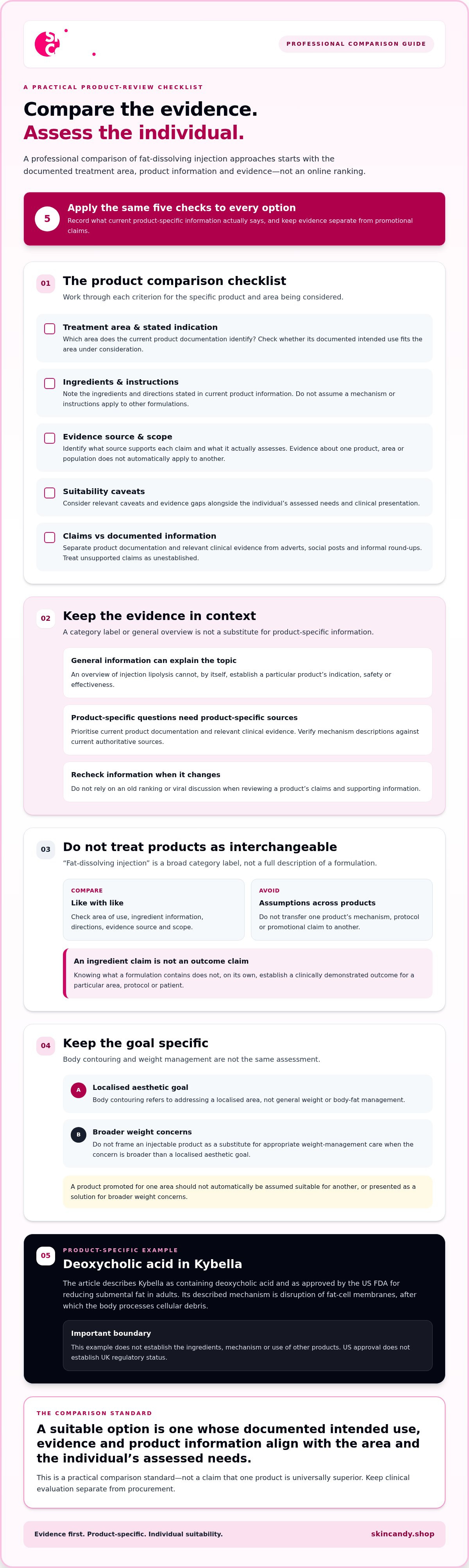
Apply the same criteria to each option: intended treatment area, stated indication, ingredients and instructions, available evidence, and relevant suitability caveats. Record what the product information actually says, then distinguish it from claims in adverts, social posts or informal round-ups. If a claimed use or outcome isn’t supported by current product-specific documentation, don’t treat it as established.
Evidence needs context. A general overview of injection lipolysis can explain the topic, but it can’t establish the indication, safety or effectiveness of a particular product. For those questions, prioritise current product documentation and relevant clinical evidence. Review comparisons when information changes instead of relying on an old ranking or viral discussion.
Body contouring is not the same as weight management
Body contouring describes an aesthetic goal: addressing a localised area rather than general weight or body-fat management. An injection promoted for a particular area shouldn’t automatically be presented as a solution for broader weight concerns or assumed suitable for other areas. Verify any claim about efficacy or an approved indication against current authoritative sources and product-specific information.
Keep the assessment anchored to the intended area and the person’s circumstances. If the concern is broader than a localised aesthetic goal, don’t frame an injectable product as a substitute for appropriate weight-management care. This helps set realistic expectations and keeps the discussion within the evidence available for that specific option.
In practice, the best fat dissolving injections for body contouring can’t be selected by popularity alone. A disciplined comparison asks:
- Which area does the product documentation identify?
- What ingredient and use are stated, and what evidence supports them?
- What caveats affect suitability for this individual?
These questions provide a more useful basis for comparison than a simple “top product” list. They also help practitioners assess product differences without treating marketing language as clinical evidence.
How fat-dissolving injection approaches differ
“Fat-dissolving injection” is a broad category label, not a complete description of a formulation. Products can differ in ingredients, stated indications, instructions and available evidence. Treat each as a distinct product: a mechanism described for one formulation can’t be applied to every injectable marketed for fat reduction.
When comparing the best fat dissolving injections for body contouring, use documented product information rather than category labels or promotional summaries. Start with the product’s current documentation to assess its composition, intended use and directions. If a detail is unclear or a claim can’t be matched to reliable product-specific evidence, record the gap rather than filling it with assumptions.
Ingredients, mechanisms and product-specific information
One documented example is deoxycholic acid in Kybella, a product approved by the US FDA for reducing submental fat in adults. Its described mechanism is disruption of fat-cell membranes, after which the body processes cellular debris. This example doesn’t establish the ingredients, mechanism or use of other products, and US approval doesn’t establish UK regulatory status.
An ingredient claim identifies what a formulation contains; on its own, it doesn’t establish a clinically demonstrated outcome for a particular area, protocol or patient. Keep those questions separate. Verify mechanism descriptions against current authoritative sources and relevant product information. Don’t extrapolate from one ingredient or formulation to the whole category.
Why named products cannot be treated as interchangeable
A shared marketing category doesn’t mean two named products have the same formulation, indication or evidence base. Compare like with like: note the stated area of use, ingredient information, directions, and the source and scope of any clinical evidence. If a source discusses one area or population, don’t assume its findings apply to another.
Use a practical evidence record for each product:
- Composition: Which ingredients does the current documentation identify?
- Intended use: Which treatment area and indication are expressly stated?
- Evidence: What source supports the claim, and what does it actually assess?
- Limitations: What suitability caveats or evidence gaps need professional consideration?
This approach avoids calling a product superior or ineffective when the evidence supports neither conclusion. It also prevents protocols or promotional claims for one product from being transferred to another. Product-specific directions and professional assessment remain essential to any clinical decision.
For clinics reviewing supply alongside product information, Skin Candy is a UK-wide wholesale supplier of professional fat-dissolving agents, with same-day and next-day delivery options across the United Kingdom. Explore professional fat-dissolving agents as part of your procurement process, keeping purchasing decisions separate from clinical suitability.
Compare options by treatment area, evidence and suitability
A useful comparison makes evidence limits visible instead of filling gaps with assumptions. The table separates a documented example from the wider category. It isn’t a product ranking: an area of use, ingredient or approval in one jurisdiction doesn’t establish suitability for another area or every patient.
| Option | Documented area | Ingredient | Evidence source | Suitability caveats |
|---|---|---|---|---|
| Kybella | Submental fat in adults, according to its US FDA-approved indication | Deoxycholic acid | US FDA approval and product information; verify current labelling and supporting evidence before publication | US approval does not establish UK regulatory status or support use in other anatomical areas. Individual suitability requires professional assessment. |
| Other fat-dissolving agents | Assess the area against each product’s current documentation. | Check the exact product information; don’t infer an ingredient from the category name. | Use current product-specific evidence and check what it actually supports. | Don’t infer an indication, protocol or suitability from marketing claims or another product’s information. |
Match the treatment area to documented indications
Start with the anatomical area stated in the relevant product information. The US FDA indication for Kybella is limited to submental fat in adults; that example can’t be extended to the abdomen, thighs, arms or other areas. Evidence for one facial or body area shouldn’t be treated as evidence for another. A qualified practitioner must assess the individual case against the product’s current information.
Assess evidence and claims consistently
Record whether each statement comes from clinical research, manufacturer documentation or marketing. These sources serve different purposes. A promotional claim isn’t clinical evidence by itself; manufacturer information describes the product but shouldn’t be mistaken for independent research. Verify any stated outcome, study population, treatment schedule or timing against its source before using it to compare options.
For a broader category overview, the professional fat-dissolving agents guide provides additional context. Use it alongside current product documentation, not as a substitute for it.
This method gives practitioners a consistent basis for evaluating the best fat dissolving injections for body contouring without creating an unsupported league table. Keep evidence fields specific to the product and source. A product’s visibility, advertised treatment area or inclusion in a comparison list can’t establish that it is suitable for a particular patient or clinical context.
Assess suitability, risks and professional responsibilities
A product’s popularity, social-media presence or place in a comparison list can’t determine whether it’s suitable for an individual. That decision belongs within a qualified practitioner’s professional assessment, informed by the treatment goal, the area being considered and the product’s current documentation. Keep procurement separate from clinical judgement: availability doesn’t establish an indication or make a treatment appropriate.
A practical suitability assessment sequence
Use a consistent sequence to structure the assessment. First clarify the person’s goal and the specific area of concern. Then consider relevant patient history and whether the proposed approach falls within your professional scope. Review the product’s stated indication, warnings, instructions and aftercare information before developing a treatment plan. Resolve any key information gaps before proceeding.
- Define the clinical question. Identify the treatment goal and area, and consider whether the discussion concerns a localised aesthetic concern or something broader.
- Review the individual context. Consider relevant history and suitability factors within your competence and professional scope.
- Check product information. Assess the current indication, contraindications, warnings, directions and aftercare guidance for the specific product.
- Record the rationale. Document the assessment, decision and informed discussion in line with applicable professional requirements.
This process turns a broad search for the best fat dissolving injections for body contouring into a case-specific decision. A product’s documented use for one anatomical area doesn’t establish suitability for a different area, even if online content presents it as versatile.
Safety claims, regulation and evidence checks
Verify the product’s current UK regulatory information before describing its status or intended use. Consult relevant MHRA materials for regulatory information and ASA guidance when assessing advertising claims. Keep each source in context: promotional wording isn’t a substitute for product documentation or clinical evidence, and a claim about one product shouldn’t be transferred to another.
Risks, contraindications, aftercare and protocols are product-specific; verify each against current product information and relevant professional guidance before use. Avoid blanket assurances about safety or results, and don’t offer recovery timelines unless reliable, product-specific evidence supports them. Where evidence is limited, say so clearly rather than presenting an unverified claim as settled fact.
Maintain a clear record of the sources reviewed and the date of review. This makes it easier to revisit a decision if product information, regulatory material or professional guidance changes. It also keeps patient-facing explanations aligned with the evidence, rather than popularity or promotional language.
Once clinical evaluation is complete, keep sourcing decisions distinct and practical. Skin Candy supplies professional fat-dissolving agents wholesale to clinics and practitioners across the UK, with same-day and next-day delivery options. Browse professional fat-dissolving agents for your clinic’s procurement needs.
Source professional fat-dissolving agents with confidence
Once a qualified practitioner has completed the clinical assessment, procurement can follow a separate process. A purchasing decision doesn’t establish that a product is appropriate for a particular person or treatment area. Resolve clinical questions first, then use verified product information to guide supply decisions.
Turn the comparison framework into a clinic purchasing decision
Before placing an order, make sure the decision record separates documented product details from assumptions. Confirm ingredient information, stated indication, instructions and relevant warnings against current product documentation. Keep evidence and suitability considerations attached to the specific product, rather than carrying them across from another formulation or relying on a general category description.
Then plan procurement around the clinic’s professional requirements. Stock volume, promotional visibility and convenience may inform purchasing, but they shouldn’t decide clinical suitability. A useful workflow is to complete the product-specific review, identify the clinic’s supply needs, then purchase the relevant professional category. This keeps clinical reasoning and stock planning aligned without confusing one for the other.
Skin Candy is a UK-wide wholesale supplier of professional fat-dissolving agents. Its professional wholesale range gives clinics and practitioners a relevant sourcing route once their product assessment and purchasing criteria are clear.
A practical next step for professional buyers
Reliable supply planning starts with an understanding of clinic requirements and procurement timing. Skin Candy offers same-day and next-day delivery options across the United Kingdom, which clinics can factor into supply planning. These are delivery options, not a promise that a particular order will arrive at a particular time. For a wider view of stock planning and fulfilment considerations, the 2026 clinic procurement and logistics guide explores the operational side of clinic purchasing.
Keep the decision sequence straightforward: establish suitability professionally, verify the product information, then select a supply route that fits your clinic’s purchasing needs. This helps prevent popularity or purchasing convenience from standing in for clinical judgement, while making procurement more organised.
Explore professional fat-dissolving agents through Skin Candy for your clinic’s wholesale sourcing. The best fat dissolving injections for body contouring remain a product-specific, patient-specific decision; confident procurement starts with clear criteria and current information.
Make your next sourcing decision with confidence
Let your clinic’s documented requirements guide the next step. Once the clinical decision is established, focus purchasing on the product information and supply needs relevant to your practice. This keeps the search for the best fat dissolving injections for body contouring grounded in professional judgement, not simply availability or online attention.
Skin Candy supplies professional fat-dissolving agents wholesale to UK clinics and practitioners, with same-day and next-day delivery options across the United Kingdom. Factor these fulfilment options into supply planning while keeping product suitability decisions within your professional assessment.
Explore professional fat-dissolving agents at Skin Candy and take a clear, informed next step for your clinic’s procurement. Strong decisions start with sound criteria and a well-planned supply process.
Frequently Asked Questions
Are fat-dissolving injections a weight-loss treatment?
No. They’re discussed for localised aesthetic contouring, not as a treatment for general weight loss or obesity. The best fat dissolving injections for body contouring shouldn’t be presented as a replacement for appropriate weight-management care. A person seeking a broad change in body weight has a different need from someone concerned about a specific area. Keep the discussion aligned with the product’s documented purpose.
Can fat-dissolving injections treat cellulite?
Don’t assume they can. Cellulite and localised fat are different aesthetic concerns, and marketing a product as a fat-dissolving agent doesn’t establish an indication for cellulite. Check whether current product information and credible clinical evidence specifically address cellulite, rather than relying on before-and-after images or broad promotional wording. If the concern is skin texture or dimpling, assess it on its own terms.
How long can swelling or bruising last after fat-dissolving injections?
There’s no single duration that applies to every product or patient. Swelling and bruising are reported injection-site effects, but expected duration depends on the specific product and clinical context. Use the product’s current aftercare information to guide patient communication; don’t promise a fixed recovery timeline. If symptoms are worsening, unusually severe or concerning, arrange appropriate clinical assessment rather than assuming they’re part of routine recovery.
Are fat-dissolving injections licensed medicines in the UK?
There isn’t one UK licence that applies to every product marketed as a fat-dissolving injection. Check regulatory status product by product: approval in another country doesn’t establish UK authorisation or an indication here. Before describing a product as a licensed medicine, check current MHRA information and the product’s documentation. Don’t rely on a seller’s description alone to establish its status.
Can fat-dissolving injections be combined with other aesthetic treatments?
Sometimes a combination may be considered, but there’s no universal rule that it’s appropriate or compatible. Review the documentation for each product, available evidence on the proposed combination, treatment sequence and relevant safety considerations. Planning two treatments in the same area raises different questions from using them in separate areas. Keep the decision within professional scope and don’t promise an enhanced result without supporting evidence.
What should a practitioner do if a client reports an unexpected reaction?
Assess the report promptly and follow the appropriate clinical escalation pathway, using emergency services for symptoms that may indicate an emergency. Don’t advise the person to wait out a potentially serious reaction. Record the reported symptoms, timing and relevant product details, and seek appropriate clinical advice. Consider whether reporting through the MHRA Yellow Card scheme is appropriate, following its current guidance.
Do all fat-dissolving injections contain deoxycholic acid?
No. “Fat-dissolving injection” is a category description, not a guarantee of a shared ingredient. Deoxycholic acid is identified in specific product information, but its presence shouldn’t be assumed for another formulation. Check the current documentation for the exact product being considered, including its stated composition. Ingredient similarity alone also doesn’t establish that two products have the same indication, evidence or instructions.