A Professional Guide to Different Chemical Peel Acids
The acid name on a peel label doesn’t tell you the whole story. Two formulations featuring the same acid can differ in strength, pH and intended depth, so choosing by ingredient alone can miss important clinical considerations. This guide to different chemical peel acids gives practitioners a clearer basis for comparison.
Acid families overlap in their uses, while marketing language doesn’t always explain how formulation affects a peel’s profile. A sound evaluation starts with the treatment objective, then considers the acid’s properties alongside the patient’s skin characteristics, treatment history and professional protocols.
This guide compares glycolic, lactic and mandelic acids, salicylic acid and trichloroacetic acid (TCA). It outlines their distinguishing properties and suitability considerations, then offers a structured framework for professional evaluation. Use it to assess chemical peel products by chemistry, formulation and intended depth, rather than relying on ingredient names or broad claims alone.
Key Takeaways
- Compare acid families by their properties and professional considerations, not by ingredient name alone.
- Assess glycolic, lactic, mandelic and salicylic acids on their individual characteristics, rather than treating them as interchangeable.
- Interpret TCA and combination peels through formulation and intended depth, not the acid name alone.
- Use a structured assessment: start with the treatment objective, then review the formulation, patient-specific factors and treatment history.
- Consider acid choice, peel formulation and clinical context together when evaluating professional chemical peel products.
Chemical peel acids explained: what changes between peel types?
A chemical peel acid is one active component in a formulated professional peel, not a complete description of the product or its effect. A formulation may contain one agent or several, alongside other ingredients that influence how it is applied and behaves on the skin. The same acid name can therefore appear in products with different formulations and protocols.
Acid family describes the agent’s chemical grouping; formulation describes the complete product and its properties; treatment depth describes how far the peel’s action extends into the skin. This distinction is a useful starting point when comparing peel acids. Ingredient identity alone doesn’t define depth or predict an individual response.
How peel depth differs from acid family
Practitioners generally describe peels as superficial, medium-depth or deep, according to the level of skin affected. Superficial peels act within the epidermis; medium-depth peels extend into the upper dermis; deep peels reach further into the dermis. These are categories of treatment depth, not acid families.
Depth depends on the complete formulation and how it is used, including concentration, pH, vehicle, application method, exposure and protocol. Skin condition and individual response also matter. An acid commonly associated with a particular depth doesn’t guarantee that depth in every product. Assess the specific product and protocol instead of assigning depth from the ingredient name.
What formulators mean by AHA, BHA and other peel agents
Alpha hydroxy acids (AHAs) include glycolic, lactic and mandelic acids. They belong to the same broad family, but that doesn’t make their properties or performance interchangeable. Their behaviour in a peel depends on the formulation and use, so compare product details rather than relying on the AHA label alone.
Salicylic acid is a beta hydroxy acid (BHA) commonly discussed in peel contexts. Trichloroacetic acid (TCA) is a separate agent, not an AHA or BHA. Retinoic acid and phenol are also discussed in relation to chemical peels, but they shouldn’t be grouped with AHAs or BHAs simply because they appear in the same treatment category. A Chemical peel overview on Wikipedia offers broader context on these agents and peel-depth terminology.
For a professional comparison, separate three questions: which agent or family is present, how the complete formulation is designed, and what depth the intended protocol aims to address. This helps keep marketing shorthand in perspective and makes this guide to different chemical peel acids practical: assess products as formulated systems, not isolated ingredients.
Glycolic, lactic, mandelic and salicylic acid: key differences
These four acids are useful reference points, but their names are only the start of a professional comparison. Glycolic, lactic and mandelic acids are AHAs; salicylic acid belongs to the BHA family. The table summarises general distinctions, not guaranteed product performance or treatment outcomes.
| Acid | Family | General characteristics | Professional consideration |
|---|---|---|---|
| Glycolic | AHA | Has a relatively small molecular structure compared with lactic and mandelic acids. | Interpret its role alongside the product’s pH, concentration, vehicle and application protocol. |
| Lactic | AHA | A larger molecular structure than glycolic acid; a distinct AHA, not a direct substitute. | Review the full formulation and intended use rather than inferring performance from its family. |
| Mandelic | AHA | Has a larger molecular structure than glycolic acid. | Consider its specific formulation and protocol; don’t assume it will behave like another AHA. |
| Salicylic | BHA | Differs chemically from the AHA group and is commonly described as oil-soluble. | Assess product-specific details and patient context; family classification alone isn’t a protocol. |
How glycolic, lactic and mandelic acids compare
All three are AHAs, but they aren’t interchangeable. Their molecular structures differ, and glycolic acid is smaller than lactic and mandelic acids. Molecular size is one chemistry consideration, not a stand-alone predictor of penetration, peel depth or response. The vehicle, pH, concentration, buffering and application method can all shape how an acid performs in a finished peel.
For a practical comparison, distinguish general information about the acid from details specific to the product. An AHA label doesn’t reveal the complete formulation or the design of the professional protocol. Avoid ranking these acids as universally stronger, gentler or more effective. Compare their documented properties in context.
What makes salicylic acid a different comparison
Salicylic acid is a BHA, not an AHA. Its oil-soluble character is a commonly discussed distinction from the water-soluble AHA family, but it doesn’t establish a specific clinical result. Treat this as general ingredient information, not a claim about every salicylic peel. Product composition and use still matter.
Keep the comparison structured: note the acid family, relevant chemical properties and available formulation details. Then consider these alongside the intended protocol and patient-specific assessment. This makes the guide useful as a reference, rather than a shortcut to choosing by name alone.
For practitioners reviewing category-level options, Skin Candy supplies professional chemical peel products for clinics and practitioners.
Trichloroacetic acid and combination peels: compare depth carefully
Trichloroacetic acid (TCA) sits outside the AHA and BHA families. Combination peels bring more than one active agent into the same treatment approach. Both require closer consideration than the ingredient name alone can provide, particularly when comparing intended depth, formulation and patient-specific factors.
Where trichloroacetic acid fits in a peel comparison
TCA is a distinct peel agent, not an alpha or beta hydroxy acid. It’s associated with a range of peel depths, but the agent’s name alone doesn’t establish where a particular formulation or protocol sits. Compared with a superficial acid peel, a TCA-based approach may be intended to act more deeply, depending on how the peel is formulated and used.
Treatment depth cannot be inferred from the acid name alone; it depends on the complete formulation and professional protocol. This distinction is central to a useful comparison of chemical peel acids. Avoid treating broad labels such as “TCA peel” as a prediction of response or recovery. Greater intended depth can involve greater clinical complexity and risk, so evaluation should include the patient’s skin characteristics, treatment history and risk profile, as well as product information and applicable professional guidance.
How to interpret combination and Jessner-type peels
A combination peel uses multiple agents, which may contribute different properties to the formulation. This makes a simple acid-by-acid comparison misleading: an ingredient’s presence doesn’t reveal its concentration, role, interaction with other components or contribution to the overall protocol. Assess the formula as a complete system.
Jessner-type peels illustrate this point. They’re commonly described as combinations involving agents such as salicylic acid, lactic acid and resorcinol, but the name doesn’t mean every product has an identical formula. Distinguish general descriptions of a peel type from the specifications of a particular professional product.
- Single-agent peel: the named acid offers a starting point for comparison, but formulation and protocol still shape interpretation.
- Combination peel: assess the agents together, including their stated roles and how the product is intended to be used.
- TCA-based peel: consider intended depth and risk in context, without assuming a fixed depth from the agent name.
Combination formulations bring different agents together, but they also make ingredient-level assumptions less reliable. A single-agent product may be easier to describe by its principal acid, yet its effects still can’t be predicted from the label alone. Neither format is automatically preferable for every patient. Keep the professional comparison anchored to the objective, formulation details and individual assessment.
Keep the distinction clear when reviewing chemical peels: TCA is a separate agent, while combination peels must be interpreted as complete formulations. This supports consistent product evaluation without turning a category label into a treatment recommendation.
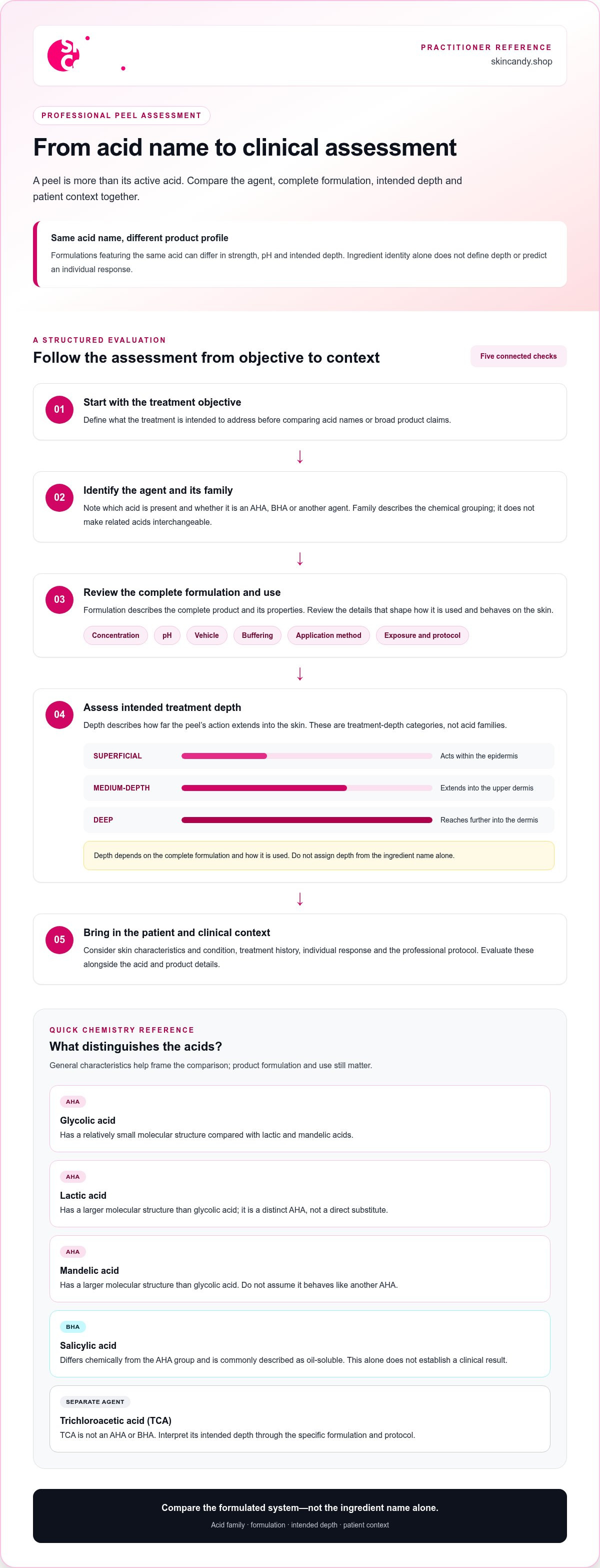
How practitioners can assess peel acids for a clinical context
Use a consistent assessment sequence to move from the treatment objective to the details that shape a peel’s use. The acid family is a useful starting point, but it can’t replace patient assessment, product documentation or the protocol. This keeps broad ingredient comparisons separate from decisions about an individual clinical context.
A practical sequence for comparing candidate acids
Work through each candidate in order. Record your reasoning, and keep the product’s documented properties distinct from general information about its main acid.
- Define the objective. Clarify the concern being assessed and the intended treatment depth. Avoid selecting an acid before the clinical aim is clear.
- Review patient-specific factors. Consider skin characteristics, including phototype, current condition and relevant sensitivities, within your professional scope. These factors inform risk assessment, not a universal suitability rule.
- Take treatment history. Review previous peels and other relevant procedures, along with the patient’s response and recovery. Include current or recent topical and systemic treatments where clinically relevant.
- Examine the complete formulation. Review the stated acid or agents alongside available details such as concentration, pH, vehicle and other formulation components. Don’t infer missing product characteristics from a familiar ingredient name.
- Read the product protocol. Compare the manufacturer’s instructions and intended use with the treatment objective and patient assessment. Resolve any mismatch before drawing a conclusion about suitability.
This sequence creates a consistent comparison across acid families. For a broader procurement perspective, the professional chemical peel clinic selection guide also considers product evaluation in a clinic context.
Safety, evidence and limits of general advice
Peels require appropriately trained professionals who can assess the patient, understand product instructions and work within their professional scope. General descriptions of acids can support product comparison, but they aren’t a substitute for product-specific documentation or current, applicable UK guidance. Don’t apply instructions from one formulation to another, even when both use the same named acid.
Marketing terms can obscure important distinctions. Claims about depth, suitability or expected response should be considered alongside the complete formulation, supporting product information and clinical protocol. A general acid reference cannot establish candidacy, prescribe a procedure or guarantee an outcome. If documentation leaves a relevant question unanswered, don’t fill the gap with assumptions based on the ingredient family.
For practitioners assessing professional chemical peel options, explore Skin Candy’s chemical peel range as part of your product review. Use the available formulation details and product documentation to support a considered, patient-specific evaluation.
Professional chemical peel acids: connect the reference to product selection
Acid comparisons are most useful when they support a consistent product review. Family, formulation, intended depth and patient context each contribute to the assessment. None should be used alone to predict how a peel will perform. Use this guide to different chemical peel acids to ask focused questions about professional products, not as a substitute for product documentation or clinical judgement.
Turn the comparison into a clinic reference
Keep the main distinctions clear: glycolic, lactic and mandelic acids are AHAs; salicylic acid is a BHA; TCA is a separate peel agent; and combination peels bring multiple agents together. These labels organise the chemistry, but they don’t establish a product’s intended depth or make different formulations equivalent.
For each product under consideration, record its named active agents, available formulation details, stated intended use and applicable protocol. Use the same headings across candidate products. This makes comparisons easier to revisit and helps distinguish documented product information from assumptions based on an acid family or marketing description.
Procurement involves more than ingredient selection. The professional chemical peel supplier guide covers clinic purchasing considerations alongside product evaluation.
Choose a professional supply partner for clinic needs
Once your criteria are clear, use them to guide your purchasing review. Match the product category to your clinic’s professional requirements, then consider the product documentation and supply arrangements relevant to your operation. Keep these checks separate from clinical suitability decisions: a product’s availability doesn’t determine whether it fits an individual patient or protocol.
Skin Candy is a UK-wide wholesale supplier of professional aesthetic products, including chemical peels for clinics and practitioners. Same-day and next-day delivery options are available across the UK. For clinics managing stock, these options can form part of replenishment planning alongside the product review.
Make your comparison actionable: shortlist the chemical peel category that aligns with your professional requirements, review the product information and organise purchasing around your clinic’s needs. Explore Skin Candy’s professional chemical peels for category-level options to support your clinic’s product selection.
Put your peel comparison to work
Turn this guide to different chemical peel acids into a practical reference for your clinic. Create a consistent review record for candidate products, capturing the clinical objective, product information considered and rationale for assessing suitability in context. This makes future comparisons easier to follow and helps separate documented facts from assumptions based on an ingredient name.
Use the framework whenever you review chemical peel options. A clear, repeatable process supports considered product selection while keeping patient-specific assessment central to professional judgement. Update your reference as your clinic’s requirements evolve, and keep the relevant product documentation alongside it.
Ready to take the next step in your professional product review? Explore professional chemical peels from Skin Candy for options to support your clinic’s purchasing considerations.
Build your reference, review with care and move forward with confidence.
Frequently Asked Questions
What are the main acids used in professional chemical peels?
Commonly discussed agents include the AHAs glycolic, lactic and mandelic acids, salicylic acid as a BHA, and trichloroacetic acid (TCA) as a separate peel agent. Some professional peels combine multiple agents. This isn’t an exhaustive list, and a shared acid family doesn’t mean two products have the same use. For a practical comparison, review the ingredient list, product documentation and protocol together.
How do glycolic, lactic and mandelic acid peels differ?
Glycolic, lactic and mandelic acids are all AHAs, but they’re distinct ingredients with different chemical properties. None is universally stronger, gentler or more effective than the others. Concentration, formulation and application protocol all affect how a particular peel is assessed. Patient-specific factors matter too. Compare the product’s instructions and supporting documentation rather than predicting performance from the acid name alone.
Is salicylic acid an AHA or a BHA?
Salicylic acid is a beta hydroxy acid (BHA). Glycolic, lactic and mandelic acids are alpha hydroxy acids (AHAs). This classification helps organise a professional comparison, but it doesn’t tell you by itself whether a particular peel is suitable, how deeply it will act or what response to expect. Those judgements require consideration of the product’s formulation and protocol in the relevant clinical context.
Can different chemical peel acids be combined?
Yes, some professional peels use combinations of agents, but a combination isn’t automatically an improvement over a single-acid peel. Its properties depend on the specific ingredients and complete formulation. Don’t mix separate products or assume ingredients are compatible based on their names. Assess a combination peel as its own product, using its instructions and professional protocol alongside appropriate clinical judgement.
What determines whether a chemical peel is superficial or deeper?
The acid name alone doesn’t determine peel depth. The complete formulation and how the product is used within its professional protocol can influence the intended depth. Superficial, medium-depth and deep are broad categories, not guarantees of a particular effect for every product or patient. When reviewing a specific peel, use its product documentation and current professional guidance rather than relying on a general acid-to-depth assumption.
Are professional chemical peels suitable for every skin type?
No. There isn’t one acid or peel that should be assumed suitable for everyone. Assessment depends on the individual clinical context, including skin characteristics, relevant treatment history and the product’s formulation and protocol. This guide is educational, not an individual treatment recommendation. Suitability decisions should be made by an appropriately trained professional, using product-specific instructions and current guidance relevant to their practice.
What should practitioners compare before selecting a peel acid?
Start with the treatment objective and intended depth, then compare the acid family, complete formulation and product-specific protocol. Include relevant patient factors and treatment history in the assessment. This guide to different chemical peel acids can help organise that review, but ingredient names and marketing claims aren’t enough to establish product performance. Review the documentation so your conclusions relate to the specific peel under consideration.