
Best Dermal Filler for Jawline: A Professional Guide
A recognisable brand name doesn’t make a filler the right choice for a jawline. The best dermal filler for jawline definition depends on the clinical fit: the patient’s anatomy and goals, the structural support being considered, and the product’s documented characteristics and intended use.
There’s no single option that suits every patient. This guide sets out what practitioners can assess when considering structural contouring, then offers a repeatable framework for weighing aesthetic aims, anatomy, safety and manufacturer documentation. The focus is evidence-led selection, not a universal recommendation or a brand-name shortcut.
It also explains how to build product checks into clinic procurement, including reviewing current instructions for use before making product-specific decisions. Skin Candy supplies professional dermal fillers to clinics and trained practitioners, with same-day and next-day delivery options across the UK. Use the framework to make a more informed selection and plan supply around your practice’s needs.
Key Takeaways
- The best dermal filler for jawline definition depends on the patient’s anatomy, contouring objective and the product’s documented intended use.
- Cohesivity, elasticity and viscosity describe different filler behaviours, but none guarantees a particular result.
- Use a structured assessment to define the goal, review current product documentation and record the rationale for selection.
- Compare filler categories using evidence and manufacturer information, rather than relying on brand rankings or contouring claims alone.
- Skin Candy’s professional filler range includes Lumifil, Regenovue, Aesossa and Volifil. Treat these as procurement options, not jawline-specific recommendations.
What makes a dermal filler suitable for jawline definition?
Jawline filler is a clinician-selected injectable used to address a defined contouring goal. Suitability isn’t determined by a product’s popularity or a general claim that it offers “structure”. It depends on the patient’s anatomy, the proposed change, the formulation’s documented characteristics and intended use, and the practitioner’s clinical judgement.
That distinction matters when considering the best dermal filler for jawline definition. A product name alone can’t show whether it fits a particular patient or objective. Manufacturer documentation provides product-specific information; clinical assessment determines whether that information is relevant to the case. General background on injectable materials and their facial applications is available in this Injectable filler overview, but it doesn’t replace product instructions or professional judgement.
What does jawline definition mean in a treatment plan?
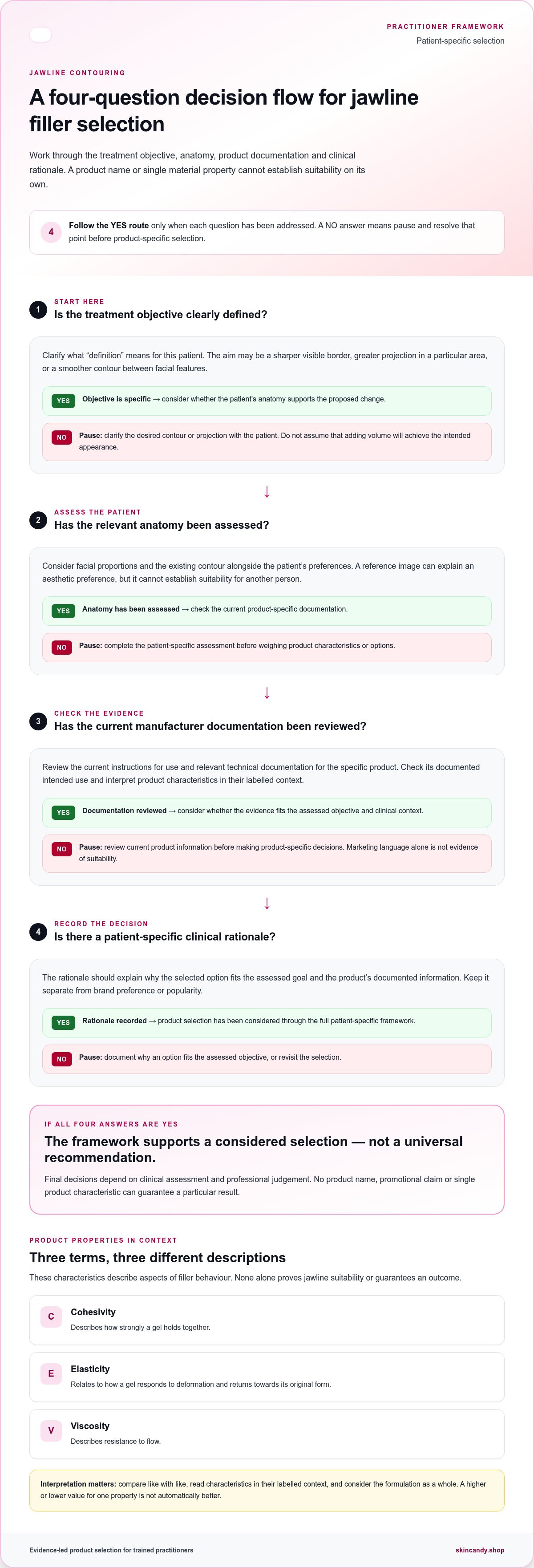
Start by clarifying what “definition” means to the patient. They may be seeking a sharper visible border, greater projection in a particular area, or a smoother contour between facial features. These are distinct objectives, not interchangeable descriptions. Each requires an individual assessment of facial proportions and existing anatomy, rather than an assumption that adding volume will create the desired appearance.
Discuss the patient’s preferences alongside realistic clinical outcomes. A reference image can help explain an aesthetic preference, but it cannot establish that the same result is suitable for someone else. Agreeing a clear, proportionate objective helps keep product selection anchored to the treatment plan.
Why is there no universal best jawline filler?
Filler formulations differ, as do their documented intended uses and material behaviours. Product information is therefore essential, but it doesn’t support a simple brand ranking. A product marketed for contouring isn’t automatically appropriate for every patient or jawline objective. The relevant question is whether the product fits the assessed indication.
Use a patient-specific review rather than relying on popularity, promotional language or a single before-and-after image. Photos show one person’s presentation under particular conditions; they don’t establish the product used, the patient’s anatomy, the clinical rationale or whether the same approach applies elsewhere. Treat marketing terms as a prompt to look more closely, not as evidence in themselves.
For a disciplined selection, separate four questions:
- What is the objective? Define whether the plan concerns contour, projection or another specific change.
- What does the patient’s anatomy support? Consider facial proportions and the existing contour before deciding which product characteristics may be relevant.
- What does the documentation say? Review the current manufacturer instructions for use and intended indications for the specific product.
- What is the clinical rationale? Record why the selected option fits the assessed goal, separately from any brand preference.
This framework informs professional product selection; it isn’t injection guidance. Jawline assessment and treatment decisions require appropriate clinical expertise. The following sections explain which product properties and documents practitioners can compare, without treating any single characteristic as proof of suitability or outcome.
Which dermal filler properties matter for jawline contouring?
Product properties help practitioners assess whether a formulation may fit a planned indication. They don’t predict an individual result on their own. Terms such as cohesivity, elasticity and viscosity describe aspects of filler behaviour, but manufacturers may use different testing methods or present data differently. Compare like with like, and interpret each characteristic alongside the product’s current instructions for use.
Rheology is the study of how a filler flows and deforms. It provides a technical vocabulary for describing product behaviour, not a shortcut to choosing a filler. A higher or lower value for one property isn’t automatically better. Its relevance depends on the intended use, the formulation as a whole and the clinical context.
How do formulation and structural support affect selection?
Practitioners may assess how a product’s documented characteristics relate to the support and tissue integration sought for the planned indication. Cohesivity describes how strongly a gel holds together; elasticity relates to how it responds to deformation and returns towards its original form; viscosity describes resistance to flow. These properties interact. None guarantees a sharper contour, a particular degree of lift or longer-lasting results.
Read characteristics in their labelled context. A property discussed generally, or in relation to another facial area, doesn’t establish suitability for jawline use. Don’t translate descriptions such as “firm” or “supportive” into clinical claims unless current product-specific documentation supports that interpretation. The best dermal filler for jawline definition can’t be identified from one rheological term alone.
What should practitioners check in product documentation?
Use the current manufacturer instructions for use and relevant technical documentation as your reference point. Check the stated intended use and review contraindications, warnings and storage instructions before considering product fit. Confirm that product identifiers and traceability information are clear for procurement and clinical records. Where documents use technical terms, assess the definitions and testing context rather than relying on a headline description.
A practical documentation review separates evidence from shorthand. Promotional material may describe a formulation as “high lift” or “long-lasting”, but those phrases don’t replace substantiated, product-specific information. Don’t infer duration, outcome or indication from a material category or property label alone.
- Match claims to the document: Check that statements about intended use or performance appear in current manufacturer information.
- Review safe handling information: Follow stated storage instructions and check product identification and traceability details.
- Keep the selection rationale clear: Record which documented characteristics informed the decision and how they relate to the planned indication.
A consistent document review makes product comparisons more useful and procurement decisions easier to audit. For clinics organising stock, Skin Candy’s professional dermal filler range offers products to assess against current manufacturer documentation, rather than a blanket recommendation for jawline contouring.
How do jawline filler options compare without relying on brand rankings?
A useful comparison starts with evidence, not a league table of familiar names. Assess products against the same criteria, and keep material-category information separate from product-specific claims. Hyaluronic acid (HA), calcium hydroxylapatite (CaHA), poly-L-lactic acid (PLLA) and polymethylmethacrylate (PMMA) are distinct material categories. Their names alone don’t establish equivalent behaviour, intended use or suitability for jawline contouring.
The framework below helps organise a review. It isn’t a product recommendation: intended use, properties and evidence must come from current documentation for the specific product under consideration.
| Material category | Documented intended use | Relevant properties to assess | Evidence to record |
|---|---|---|---|
| HA | Check the individual product’s current instructions for use; don’t assume the whole category has one indication. | Review product-specific rheology and handling information. HA fillers are generally described as dissolvable with hyaluronidase, but this does not establish suitability. | Manufacturer documentation supporting the proposed use, alongside relevant technical data. |
| CaHA | Verify the intended use for the specific formulation in its current documentation. | Assess stated product characteristics and handling information; don’t infer them from the material name. | Current instructions for use and evidence relevant to the proposed indication. |
| PLLA | Confirm the documented indication for the particular product before considering it for a treatment plan. | Use product-level data rather than assumptions about category-wide behaviour. | Manufacturer information and evidence that directly supports the intended application. |
| PMMA | Check the exact product documentation and intended use; the category label is not an indication. | Compare only properties documented for that specific formulation. | Current product documentation and relevant evidence, recorded separately from promotional claims. |
How should practitioners compare products on the same criteria?
Use the same columns for each option: material, documented intended use, relevant properties, supporting evidence and unresolved questions. This avoids giving a product with extensive promotional detail an apparent advantage over one assessed using manufacturer information alone. Label the source for each claim, such as the instructions for use, technical documentation or other evidence, and distinguish verified facts from points that need further review.
Keep procurement considerations in a separate record. Stock planning and dependable supply matter to clinic operations, but they don’t establish clinical suitability. Equally, a clinically relevant property doesn’t settle procurement decisions on its own.
When should a brand comparison be set aside?
Set rankings aside if the patient assessment or intended indication points away from a product, or if its documentation doesn’t support the proposed use. The search for the best dermal filler for jawline definition should lead back to the assessed case and relevant evidence, not brand recognition. Skin Candy’s Lumifil, Regenovue, Aesossa and Volifil ranges are supplier options, not universal jawline recommendations. Review each product’s current manufacturer documentation before drawing product-specific conclusions.
How can practitioners assess jawline filler suitability responsibly?
A product marketed for contouring isn’t automatically suitable for every patient. Responsible selection follows a consistent clinical review, not a product-page description or a single aesthetic preference. This framework focuses on assessment and product choice. It doesn’t cover injection technique or replace patient-specific medical decisions.
What should the patient assessment establish?
Begin with a clinician-led assessment of the patient’s relevant history, facial anatomy, goals and expectations. Discuss what the patient hopes to change, then consider whether that objective is realistic for their individual presentation. A product page can describe a formulation, but it can’t establish suitability or provide informed consent for a particular patient.
Consent discussions should cover relevant foreseeable risks, expected limitations and appropriate aftercare, using current professional guidance. UK professional and regulatory guidance can change, so practitioners should verify applicable current sources rather than rely on generic summaries. Keep treatment decisions within the clinician’s expertise and the individual assessment.
How can the product decision be documented?
Use a repeatable sequence. Each step should answer a specific question and leave a clear record for the clinic team.
- Assess: Record relevant history, anatomy, patient preferences and expectations from the clinical assessment.
- Define: State the intended contouring objective in clear, patient-specific terms.
- Verify: Review the current manufacturer instructions for use, including intended use, contraindications and warnings relevant to the proposed option.
- Select: Use clinical judgement to decide whether the documented product information aligns with the assessed indication. Marketing language alone isn’t a rationale.
- Document: Record the product details, decision rationale, consent discussion and relevant patient information in the clinic record.
Product selection should follow assessment and documented intended use. This keeps the decision traceable and separates the clinical rationale from brand familiarity or purchasing preference. If the product’s documentation doesn’t support the proposed use, exclude it from that decision rather than assuming a contouring claim applies to everyone.
The phrase best dermal filler for jawline definition has meaning only in relation to an assessed patient, a defined objective and the product’s current documentation. A consistent process supports careful professional evaluation, but it doesn’t replace clinical judgement, current UK guidance or the practitioner’s responsibility for patient-specific decisions.
For clinic procurement, explore professional dermal fillers as supplier options to evaluate against relevant manufacturer documentation and your clinical selection process.
Source professional dermal fillers for jawline clinics through Skin Candy
Clinical selection and dependable supply are separate parts of an organised jawline clinic. Skin Candy is a UK-wide wholesale supplier serving clinics and trained professionals, with dermal filler ranges that include Lumifil, Regenovue, Aesossa and Volifil. These are supplier options, not blanket recommendations for jawline use. Assess each product against its current manufacturer documentation and the patient-specific rationale established by the practitioner.
Same-day and next-day delivery options are available across the UK. Delivery convenience can support procurement planning, but it shouldn’t determine clinical choice. Keep product selection grounded in the assessed indication, then manage purchasing and stock through the clinic’s documented processes.
What should a clinic expect from professional filler supply?
Reliable fulfilment can help clinics plan replenishment and maintain continuity in their procurement workflow. Include it in stock planning, not as a substitute for appropriate stock control. Keep records that support consistent product handling, including the relevant manufacturer storage instructions and product identification details. These checks help clinic teams manage stock systematically, while clinical suitability remains a separate decision.
Where can practitioners explore Skin Candy’s professional range?
Use supplier ranges as a starting point for reviewing professional options, not as evidence that a named filler is indicated for jawline contouring. Product-specific claims must be supported by current manufacturer information. Practitioners researching one range can read the Lumifil dermal filler market guide; for a broader view of stock planning, the 2026 clinic procurement guide covers procurement and fulfilment considerations.
Keep the process clear: identify the product category needed for clinic purchasing, review its documentation and organise stock in line with the manufacturer’s handling instructions. Brand recognition or supplier availability should not stand in for an indication-based decision. This distinction matters when considering the best dermal filler for jawline definition, because procurement options and clinical recommendations serve different purposes.
Skin Candy’s professional dermal filler categories support clinic procurement across the UK. Explore professional dermal fillers and assess the available range as part of your clinic’s documented purchasing process.
Turn your selection framework into a clinic routine
Make product review part of your clinic’s regular procurement process. A simple record of the intended use, documentation reviewed and clinical rationale can help keep decisions consistent as stock is ordered and patient needs differ. Keep commercial convenience separate from clinical suitability, and return to current manufacturer information whenever considering a product for a specific indication.
This gives the phrase best dermal filler for jawline definition a practical meaning: a choice supported by the patient assessment and product documentation, rather than a popularity ranking. It also gives your team a clear basis for reviewing professional options without assuming that one product fits every treatment plan.
Skin Candy supplies professional aesthetic products to clinics and trained practitioners across the UK. Its dermal filler range includes Lumifil, Regenovue, Aesossa and Volifil as supplier options for professional review, not universal jawline recommendations. Same-day and next-day delivery options are available across the United Kingdom.
Plan your clinic’s product selection around clear documentation and clinical fit. Explore professional dermal fillers at Skin Candy to review the range for your purchasing needs.
Frequently Asked Questions
Which type of dermal filler is generally considered for jawline definition?
Hyaluronic acid (HA) fillers are one category practitioners may consider, but that doesn’t mean every HA formulation is suitable for jawline use. Products within the same material category can differ, and intended uses are product-specific. Calcium hydroxylapatite and other materials also exist, but they aren’t interchangeable with HA. Base any clinical consideration on the individual product’s current manufacturer documentation and the patient’s needs.
Is a firmer dermal filler always better for jawline contouring?
No. “Firmer” isn’t a universal measure of suitability, and the term may not describe products consistently across manufacturers. A practitioner should interpret relevant technical data in the context of the formulation and documented intended use. A firmness claim alone can’t show how a product will perform for a particular patient. Avoid selecting a filler based on one descriptive term without product-specific evidence.
How long does jawline filler last?
Duration varies by product, treatment area and individual factors. General estimates describe HA filler results as often lasting around 12 to 18 months, whilst calcium hydroxylapatite may last up to two years. These ranges aren’t promises for a specific product or patient. For counselling and review planning, use the manufacturer’s product information and explain that individual experience may differ.
Can jawline filler be used for every patient?
No. A patient’s health history, facial anatomy, expectations and treatment goals all affect whether filler is appropriate. A clinician may decide that the proposed product or objective isn’t suitable, or that treatment should be deferred. A product being available or marketed for contouring doesn’t establish patient suitability. The decision belongs in a clinical assessment, not a product-page comparison.
What are the common side effects of jawline filler?
Common temporary effects include swelling, bruising, redness and tenderness around the treated area. Less common but serious complications can include infection or vascular occlusion, where a blood vessel is blocked. Patients should receive risk and aftercare information appropriate to the product and treatment from their clinician. Any concerning or worsening symptoms after treatment need prompt clinical assessment.
Does jawline filler produce immediate results?
Some change in contour may be visible soon after treatment, but the early appearance isn’t necessarily the settled result. Swelling and bruising can affect how the area looks, and the amount of change varies between patients and products. Explain this distinction during consent and follow-up planning. Avoid using a fresh post-treatment image alone to represent the eventual outcome.
How should a clinic compare dermal fillers for jawline treatments?
Compare options using the same record for each product: material, current intended use, relevant manufacturer information, evidence source and any unresolved points. Note the version or date of documents reviewed so the comparison can be revisited if information changes. Keep ordering and stock considerations separate from clinical suitability. The best dermal filler for jawline definition is a patient-specific clinical decision, not a brand ranking.