
Aesthetic Clinic Inventory Management Tips: The 2026 Practitioner’s Checklist
How much capital is currently sitting on your clinic shelves, slowly ticking toward an expiry date? Every box of Lumifil or polynucleotides that expires before use represents more than just a logistical error; it's a direct hit to your bottom line. We understand that managing high-value consumables whilst juggling a busy patient list is a constant balancing act. These aesthetic clinic inventory management tips are designed to help you regain control over your stockroom and eliminate the stress of last-minute ordering.
By implementing professional strategies to reduce waste and track high-value items, you can ensure your practice runs with maximum efficiency. You deserve the peace of mind that comes with accurate stock levels and reliable procurement cycles. This article outlines the essential 2026 practitioner’s checklist for masterly logistics. We'll explore how to transition to automated tracking, optimise your ordering frequency, and leverage next-day delivery to maintain a lean, profitable inventory. Stop worrying about missing stock or cancelled appointments and start focusing on delivering exceptional patient results. It is time to master your supply chain and protect your margins with a systematic approach to stock control.
Key Takeaways
- Identify and eliminate hidden costs by unlocking frozen capital tied up in overstocked or expired consumables.
- Apply the ABC Analysis method to categorise and prioritise high-value injectables such as Lumifil and polynucleotides.
- Implement professional aesthetic clinic inventory management tips to transition from manual logs to scalable digital tracking systems.
- Improve your practice cash flow by leveraging just-in-time procurement and reliable next-day delivery options.
- Maintain operational consistency using a structured daily and weekly checklist for restocking and waste disposal.
Understanding the Financial Impact of Inventory Management
Inventory represents the largest "frozen" asset in your aesthetic clinic. Every box of Lumifil dermal filler or Regenovue sitting on your shelf is cash that isn't working for the business. Whilst foundational inventory management principles apply to any retail business, the medical aesthetics sector faces unique pressures due to product shelf lives and high unit costs. Implementing effective aesthetic clinic inventory management tips helps transform your stockroom from a cost centre into a streamlined engine for growth.
Overstocking creates hidden drains on your capital. Beyond the initial purchase price, you must account for storage costs, insurance premiums, and the risk of obsolescence as new technologies emerge. Poor oversight also leads to "treatment friction" where a practitioner discovers a lack of fat dissolving agents or chemical peels just as a patient arrives. This results in cancelled appointments and lost revenue. Conversely, a tidy, well-organised clinical stockroom provides a psychological boost to your team, reducing workplace stress and projecting a professional image to patients.
The Silent Profit Killer: Expired Consumables
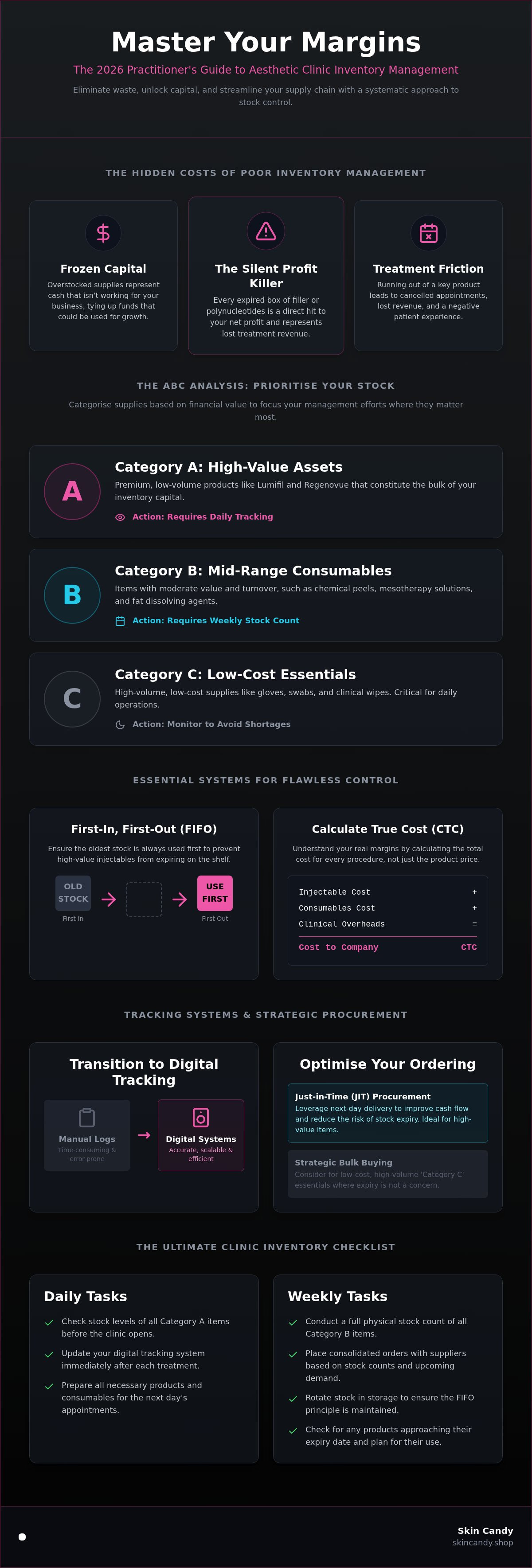
Losing a single box of premium dermal filler to an expiry date is a direct hit to your net profit. It's not just the cost of the product; it's the lost opportunity of the treatment revenue that box would have generated. Certain products, such as polynucleotides and exosomes, often require stricter monitoring due to specific storage requirements or shorter shelf lives. You must implement a "First-In, First-Out" (FIFO) system. This ensures that the oldest stock is always used first, preventing high-value injectables from migrating to the back of the shelf and expiring unnoticed. These aesthetic clinic inventory management tips focus on protecting your margins by reducing waste through rigorous batch tracking.
Defining Cost to Company (CTC) for Injectables
Understanding your true margins requires more than just knowing the wholesale price of a syringe. You must calculate the Cost to Company (CTC) for every procedure you offer. This figure includes the injectable itself plus all associated consumables like needles, cannulas, prep kits, and numbing creams. Cost to Company (CTC) is the total expenditure required to deliver a single treatment, including the product, consumables, and clinical overheads, ensuring every procedure maintains a healthy profit margin. Tracking CTC is vital for setting an accurate treatment price list. If you don't know the exact cost of the kit required for a polynucleotide treatment, you're likely underpricing your services and eroding your business's financial health.
Categorising Your Aesthetic Supplies for Maximum Efficiency
Effective stock control starts with logical classification. One of the most practical aesthetic clinic inventory management tips is the ABC Analysis. This method organises your supplies based on their financial value and turnover rate, allowing you to focus your oversight where it matters most. By segmenting your stock, you avoid the trap of treating a box of nitrile gloves with the same level of scrutiny as a high-value injectable.
- Category A: High-value, low-volume assets. This includes premium products like Lumifil dermal filler UK and Regenovue. These items represent the bulk of your "frozen" capital and require daily tracking.
- Category B: Mid-range consumables. These are items like chemical peels, mesotherapy solutions, and fat dissolving agents. They have moderate value and typically require a weekly stock count.
- Category C: Low-cost, high-volume essentials. This category covers gloves, swabs, and clinical wipes. Whilst individual costs are low, the impact of inventory inaccuracy in this category can still cause significant "treatment friction" if you run out during a busy clinic day.
Implementing this tiered approach ensures your most expensive products are never lost or expired. It also simplifies the ordering process by highlighting which items need immediate replenishment versus those that can wait for a monthly bulk order.
Specialised Handling for Advanced Consumables
Advanced treatments demand specific storage and handling protocols. Understanding the various polynucleotide indications for aesthetic clinics is essential for clinical results, but managing their logistics is vital for safety. You must maintain a strict cold chain for exosomes or specific skin boosters that require refrigeration. Traceability is equally critical. Always link lot numbers and expiry dates directly to patient records. This creates a digital paper trail that protects your practice during clinical audits or in the rare event of a product recall.
Retail vs. Professional Use Products
Never mix your treatment stock with patient-facing retail products. Clear physical separation prevents practitioners from accidentally using high-margin retail items during a procedure. When deciding how to choose chemical peels for clinic use, ensure your back-bar is organised by treatment type rather than brand. Assign distinct SKU codes for retail and professional variants. This distinction keeps your financial reporting clean and ensures your profit margin calculations remain accurate. If your stockroom feels overwhelmed, consider moving to a wholesale supply model that offers rapid fulfilment to keep your on-site inventory lean and manageable.
Digital vs. Manual Tracking: Choosing the Right System
Choosing between manual logbooks and digital systems is a pivotal decision for any growing practice. Manual tracking is often the starting point for boutique clinics because it requires zero initial investment. However, paper logs are notoriously prone to human error and offer no real-time visibility. As you scale to multiple treatment rooms, the risk of "treatment friction" mentioned earlier increases. Relying on memory or scribbled notes leads to stockouts and missed revenue opportunities.
Many practitioners attempt to bridge the gap using spreadsheets. Whilst better than paper, spreadsheets are static and don't integrate with your patient booking software. They require manual data entry that busy staff often neglect. Transitioning to modern inventory management software allows for automated deductions. When a practitioner completes a treatment, the system automatically removes that specific syringe or vial from your virtual shelf. This real-time update is one of the most effective aesthetic clinic inventory management tips for maintaining high-performance logistics.
- Expiry Alerts: Automated notifications ensure you never lose money on "dead stock" or expired injectables.
- Barcode Scanning: Rapidly log incoming deliveries and outgoing items with 100% accuracy.
- Treatment Linking: Connect specific batch numbers directly to patient records for clinical safety.
Implementing a Digital Stock Audit
You don't need to close your doors to digitise your inventory. Start by categorising your "Category A" items first. Conduct a "Blind Count" where staff record quantities without seeing the system's expected numbers. This removes confirmation bias and ensures your digital baseline is perfectly accurate. We recommend a full audit monthly, whilst high-turnover items should be checked weekly. This systematic approach ensures your digital system remains a reliable source of truth for your procurement decisions.
Ensuring Compliance and Traceability
UK clinics must meet stringent CQC and insurance requirements regarding product traceability. Digital systems provide an immutable audit trail that paper logs simply cannot match. If you are using the best professional fat dissolving agents UK clinics trust, you must record batch numbers and expiry dates for every patient. In the event of a product recall, a digital database allows you to identify affected patients in seconds rather than hours. This level of logistical excellence protects your clinical reputation and ensures you remain compliant with UK medical regulations.
Strategic Procurement: Bulk Buying vs. Just-in-Time Delivery
Procurement is a delicate balancing act between maintaining liquidity and ensuring you never turn a patient away. Many practitioners fall into the "Bulk Buying Trap" by chasing unit discounts that tie up thousands of pounds in stock for months. Whilst a lower price per syringe looks good on paper, the impact on your monthly cash flow can be devastating. These aesthetic clinic inventory management tips focus on finding your specific "Reorder Point" for popular dermal fillers to keep your business agile.
Your reorder point is the minimum stock level that triggers a new purchase. Calculate this by multiplying your average daily usage by the delivery lead time, then adding a small safety margin. Adopting just-in-time inventory aesthetic clinic strategies allows you to operate with leaner shelves. This approach frees up capital for marketing or clinic upgrades whilst ensuring your products are always well within their expiry dates. Negotiate with wholesalers who offer consistent supply and reliable delivery schedules rather than just the lowest one-off price.
When to Bulk Buy Consumables
Bulk purchasing is most effective for "Category C" items or high-turnover consumables with long shelf lives. You should stock up ahead of seasonal peaks, such as the pre-holiday "glow" treatment rush, to avoid industry-wide shortages. Investing in mesotherapy products wholesale UK packages can significantly improve your margins on high-frequency skin rejuvenation treatments. Always assess the shelf-life of any product before committing to large volumes. If a product expires in six months but your usage data suggests it will take nine months to clear, the bulk discount is a guaranteed loss.
The Power of Next-Day Delivery
A fast UK wholesale partner is the secret to a successful just-in-time model. Relying on rapid fulfilment reduces the need for massive on-site storage and lowers your insurance premiums. Reliable same-day dispatch is the backbone of a modern clinic, ensuring you never have to turn away a last-minute booking due to a missing vial of Lumifil or Regenovue. This logistical confidence allows you to say "yes" to every high-value patient who walks through your door. To keep your inventory lean and your treatment rooms fully stocked without the bloat, order your clinical supplies from Skin Candy for guaranteed next-day delivery across the UK.
The Ultimate Aesthetic Clinic Inventory Checklist
Operational excellence requires more than just the right software; it demands a disciplined routine. Implementing these aesthetic clinic inventory management tips through a structured checklist ensures that your clinic remains clinical, compliant, and consistently profitable. By breaking your logistics down into manageable cycles, you prevent the chaos of last-minute ordering and the financial drain of expired products.
- Daily: Restock treatment rooms every morning. Conduct basic clinical waste disposal checks at the end of every shift to maintain a sterile environment.
- Weekly: Review high-turnover items like gloves and swabs. Verify all incoming deliveries against your purchase orders to catch discrepancies immediately.
- Monthly: Perform a full physical audit of your Category A assets. Verify expiry dates across all categories and move items with the closest dates to the front of the shelf.
- Quarterly: Conduct a formal supplier review. Analyse your inventory turnover rates to identify "dead stock" and adjust your reorder points accordingly.
Step 1: Organising Your Physical Space
Visual management is the key to speed in a high-volume clinic. Use clear, labelled bins for all consumables and implement "shadow boards" for clinical tools to ensure everything has a dedicated home. This reduces the time practitioners spend searching for supplies during a procedure. Your stockroom must be climate-controlled to protect the integrity of dermal fillers and skin boosters. A secure, locked environment is essential for high-value assets. Organise your shelves by treatment type rather than manufacturer. This allows a practitioner to grab a complete treatment kit of fillers, needles, and prep wipes in one movement, significantly improving clinical efficiency.
Step 2: Streamlining Your Ordering Process
Consistency is the enemy of waste. Create a "Master Order List" with a reliable partner like Skin Candy to ensure you never miss a vital item during your weekly restock. This list should include your baseline requirements for Lumifil, Regenovue, and polynucleotides. Assign a dedicated "Inventory Champion" within your team. This individual takes full accountability for the stockroom, ensuring that audits are completed and orders are placed on time. Accountability prevents the "I thought someone else ordered it" excuse that leads to cancelled appointments. To maintain a lean, high-performance practice, simplify your procurement with Skin Candy’s next-day delivery and protect your clinic from the risks of stockouts and over-ordering.
Future-Proof Your Practice Logistics
Efficient stock control is the silent engine of a high-performance practice. You've now gained the framework to categorise high-value injectables and implement a systematic audit cycle that protects your margins from waste. Transitioning to a leaner, just-in-time procurement model allows you to reinvest capital into clinic growth whilst maintaining peak operational readiness at all times. These aesthetic clinic inventory management tips are your roadmap to a more resilient, waste-free business.
Success in the 2026 landscape requires a partner who understands the pressure of a busy patient list. Skin Candy acts as your reliable UK wholesale partner for Lumifil and Regenovue, providing the specialist support and logistical speed your clinic demands. Don't let inaccurate stock levels or expired products disrupt your success. Browse professional aesthetic supplies with next-day UK delivery and experience the satisfaction of a perfectly streamlined supply chain. It's time to reclaim your peace of mind and focus on what you do best: delivering exceptional patient results.
Frequently Asked Questions
How much stock should a new aesthetic clinic carry?
New clinics should maintain a lean inventory to protect cash flow. Aim for a 20% buffer above your confirmed weekly bookings. Relying on next-day delivery from a UK wholesaler ensures you don't over-invest in stock before you understand your treatment trends. This approach keeps your capital liquid for marketing and clinic overheads whilst ensuring you're never short of essential fillers or fat dissolvers.
What is the best way to track expiry dates on dermal fillers?
Digital tracking with automated alerts is the gold standard for modern practices. Physically, you must implement a "First-In, First-Out" (FIFO) system where older stock sits at the front of the shelf. Monthly audits are vital to verify that the digital record matches the physical shelf. These aesthetic clinic inventory management tips help prevent the financial loss associated with expired, high-value injectables like polynucleotides or exosomes.
How do I handle damaged or leaked products in my inventory?
Document the issue immediately by taking clear photographs of the damage and the batch number. Move the item to a secure quarantine area to ensure it's never used on a patient. Contact your supplier's customer service team straight away to initiate a claim. Never attempt to use a product with a compromised seal. This poses a significant clinical risk and violates professional safety protocols.
Should I use a barcode scanner for my clinic stock?
Barcode scanners are highly recommended for clinics looking to scale. They eliminate manual entry errors and speed up the audit process significantly compared to paper logs. Scanning items at the point of delivery and the point of use ensures your stock levels remain 100% accurate. This technology is a cornerstone of high-performance practice logistics and improves clinical safety tracking across multiple treatment rooms.
What is a "safety stock" level for aesthetic clinics?
Safety stock is the minimum buffer you hold to protect against unexpected demand or delivery delays. For most UK practitioners, a three-day supply of high-value items is a safe baseline. If you use five vials of a specific filler daily and your supplier offers next-day delivery, your safety stock should be roughly fifteen units. This prevents treatment friction and the stress of cancelled appointments.
How does treatment-linked inventory tracking work?
This method links your inventory levels directly to your patient records and booking software. When you record a treatment, the system automatically deducts the specific syringe or vial from your stock count. It creates a digital paper trail that includes batch numbers and expiry dates. This automation reduces administrative burden and ensures your clinical records remain compliant with UK insurance and regulatory standards.
Can I manage inventory without expensive software?
You can start with simple spreadsheets or paper logbooks if you're running a boutique, low-volume practice. However, these manual methods lack the automated alerts and real-time deductions provided by digital systems. As your clinic grows, the time spent managing manual logs becomes a hidden cost. Investing in basic inventory software often pays for itself by preventing just one or two costly expiry errors.
Why is traceability so important for injectables?
Traceability is essential for patient safety and regulatory compliance in the UK. It allows you to link every injectable product back to a specific batch and manufacturer. If a product recall occurs or a patient experiences an adverse reaction, you can identify the exact product used in seconds. Maintaining a clear digital audit trail protects your professional reputation and ensures you meet stringent clinical audit requirements.