PLLA vs Hyaluronic Acid Fillers: A Practitioner’s 2026 Buying Guide
Choosing the most popular filler for every patient might actually be the quickest way to stall your clinic's growth. Whilst hyaluronic acid remains the industry standard for instant volume, relying solely on it limits your ability to offer the structural, collagen-stimulating results that 2026 patients demand. You likely already recognise that the debate of PLLA vs hyaluronic acid fillers isn't about which is better, but about which clinical tool fits the specific anatomical goal. Mastering this distinction is essential for any practitioner looking to refine their treatment menu and secure long-term patient loyalty.
This guide provides the technical clarity you need to navigate these two distinct categories with confidence. You will learn the commercial differences between bio-stimulators and traditional fillers to optimise your clinic’s revenue and patient outcomes. We examine the latest UK market data, compare the mechanisms of action, and provide a clear roadmap for sourcing high-quality PLLA with the logistical speed your business requires. From understanding the shift toward natural-look preventative treatments to streamlining your procurement, we ensure your supply chain is as efficient as your clinical practice.
Key Takeaways
- Differentiate between immediate hydrophilic volumisation and long-term bio-stimulatory collagen production to tailor treatments to specific anatomical goals.
- Analyse the commercial advantages of offering results that last over two years, enhancing patient retention and long-term clinic ROI.
- Master the technical nuances of PLLA vs hyaluronic acid fillers, focusing on particle distribution and precise reconstitution protocols to ensure patient safety.
- Evaluate heritage brands like Sculptra against modern alternatives like AesPlla to find the best fit for your clinic’s high-performance treatment menu.
- Optimise clinic cash flow and operational efficiency by switching to a "just-in-time" supply model with guaranteed next-day UK delivery.
Understanding the Science: Bio-stimulation vs Dermal Filling
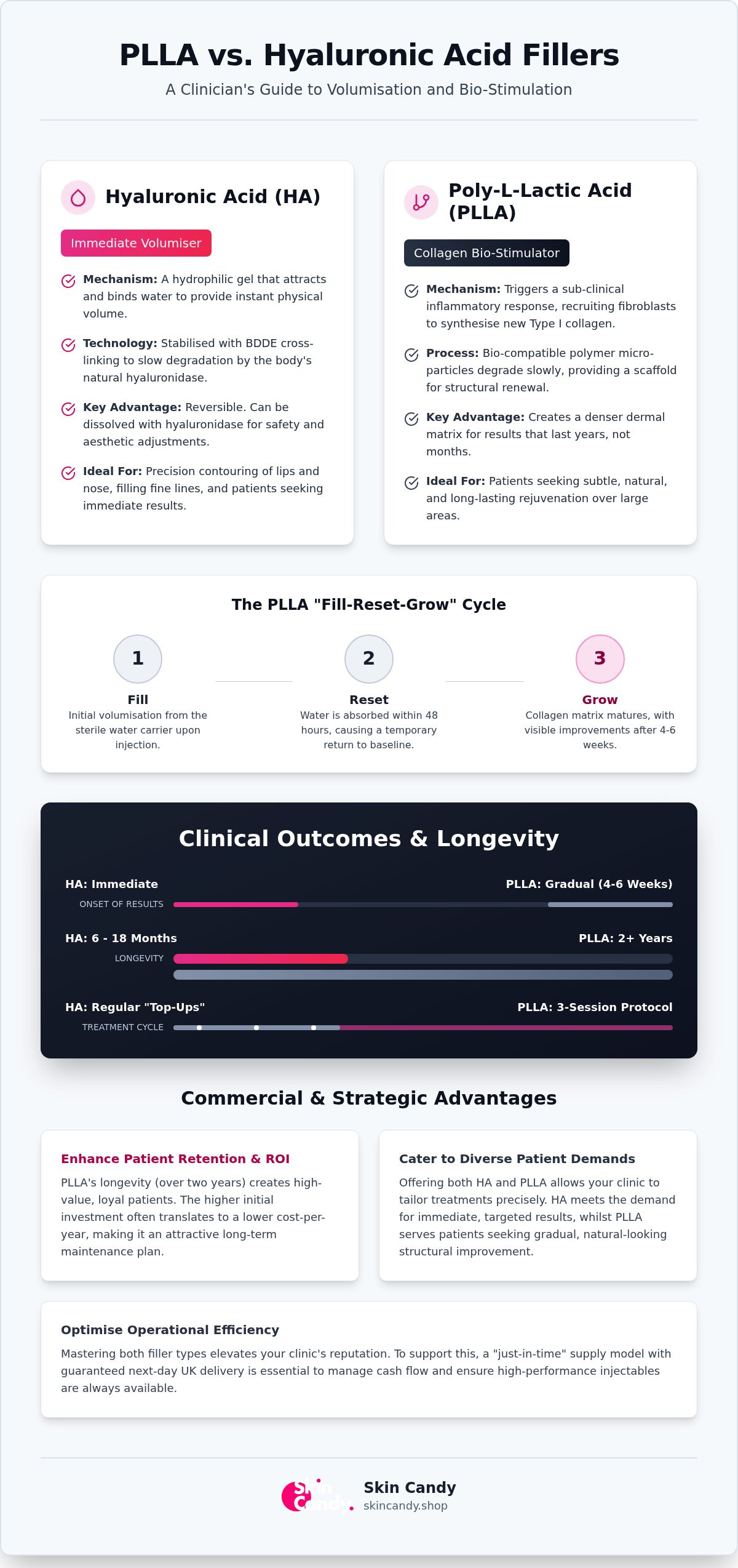
The clinical choice between PLLA vs hyaluronic acid fillers depends entirely on whether the patient requires immediate volume or long-term structural restoration. Hyaluronic acid (HA) fillers are hydrophilic gels. They work by attracting and binding water molecules to provide instant physical volume. In contrast, Polylactic acid (PLLA) is a synthetic, bio-compatible polymer. It doesn't just fill a space; it triggers a sub-clinical inflammatory response. This controlled irritation recruits fibroblasts, the cells responsible for synthesising new Type I collagen. Whilst HA offers a "temporary fix" by replacing lost volume, PLLA provides "structural renewal" by encouraging the body to rebuild its own foundation over several months. This biological shift creates a denser dermal matrix that HA simply cannot replicate.
The Immediate Impact of Hyaluronic Acid
Modern HA fillers utilise BDDE (1,4-butanediol diglycidyl ether) cross-linking technology to ensure stability and longevity. This chemical bond prevents the body's natural hyaluronidase from breaking down the gel too quickly. HA is the gold standard for precision contouring. It's ideal for refining the lips, nose, or filling fine lines where immediate gratification is the priority. A major safety advantage is its reversibility. If a vascular occlusion occurs or the patient is unhappy with the aesthetic outcome, the filler can be dissolved rapidly using injectable hyaluronidase. This provides a safety net that biostimulators lack, making HA the preferred choice for high-risk areas or first-time patients.
The Gradual Evolution of PLLA Results
PLLA results don't happen overnight. Once injected, the micro-particles begin a slow degradation process, eventually breaking down into lactic acid, a substance naturally processed by the body. This process initiates neocollagenesis. Practitioners must manage patient expectations regarding the "fill-reset-grow" cycle:
- Fill: Initial volumisation from the sterile water carrier.
- Reset: The water is absorbed within 48 hours, causing the "disappearance" of results.
- Grow: The collagen matrix matures, with visible improvements appearing after 4 to 6 weeks.
This gradual evolution makes PLLA the superior choice for patients seeking subtle, long-lasting rejuvenation without the overfilled look associated with excessive HA use. It requires patience but rewards the patient with a foundation that lasts years rather than months. Securing these high-performance injectables requires a logistical partner that understands the urgency of clinic operations, such as Skin Candy, ensuring your stock levels always match your treatment schedule.
PLLA vs Hyaluronic Acid: Comparing Clinical Outcomes and Longevity
Understanding the clinical lifespan of PLLA vs hyaluronic acid fillers is vital for managing patient expectations and clinic profitability. Hyaluronic acid (HA) typically offers results lasting between 6 and 18 months, depending on the product viscosity and the patient's metabolic rate. Conversely, PLLA is a long-term investment. Once the collagen matrix matures, results often persist for over two years. Whilst HA provides immediate gratification, the cost-per-year for the patient is often lower with PLLA despite the higher initial investment. This financial efficiency makes bio-stimulators an attractive option for patients prioritising long-term maintenance over frequent clinic visits.
Longevity and Treatment Cycles
Hyaluronic acid requires regular maintenance "top-ups" to preserve the aesthetic contour. You can find more detail on this in our Lumifil Dermal Filler guide, which outlines why specific HA brands are dominating the UK market. PLLA follows a different trajectory. It usually requires a 3-session protocol spaced 4 to 6 weeks apart to reach peak efficacy. This phased approach ensures the sub-clinical inflammatory response is sustained enough to build a robust collagen foundation. For practitioners, referencing FDA information on dermal fillers helps validate these protocols to patients who may be wary of the delayed onset of results.
Ideal Patient Demographics
Patient profiles differ significantly when choosing between PLLA vs hyaluronic acid fillers. The "HA patient" is often younger, looking for precise feature enhancement like lip augmentation or sharp jawline definition. These treatments usually sit within the mid-to-deep dermis. The "PLLA patient" is typically older, presenting with global volume loss, skin laxity, or "gaunt" facial features. PLLA is often injected deeper, frequently at the supra-periosteal level, to provide structural support from the bone up.
The most successful 2026 clinics are identifying "hybrid" patients. These individuals benefit from a PLLA foundation for overall skin quality and structural lift, followed by HA for fine-tuning specific areas like the nasolabial folds. This combination approach maximises both immediate satisfaction and long-term biological improvement. If you're looking to expand your clinic's capabilities, consider stocking professional-grade PLLA solutions to meet this growing demand for natural, structural rejuvenation.
Key Factors to Consider When Selecting PLLA for Your Clinic
Selecting the right PLLA for your clinic requires more than just looking at the price per vial. You need to scrutinise the particle size and distribution carefully. Uniform micro-particles are essential for a predictable, controlled inflammatory response. If the particle distribution is uneven, you significantly increase the risk of sub-clinical nodules or visible papules. A clinical study comparing PLLA and HA fillers underscores that while both materials are biocompatible, the technique-sensitive nature of PLLA demands a higher level of preparation and technical precision. Choosing a brand with robust clinical backing ensures that the "reset" phase of the treatment remains predictable for your patients.
Molecular Concentration and Reconstitution
The reconstitution process is a major operational factor for busy UK clinics. Older generations of PLLA often required a 24 to 48 hour wait time before they could be safely injected. This delay often hindered same-day bookings and complicated clinic scheduling. Modern formulations have streamlined this, with some products ready for use in under 30 minutes. High molecular concentration is another critical metric. Vials with a higher PLLA-to-carrier ratio offer a superior ROI, as you achieve more significant neocollagenesis with less physical volume. When it comes to the injection itself, using a 22G or 25G cannula is usually preferred. It ensures a smoother delivery across the supra-periosteal plane and reduces the risk of bruising compared to traditional needle techniques.
Safety and Side Effect Profiles
Safety profiles differ fundamentally between PLLA vs hyaluronic acid fillers. PLLA is strictly contraindicated for high-mobility areas like the periorbital or perioral regions. In these zones, the constant muscle movement can cause the micro-particles to clump, leading to persistent granulomas. Proper injection depth is non-negotiable. You must ensure the product is placed in the deep dermis or at the supra-periosteal level to provide structural support.
Patient education regarding post-treatment care is vital for mitigating side effects. You must enforce the "5-5-5" massage rule: patients should massage the treated area for five minutes, five times a day, for five days. This prevents product migration and ensures even collagen stimulation. Sourcing your injectables from a reliable aesthetic clinic procurement partner guarantees that every vial meets UK medical standards. This logistical reliability allows you to focus on clinical excellence rather than worrying about the integrity of your supply chain.
Top PLLA Products for Professional Use in 2026
Selecting the right injectable is a commercial decision as much as a clinical one. When evaluating PLLA vs hyaluronic acid fillers, practitioners must weigh the immediate results of HA against the long-term biological investment of PLLA. The 2026 market offers a range of bio-stimulators that cater to different clinic demographics and budget requirements. Understanding the nuances between heritage brands and modern alternatives allows you to tailor your treatment menu for maximum ROI and patient satisfaction.
The Heritage Standard: Sculptra (£249.99)
Sculptra remains the benchmark for bio-stimulatory treatments. It has the longest clinical history in the industry. This product is specifically designed to address deep facial wrinkles and significant volume loss by reinforcing the skin's internal structure. Its biocompatible and biodegradable nature ensures long-term patient safety, making it a reliable choice for high-end clinics. Whilst it carries a premium price point, its reputation for delivering predictable, multi-year results often justifies the investment for brand-conscious patients seeking the "gold standard" in collagen stimulation.
The Modern Bio-stimulator: AesPlla (£90.00)
AesPlla has emerged as a high-performance alternative for clinics prioritising both efficacy and margin. This modern formulation provides natural-looking volumisation for shallow to deep wrinkles. It's particularly effective for patients who are wary of the "over-filled" look often associated with excessive HA use. AesPlla offers a gradual enhancement profile that aligns with the current trend for "quiet aesthetics." To ensure your clinic stays ahead of these trends, you can browse the PLLA collection for the latest availability and technical specifications.
Advanced Regeneration: iLLUMA PLLA 500 (£130.00)
iLLUMA PLLA 500 is engineered for practitioners who focus on tissue regeneration as well as volumisation. It boosts collagen production whilst simultaneously enhancing overall tissue health. This makes it an excellent choice for firming and smoothing skin texture in patients with moderate laxity. In a busy clinic setting, its efficiency and predictable integration into the dermal matrix make it a valuable tool for maintaining a high turnover of satisfied patients.
Comparing these three options reveals a clear strategic path. Sculptra serves the premium, heritage-focused market. AesPlla provides an accessible entry point for gradual volumisation with excellent commercial margins. iLLUMA PLLA 500 bridges the gap by offering advanced regenerative benefits. By stocking a variety of these high-performance injectables, you can address a broader range of patient concerns. If you are ready to upgrade your clinic's offerings, order your PLLA supplies today to benefit from next-day UK delivery.
Strategic Procurement: Stocking Your Clinic with High-Performance Injectables
Clinic management in 2026 requires a lean approach to stock. Holding excessive inventory ties up capital that could be used for marketing or staff training. By adopting a "Just-in-Time" (JIT) procurement model, you ensure that your supplies arrive exactly when needed. This approach is particularly effective when balancing the stock requirements of PLLA vs hyaluronic acid fillers, as the two products have different patient turnover rates. Skin Candy facilitates this model with guaranteed next-day delivery across the UK. This allows you to respond to patient demand without over-leveraging your cash flow.
Maximising Clinic ROI
Offering bio-stimulators as a premium "longevity" service can significantly increase your average transaction value. Whilst HA fillers are often seen as a commodity, PLLA is marketed as a structural investment. By stocking multiple brands, such as AesPlla and Sculptra, you can implement tiered pricing. This strategy allows you to capture a broader market segment, from price-conscious patients to those seeking heritage brands. Proper menu planning is essential for cross-selling. For example, aligning your injectable schedule with skin resurfacing can enhance patient outcomes. See our guide on choosing chemical peels to see how to integrate these into a comprehensive treatment plan.
Why Skin Candy is Your Dedicated Logistics Partner
Reliability is the foundation of a successful aesthetic practice. A missed delivery means a cancelled appointment and lost revenue. Skin Candy operates as the silent engine behind your business, providing same-day fulfilment and medical-standard supplies. We understand the high-pressure environment of UK aesthetic clinics. Our commitment to logistical excellence ensures you never have to turn a patient away due to stock shortages. Bulk-buying consumables for these treatments is another effective way to increase your profit margins over time.
Mastering the clinical and commercial balance of PLLA vs hyaluronic acid fillers is the key to a resilient clinic. Integrate PLLA for your long-term, high-value patients who prioritise structural integrity and skin quality. Reserve HA for new feature-seekers who want immediate, visible changes. This balanced approach ensures high patient retention and a diversified revenue stream. Explore our full PLLA and dermal filler range today to streamline your clinic's procurement process and secure next-day UK delivery.
Future-Proofing Your Aesthetic Practice
Mastering the clinical nuances of PLLA vs hyaluronic acid fillers is no longer optional for practitioners aiming to lead the 2026 market. You now have the technical insight to distinguish between immediate hydrophilic volumisation and long-term structural renewal. By integrating bio-stimulators like AesPlla and Sculptra into your treatment menu, you can cater to the growing demand for natural, regenerative results that last over two years. This dual approach ensures you meet the needs of both new feature-seekers and long-term maintenance patients whilst maximising your clinic's revenue potential.
Efficiency in the treatment room must be matched by efficiency in your supply chain. Skin Candy acts as your dedicated logistics partner, providing next-day UK delivery on all professional-grade injectables. We are an official stockist of industry leaders and offer dedicated support to ensure your operational needs are met without delay. Don't let stock shortages or slow shipping hinder your clinic's growth or disrupt your patient scheduling.
Shop the Professional PLLA Collection at Skin Candy to optimise your clinic's ROI and elevate your patient outcomes today. You're now equipped to build a more resilient, profitable, and scientifically advanced practice.
Frequently Asked Questions
How long do I need to wait after reconstituting PLLA before injecting?
Reconstitution times vary significantly depending on the specific product formulation. Whilst heritage brands like Sculptra traditionally required a 24 to 48 hour lead time, modern alternatives such as AesPlla are ready for clinical use in as little as 30 minutes. Practitioners must ensure a uniform suspension to prevent clogging and ensure even distribution. Always check the manufacturer's instructions for the precise sterile water ratios required for your chosen brand.
Can I use Hyaluronic Acid and PLLA in the same treatment session?
Practitioners can use both Hyaluronic Acid and PLLA in a single session if they are targeting different anatomical layers. PLLA is typically placed at the supra-periosteal level for structural lift, whilst HA is used for superficial refinement in the dermis. Never mix these products in the same syringe. This combination approach allows you to provide the immediate gratification of HA alongside the long-term collagen stimulation of PLLA.
What is the recommended massage protocol for patients after PLLA injections?
The industry-standard massage protocol for PLLA is the "5-5-5" rule. Patients must massage the treated area for five minutes, five times a day, for the first five days following their appointment. This mechanical action is vital to ensure the PLLA micro-particles remain well-distributed and don't clump together. Consistent massage significantly reduces the risk of sub-clinical nodules or palpable papules forming during the initial phase of the bio-stimulatory response.
Is PLLA reversible if the patient is unhappy with the results?
PLLA is not reversible and there is no dissolving agent equivalent to hyaluronidase for this material. The product must biodegrade naturally over time, which usually takes around two years. This lack of reversibility makes precise injection technique and conservative dosing essential. Because you cannot "undo" the treatment, practitioners must be confident in their placement and ensure the patient understands the gradual, permanent nature of the collagen-building process.
How many vials of PLLA are typically required for a full-face rejuvenation?
A typical full-face rejuvenation requires one to two vials per session. A complete treatment course usually consists of three sessions spaced six weeks apart, meaning a patient might require three to six vials in total. The exact amount depends on the patient's age and the severity of their volume loss. It's best to start conservatively and build the foundation gradually to ensure a natural aesthetic result.
What are the most common side effects associated with PLLA stimulators?
Common side effects include transient swelling, bruising, and tenderness at the injection site. The most significant long-term risk associated with PLLA stimulators is the formation of nodules or granulomas. These usually occur if the product is injected too superficially or if the patient fails to follow the mandatory massage protocol. Selecting high-quality brands with consistent particle sizes can help mitigate these risks and ensure a smoother clinical outcome.
Why is PLLA more expensive per vial than most HA fillers?
The higher cost per vial reflects the complex bio-stimulatory mechanism and the superior longevity of the results. In the debate of PLLA vs hyaluronic acid fillers, PLLA provides a biological foundation that lasts for over two years, whereas HA fillers are temporary. For the clinic, the higher price per vial is offset by the premium nature of the service and the increased patient retention associated with long-term structural restoration.
Can PLLA be used for body contouring or only facial treatments?
PLLA is highly effective for body contouring treatments beyond facial rejuvenation. It is frequently used for non-surgical buttock lifts or correcting "hip dips" where volume loss is a concern. It's also useful for improving skin laxity on the décolletage, neck, and arms. Using a cannula for these larger body treatments ensures a more comfortable experience for the patient and a more uniform distribution of the product across the treated area.