Wholesale dermal fillers for nasolabial folds: UK guide
The right wholesale choice isn’t simply the filler with the most familiar name. Sourcing wholesale dermal fillers for nasolabial folds means comparing product documentation, stated intended use and how reliably your clinic can replenish stock.
That can be a practical challenge for busy clinics. Supplier pages may leave important details hard to compare, while an interrupted supply can complicate stock planning. Assess product suitability against current manufacturer documentation and the practitioner’s professional judgement, not a product name alone.
This UK guide sets out a practical framework for comparing wholesale options: which product and regulatory information to review, how to assess options against clinic procurement needs, and which fulfilment details matter to day-to-day operations. Skin Candy supplies professional dermal fillers, including Regenovue, Aesossa, Teofil and Volifil, with same-day and next-day delivery options across the UK. Use the guide to structure purchasing decisions and make replenishment planning more dependable.
Key Takeaways
- Assess wholesale dermal fillers for nasolabial folds against product documentation and your clinic’s professional requirements, not brand familiarity alone.
- Use manufacturer labelling and intended-use information to make consistent product comparisons and support informed procurement.
- Compare suppliers’ ordering processes, fulfilment options and account arrangements against your clinic’s operational needs.
- Build a stock-planning workflow around your usage patterns, stated delivery options and product storage requirements.
- Review Skin Candy’s professional dermal filler range as part of a structured wholesale purchasing process.
Wholesale dermal fillers for nasolabial folds: what professional buyers need to know
Nasolabial folds are the lines running from each side of the nose towards the corners of the mouth. Their appearance can be influenced by facial structure, movement and age-related changes. The Nasolabial fold overview provides useful anatomical context, but it cannot determine whether a particular product or treatment is appropriate for an individual.
For clinics, searching for wholesale dermal fillers for nasolabial folds is a procurement task, not a shortcut to a treatment decision. Product categories and supplier information can support purchasing, but the qualified practitioner remains responsible for clinical assessment and treatment selection. This guide focuses on professional sourcing, not patient-specific advice or treatment instructions.
Wholesale dermal filler procurement means sourcing products for professional clinic use through a supplier while reviewing product information, ordering arrangements and replenishment needs. Keeping procurement separate from clinical decision-making helps clinics manage purchasing without treating a product description as a recommendation for every patient.
What does wholesale dermal filler sourcing involve?
A clinic purchases products made by a manufacturer through a wholesale supplier. The manufacturer’s current product information and labelling provide the basis for understanding the product category and its stated intended use. Supplier listings can help clinics identify options, but they don’t replace manufacturer documentation or the practitioner’s clinical judgement.
Review procurement as a connected workflow. Documentation supports product due diligence; ordering processes affect how purchases are placed and recorded; fulfilment and replenishment affect stock planning. Considering these elements together helps the clinic assess whether its purchasing process is practical, rather than focusing on a product name alone.
Why do nasolabial folds require a focused purchasing lens?
The treatment area gives the search a useful focus, but it doesn’t establish that one filler suits every person or clinical context. Practitioners assess each individual and make treatment decisions using their professional judgement and the current instructions for the specific product. Buyers should avoid inferring clinical indications or results from broad category descriptions or comparisons between brands.
For purchasing, keep the distinction clear. A catalogue may describe a dermal filler range, while manufacturer documentation provides product-specific information. Neither, on its own, determines an individual treatment plan. Clinics can make sourcing reviews more consistent by checking that the information relates to the exact product being considered and is current.
- Separate the decisions: assess the supplier and purchasing process for procurement; leave product selection for an individual to the qualified practitioner.
- Use product-specific information: review current manufacturer labelling and instructions rather than relying on general descriptions.
- Plan beyond the initial order: consider how documentation, ordering and replenishment fit the clinic’s ongoing stock management.
This approach makes a focused search more useful. It connects the treatment-area context with disciplined sourcing, without confusing wholesale availability with clinical suitability.
Product information to assess when sourcing nasolabial-fold fillers wholesale
Product names and broad category descriptions are only a starting point. When sourcing wholesale dermal fillers for nasolabial folds, professional buyers need to distinguish verified facts about the specific product from general information about fillers. A formulation or category label alone doesn’t establish intended use, clinical suitability or expected results.
Product-specific documentation gives professional buyers a reliable basis for checking what a product is, how it is labelled and how it should be handled. Use current manufacturer material as the reference point rather than relying solely on a supplier listing or a comparison written for a different product.
Which product documents should a clinic review?
Start with the manufacturer’s current instructions for use, product labelling and other product-specific documentation. Check that the product name and variant match the item being considered. Keep relevant documents with purchasing records so staff can refer to the same information during stock management.
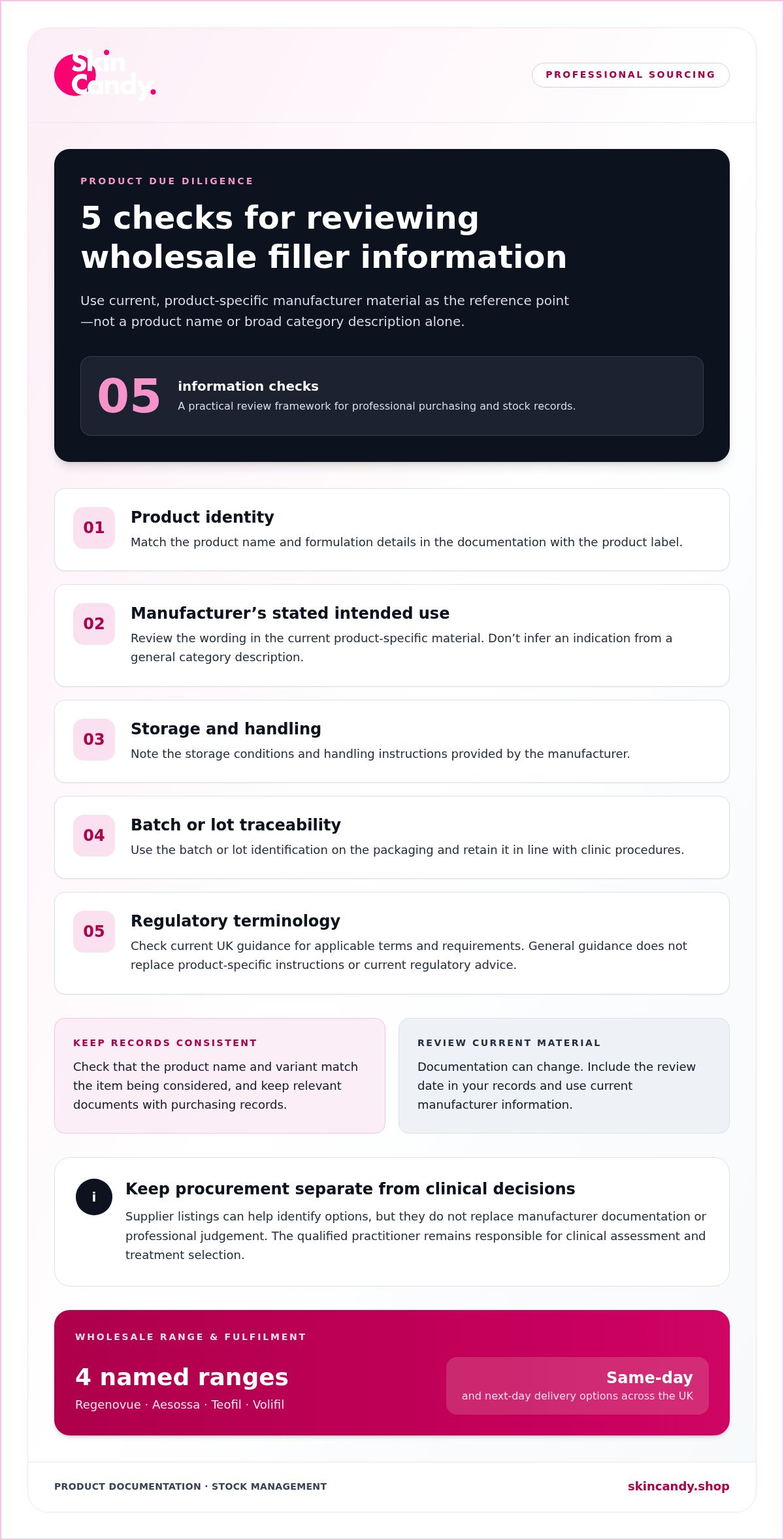
- Product identity: compare the name and formulation details in the documentation with the product label.
- Intended use: review the manufacturer’s stated wording; don’t infer an indication from a general category description.
- Handling information: note the storage conditions and handling instructions provided by the manufacturer.
- Traceability: use batch or lot identification on the product packaging and retain it in line with clinic procedures.
- Regulatory terminology: check current UK guidance for applicable terms and requirements. GOV.UK’s information on UK regulation of non-surgical cosmetic procedures provides relevant context, but it doesn’t replace product-specific instructions or current regulatory advice.
Documentation can change, so include the review date in your records. If a detail isn’t stated in the materials available to the clinic, don’t fill the gap with assumptions. Keep verified product facts distinct from general category information, and leave clinical interpretation to the qualified practitioner.
How should clinics compare product categories and brands?
Compare like with like. Build a simple product-by-product record of the documented formulation, stated intended use, labelling and handling information. Don’t treat a feature associated with one formulation or category as a property of every dermal filler. Similarly, don’t rank brands for nasolabial folds without product-specific evidence and clinical assessment.
Skin Candy’s dermal filler range includes Lumifil, Regenovue, Aesossa, Teofil and Volifil. Treat these as range options, then review the current manufacturer documentation for the specific product being considered. The Lumifil dermal filler market guide offers brand-specific context; use manufacturer materials for product-level details. Clinics can also browse Skin Candy’s professional dermal filler range as part of their sourcing review.
A consistent comparison is easier to document and revisit. Record the source and date of each product fact, keeping it separate from the practitioner’s assessment of treatment suitability. This gives clinic teams a clearer basis for procurement without turning wholesale information into patient-specific advice.
How to compare wholesale filler suppliers for clinic purchasing
A useful supplier comparison looks beyond the product name. For clinics assessing wholesale dermal fillers for nasolabial folds, operational consistency matters too. Clear listings, accessible product information and an ordering process staff can follow all help reduce administrative friction. Compare suppliers against the same criteria, using stated information rather than assumptions about product performance or service quality.
Which supplier criteria matter beyond the product name?
Review how clearly a supplier presents its catalogue, product information and ordering steps. Consider whether the ordering process fits your clinic’s purchasing records and whether the supplier’s stated fulfilment options work with routine stock replenishment. Keep claims about sourcing, authenticity or quality tied to evidence you can assess, such as product documentation and traceability details, rather than relying on broad assurances.
| Comparison area | What to assess |
|---|---|
| Product documentation | Are product listings clear, and can you identify where product-specific manufacturer information and labelling fit into your review? |
| Ordering process | Are ordering steps and account arrangements easy for relevant clinic staff to understand and record? |
| Fulfilment | What delivery options does the supplier state, and how can those options inform your reorder timing? |
| Account suitability | Does the purchasing arrangement support your clinic’s routine ordering and the range of products it procures? |
Use the same questions for each supplier under consideration. A clear listing can make it easier to identify the item being ordered and find relevant information. A repeatable ordering routine can reduce avoidable back-and-forth, particularly when more than one team member handles procurement. Record your criteria and findings so future reviews follow a consistent process.
How does delivery reliability affect clinic stock planning?
Delivery options help clinics plan when to place an order, but they shouldn’t be treated as a guaranteed arrival time. Set reorder timing around the supplier’s stated fulfilment information, your clinic’s usage patterns and the stock levels you choose to maintain. Skin Candy offers same-day and next-day delivery options across the UK, which clinics can factor into their replenishment planning.
For broader context on organising orders and stock, the aesthetic clinic procurement logistics guide explores procurement planning. Keep your comparison practical: document the options available, how orders are placed and how fulfilment fits your workflow. Clinics sourcing professional fillers can also review Skin Candy’s wholesale dermal filler range as part of their purchasing assessment.
A practical wholesale ordering and stock-planning workflow
A repeatable process helps clinic teams place orders accurately and avoid last-minute stock decisions. When sourcing wholesale dermal fillers for nasolabial folds, keep procurement focused on the clinic’s documented product requirements and inventory needs. Treatment choice and quantities for individual patients remain separate clinical decisions.
How can clinics organise a repeatable reorder process?
Start with the clinic’s own stock movement. Record orders and usage through the established inventory process, then set internal review dates that reflect actual demand. A reorder point can be based on the level at which remaining stock, considered alongside supplier-stated delivery information, prompts a review. It is a planning trigger, not a recommendation for a fixed purchase quantity.
Build flexibility into the routine. Supplier delivery options can inform when the team begins replenishment, but shouldn’t be treated as a promise of a particular arrival time. Skin Candy offers same-day and next-day delivery options across the UK. Clinics can include these stated options in their planning while allowing for their own ordering procedures and stock requirements.
Keep records consistent across the team. Use the clinic’s chosen system to log product names, batch details when available, order dates and relevant order history. This makes it easier to review stock movement, trace a product through purchasing records and apply the same process when staff responsibilities change.
What should buyers check before submitting an order?
Use a short pre-order check to catch mismatches before placing an order. Compare the selected product with the clinic’s purchasing record and current manufacturer information. Then review the pack details shown for the item and make sure the clinic has a suitable process for receiving, recording and storing it in line with manufacturer instructions.
- Check the product: match the selected name and any relevant product variant against the clinic’s approved purchasing record.
- Review pack information: confirm the listing and order details correspond to the item intended for purchase.
- Use current documentation: make sure the relevant manufacturer instructions and product information are accessible to the clinic team.
- Plan handling: review the manufacturer’s storage and handling requirements, and ensure the clinic’s arrangements can follow them.
- Record the order: document the order through the clinic’s established process so stock records can be updated on receipt.
After delivery, update inventory records through the clinic’s usual receiving process, including product and batch details where applicable. This links purchasing with stock review and gives the team a clearer basis for setting its next internal review point. Keep the system proportionate: it should help staff make consistent decisions, not create unnecessary administration.
Once your workflow is in place, explore professional filler options as part of your clinic’s wholesale purchasing process.
Source wholesale dermal fillers for nasolabial folds with Skin Candy
Skin Candy is a UK-wide wholesale supplier of professional aesthetic products, serving clinics and trained professionals. For clinics sourcing wholesale dermal fillers for nasolabial folds, the range offers named options to consider within a structured purchasing process. A product appearing in a wholesale range does not, by itself, establish that it is suitable for a treatment area or individual patient.
Keep the roles clear. The supplier supports professional procurement; the qualified practitioner makes clinical decisions. Use current, product-specific information to understand each option and assess it against your clinic’s purchasing requirements. This keeps brand browsing separate from treatment recommendations and helps clinic teams approach ordering consistently.
Which filler brands can professional buyers browse?
Skin Candy’s dermal filler range includes Lumifil, Regenovue, Aesossa, Teofil and Volifil. These are range options, not a ranking or a claim that any one is indicated for nasolabial folds. Product details can vary, so base comparisons on information for the specific item rather than general assumptions about a brand or category.
As you review an option, focus on its product-specific information and documentation. Keep the manufacturer’s stated instructions and labelling central to the assessment, and separate verified details from broader category descriptions. The practitioner can then make clinical decisions independently, using their professional judgement and the current product instructions. This supports informed wholesale purchasing without turning a catalogue into patient-specific advice.
How can clinics move from comparison to ordering?
Follow a simple sequence: review the product information, assess the clinic’s procurement needs, then organise ordering and replenishment. The clinic’s stock records and internal process can guide when to review requirements, while supplier-stated delivery options can inform planning. They’re useful operational information, not a guarantee of a particular delivery time.
Skin Candy offers same-day and next-day delivery options across the UK. Clinics can include these options in replenishment planning alongside their own stock movement, product handling arrangements and ordering routines. Keeping those factors visible helps staff make purchasing decisions that fit clinic operations, without relying on assumptions about individual treatment volumes or committing to a fixed order quantity.
Before placing an order, make sure the chosen product matches the clinic’s purchasing record and that the relevant product information is available to the team. Once the order is placed, record it through the clinic’s established process and update stock records on receipt. This creates a straightforward link between product review, procurement and future replenishment.
For professional wholesale purchasing, Browse Skin Candy’s professional wholesale range and review product information as part of your clinic’s sourcing process.
Make your next purchasing review more deliberate
Turn your sourcing criteria into a simple review your team can use whenever purchasing needs change. A shared record of product information, ordering considerations and stock-planning assumptions helps keep decisions consistent, even when different staff manage procurement. Revisit it when clinic requirements or the product information you rely on changes.
That discipline is especially useful when evaluating wholesale dermal fillers for nasolabial folds. Ground procurement decisions in documented product details and clinic operations, while leaving patient-specific product selection to the qualified practitioner. A clear process gives your team a practical reference for future orders, rather than relying on memory or informal comparisons.
Skin Candy supports professional clinic purchasing with a wholesale range of aesthetic products. Browse Skin Candy’s professional wholesale range and take the next step towards a more organised sourcing process.
Frequently Asked Questions
Can any dermal filler be used for nasolabial folds?
No, clinics shouldn’t assume that every dermal filler is suitable for this area. The qualified practitioner makes treatment decisions based on individual assessment and the current instructions for the specific product. For purchasing, a catalogue category or brand name alone isn’t enough to establish suitability. Keep clinical judgement separate from procurement, and use product-specific manufacturer information when reviewing an item for professional use.
What should clinics check before buying dermal fillers wholesale?
Before ordering, match the exact product and pack details to the clinic’s purchasing record, then review the current manufacturer labelling and instructions. For example, if staff use a saved product name, check it against the item being added to the order rather than relying on memory. Also consider whether the clinic can follow the stated storage and handling requirements and record the purchase through its usual system.
How do clinics compare wholesale dermal filler suppliers?
Compare suppliers against the same operational criteria: how clearly products are listed, how product information is presented, how orders are placed and which fulfilment options are stated. Consider a routine scenario, such as a colleague needing to reorder an item using the clinic’s existing records. A clear, repeatable process can make purchasing easier to manage. Keep comparisons evidence-based, and don’t infer clinical performance from a supplier’s catalogue.
How quickly can wholesale dermal fillers be delivered in the UK?
Delivery timing depends on the supplier’s stated options and the order, so an option shouldn’t be treated as a guaranteed arrival time. Skin Candy offers same-day and next-day delivery options across the UK. Clinics can factor these into their own ordering plans, allowing time to review stock, place an order and process receipt. Plan replenishment with flexibility rather than relying on a specific delivery outcome.
How many dermal filler products should a clinic hold in stock?
There’s no single stock quantity that suits every clinic. Set internal levels using your own stock movement, ordering history, storage capacity and supplier delivery information. For example, a clinic can review how frequently a product is reordered and use that pattern to decide when stock needs attention. Keep inventory planning separate from treatment quantities, which are determined by qualified practitioners in individual clinical contexts.
Are different dermal filler brands interchangeable?
No, don’t assume products from different brands are interchangeable based on a shared category label. Product-specific formulation details, labelling and manufacturer instructions may differ. For instance, a clinic updating its purchasing records after changing products should review the documentation for the new item rather than carrying forward assumptions from the previous one. Clinical decisions remain with the qualified practitioner, using the current instructions for the product selected.
Does Skin Candy sell wholesale dermal fillers to UK clinics?
Yes. Skin Candy supplies professional aesthetic products wholesale to clinics and trained professionals in the UK. Its dermal filler range includes Lumifil, Regenovue, Aesossa, Teofil and Volifil. Buyers can use product-specific information to assess options for professional procurement, while leaving patient-specific treatment decisions to the qualified practitioner. This separates sourcing from clinical selection and helps keep purchasing aligned with the clinic’s established process.