Filler Injection Techniques for Lips: A 2026 Practitioner Reference
The most familiar approach to filler injection techniques for lips isn’t automatically the right one for every patient. Technique names can vary between educational sources, and the same approach may not suit different anatomy or treatment goals.
Comparing techniques is about more than terminology. Practitioners need to understand the intended effect and limitations of each approach, then put patient assessment and safety at the centre of treatment planning.
This reference compares commonly described techniques at a conceptual level and outlines the factors that guide selection. It offers a practical framework for assessing anatomy and goals, considering product characteristics and instructions for use, and recognising risks that may affect clinical decisions. The aim is to connect the planned result with the patient in front of you, choose products responsibly and work within current UK professional and regulatory requirements.
Key Takeaways
- Compare filler injection techniques for lips by their intended effects and trade-offs, not by technique name alone.
- Use patient goals, anatomy, treatment history and clinical assessment to shape the treatment plan.
- Consider filler characteristics and product instructions for use when selecting a suitable product. Don’t assume one product fits every approach.
- Keep informed consent, relevant medical history, aseptic practice and emergency preparedness central to pre-treatment checks.
- Product documentation, traceability and dependable fulfilment can support clinic operations when sourcing professional dermal fillers.
What do lip filler injection techniques aim to achieve?
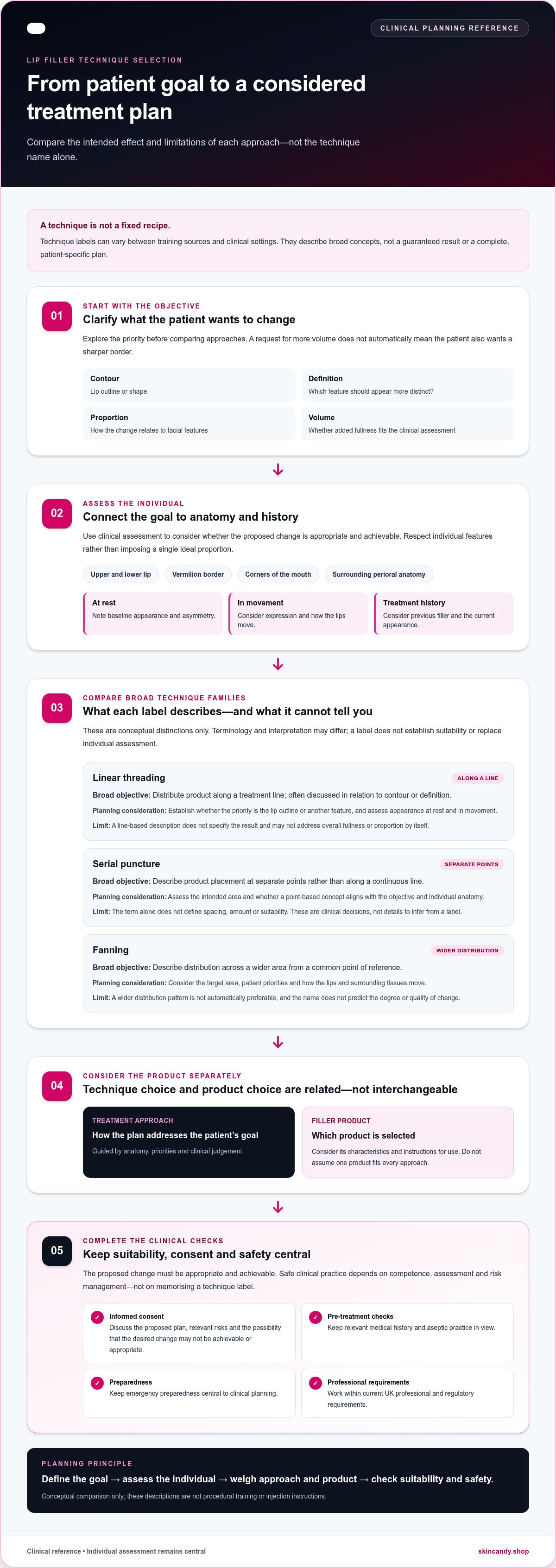
Lip filler techniques are clinician-selected approaches for addressing a defined treatment objective. They aren’t fixed recipes, and a technique name alone can’t determine what’s suitable for an individual. Start with the patient’s priorities, facial anatomy, relevant treatment history and clinical assessment. Then consider whether the proposed change is appropriate and achievable.
Definition: A lip filler injection technique is the clinician’s chosen approach to placing filler in pursuit of a treatment goal. Product choice is the separate decision about which filler to use.
These decisions are related, but not interchangeable. A product’s characteristics and instructions for use inform its clinical use, while the treatment plan must account for the person’s anatomy and expectations. For general background on filler types, uses and potential side effects, see Dermal filler.
Which lip features may inform treatment planning?
Assessment may consider the upper and lower lip, the vermilion border, the corners of the mouth and surrounding perioral anatomy. The objective might be clearer definition, a change in contour, greater apparent volume or improved proportion. These are distinct aims. A request for more volume, for example, doesn’t automatically mean the patient also wants a sharper border.
Observe the lips at rest and in movement. Baseline asymmetry, expression and how the lips relate to the rest of the face can shape the discussion. There’s no single proportion that should be treated as universally ideal. Planning should respect individual features rather than impose a template.
What does a technique name tell a practitioner?
Terms for approaches can differ between training sources and clinical settings. A label may describe a broad method, but it doesn’t capture the full patient-specific plan, the clinical rationale or the suitability of a product. Interpret terminology in context, and don’t treat a named approach as a standardised recipe.
Conceptual descriptions help practitioners compare intended objectives and limitations. They aren’t procedural training or injection instructions. Safe clinical practice depends on appropriate competence, assessment and risk management, not on memorising a technique label.
Set the objective before comparing approaches. Clarify what the patient means by “definition” or “volume”, and discuss what treatment may realistically address. Informed consent should reflect the proposed plan, relevant risks and the possibility that the desired change may not be achievable or appropriate. Previous filler treatment matters too: consider the current appearance and treatment history rather than planning from a photograph or preference alone.
- Contour: Establish whether the priority is the lip outline or the shape of the lip itself.
- Definition: Clarify which feature the patient wants to appear more distinct.
- Proportion: Discuss how the requested change relates to the person’s facial features, without prescribing one ideal ratio.
- Volume: Confirm the patient’s expectations and whether added fullness aligns with the clinical assessment.
This framework keeps the discussion focused: define the goal, assess the individual, then weigh technique and product choices within the limits of clinical judgement and patient safety.
How do common lip filler technique families differ?
Technique labels describe broad approaches to filler distribution, not a guaranteed result or a complete treatment plan. Definitions can vary between training materials and clinical settings, so compare the intended objective and limitations rather than relying on a name alone. These conceptual distinctions can help practitioners assess options, but they aren’t procedural guidance.
Linear threading, serial puncture and fanning: what is the distinction?
At a high level, linear threading describes distribution along a line, serial puncture refers to separate points of placement, and fanning describes a spread pattern from a shared area. Terminology and interpretation may differ. Anatomy, practitioner competence and the product’s instructions for use must guide clinical decisions. A technique label cannot establish suitability or replace individual assessment.
| Approach | General objective | Planning considerations | Limitations |
|---|---|---|---|
| Linear threading | Broadly, to distribute product along a treatment line, often discussed in relation to contour or definition. | Consider whether the patient’s priority concerns the lip outline or another feature, and how the area appears at rest and in movement. | A line-based description doesn’t specify the result. It may not address a goal focused on overall fullness or proportion by itself. |
| Serial puncture | Broadly, to place product at separate points rather than describing a continuous line. | Assess the intended area and whether a point-based concept aligns with the clinical objective and individual anatomy. | The term alone doesn’t define spacing, amount or suitability. Those are clinical decisions, not details to infer from a label. |
| Fanning | Broadly, to describe distribution across a wider area from a common point of reference. | Consider the target area, patient priorities and how the lips and surrounding tissues move. | A wider distribution pattern isn’t automatically preferable, nor does the name predict the degree or quality of change. |
How does a structural approach differ from a volume-focused approach?
A structural approach prioritises features such as contour or support, while a volume-focused approach places more emphasis on fullness. These are planning concepts, not mutually exclusive technique names or promises of an outcome. Someone seeking a more defined outline may have a different objective from a patient whose main concern is overall volume, even if both describe their goal as “fuller lips”.
Movement matters. A plan should account for how the lips look during expression as well as at rest, and whether the requested change fits the patient’s priorities. Different objectives call for different assessment and planning. Don’t select an approach solely because it is familiar or associated with a particular result.
Keep product choice distinct from technique choice. Consider the selected filler against its instructions for use and the patient-specific plan. No technique family is inherently tied to a particular product. For clinics reviewing professional dermal filler options, Skin Candy’s range includes Lumifil, Regenovue and Aesossa. Product availability supports clinic operations, but it doesn’t determine clinical suitability.
How should anatomy, filler characteristics and goals guide technique selection?
Technique selection is a clinical decision, not a trend-led choice. A sound plan connects the patient’s priorities with their anatomy, treatment history and relevant clinical history, then considers whether a product’s characteristics and intended use fit that plan. This keeps the choice of approach and the choice of filler related, but distinct.
Let assessment, not a trend or technique label, lead the plan. The same requested change can call for different considerations in different patients. Assessment may also show that expectations need discussion before agreeing a plan.
Which patient and anatomical factors deserve assessment?
Build a rounded picture before comparing filler injection techniques for lips. Note baseline lip shape and symmetry, tissue characteristics, the relationship between the lips and surrounding features, and how the lips move during expression. A static view alone may not show how a proposed change relates to normal movement.
Include previous filler or other relevant treatments, medical and clinical history, the patient’s priorities and expectations, and informed consent. These details help frame the objective and identify matters requiring further clinical consideration. A photograph, a preferred trend or a single feature is not a complete assessment.
- Clarify the goal: Establish what the patient means by definition, contour, proportion or added volume.
- Record the baseline: Consider shape, symmetry, tissue characteristics and movement together.
- Review context: Take relevant history and previous treatment into account.
- Align expectations: Discuss realistic aims, limitations and consent before finalising the plan.
How can filler characteristics affect the plan?
Hyaluronic acid fillers aren’t interchangeable. Rheological properties, such as a product’s behaviour under deformation, are product-specific, as are its intended use and instructions. Don’t infer suitability from a general label or a brand name. Review current product information and instructions for use alongside applicable UK professional guidance and evidence relevant to the proposed use.
Product selection should follow the clinical objective, not dictate it. First define what is being assessed and why, then evaluate whether a particular product is appropriate for that plan. If the available information doesn’t support a proposed use, don’t fill the gap with assumptions. The Lumifil dermal filler information provides product context, but doesn’t establish suitability for a specific lip technique.
Keep the decision pathway clear: identify the patient’s goal, assess anatomy and history, consider expectations and consent, then review product-specific information before settling on a clinical plan. Each step informs the next. None is replaced by a familiar technique name or a product’s general reputation.
What safety checks and limitations matter before lip filler treatment?
Safety planning starts before any treatment. Recognising filler injection techniques for lips doesn’t remove the need for individual assessment, informed consent, appropriate clinical governance and preparation for complications. Use this as a high-level checklist, not an injection protocol. Practitioners should work within their competence and follow current UK professional guidance, product instructions for use and local clinical procedures.
What should a practitioner establish before treatment?
Confirm the agreed treatment objective, document the assessment and obtain informed consent covering material risks, limitations and alternatives. Review relevant medical and treatment history, including previous filler. Check the product’s identity, packaging, storage conditions and current instructions for use. Before proceeding, ensure aseptic practice, appropriate clinical governance and clear complication pathways are in place.
How should the article discuss complications responsibly?
Dermal filler treatment can involve adverse events, including swelling, bruising, infection and, rarely, serious complications such as vascular compromise. Don’t imply that a particular technique eliminates risk or suggest that serious events are likely. If a serious complication is suspected, it requires prompt action under the practitioner’s current training and local protocols, with appropriate escalation.
- Assessment and consent: Record the clinical rationale, relevant history, agreed objective and consent discussion.
- Product checks: Verify product identity, packaging integrity, storage and instructions for use before treatment.
- Practice environment: Follow appropriate aseptic practice and the clinic’s governance arrangements.
- Preparedness: Ensure emergency arrangements and complication pathways are understood and accessible to the clinical team.
These checks support a consistent process, but they don’t make treatment risk-free. A patient’s history or assessment may raise concerns that require further consideration, a change to the plan or a decision not to proceed. Document the rationale and communicate clearly. A familiar technique label is no substitute for clinical judgement.
Emergency preparedness means knowing the relevant response pathway before it is needed. Practitioners should use current recognised complication guidance and local procedures, rather than relying on a general article for emergency instructions. Serious events need timely assessment and action appropriate to the circumstances. This section does not replace professional training, supervision, clinical judgement or current guidance.
Product traceability is also part of responsible clinic operations. Maintain clear records linking the product used to its packaging and documentation, and follow its storage and handling instructions. Reliable access to professional products can support planning, but it cannot determine whether a product or technique is clinically appropriate. Explore professional dermal fillers for clinics as part of your supply planning.
How can clinics source lip filler products with confidence?
Reliable sourcing supports more than stock availability. Clear product documentation and traceability help clinics maintain organised records, check product identity and manage stock responsibly. These operational controls matter alongside clinical decision-making: a wholesale catalogue can support procurement, but it can’t determine whether a product is suitable for an individual patient or a particular use.
For filler injection techniques for lips, keep clinical assessment, practitioner competence and the product’s current instructions for use central. Skin Candy’s professional dermal filler range includes Lumifil, Regenovue and Aesossa. These are product options, not endorsements for any specific technique or treatment objective.
What does a dependable product supply process support?
Planned procurement helps clinics monitor stock, organise ordering and support continuity of operations. Maintain a clear process for receiving products, checking packaging and documentation, recording relevant traceability details, and storing products according to their instructions. Reviewing stock levels against clinic demand can help teams plan replenishment rather than rely on last-minute decisions.
Skin Candy offers same-day and next-day delivery options across the UK. These options can support fulfilment planning, but clinics shouldn’t assume a particular delivery timing applies to every order. Broader stock-planning considerations are covered in this guide to just-in-time clinic procurement.
- At receipt: Check product identity and packaging, and record traceability information in line with clinic processes.
- In storage: Follow the product’s stated storage and handling instructions.
- For replenishment: Review stock levels and delivery options as part of routine clinic planning.
How should practitioners connect product choice to clinical use?
Separate sourcing from treatment planning. A product’s presence in a catalogue doesn’t establish its clinical indication or suitability for a patient. Review the current instructions for use and relevant evidence, then apply professional judgement within your competence. Don’t infer performance, outcomes or technique-specific suitability from a brand name alone.
Product information can help practitioners understand what they are sourcing, but it doesn’t replace assessment, consent or clinical governance. For additional product context, read the 2026 Lumifil market guide, without treating general market information as a clinical indication.
Keep procurement dependable and clinical decisions individual. Explore professional dermal fillers for clinic supply planning.
Make your next treatment plan deliberate
Use your next case review to turn the principles behind filler injection techniques for lips into a consistent planning habit. Before selecting an approach, write down the patient’s priority in their own terms, the assessment findings relevant to that goal, and the evidence or product information that supports the intended use. This makes the rationale easier to communicate, document and revisit.
Apply the same discipline to your clinic’s procurement process. Clear records and planned replenishment help teams stay organised, while clinical judgement remains central to every product decision. Choose supply options that fit your operational needs, and keep product documentation accessible for reference.
For your next stock-planning step, explore professional dermal fillers from Skin Candy. A considered approach to clinical planning and procurement helps your team work with greater clarity and confidence.
Frequently Asked Questions
Can lip filler injection techniques be combined?
Yes, approaches may be combined in clinical practice, but that doesn’t make combination treatment suitable for everyone. For filler injection techniques for lips, consider whether each approach contributes to the agreed objective and is appropriate for the patient’s anatomy and treatment history. Product characteristics and practitioner competence also matter. Any combined plan should follow relevant training, product instructions and current professional guidance, with its clinical rationale documented.
Is a cannula technique safer than a needle technique for lips?
Neither a cannula nor a needle should be described as risk-free or universally safer. The risk profile depends on several clinical and procedural factors, so a broad instrument comparison can’t predict an individual outcome. Instrument choice belongs to a suitably trained practitioner’s clinical judgement, informed by current evidence and relevant guidance. Whichever instrument is used, appropriate preparation and a clear complication pathway remain essential.
How long do lip filler results last?
There’s no single timeframe that applies to every patient or product. Visible effects can vary with the specific filler, treatment factors and individual response. Practitioners should refer to current product information and explain this uncertainty during consultation rather than promise a fixed duration. Visible change should not be treated as a precise measure of how much product remains, and it doesn’t establish a universal schedule for repeat treatment.
What should patients expect before a lip filler appointment?
Expect a consultation to discuss your goals, relevant medical and treatment history, expectations and informed consent before any procedure. The practitioner should explain appropriate risks, aftercare and follow-up arrangements in language you understand, and assess whether treatment is suitable in your circumstances. Bring details of previous filler or relevant treatments if available. General preparation information can’t replace advice based on an individual clinician’s assessment.
Can lip filler be dissolved if a patient is unhappy with the result?
Some hyaluronic acid fillers may be treated with hyaluronidase, but this isn’t a guaranteed or instant reversal, and it may not be appropriate for every concern. Suitability and expected outcomes depend on the product and clinical circumstances. A qualified practitioner should assess the situation and follow current guidance and product information. Dissatisfaction with appearance should also be distinguished from symptoms that could indicate an urgent complication.
What happens if a serious complication is suspected after lip filler?
A suspected serious complication needs prompt clinical assessment and action under the practitioner’s current training, established emergency pathway and recognised guidance. Don’t rely on an online article to diagnose or manage symptoms, or delay seeking appropriate urgent care. The practitioner should document the event and follow applicable reporting and follow-up procedures. The right response depends on the circumstances, so this FAQ cannot provide a treatment protocol.