Regenovue vs Lumifil: 2026 Professional Comparison Guide
Is the premium you're paying for "big-name" fillers actually buying better results, or is it just eroding your clinic's bottom line? Most UK practitioners feel the constant pressure of rising consumable costs whilst trying to maintain the five-star patient satisfaction scores that built their reputation. Choosing between Regenovue vs Lumifil for practitioners often comes down to a fine balance of chemical purity and anatomical versatility. It's about finding that sweet spot where clinical excellence meets commercial viability.
This 2026 professional guide provides a technical and commercial breakdown to help you select the most effective, profitable, and reliable dermal filler for your practice. We'll examine the specific cross-linking technologies of both brands, compare their longevity in clinical settings, and look at the logistical advantages of a streamlined supply chain. You'll discover how to maximise your profit per syringe while ensuring your clinic remains compliant with the latest UK licensing standards for Class III medical devices. We'll also address how to avoid the logistical delays that can disrupt a busy clinic day, ensuring you always have the right product on hand for your next patient.
Key Takeaways
- Understand the rheological differences between monophasic and biphasic structures to select the correct filler for specific facial zones.
- Compare the clinical efficacy of Lumifil Kiss against Regenovue Deep to achieve predictable and high-satisfaction results in lip augmentation.
- Analyse the commercial advantages of Regenovue vs Lumifil for practitioners to maximise profit per syringe without sacrificing clinical standards.
- Optimise clinic operations by leveraging next-day delivery and just-in-time logistics to improve cash flow and reduce inventory overheads.
Analysing the UK HA Market: Why Practitioners Favour Regenovue and Lumifil
The UK aesthetics market is undergoing a fundamental shift. In 2026, practitioners are increasingly moving away from traditional, high-priced premium brands for routine treatments. The reason is simple: commercial sustainability. Whilst legacy brands once dominated the space, the modern clinic owner prioritises a balance between clinical efficacy and healthy margins. This has led to the rise of "value-performance" injectable fillers that deliver high-end results without the prohibitive cost.
Choosing between Regenovue vs Lumifil for practitioners is now a standard operational decision for high-volume clinics. Both brands have established themselves as reliable alternatives to the market leaders. They offer the CE-certification and safety profiles required to satisfy both insurance providers and discerning patients. Partnering with a single, reliable wholesaler makes switching between these brands seamless, ensuring that operational flow remains uninterrupted.
The Rise of Cost-Effective Aesthetics in 2026
Consumer behaviour in the UK has evolved. Patients expect premium outcomes but are increasingly price-sensitive. To maintain a competitive edge, practitioners must find ways to reduce overheads without cutting corners on safety. Using fillers that offer high longevity and predictable rheology allows for consistent results. Professional-grade consumables like Regenovue and Lumifil allow clinics to offer accessible pricing whilst protecting their profit per syringe. Safety remains the priority; both brands maintain rigorous quality control standards and full CE-certification, which is essential in the current UK regulatory landscape.
Brand Heritage: Korean Innovation vs UK Market Leadership
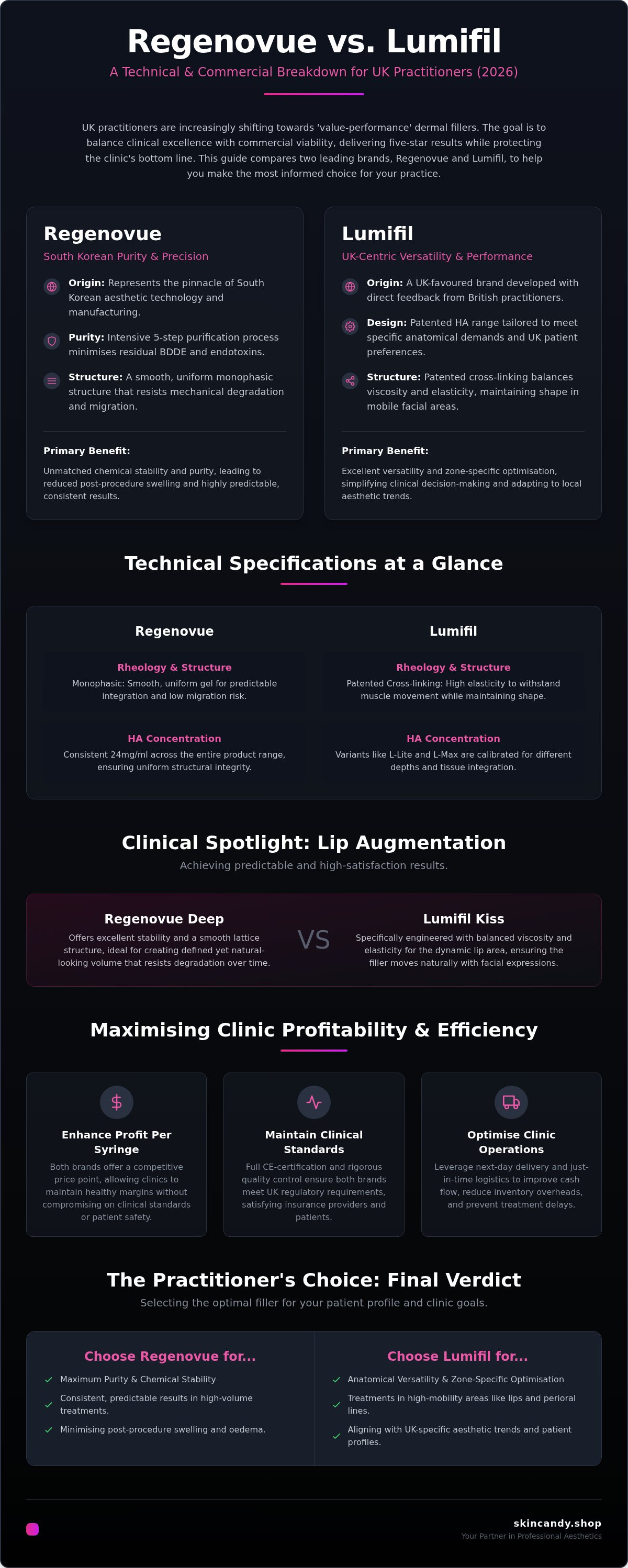
Regenovue represents the pinnacle of South Korean aesthetic technology. It's widely recognised for its intensive 5-step cleaning process. This methodology removes residual BDDE and impurities, resulting in a high-purity hyaluronic acid that minimises post-procedure swelling. It's a powerhouse for practitioners who value chemical stability and purity above all else. The brand has built a reputation for consistency, making it a staple for clinics that focus on high-volume, reliable treatments.
Lumifil takes a different approach. It's a UK-favoured brand that has built its reputation on direct practitioner feedback. Their patented HA range is designed to meet the specific anatomical demands of British patients. Comparing Regenovue vs Lumifil for practitioners reveals a choice between Korean technical precision and UK-centric product development. Lumifil focuses on tailored performance; their range simplifies clinical decision-making by offering variants specifically optimised for different facial zones. This direct connection to the UK market ensures their products evolve alongside local aesthetic trends and patient preferences.
Technical Specifications: Cross-linking, Purity, and Rheology Compared
Analysing Regenovue vs Lumifil for practitioners requires a deep dive into the chemical composition that dictates clinical results. Regenovue maintains a consistent hyaluronic acid concentration of 24mg/ml across its entire range, from Fine to Sub-Q. This uniformity ensures a predictable baseline for structural integrity. Lumifil variants, such as L-Lite and L-Max, offer similar concentrations but are specifically calibrated for different depths of tissue integration. Whilst both brands meet the rigorous safety standards expected of FDA-approved dermal fillers, their rheological profiles differ. Regenovue is celebrated for its low BDDE residue and minimal endotoxin counts, achieved through a proprietary 5-step purification process. This technical purity is a primary factor in reducing post-injection oedema and inflammatory responses.
Cross-linking and Stability
Technical stability is the cornerstone of long-lasting results. Regenovue utilises a monophasic structure, creating a smooth and uniform HA lattice that resists mechanical degradation. This consistency is excellent for preventing late-onset nodules and ensuring the gel doesn't migrate over time. Lumifil employs a patented cross-linking technology that balances viscosity with high elasticity. This allows the filler to withstand the constant movement of the facial muscles whilst maintaining its shape. For the practitioner, this means the gel stays exactly where it's placed. Choosing the right stability profile depends on the patient's tissue density and the specific area of concern. High G-prime variants like Regenovue Sub-Q provide the projection needed for malar support, whilst Lumifil’s elasticity excels in more dynamic zones.
Extrusion Force and Practitioner Comfort
The physical experience of injecting is often overlooked but remains critical for precision. Regenovue is known for its exceptionally low extrusion force. This allows for a steady and controlled delivery, even when using ultra-fine needles for delicate tear trough work. Lumifil prioritises a smooth extrusion profile that reduces hand fatigue during high-volume clinic days. Both ranges feature integrated lidocaine to enhance patient comfort. A relaxed patient is easier to treat, leading to more accurate product placement and better aesthetic outcomes. Precision in fine-line work relies on this synergy between gel viscosity and syringe ergonomics. To maintain these standards without overstocking, many clinics now utilise just-in-time logistics to ensure they always have fresh, high-performance stock on hand.
Clinical Performance: Zone-Specific Results for Lips, Cheeks, and Contours
Clinical success depends on matching the right rheology to the target anatomical zone. When evaluating Regenovue vs Lumifil for practitioners, the choice often hinges on whether you need immediate structural projection or soft-tissue integration. Both brands offer high patient satisfaction scores, but their behaviour in the skin varies significantly during the first 48 hours. Successful practitioners utilise these differences to manage patient recovery times and long-term aesthetic goals. Precision in product selection is the most effective way to reduce post-procedure complications and maintain clinic reputation.
The Lip Specialist: Achieving the Perfect Pout
Lumifil Kiss has established itself as a staple in UK clinics for its specific focus on mucosal tissue. It offers a soft, natural feel that integrates seamlessly into the lip body. For patients seeking the popular "Russian Lip" technique or crisp vermillion border definition, it provides excellent control. Conversely, Regenovue Deep is often the preferred choice for more structural lip volume. Its higher G-prime makes it ideal for patients with thinner lips who require more significant augmentation. Whilst both products contain lidocaine, practitioners should note that Regenovue’s high purity often results in less initial oedema. Following FDA guidelines on dermal fillers regarding patient selection and injection technique ensures these results remain safe and predictable.
Volumisation and Structural Support
Facial contouring requires a product that can withstand the weight of overlying tissue. Lumifil Max is specifically engineered for deep-layer injections in the cheeks and jawline. It provides robust lift and stays localised, reducing the risk of product migration. Regenovue Sub-Q offers a similar level of structural support but is often noted for its longevity. Many practitioners report results lasting 12 months or more with Sub-Q, compared to the 9 to 12 month window typical of Lumifil Max. This difference is largely due to Regenovue's consistent monophasic lattice. Both brands are moderately hydrophilic; they draw in moisture to maintain volume without causing excessive post-procedure swelling.
For fine lines and perioral rejuvenation, the lighter variants come into play. Lumifil Lite is exceptionally fluid, making it perfect for the "blanching" technique in superficial dermis layers. Regenovue Fine provides a similar effect with a focus on high-purity HA that settles quickly. Immediate post-procedure "settling" is a key metric for patient satisfaction. Minimising bruising and swelling through precise product choice allows patients to return to their daily routines faster. This efficiency is a major selling point for any high-volume clinic looking to maximise patient turnover and satisfaction scores.
Operational Efficiency: Procurement, Pricing, and Logistics for UK Clinics
High-volume clinics require more than clinical expertise; they need commercial agility. Comparing Regenovue vs Lumifil for practitioners often reveals that the most significant difference isn't just in the syringe, but in the spreadsheet. Both brands offer wholesale pricing structures that significantly undercut legacy premium fillers. This allows for a more aggressive pricing strategy in a competitive local market or, more importantly, a higher profit margin per patient. Managing these costs is the difference between a struggling practice and a scalable business.
Maximising Clinic Profitability
Calculating the ROI of your consumables is essential for long-term growth. Switching to high-performance value fillers can reduce your annual consumable budget by a significant margin without compromising patient safety. Bulk purchasing is the most effective lever for this. By committing to larger volumes, practitioners can lock in a lower cost-per-syringe, providing a buffer against other rising clinic costs. This doesn't mean you have to compromise on brand reputation. Both Regenovue and Lumifil are CE-certified and trusted by thousands of UK professionals. Marketing these as high-purity or UK-specialist ranges maintains patient trust whilst protecting your bottom line. Efficient clinics treat their procurement as a strategic asset, not just an administrative task.
Reliable Supply Chains and Delivery
Operational flow depends entirely on stock availability. A stock-out on a busy clinic day represents a lost revenue opportunity and a damaged reputation. This is why just-in-time inventory is becoming the standard for modern aesthetics. It minimises capital tied up in stock whilst ensuring you never run out of essential SKUs. Next-day delivery is a non-negotiable requirement for this model. It allows you to organise your procurement to match your treatment calendar perfectly, reducing the need for large, expensive storage facilities.
Skin Candy serves as the logistical engine for clinics across the UK. As an official distribution partner for both brands, we ensure your supplies arrive exactly when you need them. Whether you require Regenovue for high-volume structural work or Lumifil for its specific lip augmentation variants, having a single, reliable source simplifies your business operations. You focus on the patient; we handle the logistics. Our systems are built for speed and reliability, mirroring the high-pressure environment of the clinics we serve.
Browse our full range of wholesale dermal fillers to start optimising your clinic's profit margins today.
The Final Verdict: Selecting the Optimal Filler for Your Patient Profile
Deciding between Regenovue vs Lumifil for practitioners isn't about finding a single winner. It's about building a versatile toolkit. Both brands offer exceptional safety and performance, but they serve different clinical needs. Regenovue is the Korean powerhouse for purity and structural integrity. Lumifil is the UK-centric specialist for anatomical precision. Most high-performance clinics now adopt a hybrid approach, stocking both ranges to ensure they can meet any patient requirement whilst protecting their profit margins.
Patient Persona Matching
Successful clinics categorise their product selection by patient goals. Matching the rheology to the individual ensures predictable results and reduces the need for touch-ups. Consider these three common profiles:
- The First-Timer: Lumifil Lite or L-Kiss often provides the most natural introduction. Its smooth integration into the tissue reduces the "overfilled" look that many new patients fear. It's an excellent choice for building trust through subtle rejuvenation.
- The Regular: For patients who prioritise longevity and value, Regenovue’s monophasic lattice is superior. It offers consistent results that last, making it the cost-effective choice for long-term maintenance treatments.
- The High-Definition Client: When sharp contouring is required for the jawline or malar area, Regenovue Sub-Q provides the necessary G-prime for projection. Alternatively, Lumifil Max offers excellent elasticity for dynamic facial zones where movement must remain natural.
Future-Proofing Your Practice
The UK aesthetics industry is becoming more regulated and more competitive. Staying ahead requires a partnership with a reliable wholesaler that understands these shifts. Skin Candy provides the logistical infrastructure needed to keep your clinic operational. By offering both Regenovue and Lumifil with next-day delivery, we allow you to pivot your stock levels based on current patient trends without tying up excess capital. This agility is essential for maintaining a healthy cash flow in 2026.
Don't limit your practice to a single brand. Mix and match based on the specific facial zone and tissue density. Use Regenovue for deep structural work where purity and stability are paramount. Switch to Lumifil for superficial work or specific lip augmentation techniques where texture is the priority. This dual-brand strategy ensures high patient satisfaction scores and maximises your revenue per syringe. Follow this checklist for every new procurement cycle:
- Identify if the treatment requires structural lift or soft-tissue integration.
- Assess the patient's priority between immediate results and long-term longevity.
- Select the product that fits the patient's budget whilst maintaining your clinic's margin.
- Ensure your inventory is managed via a reliable UK supplier to avoid stock-outs.
Scale Your Practice with Strategic Filler Selection
Selecting between Regenovue vs Lumifil for practitioners is a decision that balances chemical precision with commercial viability. You've seen how Regenovue offers unmatched purity through its rigorous cleaning process, making it a reliable choice for structural work. Conversely, Lumifil provides the anatomical specificity required for high-demand treatments like lip augmentation. Successful UK clinics don't limit themselves to one brand; they use a hybrid approach to meet every patient profile whilst protecting their margins.
Efficient procurement is the silent engine of your business growth. By leveraging competitive bulk-buy pricing and expert-led support, you can reduce overheads and focus entirely on patient outcomes. Maintaining a streamlined supply chain ensures you never face the risk of stock-outs on busy clinic days. Explore our full range of wholesale Lumifil and Regenovue fillers with next-day delivery across the UK. It's time to optimise your inventory and deliver the consistent, high-end results your patients expect. We're here to support your commercial success every step of the way.
Frequently Asked Questions
Is Regenovue CE-certified for use in UK aesthetic clinics?
Yes, Regenovue is fully CE-certified and compliant with UK medical device regulations. It's classified as a Class III medical device, ensuring it meets the safety and quality standards required for professional clinical use. Practitioners can use these products with confidence, knowing they've undergone rigorous testing. This certification is essential for maintaining insurance coverage and meeting the upcoming 2026 licensing requirements for practitioners in England.
Which filler has better longevity: Lumifil or Regenovue?
Regenovue typically offers slightly better longevity due to its consistent monophasic lattice structure. Many practitioners report results lasting 12 months or more with the Sub-Q variant. Lumifil provides excellent integration and usually lasts between 9 and 12 months, depending on the specific product and patient metabolism. When comparing Regenovue vs Lumifil for practitioners, the choice depends on whether you prioritise long-term structural support or soft, natural tissue integration.
Can I use Lumifil Kiss and Regenovue Deep in the same treatment session?
Yes, you can use both in the same session provided they are injected into different anatomical zones or tissue depths. For example, you might use Lumifil Kiss for soft lip augmentation whilst using Regenovue Deep for nasolabial folds or deeper structural work. It's vital to maintain precise records of which product was used in each area. This hybrid approach allows you to tailor the treatment to the patient's specific needs.
What is the risk of delayed inflammatory reactions with these brands?
The risk of delayed inflammatory reactions is minimal with both brands because of their high purity levels. Regenovue utilises a proprietary 5-step purification process to remove residual BDDE and endotoxins. Lumifil also maintains strict quality control to ensure a clean HA profile. Low impurity levels are the primary factor in preventing late-onset nodules and oedema. Using high-quality, purified fillers protects your clinic's reputation and ensures high patient satisfaction scores.
How does the price per syringe compare for wholesale bulk buys?
Both brands are positioned as high-performance, cost-effective alternatives to traditional premium fillers. Wholesale bulk-buy structures allow clinics to significantly reduce their cost-per-syringe, which directly improves profit margins. Whilst specific pricing varies based on volume, both ranges offer a similar commercial advantage. Choosing Regenovue vs Lumifil for practitioners often comes down to the specific clinical application rather than a major price difference, as both provide excellent ROI for high-volume practices.
Are these fillers reversible with hyaluronidase if needed?
Yes, both Regenovue and Lumifil are hyaluronic acid based fillers and are fully reversible with hyaluronidase. This is a critical safety feature for any professional injectable treatment. In the unlikely event of a vascular compromise or if a patient is unhappy with the aesthetic result, the gel can be dissolved quickly. Practitioners should always have a fresh supply of hyaluronidase on hand as part of their emergency kit when performing these procedures.
Do practitioners need specific training to switch between HA brands?
No specific mandatory training is required to switch between these brands if you are already a qualified aesthetic professional. However, you must understand the rheological differences, such as G-prime and viscosity, to ensure correct placement. Each brand has a slightly different "feel" during extrusion and integration. We recommend reviewing the technical specifications of each variant before use. This ensures you can predict exactly how the gel will behave in the tissue.
What is the BDDE residue level in Regenovue compared to Lumifil?
Regenovue is specifically known for its exceptionally low BDDE residue, often cited as undetectable in standard testing. This is achieved through its intensive cleaning methodology. Lumifil also meets all safety standards for residual cross-linking agents, ensuring it's well below the threshold for adverse reactions. Minimising BDDE residue is essential for reducing the risk of hypersensitivity. Both brands prioritise chemical purity to ensure the highest levels of safety for your patients.