
PLLA Fillers Wholesale UK: A Clinic Buyer’s Guide to Sourcing
The lowest headline offer may not be the right choice if you haven’t checked product provenance, documentation or clinic demand. Sourcing PLLA fillers wholesale UK involves more than comparing unit costs. First verify the product’s identity, intended use and traceability, then decide whether the order fits your practitioners’ requirements and expected demand.
These checks are useful when comparing suppliers or considering a new treatment category. This guide explains what to review before ordering, how to compare wholesale options consistently and how to plan stock without committing budget before demand is clear.
Skin Candy lists PLLA products among its professional aesthetic offerings and reports UK-wide fulfilment options, including same-day and next-day delivery. Confirm current product documentation, availability and ordering terms directly before purchase. The sections ahead cover product suitability, supplier reliability and practical clinic-readiness checks.
Key Takeaways
- Compare PLLA fillers wholesale UK options using consistent criteria, not headline claims or price alone.
- Check that product identity, intended use and supporting documentation align before placing an order.
- Distinguish product evidence from claims made by a manufacturer or distributor.
- Compare traceability, order support and fulfilment terms against your clinic’s procurement needs.
- Introduce PLLA methodically: review practitioner scope and guidance, assess patient demand, then plan stock.
PLLA fillers wholesale in the UK: what clinics should assess first
Before comparing suppliers, establish exactly what you’re buying and how it fits your clinic. PLLA stands for poly-L-lactic acid, a material used in some professional aesthetic products. A general overview describes polylactic acid as a biocompatible and biodegradable polymer, but that background does not confirm the specifications, evidence or intended use of any individual product.
This guide focuses on sourcing and clinic readiness, not treatment outcomes. Product fit, practitioner competence and supplier reliability are connected: the product must suit the clinic’s intended use, practitioners must work within their professional scope, and the supply route should allow you to verify what is being purchased.
What does PLLA wholesale mean for an aesthetics clinic?
A wholesale supplier distributes products to professional buyers; it is not necessarily the manufacturer, a treatment provider or a training provider. Keep those roles distinct. The manufacturer is the source for product-specific information, while the distributor is a procurement route. Do not assume either role includes in-clinic treatment or practitioner training.
Check each item individually. Confirm its product identity, specifications, intended use and supporting documentation rather than assuming all products containing PLLA have the same composition, evidence or use. Make sure the information relates to the exact product being considered. Broad promotional wording is not a substitute for product-specific documentation.
For clinics searching PLLA fillers wholesale UK, the aim is to compare a clearly identified product and supply route, not just a category label. Ask who manufactured the product, who is supplying it and what documentation is available for review before ordering.
When should a clinic consider adding PLLA products?
Start with your clinic’s service plans, not a supplier promotion. Review your treatment mix, practitioner scope and evidence of patient interest. If demand is uncertain, assess it before committing clinic stock. A new category should make operational sense as well as fit the services your clinic intends to offer.
Keep the decision measured:
- Confirm that the proposed product and its intended use fit the clinic’s plans.
- Ensure clinical decisions sit with appropriately qualified practitioners, guided by current professional advice.
- Review patient demand and procurement requirements before deciding what, if anything, to order.
PLLA is a sourcing consideration, not a promise of a particular clinical result. Review product information, practitioner readiness and supplier support together before adding it to your procurement plan.
Five wholesale supplier criteria for comparing PLLA fillers in the UK
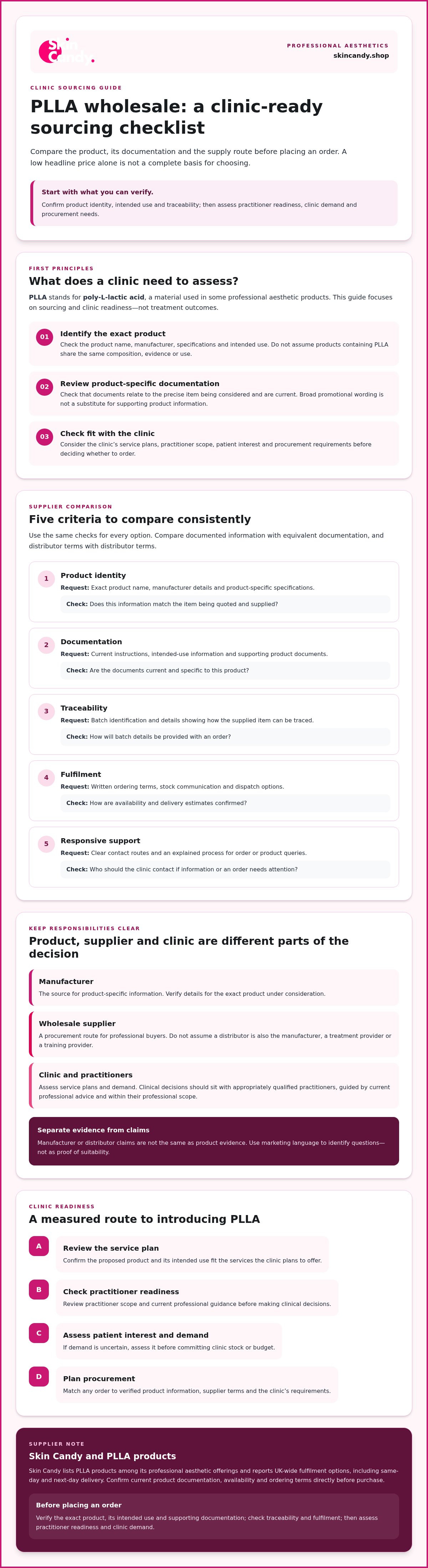
A useful supplier comparison goes beyond manufacturer credentials or performance claims. Apply the same checks to every option and record what you can verify. Compare documented information, not claims alone.
Compare like with like: manufacturer information against manufacturer information, product documents against product documents, and distributor terms against distributor terms. Marketing language can help you identify questions, but it does not prove product suitability or replace current documentation.
| Criterion | Evidence to request | Follow-up question |
|---|---|---|
| Product identity | Exact product name, manufacturer details and product-specific specifications. | Does this information match the item being quoted and supplied? |
| Documentation | Current instructions, intended-use information and supporting product documents. | Are these documents current and specific to this product? |
| Traceability | Batch identification and details showing how the supplied item can be traced. | How will batch details be provided with an order? |
| Fulfilment | Written ordering terms, stock communication and dispatch options. | How are availability and any delivery estimates confirmed? |
| Responsive support | Clear contact routes and an explained process for handling order or product queries. | Who should the clinic contact if information or an order needs attention? |
Which supplier and product documents should clinics request?
Request the current instructions and intended-use information for the specific product, together with its identity, manufacturer details and traceability information. Check relevant product marking and regulatory details against current UK guidance. The UK government’s announcement on cosmetic procedure regulation provides context, but verify current requirements through authoritative guidance rather than relying on a supplier summary alone.
Review the documents themselves. A broad claim such as “compliant” or “clinically proven” does not explain which product, evidence or requirements it refers to. Ask for clarification if a claim cannot be matched to product-specific information.
How should clinics assess wholesale service and fulfilment?
Check how ordering support works in practice. Find out how the supplier communicates stock status, confirms dispatch options, provides batch information and handles order issues. Treat delivery statements as terms to confirm for your order, not guaranteed outcomes. Check availability and timing before planning clinic stock.
Clinics assessing PLLA fillers wholesale UK options can use the table above to compare suppliers consistently. Skin Candy lists PLLA products among its professional aesthetic offerings and reports UK-wide fulfilment options. Clinics can review Skin Candy’s professional aesthetic products, then confirm current PLLA product documentation, availability and ordering terms before purchase.
How to compare PLLA wholesale options without relying on headline claims
Use one comparison record for each option and keep evidence in the right category. Manufacturer information identifies who made the product; product documentation relates to the specific item; distributor information explains how it is supplied and supported. A strong claim in one category does not prove another.
For clinics reviewing PLLA fillers wholesale UK options, mark a blank or unanswered field as unresolved, rather than treating it as proof that a product or supplier is unsuitable. This gives you a clear follow-up question and helps prevent assumptions from influencing the decision.
What should a clinic comparison table include?
Record the exact product identity and supplier details, then note what information you received and when. Capture how to check batch details, where to find storage information and product instructions, and which contact route to use for order queries.
Product and documentation: Product name, manufacturer, documents received, intended-use information and any missing items.
Traceability and handling: How batch details are supplied, and where to find product-specific storage information and instructions.
Order support: Contact route, response process and how product or order queries are handled.
Fulfilment: Stock confirmation, dispatch options and delivery terms confirmed directly with the supplier.
Clinic fit: Whether the product information, procurement process and practitioner requirements align with your clinic’s plans.
Keep notes factual. For example, write “storage information not yet received” rather than assuming how the product should be stored. This makes options easier to compare and shows what you need to clarify before considering an order.
How can clinics assess claims and regulatory information?
Match each claim to its source. Check product-specific statements against the relevant product documentation, and confirm supply and fulfilment claims with the distributor. If a claim is broad, ask what evidence supports it and which product or process it refers to. Promotional language is not a substitute for verifiable information.
Verify current regulatory and product-marking requirements against authoritative UK guidance before relying on a marking or placing an order. A CE or UKCA mark alone does not establish that a product is suitable for every clinic or intended use. Check the details relevant to the specific item and your procurement decision. If documents conflict, are incomplete or remain unclear, pause the comparison and seek appropriate professional or regulatory advice.
Once you have resolved outstanding questions, compare the complete records side by side. This gives your clinic a more reliable basis for evaluating documentation, supplier support, fulfilment and operational fit than headline claims alone.
Prepare your clinic to introduce PLLA as a new treatment category
A new product category needs more than a supplier and an order. Use a staged process: confirm practitioner scope, review the specific product documentation, assess likely clinic demand, then plan procurement. Keep clinical decisions with appropriately qualified practitioners and current professional guidance. Purchasing should follow readiness, not drive it.
What should be ready before ordering PLLA wholesale?
Before considering a first order, confirm that practitioner competence, clinic protocols and product-specific instructions have been reviewed. Check the instructions for intended use, storage and handling, and resolve unclear points before stock arrives. Do not apply assumptions from another PLLA product to the item under consideration.
Assign responsibility for the practical checks. Agree who will review documentation, receive and check stock, record batch details and raise queries with the supplier. A clear handover helps ensure product information and traceability details are captured consistently.
How can a clinic test demand without overcommitting?
Use evidence from your own clinic. Review patient enquiries and service plans, then consider whether the proposed category fits your patient base and practitioner scope. General market trends or unsubstantiated treatment claims cannot tell you how much stock your clinic will use.
Plan an initial order around realistic expected uptake and the supplier’s confirmed terms. Check current availability, ordering requirements and any stated lead-time information directly with the supplier. Avoid ordering more than the clinic can reasonably use or manage under the product’s storage instructions. After launch, review actual uptake and updated supplier information before adjusting future orders.
- Confirm scope: Check practitioner readiness and clinic protocols.
- Review documentation: Understand the specific product’s instructions and handling requirements.
- Assess demand: Use clinic enquiries and service plans, not broad predictions.
- Plan procurement: Set an initial stock level and review it against real uptake.
For a wider framework on aligning stock decisions with clinic operations, see the UK clinic procurement guide. This measured approach helps clinics considering PLLA fillers wholesale UK avoid committing stock before practitioner readiness and demand are clear.
Skin Candy lists PLLA products among its professional aesthetic offerings. Review professional aesthetic products and confirm current product documentation, availability and ordering terms before making a procurement decision.
Choose a PLLA wholesale partner that supports reliable clinic procurement
A suitable wholesale partner is one that fits your clinic’s purchasing priorities and can provide clear answers before you order. Your priorities may include product documentation and traceability, responsive order support or fulfilment options that work with your stock-planning process. Compare these needs against evidence and confirmed terms, rather than choosing on broad claims alone.
Skin Candy is a UK-wide wholesaler of professional aesthetic products and lists PLLA among its offerings. The business reports same-day and next-day delivery options across the UK. These are options to confirm, not guaranteed delivery times. Check current terms and availability, including whether the specific product you’re considering is listed, before making a procurement decision.
When could Skin Candy fit a clinic’s sourcing shortlist?
Skin Candy may be worth assessing if your clinic is comparing professional wholesale supply options and wants to review a UK-wide supplier. As with any potential partner, assess the fit against your own requirements: product-specific documentation, clear communication about availability and fulfilment terms that work with your stock plan. Check directly rather than assuming a particular PLLA product is currently available.
A supplier’s wider product range or reported delivery options can help inform a shortlist, but they do not replace product checks. Confirm that the exact item, supporting information and supply route meet your clinic’s needs before progressing.
What should a practitioner confirm before placing an order?
Before purchase, confirm the identity, intended use and current documentation for the specific product. Ask Skin Candy directly about availability, fulfilment timing and order conditions. Check that the information provided is sufficient for your clinic’s review and procurement records. If anything is unclear, resolve it before committing stock.
This final check links supplier choice to clinic readiness and helps avoid planning around unconfirmed stock or delivery assumptions. For buyers comparing PLLA fillers wholesale UK options, a sound procurement decision rests on verified product details and terms that suit the clinic, not simply a supplier’s headline offer.
Ready to review the current range? Explore Skin Candy’s professional aesthetic supplies, then confirm PLLA product identity, documentation, availability and ordering terms directly before placing an order.
Make your next PLLA sourcing decision with confidence
A sound PLLA fillers wholesale UK decision starts with product-specific checks, not headline claims. Verify identity, intended use and documentation, then compare supplier traceability, support and fulfilment terms on a like-for-like basis.
Before ordering, make sure practitioner scope and clinic processes are ready. Use patient enquiries and service plans to guide initial stock decisions, then review actual uptake before adjusting future orders. This helps avoid committing to stock before demand is clear.
Skin Candy lists PLLA products among its professional aesthetic offerings and reports same-day and next-day delivery options across the UK. Confirm current product details, availability and delivery terms directly before ordering. Explore Skin Candy’s professional aesthetic supplies to review the current range.
With careful checks and a realistic procurement plan, your clinic can assess its options and take the next step at a pace that fits.
Frequently Asked Questions
How do I choose a PLLA filler wholesale supplier in the UK?
Compare product identity, documentation, batch traceability, ordering support and fulfilment terms. Ask for product-specific information, then check applicable regulatory details against current authoritative UK guidance. Assess whether the product fits your clinic’s professional scope and procurement process. For PLLA fillers wholesale UK, do not base your decision solely on promotional claims or general manufacturing credentials. Record what is verified and follow up on anything unclear before ordering.
What documents should I check before buying PLLA fillers wholesale?
Request documentation for the exact product, including its identity, manufacturer details, instructions, intended use and batch traceability information. Check that names and details match the item being offered, rather than relying on information about a broader product category. Verify regulatory or product-marking details against current UK requirements. If documents are missing, inconsistent or unclear, pause and seek suitable professional or regulatory advice before proceeding with procurement.
Are PLLA fillers regulated in the UK?
Regulatory requirements depend on the specific product, its intended purpose and the circumstances in which it is supplied or used. Do not assume that a product name, category or marking alone establishes that it is suitable for your clinic. Review the product documentation and consult current guidance from relevant UK authorities. Rules and guidance can change, so verify the position at the time of purchase and seek professional advice if you’re uncertain.
Can any aesthetics clinic buy PLLA fillers wholesale?
Wholesale availability does not automatically mean a product is suitable for every clinic or practitioner. Check the supplier’s purchasing requirements, the product documentation and intended use, and the professional standards relevant to your circumstances. Practitioners should work within their competence and applicable scope. Confirm these points with the supplier and appropriate professional or regulatory sources before ordering. Do not rely on a general product description as confirmation of clinic or practitioner suitability.
How should a clinic compare wholesale PLLA products?
Compare exact product details rather than treating PLLA products as interchangeable. Record manufacturer and product identity, documentation, batch traceability, ordering support and fulfilment terms for each option. Separate verified information from claims that still need checking. For PLLA fillers wholesale UK decisions, use a side-by-side comparison to identify gaps, then check regulatory questions against current authoritative sources. Do not infer product performance or clinical outcomes from supplier claims alone.
How much PLLA filler should a clinic order initially?
There’s no single starting quantity that suits every clinic. Base an initial order on credible patient enquiries, your clinic’s service plans, supplier terms and product-specific information. Avoid ordering extra stock solely to access a wholesale advantage when demand is uncertain. Review actual uptake and confirmed supplier lead-time information before reordering. Check the product documentation for storage and handling requirements, and make sure the proposed stock level is manageable for your clinic.
Does Skin Candy supply PLLA products to UK clinics?
Skin Candy lists PLLA products among its professional aesthetic offerings and serves clinics and practitioners nationally across the UK. The available information does not confirm a specific PLLA product’s current name, specifications or stock status. Check the current range and ask Skin Candy directly to confirm product documentation, intended use, availability, ordering terms and delivery options. The business reports same-day and next-day delivery options, but confirm current terms before planning an order.