
High-Profit-Margin Aesthetic Treatments: A 2026 Clinic Guide
Could a treatment with a high headline fee deliver a weaker margin once consumables, practitioner time and operating costs are counted? For clinics assessing high profit margin aesthetic treatments, revenue alone is a poor guide. A service also needs dependable demand and a delivery model that fits the team and clinic workflow.
It can be tempting to prioritise popular treatments or add a new category quickly. But repeat appointments, stock requirements and operational complexity all affect what a service contributes. Sustainable margins come from consistent delivery, not headline prices.
This guide compares aesthetic treatment categories using the same clinic-level framework: client demand, direct costs, practitioner time, repeatability and clinic fit. You’ll see which expenses to include in your calculations, from consumables and equipment use to appointment capacity and procurement. Then you can assess how dermal fillers, chemical peels, skin boosters and polynucleotides could support a balanced portfolio based on client needs and practitioner capabilities. The aim is to build a resilient service mix with a practical supply plan, rather than rank treatments by revenue alone.
Key Takeaways
- Assess high profit margin aesthetic treatments by what remains after costs, not by booking revenue alone.
- Compare fillers, skin boosters, chemical peels, polynucleotides and fat dissolving treatments against the same operational criteria.
- Calculate contribution per appointment and per practitioner hour to account for delivery time and clinic capacity.
- Match potential services to client demand, practitioner capability and available appointments before expanding your portfolio.
- Plan consumable procurement and stock levels to help reduce avoidable expiry, urgent orders and disruption to scheduled services.
What makes an aesthetic treatment high-margin for a clinic?
A high booking price doesn’t automatically make a treatment high-margin. The useful question is how much revenue remains after the costs of delivering the appointment, and whether that contribution helps cover the clinic’s wider operating expenses. This distinction lets clinics compare high profit margin aesthetic treatments using their own figures instead of relying on headline prices or broad industry claims.
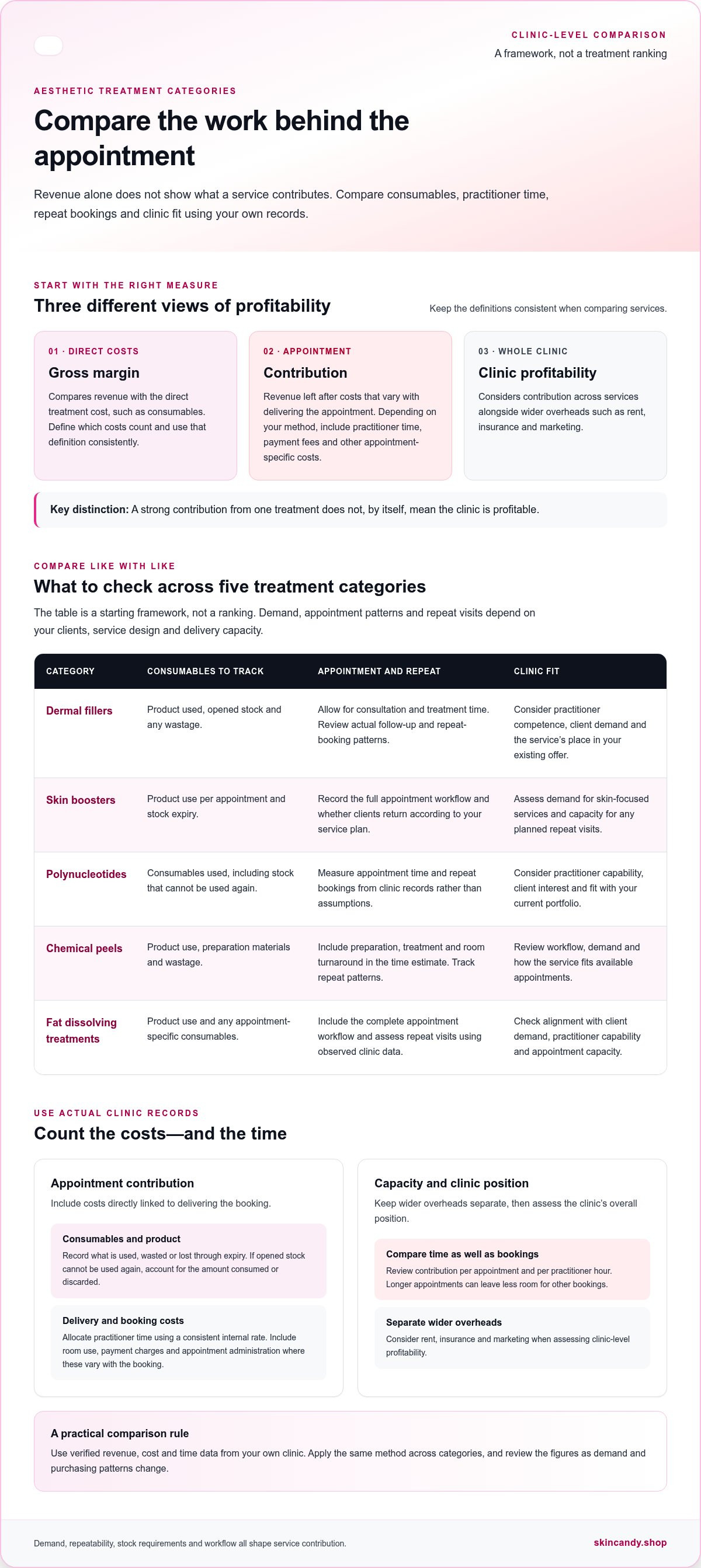
Keep these three measures separate:
- Gross margin compares revenue with the direct cost of the treatment, such as the consumables used. Define which costs you include and apply that definition consistently.
- Contribution per appointment is the revenue left after costs that vary with delivering the appointment. Depending on your method, this can include consumables, practitioner time, payment fees and other appointment-specific costs.
- Clinic-level profitability considers contribution across all services alongside wider overheads such as rent, insurance and marketing. A strong treatment-level contribution doesn’t, by itself, mean the clinic is profitable.
Quotable definition: Treatment revenue is what a client pays; clinic-level profit is what remains after treatment delivery costs and the clinic’s wider operating expenses are accounted for.
Demand and repeatability affect how often a service may be booked and whether its contribution can be delivered consistently. They don’t change the arithmetic for an individual appointment. Practitioner time affects capacity: a longer appointment can leave less room for other bookings. Consumables, wastage and stock expiry also affect what the clinic retains, particularly when stock is ordered for demand that doesn’t materialise.
Which costs belong in a treatment margin calculation?
Start with the costs directly linked to the appointment. Record the consumables used, including anything wasted or lost through expiry, and allocate practitioner time using a consistent internal rate. Include room use, payment charges and appointment administration where these vary with the booking. Keep fixed and wider overheads, such as rent, insurance and marketing, separate so you can assess both appointment contribution and the clinic’s overall position.
Use actual clinic records wherever possible. If a product is opened for one appointment and some cannot be used again, account for the amount consumed or discarded rather than treating the rest as cost-free. Apply the same method across categories, including dermal fillers, chemical peels and polynucleotides. Stock planning also helps you monitor expiry and avoid tying up supplies in services with uncertain demand.
Why high revenue does not always mean high profit
A busy service can generate substantial revenue yet leave a modest contribution if its direct costs are high. Appointment length matters too: compare contribution per booking with contribution per practitioner hour. A service that takes more clinical time may displace other appointments, so consider that opportunity cost. Avoid relying on universal margin benchmarks. Use verified revenue, cost and time data from your own clinic, then review the figures as demand and purchasing patterns change.
Which aesthetic treatment categories are worth comparing?
Compare services that use related professional consumables, but don’t assume they have the same cost structure or appointment pattern. The table is a starting framework, not a ranking: actual demand, time and repeat visits depend on your clients, service design and delivery capacity. Use appointment and stock records to assess which options could support high profit margin aesthetic treatments.
| Category | Consumables to track | Appointment and repeat considerations | Clinic fit |
|---|---|---|---|
| Dermal fillers | Product used, opened stock and any wastage. | Allow for consultation and treatment time; review actual follow-up and repeat-booking patterns. | Consider practitioner competence, client demand and the service’s place in your existing offer. |
| Skin boosters | Product use per appointment and stock expiry. | Record the full appointment workflow and whether clients return according to your service plan. | Assess demand for skin-focused services and capacity for any planned repeat visits. |
| Polynucleotides | Consumables used, including any stock that cannot be used again. | Measure appointment time and repeat bookings from clinic records rather than assumptions. | Consider practitioner capability, client interest and how the category fits your current portfolio. |
| Chemical peels | Product use, preparation materials and wastage. | Include preparation, treatment and room turnaround in the time estimate; track repeat patterns. | Review workflow, demand and how the service fits available appointments. |
| Fat dissolving treatments | Product use and any appointment-specific consumables. | Include the complete appointment workflow and assess repeat visits using observed clinic data. | Check alignment with client demand, practitioner capability and appointment capacity. |
| Exosomes | Assess the relevant consumables and stock requirements for the proposed service. | Build the time and repeat-visit profile from the clinic’s own service plan and records. | Treat this as a category for evaluation, without assuming suitability or outcomes. |
Injectables and skin-focused consumables
Dermal fillers, skin boosters and polynucleotides each need a separate service-level assessment. Compare consumables, appointment duration, room turnover and repeat bookings, alongside practitioner competence and demonstrated client demand. Don’t infer clinical outcomes or repeat frequency from the product category alone. For additional context on the filler category, explore this professional dermal filler market guide.
Peels and body-focused treatment categories
Chemical peels and fat dissolving treatments involve different workflows, so assess their consumable requirements and appointment demands separately. Consider how stock use, room time and repeat appointments fit your clinic’s schedule, without assuming a particular service suits every client. For category-level information, see this guide to professional fat dissolving agents.
Once you’ve identified categories that fit your service model, organise procurement around realistic demand and stock use. Skin Candy supplies professional aesthetic consumables wholesale, including fillers, skin boosters, polynucleotides, chemical peels and fat dissolving agents. Explore professional aesthetic consumables for your clinic’s supply needs.
How can you compare treatment margins without relying on hype?
Use the same calculation method for every service, then test the result against appointment time, stock use and actual booking patterns. This gives you a more useful comparison than a generic ranking of high profit margin aesthetic treatments. Keep assumptions visible and distinguish observed results from forecasts.
- Record revenue received. Use actual appointment revenue after discounts, refunds or other adjustments, rather than the headline menu price.
- Subtract direct costs. Include consumables used, payment charges and any other costs directly tied to delivering the appointment. Apply the same cost rules to every treatment.
- Calculate contribution per appointment. Revenue minus direct costs gives the amount available to cover wider clinic costs. If practitioner pay varies with the appointment, include it as a direct cost. If you treat it as overhead, leave it out of this calculation and account for it consistently elsewhere.
- Compare contribution per practitioner hour. Divide appointment contribution by total practitioner time, including preparation, treatment, documentation and reset where applicable. This shows how each service uses limited clinical capacity.
Calculate contribution per appointment and practitioner hour
Use the formula: appointment revenue − direct appointment costs = contribution per appointment. Then calculate contribution per appointment ÷ total practitioner hours = contribution per practitioner hour. For a hypothetical service, label revenue as R, direct costs as C and total practitioner hours as T. Its contribution is R − C, and its hourly contribution is (R − C) ÷ T. Use your own verified figures, not market prices or assumed margins.
A clinic must use its own verified operating figures because clinic-specific costs, workflows and booking patterns determine what each treatment actually contributes.
Account for stock, demand and capacity
Consumable costs aren’t limited to what’s used in a typical appointment. Include realistic wastage, expired stock and inventory holding in your comparison. Review ordering and usage records together: stock purchased for a service that books irregularly can tie up cash or go unused. A wholesale supply partner can support procurement planning, but reliable fulfilment alone can’t guarantee a profitable service.
Next, check demand against appointment records. Look at completed bookings, cancellations, rebookings and gaps between appointments. Don’t count a possible repeat visit as guaranteed future revenue. If you model repeat business, use a conservative estimate grounded in your clinic’s observed pattern, and keep it separate from the contribution earned at the first appointment.
Finally, test whether the service fits available capacity. Consider practitioner hours, room availability and follow-up administration together. An appointment may look attractive per booking but take time needed for other services or create work outside the treatment slot. Compare like with like, review the figures regularly and update them when costs, stock use or demand change. This turns a margin estimate into a practical planning tool.
How should a clinic choose a profitable treatment portfolio?
A resilient portfolio isn’t the longest menu. It’s a set of services that matches evidenced client demand, practitioner capability and the capacity to deliver appointments consistently. Use a simple screen before adding a treatment. A service that looks commercially attractive on paper may still be a poor fit if it relies on skills, room time or follow-up capacity the clinic can’t reliably provide.
Match services to your clinic's clients and capabilities
Start with enquiry and booking data. Look for recurring requests and completed appointments, not just interest in a trend or a burst of social media attention. Then assess whether practitioners have the relevant qualifications, scope and operational readiness for the service. Review governance, insurance and current professional requirements before introducing it, and account for appointment length, room availability and follow-up workload.
Build a short assessment for each candidate service. Record what supports demand, who can deliver it, what the appointment requires and where it could fit in the schedule. This makes gaps visible early. For example, strong client interest may not justify adding a service if it would compete for the same room or practitioner time as established bookings. Equally, unused capacity alone isn’t evidence of demand.
Build a manageable, evidence-led service mix
Begin with a focused portfolio and set a review point before expanding. Track contribution, room and practitioner utilisation, repeat bookings and stock wastage as separate measures. Compare actual performance with your initial assumptions, including cancellations and follow-up time. Keep the measures consistent so you can compare each service fairly with the rest of the clinic’s offer.
Make procurement part of that review. Match stock levels to realistic booking patterns, product usage and expiry risk rather than optimistic forecasts. Consider supplier fulfilment when planning orders, especially when a service depends on consumables being available for scheduled appointments. Avoid holding more stock than demand supports, while accounting for the operational impact of ordering too late. Good stock management supports planning, but doesn’t promise profitability.
- Retain services with evidenced demand and delivery that fits clinic capacity.
- Adjust appointment planning or stock levels where workflow or wastage weakens performance.
- Pause expansion if capability, governance or demand isn’t established.
For chemical peel purchasing decisions, use this chemical peel procurement guide to consider category-specific stock requirements. As your portfolio takes shape, explore professional aesthetic consumables to support clinic procurement across relevant treatment categories.
How can reliable procurement support sustainable treatment margins?
Procurement affects more than whether a product is on the shelf. Poor stock planning can tie up working capital in slow-moving items, increase exposure to expiry and lead to urgent orders when bookings are already scheduled. A consistent replenishment process helps clinics align purchasing with actual service demand and consider stock decisions alongside treatment performance.
Reliable fulfilment can support continuity, but it can’t guarantee that a treatment will be profitable. Demand, practitioner time, consumable use and operating costs still determine the clinic’s results. Treat supply as one part of the operating model: plan for the services you can deliver, then review whether purchasing patterns reflect what clients actually book.
Plan consumable purchasing around actual clinic demand
Use appointment records and stock data together. Track bookings by service, product usage, what remains after appointments and what reaches its expiry date. Set replenishment points using observed usage and supplier lead times, then review them as booking patterns change. This helps balance continuity against over-ordering. For a structured approach to inventory, see the just-in-time clinic procurement guide.
Make the process practical. Separate frequently used consumables from items bought for occasional appointments, and don’t treat forecast bookings as confirmed demand. If a service has an uneven booking pattern, smaller, more regular purchasing decisions may limit expiry exposure when fulfilment arrangements support that approach. Record urgent orders too. Repeated last-minute purchasing can indicate that stock thresholds or demand forecasts need attention.
Explore Skin Candy's professional aesthetic supplies
Skin Candy is a UK-wide wholesale supplier of professional aesthetic consumables, with categories including dermal fillers, skin boosters, polynucleotides, chemical peels and fat dissolving agents. Supplied brands include Lumifil, Regenovue and Aesossa. Same-day and next-day delivery options are available across the UK, giving clinics fulfilment choices when planning replenishment for scheduled services.
Build purchasing decisions around the portfolio your clinic can support. Compare stock use and booking patterns by category, monitor expiry exposure, and factor fulfilment options into replenishment routines. This keeps procurement connected to real clinic activity rather than broad assumptions about which high profit margin aesthetic treatments will sell.
For professional aesthetic supplies across these categories, explore Skin Candy's professional aesthetic supplies and plan stock around your clinic’s service mix and demand.
Turn your treatment strategy into a clear next step
Choose one upcoming portfolio decision and set a practical review point. At that point, check booking patterns, stock use and service capacity, then use what you learn to guide your next procurement decision. This creates a feedback loop that helps your clinic adapt as client needs and operating conditions change.
The strongest high profit margin aesthetic treatments for your clinic depend on the services your team can deliver reliably and the demand you can evidence. Ground your planning in real activity, and make each change for a clear operational reason.
For your next step, align professional supplies with the categories your clinic plans to offer. Explore Skin Candy's professional aesthetic supplies and build a procurement plan around your clinic’s direction.
Frequently Asked Questions
What does high profit margin mean for an aesthetic treatment?
It means a relatively large share of treatment revenue remains after the costs included in the calculation. Clinics comparing high profit margin aesthetic treatments should state whether they mean gross margin, contribution after appointment-specific costs or net profit after overheads. These measures answer different questions. A service can show a strong margin percentage but still contribute little overall if it attracts few bookings or uses substantial clinic capacity.
Which aesthetic treatments can clinics compare for potential profitability?
Clinics can compare dermal fillers, skin boosters, polynucleotides, chemical peels and fat dissolving treatments, as well as other categories they’re equipped to deliver. Include exosomes as a category for assessment, not as an assumption about suitability or results. For a useful comparison, note the service’s appointment workflow, consumable usage, demand evidence and follow-up requirements. Keep each category’s figures separate rather than assuming similar delivery patterns.
How do I calculate the profit margin on an aesthetic treatment?
Choose a clearly defined cost basis, then subtract those costs from appointment revenue. Divide the resulting amount by revenue and multiply by 100 to express the margin as a percentage. For example, label revenue as R and included costs as C: the calculation is ((R − C) ÷ R) × 100. Use the same cost categories across services, and don’t mistake this appointment-level figure for net clinic profit after overheads.
Are injectable treatments more profitable than chemical peels?
Not necessarily. The result depends on the clinic’s consumable use, appointment duration, demand, practitioner costs and stock management. A peel appointment and an injectable service may involve different workflows, so compare each using the same accounting method and include preparation and reset time. Review completed bookings and costs over a consistent period. Popularity or booking price alone can’t establish which option contributes more to your clinic.
Can a treatment with repeat appointments improve clinic profitability?
It can support more predictable revenue if clients return and each appointment makes a positive contribution after its costs. But repeat visits aren’t guaranteed, and each one uses consumables, practitioner time and appointment capacity. Track actual rebooking and completion patterns by service. For planning, separate confirmed bookings from possible future visits, and don’t rely on projected repeat business to justify stock purchases or wider operating commitments.
What costs should an aesthetic clinic include when comparing treatments?
Include treatment consumables, practitioner time, room use and payment charges where they apply. Also account for appointment administration, wastage and stock that expires unused. Record wider costs, such as rent, insurance and marketing, separately if you’re assessing overall clinic profitability. This makes comparisons clearer: you can see what an appointment contributes before overheads, then assess whether the full service mix covers the business’s operating costs.
How can an aesthetic clinic reduce the risk of holding too much treatment stock?
Reconcile stock on hand with completed appointments and actual product use before placing each order. Track expiry dates, flag items with little recent movement and distinguish regular-use consumables from stock bought for occasional bookings. Set replenishment points around observed demand and supplier fulfilment arrangements, then adjust them when booking patterns change. Avoid ordering against enquiries alone, since interest may not lead to a completed appointment.
Do high-margin aesthetic treatments guarantee a profitable clinic?
No. A favourable treatment-level margin doesn’t account for every factor affecting the business, including total booking volume, staff and premises costs, cancellations, marketing and unused stock. A clinic also needs suitable practitioner capability and enough capacity to deliver its planned services. Review service contribution alongside wider financial performance. Treat margin as one decision-making measure, not a promise of profit or a substitute for clinic-level accounts.