
Fat dissolving patient selection: who may be suitable
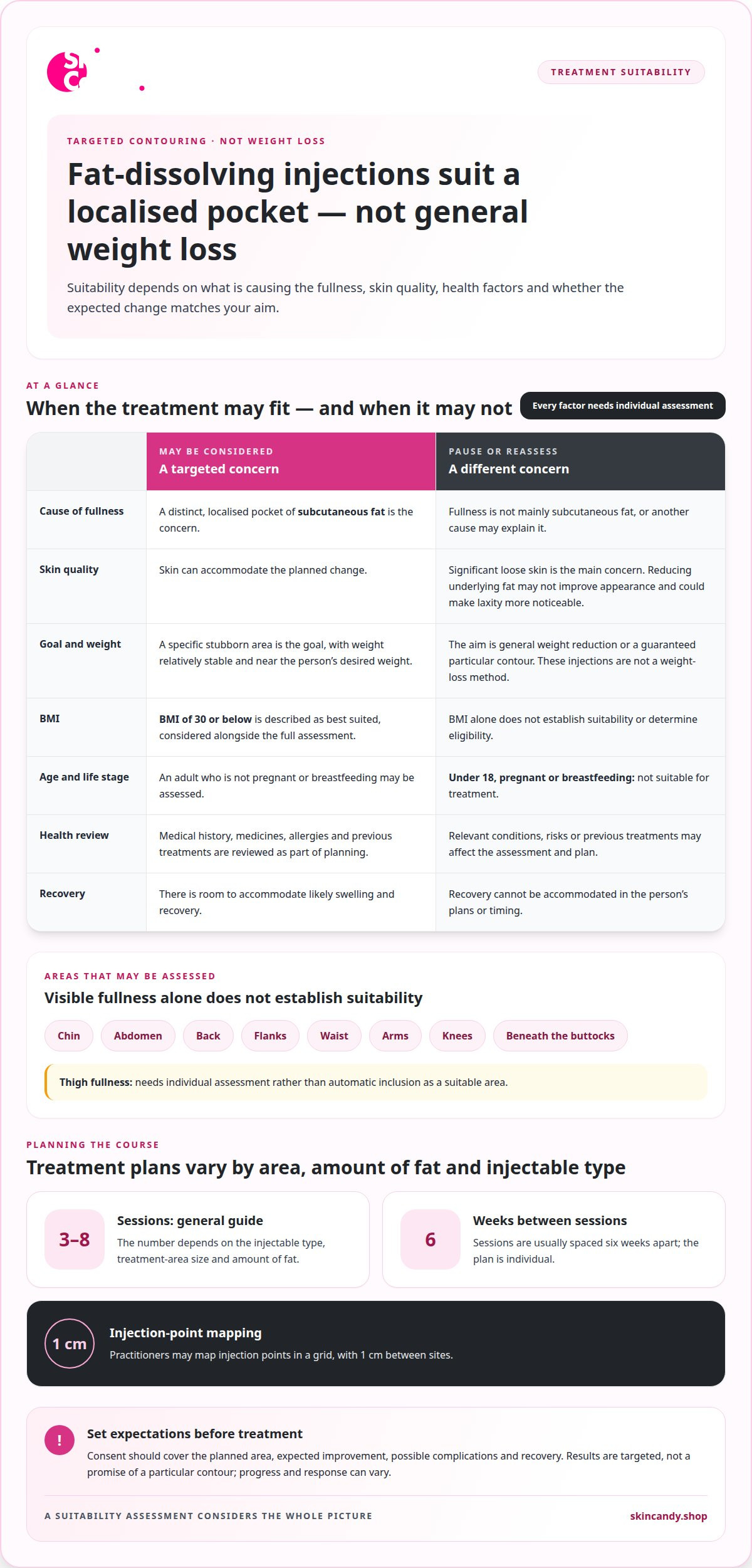
Fat-dissolving injections are for localised fat, not general weight loss. The fat dissolving patient selection criteria centre on a suitable pocket of subcutaneous fat, stable weight and realistic expectations of targeted improvement. Adults who are pregnant or breastfeeding, or under 18, are not suitable for treatment.
It makes sense to want a clear answer before considering an injectable treatment. Areas that may be assessed include the chin, abdomen, flanks, back, arms, knees and the area beneath the buttocks, but visible fullness alone does not establish suitability. Skin laxity, medical history, medicines, allergies, previous treatments and likely recovery all matter.
This guide explains why these injections are not a weight-loss method, which areas may be considered and what a suitability assessment covers. It also outlines how the treatment area and injection type can affect the number of sessions and how results may vary. Use this practical framework to understand who may be suitable and when another approach may better match the concern.
Key Takeaways
- Assess whether fullness is caused by a localised pocket of subcutaneous fat; loose skin or another underlying cause may call for a different approach.
- Use the treatment area, the amount of fat and the injectable type to understand why treatment plans and session numbers can vary.
- Allow for swelling and recovery when considering timing, and judge progress over time rather than from an early change alone.
- Consider BMI alongside skin quality, medical history and treatment goals; no single factor establishes suitability on its own.
Treatment areas
Fat-dissolving injections target small, localised pockets, not general weight loss. Areas commonly assessed include the chin, abdomen, back, flanks, waist, arms, knees and beneath the buttocks. A body-contouring plan should distinguish these targeted uses from surgery and weight-management goals. Thigh fullness, for example, needs individual assessment rather than automatic inclusion as a suitable area.
Practitioners may map injection points in a grid, with 1 cm between sites. A general guide is 3-8 sessions, usually spaced 6 weeks apart. The number depends on the injectable type, treatment area size and amount of fat. Progress is targeted, not a promise of a particular contour; discuss the expected change before planning a course.
Compared with liposuction, injections are non-surgical and target localised pockets. They are not a substitute for surgery or a method of general weight loss, and other non-surgical treatments may work differently. Suitability depends on the concern and the area being considered.
People under 18 are unsuitable. Before treatment, consent should cover the planned area, expected improvement, possible complications and recovery. Pregnancy and breastfeeding are also reasons not to proceed. A medical history review should consider medicines, allergies and previous treatments.
In the UK, Belkyra/Kybella is a prescription medicine licensed for use; most fat-dissolving injectables are regulated as cosmetic products. The MHRA advises that phosphatidylcholine is not licensed for cosmetic purposes, and the Joint Council for Cosmetic Practitioners requires practitioners to stop promoting, supplying and using it for aesthetic fat reduction. Avoid treatment if the fullness is not mainly subcutaneous fat, significant loose skin is the main concern, or recovery cannot be accommodated. Reviewing medical history helps identify relevant conditions and individual risks.
Suitability for localised fat rather than weight loss
Fat-dissolving injections are a cosmetic procedure for targeted contouring, not general weight reduction. The fat dissolving patient selection criteria focus on the cause of fullness, skin quality and the person’s aims.
Suitability for localised fat
A suitable candidate has a distinct pocket of subcutaneous fat and skin that can accommodate the planned change. No single volume determines suitability: both the area’s size and its tissue characteristics matter. For example, if loose skin is the main concern, reducing underlying fat may not improve appearance and could make laxity more noticeable. Discuss intended effects and possible side effects when setting a realistic cosmetic goal.
Candidate assessment and BMI
Candidate assessment considers whether someone is near their desired weight and wants to address a specific stubborn area. Fat-dissolving injections are described as best suited to people with a BMI of 30 or below, but that figure alone does not determine eligibility. A consultation considers the treatment area, skin laxity, medical history, medicines, allergies and previous treatments. In practice, fat dissolving patient selection criteria bring these factors together with expected improvement and recovery, helping align the procedure with the person’s health and aims.
Suitability for Aqualyx
Aqualyx may suit someone whose weight is relatively stable and whose fullness is mainly subcutaneous fat. It may be inappropriate if another cause explains the fullness or loose skin is the primary concern. Assessment should also consider whether the person can accommodate likely swelling and recovery. This helps match the plan to the concern instead of assuming every visible pocket will respond in the same way.
Expected progress and individual variation
Fat reduction is gradual, so an early review may not show the final contour. Patients may begin to see a change after the first few weeks, but progress at one week can vary between individuals. Treatment should address a stubborn, localised concern, not promise a specific appearance. The treatment area and injectable type also influence how the response develops.
Swelling, redness, pain and bruising around injection sites are common side effects. Kingshurst Dental Surgery says swelling after fat-dissolving treatment can take 7 to 10 days to resolve completely. Kingshurst Dental Surgery says peak swelling occurs during days 1-5 and can take 7 to 10 days after treatment to resolve completely. Plan social commitments around this early recovery period.
Mild to moderate pain is expected with fat-dissolving injections. Injection depth and location affect discomfort because some areas are more sensitive than others. Numbing cream or cold packs may be used to ease it. These short-term effects differ from complications that require prompt clinical attention, so the distinction should be clear before treatment.
Possible complications include prolonged swelling, redness or pain, skin hardening and palpable nodules. More serious risks include tissue necrosis and nerve injury; rare systemic reactions and hypersensitivity responses are also reported. Infection, allergic reactions and uneven results are serious concerns. A clinical review should cover these risks, recovery and how to respond to changes that persist or worsen.
Fat dissolving is non-surgical, but recovery is not immediate or identical for everyone. Planning should set expectations around gradual progress and temporary swelling, rather than treating an early difference as the final result. For stubborn fullness, record the treatment area and review its appearance over time against the agreed goal.
ATX-101 evidence and patient selection
ATX-101 evidence makes patient selection an anatomical question, not a route to general weight loss. Deoxycholic acid is used to target a defined pocket of submental fat beneath the chin. The practical takeaway is to match the treatment area to the evidence, rather than assume all facial or body pockets are equivalent.
Treatment beyond the submental area of the face is discouraged because of the greater risk of nerve injury. A cheek or jawline concern, for example, should not automatically be treated as a suitable fat pocket. Ankles are also unsuitable: apparent fullness there often reflects underlying anatomy rather than excess fat. The visible area alone cannot establish the cause of the fullness.
Patient selection also weighs body composition and health. Fat-dissolving injections are described as best suited to people with a BMI of 30 or below. This is one consideration, not a guarantee of candidacy or a target for weight loss. People under 18, pregnant people and people who are breastfeeding are unsuitable for treatment.
Before Aqualyx treatment, medical history must be reviewed. Skin quality and laxity also need assessment, since reducing underlying fat may not address loose skin. Medicines, allergies and previous treatments add context to the decision. Aqualyx may be inappropriate if recovery or likely swelling cannot be accommodated. These checks help distinguish a suitable submental pocket from fullness caused by anatomy, skin laxity or another concern.
ATX-101 patient selection therefore centres on the precise site, the cause of fullness and the person’s health, not a broad promise to achieve facial slimming. For clinics developing a responsible approach, explore professional aesthetic supplies alongside careful assessment and consent.
Skin Candy: Fat Dissolving Agents
Skin Candy supplies Fat Dissolving Agents to clinics and practitioners sourcing professional aesthetic products. This is a practical next step when treatment planning identifies a suitable use for fat-dissolving products and your clinic needs supplies. Product choice should follow your clinical assessment, intended treatment area and applicable professional requirements, not replace them.
Skin Candy also supplies Lumi Meso, Polynucleotides and Chemical Peels for other clinic requirements. These are distinct product categories, so choose them according to the treatment plans they support, not as substitutes for fat-dissolving agents.
For product enquiries or supply needs, contact Skin Candy.
Build a considered next step
Turn the assessment into a consistent clinic protocol. Record how the treatment goal, patient history and chosen area inform the plan, then ensure consent and aftercare information support an informed decision. Applying the fat dissolving patient selection criteria consistently keeps product choice connected to the clinical rationale, rather than treating every concern alike.
For clinic procurement, Skin Candy supplies Fat Dissolving Agents, Lumi Meso and Polynucleotides. These products support distinct treatment plans, so choose supplies in line with the work your clinic intends to provide.
For product-supply enquiries, contact Skin Candy about your clinic’s requirements. A clear plan gives your team a practical foundation for the next step.
Frequently Asked Questions
Who is suitable for treatment?
Adults seeking targeted contouring of a distinct fat pocket may be suitable if assessment confirms the fullness is subcutaneous fat. For example, an adult with stable weight and concern about a small area may be a more appropriate candidate than someone seeking broad weight reduction. Suitability also depends on skin quality, health, medicines, allergies and recovery expectations. The intended treatment site matters: not every area of visible fullness is suitable.
Are there any risks associated with fat dissolving?
Yes. Injection-site pain, bruising, redness and swelling can occur, alongside less common but serious complications such as infection, nerve injury, tissue necrosis, nodules or hypersensitivity reactions. Uneven results are another concern. The risk profile depends on the product, site and technique, so informed consent should explain possible effects and what to do if symptoms persist, worsen or cause concern after treatment.
Can you have Aqualyx during pregnancy or breastfeeding?
No. People who are pregnant or breastfeeding are not suitable for fat-dissolving injections, including Aqualyx. Defer treatment during these periods rather than using it to address changes in body shape. A later assessment can consider the treatment goal, health history and intended area once pregnancy or breastfeeding no longer applies. Aqualyx suitability also depends on whether the fullness is appropriate subcutaneous fat.
What are the eligibility criteria for fat-dissolving injections?
Eligibility centres on age, treatment purpose, anatomy and health. People under 18 are unsuitable, and injections are intended for localised fat rather than obesity or general weight loss. A BMI of 30 or below is described as a suitable profile, but it is not the only consideration. Skin laxity, allergies, medicines, previous procedures and ability to manage recovery also affect candidacy.
Are fat-dissolving injections suitable for weight loss or obesity?
No. These injections are intended for specific pockets of stubborn fat, not broad weight reduction or obesity treatment. Someone hoping to reduce overall body weight, for example, should not treat injections as a substitute for a weight-management plan. The procedure targets a selected area; it does not address wider factors behind weight gain or provide general weight control.
What assessment and consultation should a UK practitioner complete before treatment?
A UK practitioner’s assessment should establish the treatment goal and determine whether the area’s fullness is suitable subcutaneous fat. It should review skin laxity, medical history, medicines, allergies and previous treatments, then discuss expected improvement, recovery and material risks. The practitioner should also select a product appropriate to the site and treatment plan, and obtain informed consent before proceeding.