
Dermal Filler Storage Temperature Guidelines: A UK Clinic Reference
There’s no single storage temperature that safely applies to every dermal filler. Conflicting brand advice can make a clinic’s fridge or stockroom routine harder to manage, so dermal filler storage temperature guidelines must start with the manufacturer’s current instructions for each product. The label and instructions for use (IFU), not a generic rule, are your reference point.
Consistent storage depends on following those instructions and keeping clear records. This guide covers how to interpret product-specific directions and build a practical process for receiving stock, storing it, monitoring temperatures and rotating inventory. It also explains what to do after a temperature excursion: quarantine affected stock, record the details and keep it out of use until you have manufacturer guidance. A simple, auditable routine helps your team make informed decisions and prevents products with unresolved storage concerns from reaching treatment.
Key Takeaways
- Use the current manufacturer instructions for each filler. There is no single assumed storage temperature for every product.
- Check whether the label gives a temperature range, a maximum or minimum, or a specific restriction.
- Apply dermal filler storage temperature guidelines by matching each product’s instructions to its storage conditions, rather than relying on general advice.
- Build a repeatable workflow for checking deliveries, recording storage conditions and rotating stock.
- Include product identification and clinic-side checks in procurement planning. Delivery speed alone doesn’t confirm storage conditions or suitability for use.
Dermal filler storage temperature guidelines: why one range does not fit every product
Storage guidance comes from the manufacturer’s instructions for the specific product. Don’t assign every dermal filler one assumed temperature range. The correct conditions depend on the product and its presentation. Formulation, packaging and handling requirements can differ, even between products in the same broad category.
The current manufacturer instructions take precedence over generic storage advice because they specify the conditions for that particular product. This is the foundation of reliable dermal filler storage temperature guidelines. General recommendations may offer background, but they cannot determine how to store a specific item in your clinic’s stock.
Hyaluronic acid is used in many dermal fillers, but sharing an ingredient doesn’t mean products share identical storage requirements. Read about hyaluronic acid for scientific background, then use the relevant product instructions to guide handling. Ingredient-level information isn’t a substitute for product-specific directions.
Where to find the correct storage instructions
Check the product packaging and current manufacturer instructions for use (IFU) before putting stock away. Match the product name and presentation, such as its specific variant or format, to the documentation. Batch details can help identify the instructions that apply to the goods received, so retain the relevant IFU with your storage records. Retailer descriptions and general online advice may help you locate a product, but they don’t replace the manufacturer’s instructions.
Why dermal filler storage advice can differ
Formulation and packaging can affect handling requirements. Don’t transfer instructions from one filler to another based on brand family, ingredient or appearance alone. Confirm the exact product and presentation each time. Also distinguish routine storage directions from temporary guidance for transport or preparation. An instruction for one stage doesn’t automatically define the product’s ongoing storage conditions.
When reading the IFU, identify precisely what the wording describes. A stated storage range, a maximum or minimum temperature, and a specific restriction are not interchangeable. Apply each direction as written, and don’t infer a wider acceptable range from a single limit. If the packaging and available documentation appear inconsistent, pause and resolve the discrepancy before treating the product as routine stock.
A product-by-product approach gives clinic staff a dependable reference: identify the item, match its documentation, then follow the stated conditions. It also prevents familiar advice or assumptions about other fillers from becoming an unofficial storage rule.
How to read a dermal filler label and instructions for use
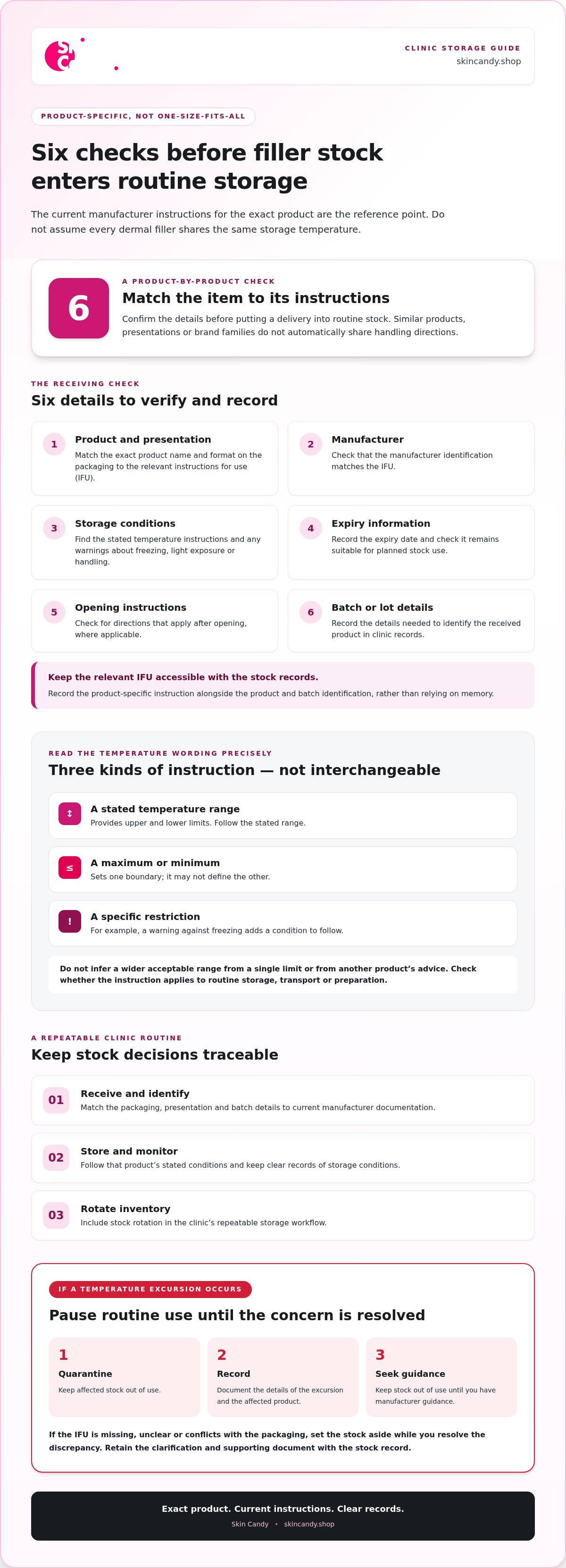
Before storing a delivery, match the packaging to the correct manufacturer instructions for use (IFU). Check the complete product identity, not just the brand name. Similar-looking products or different presentations may have different handling directions, so confirm the details before adding stock to routine storage.
Use this quick check for each item:
- Product and presentation: Match the exact product name and format shown on the packaging.
- Manufacturer: Check the manufacturer identification against the IFU.
- Storage conditions: Locate the stated temperature instructions and any warnings about freezing, light exposure or handling.
- Expiry information: Record the expiry date and check that it remains suitable for planned stock use.
- Opening instructions: Look for any directions that apply after opening, where applicable.
- Traceability: Note the batch or lot details so the received product can be identified in clinic records.
Record the product-specific instruction alongside the product and batch identification. This gives staff a useful reference and supports traceability if a question arises. Keep the relevant IFU accessible with the stock records, rather than relying on someone remembering a temperature instruction.
Read the wording precisely
Don’t treat every temperature statement as a range. A stated range gives upper and lower limits. A maximum or minimum sets one boundary, but may not define the other. A specific restriction, such as a warning against freezing, adds a condition that must also be followed. Apply the full instruction as written. Don’t infer a wider acceptable range from a single limit or from storage advice for another product.
Check whether the wording applies to routine storage, transport or preparation. These are different stages of handling. A temporary direction for one stage doesn’t automatically replace the product’s ongoing storage instructions.
Resolve unclear or conflicting information
If the IFU is missing, unclear or inconsistent with the packaging, don’t choose whichever temperature is easiest to meet. Set the affected stock aside from routine use while you resolve the discrepancy. Use current manufacturer-issued instructions that match the supplied product, and retain the clarification and supporting document with the stock record.
Record what was unclear, which product and batch were involved, and what documentation resolved the issue. This creates a clear decision trail and helps prevent the same uncertainty from recurring during a stock check or handover. Once the product identity and instructions align, staff can follow the stated conditions.
For clinic procurement planning, browse professional dermal fillers and build receipt checks around the documentation for each product.
Room temperature, refrigeration, and temperature excursions: how to assess the guidance
“Room temperature” and “refrigerate” aren’t universal instructions for every dermal filler. Use the product’s current instructions to determine which conditions apply, and don’t add a temperature range that the manufacturer hasn’t stated. The same applies to instructions about light exposure, freezing or handling.
Read the wording closely. A temperature outside the product’s stated conditions is an excursion that needs assessment, not an automatic verdict that the stock is usable or unusable. Use the manufacturer’s documented advice to guide any decision about affected stock.
| Instruction type | What it means | Clinic action |
|---|---|---|
| Stated storage range | The manufacturer specifies the conditions within which the product should be stored. | Store and monitor stock according to the stated range. |
| Maximum or minimum | A limit is given, but it may not describe a complete range. | Follow the stated limit and check the IFU for any other applicable conditions. Don’t infer an unstated boundary. |
| Specific restriction | A condition such as avoiding freezing or protecting the product from light is stated. | Apply the restriction alongside the other storage instructions. |
| Transport or handling condition | The direction may apply only during a particular stage, such as transit or preparation. | Check when it applies. Don’t treat it as a replacement for routine storage directions. |
| Conditions exceeded | Observed temperatures fall outside the product’s stated conditions. | Segregate the affected stock, document the event and obtain product-specific guidance before deciding what happens next. |
Distinguish storage from transport conditions
Packaging or manufacturer documentation may give separate directions for receipt, routine storage and handling. Identify which stage each statement covers before acting. Delivery speed alone doesn’t establish the conditions a product experienced in transit, and a general delivery offer doesn’t confirm temperature-controlled transport. At receipt, compare the goods and available information with the relevant product instructions, then follow the stated storage conditions.
Respond to a suspected temperature excursion
Act promptly, but don’t guess. Keep affected stock separate from products cleared for routine use, and identify each item by product and batch. Record the observed conditions, the duration if known, when the issue was noticed and any actions taken. Then obtain the manufacturer’s documented advice for that product and those circumstances.
Don’t use, discard or return stock based on an invented universal threshold. Until the assessment is resolved, keep the decision and supporting guidance with the product record. This makes dermal filler storage temperature guidelines practical to apply when an unexpected reading occurs, without turning a temperature deviation into an unsupported product verdict.
Build a practical dermal filler storage checklist for your clinic
A consistent workflow helps staff move stock from delivery to use without losing product identity or storage history. Assign responsibility for receipt checks, routine monitoring and escalation, then keep the relevant records together. Apply dermal filler storage temperature guidelines to each exact product, rather than relying on a general clinic-wide assumption.
- Match the delivery. Compare each item with the order and product-specific instructions before putting it away. Check the exact product name and presentation, manufacturer details, packaging, batch or lot identification and expiry information.
- Inspect and record receipt. Look for visible packaging damage or other delivery concerns. Record the date received, product and batch details, expiry information, packaging condition and any observations that need follow-up.
- Confirm storage instructions. Match the supplied product to its current manufacturer instructions. Identify the stated storage conditions and any relevant warnings before moving stock into its designated storage location. If details are unclear or inconsistent, keep the stock separate from routine-use products until the issue is resolved.
- Monitor and log conditions. Use a consistent monitoring process suited to the storage arrangements and the instructions for the products held there. Record readings, checks, exceptions and actions taken. Name who completes the checks, who reviews the log and who escalates an out-of-condition reading.
- Rotate and check stock before use. Follow a documented rotation method that makes earlier-expiring stock easy to identify. Before use, check the product identity, expiry information and packaging integrity. Keep affected or unresolved stock out of routine use while its status is assessed.
Make receipt checks part of the routine
Complete the receipt check promptly so products aren’t put away under assumed conditions. If a delivery observation raises a storage concern, document what you saw and follow the product-specific instructions for the next step. Delivery speed alone doesn’t confirm the temperature conditions experienced in transit, so don’t treat it as evidence of suitability.
Keep records useful and auditable
A monitoring log should make the timeline clear: what was checked, when, by whom, what was found and what action followed. Record any excursion against the affected product and batch, including the observed conditions and duration if known. Brief staff on where to find instructions and how to report an exception. This supports consistent handovers between shifts.
For broader procurement planning, use a just-in-time inventory approach for aesthetic clinics alongside your receipt and storage checks. Browse professional dermal fillers and build each product’s instructions into your clinic’s stock process.
Choosing a reliable dermal filler supply process for UK clinics
A dependable supply process doesn't end when an order arrives. Connect product identification, current manufacturer instructions, receipt checks, storage and record-keeping so every item has a clear route from delivery to clinic stock. This makes dermal filler storage temperature guidelines part of purchasing and handling decisions, not a document staff consult only after a problem.
Plan purchasing around documented product requirements
Keep the current instructions for each stocked product accessible to the staff responsible for receiving deliveries. Before stock arrives, assign someone to match the product and presentation to its instructions, check batch and expiry details, and move it into the specified storage conditions without avoidable delay.
Skin Candy supplies professional aesthetic products across the UK, with same-day and next-day delivery options. Delivery speed supports purchasing plans, but it doesn't confirm the temperature conditions experienced in transit or establish that a product is suitable for use. Include clinic receipt checks in the procurement plan, then assess each product against its packaging, documentation and condition when it arrives.
Turn storage guidance into a repeatable clinic standard
Set out a concise staff procedure covering where to find product instructions, how to record receipt and storage checks, and who reviews or escalates an exception. Keep the product name, presentation, batch, expiry and relevant storage records easy to retrieve. Clear responsibilities and consistent records help staff follow the same process across deliveries and handovers.
Always use the specific instructions that match the exact product and presentation currently in stock. For broader product context when making a purchasing decision, consult industry reference materials alongside the manufacturer's documentation. Market information can support product selection, but it doesn't replace storage instructions.
Build procurement around traceability: identify the product, retain its current instructions, check it at receipt, store it as directed and keep records through stock use. Browse Skin Candy's professional dermal fillers as you plan your clinic's supply and storage process.
Make product-specific storage part of your clinic routine
There’s no universal temperature rule for every filler. Use each product’s current manufacturer instructions, match them to the exact product and batch, and keep the supporting details in your clinic records. If stock may have experienced conditions outside its stated requirements, separate it from routine use and base the next step on documented manufacturer advice.
A clear process connects procurement with receipt checks, appropriate storage, monitoring and stock rotation. These dermal filler storage temperature guidelines help staff apply product-specific information consistently and make storage decisions easier to trace.
Skin Candy supplies professional aesthetic products to clinics and practitioners across the UK, with same-day and next-day delivery options available nationally. Plan your purchasing alongside your clinic’s receipt and storage procedures, then browse professional dermal fillers at Skin Candy.
With clear instructions and a consistent workflow, your team can manage stock with greater confidence. Make the process practical, keep records accessible and build good storage habits into every delivery.
Frequently Asked Questions
What temperature should dermal fillers be stored at?
Store each dermal filler at the temperature stated in its current manufacturer instructions for use (IFU). There isn’t one range that applies to every product. Check the exact product and presentation, then follow the instructions on its packaging and matching documentation. Don’t substitute general online advice or another filler’s requirements. If the directions are unclear or inconsistent, keep the stock separate from routine use until the instructions are resolved.
Can dermal fillers be stored at room temperature?
Some products may have room-temperature storage instructions, but don’t assume this applies to every dermal filler. Check the specific product’s packaging and current IFU to see what “room temperature” means for that item and whether there are additional restrictions. Follow the stated conditions in your clinic’s storage process. If the instructions don’t clearly explain what to do, seek product-specific clarification before treating room-temperature storage as suitable.
Should dermal fillers be refrigerated?
Refrigerate a dermal filler only if its current manufacturer instructions say to do so. Refrigeration isn’t a universal requirement, and storing a product under conditions that aren’t specified may create a storage concern. Check the exact product documentation for temperature limits and handling restrictions. If stock has been refrigerated contrary to, or outside, its stated conditions, set it aside and obtain documented manufacturer guidance before deciding whether it can be used.
What happens if dermal filler is stored at the wrong temperature?
Storage outside the product’s stated conditions may compromise its quality or safety, but a temperature deviation alone doesn’t determine the product’s status. Treat it as an excursion that requires assessment. Separate and identify the affected stock, record the observed conditions and duration if known, and obtain the manufacturer’s advice for that product. Don’t use, discard or return it based on a general threshold or an assumption about another filler.
Can dermal fillers be frozen?
Don’t freeze a dermal filler unless its manufacturer’s instructions explicitly permit it. Check the product’s IFU and packaging for a specific warning about freezing, and follow any restriction as written. If you suspect a product has frozen, keep it separate from stock cleared for routine use. Record what happened and obtain documented guidance from the manufacturer before deciding whether to use or dispose of it.
How should a clinic monitor dermal filler storage temperature?
Use a consistent monitoring and record-keeping process that reflects the storage conditions specified for each product. Assign staff to complete checks, record readings and observations, and identify who reviews the log and escalates exceptions. Keep records traceable to the relevant product and batch. If a reading falls outside stated conditions, segregate affected stock, document the event and follow product-specific guidance before returning it to routine stock.
Do all hyaluronic acid fillers have the same storage requirements?
No. A shared hyaluronic acid ingredient doesn’t mean different fillers have identical storage requirements. Formulation, presentation, packaging and manufacturer instructions can all affect handling. Check the current IFU for the exact product rather than applying one filler’s conditions to another. These dermal filler storage temperature guidelines are product-specific: match the documentation to the item and batch, and resolve any uncertainty before routine storage or use.