
Dermal Filler Reconstitution: Practitioner Guide
There’s no universal recipe for dermal filler reconstitution. A dermal filler reconstitution guide should start with the exact product, not a mixing ratio copied from another injectable. Reconstitution, when required by the manufacturer, prepares a product for use. Dissolving hyaluronic acid filler with an enzyme is a separate process with a different purpose.
If you’re unsure whether a filler needs preparation, check before opening the pack. Products may be supplied ready to use or require product-specific preparation, and instructions for one product must never be applied to another. This guide explains how to confirm the product’s intended presentation, find the relevant instructions and check the packaging before clinical use. It also covers product identity, seal condition, batch or lot number and expiry date, all of which support traceability.
Always consult the current manufacturer’s Instructions for Use for the exact product in hand. Skin Candy supplies professional aesthetic products, but preparation requirements must be confirmed against the product’s own documentation. The steps below help you make that check without treating reconstitution as a universal procedure.
Key Takeaways
- Use the current manufacturer instructions to confirm whether a product is ready to use or requires preparation.
- Keep reconstitution separate from dissolving previously injected hyaluronic acid filler. They are different processes.
- This dermal filler reconstitution guide provides a product-specific checking workflow, not a universal recipe or mixing method.
- If the product presentation or instructions are unclear, pause and seek clarification before clinical use.
- Include traceability in stock checks and preparation records, and source products through a reliable professional supplier such as Skin Candy.
Dermal filler reconstitution: what it means and what it does not
Reconstitution means preparing a product before use when, and only when, its current manufacturer instructions require it. The process depends on the specific product and how it is supplied. Some fillers are ready to use; others may need preparation. Never assume every dermal filler requires reconstitution or that a method used for one product applies to another.
This distinction matters because preparation must follow the product’s intended handling. Check the exact product packaging and current Instructions for Use (IFU) before proceeding. A general dermal filler reconstitution guide can help you identify what to verify, but it cannot replace the instructions for the product in hand. For background on different injectable filler materials, consult an overview separately. It is not a preparation protocol.
Does every dermal filler need reconstitution?
No. The product formulation and presentation determine whether preparation is required. The packaging may state that a product is ready to use or direct the practitioner to prepare it. Confirm this against the current product-specific IFU, not a remembered technique, another product’s directions or a general assumption about the brand. If the packaging and instructions don’t clearly match, pause and seek clarification before clinical use. Don’t infer preparation requirements from the product name alone.
Reconstitution versus dissolving dermal filler
Reconstitution concerns preparation before use, where the product’s instructions require it. Dissolving filler is a separate clinical procedure involving material that has already been injected. Hyaluronidase may be used to break down hyaluronic acid filler, but guidance for its use is not a reconstitution protocol for a dermal filler. The products, purpose and relevant instructions differ. Keep the terms distinct when reviewing references and recording clinical decisions.
This section is for appropriately trained professionals working within their scope of practice. It isn’t a self-treatment guide or patient instruction. Don’t use general online advice to decide how to prepare or administer a product. First verify the product identity and its current instructions, then follow those directions and applicable professional procedures. The practical starting point is to confirm that the pack, presentation and documentation all refer to the same product.
Before preparing a dermal filler, check the product and its instructions
Preparation starts with verification, not mixing. Match the product in your hand to its current manufacturer’s Instructions for Use (IFU). The IFU for that exact product and presentation is the controlling source for whether preparation is required and, if so, what the manufacturer directs. Requirements vary by product, so follow that product’s current instructions.
Use this pre-use checklist before opening the pack:
- Identity and presentation: Confirm the exact product name and check that the packaging matches its IFU.
- Instructions: Make sure the document is current, complete and obtained from a reliable manufacturer or supplier source.
- Packaging: Inspect the seal and pack for damage, tampering or signs that the product may not be in the expected condition.
- Traceability: Verify the batch or lot details and expiry, then follow your clinic’s documentation process.
- Storage: Check the product-specific storage requirements and whether they’ve been maintained.
- Professional readiness: Confirm you’re trained, working within your professional scope and following relevant clinic procedures.
How to locate the correct product-specific instructions
Match the IFU to the exact product name and presentation shown on the packaging. Don’t rely on a search result, an old saved document or instructions for a similar product. Check the version or date where available, and obtain the document from a reliable manufacturer or supplier source. If it’s missing, unclear or inconsistent with the pack, stop and seek clarification before proceeding.
What to verify before opening a product
Before opening, check the seal, batch identification, expiry and storage conditions. Record the details required by your clinic’s traceability process, and make sure the product can be matched to its documentation later. A damaged pack, uncertain storage history or unreadable batch details are reasons to pause. Don’t use a product if its identity, condition or applicable instructions can’t be verified.
The FDA Dermal Filler Guidelines provide a US government reference on filler risks and safety. They’re useful background, but they don’t replace the exact product IFU or UK-relevant information. Practitioners sourcing professional aesthetic products can review the range from Skin Candy, a UK-wide professional aesthetic product wholesaler, then confirm product-specific information before ordering or preparation.
How to follow a dermal filler reconstitution guide without guessing
A reliable workflow is product-led and repeatable. This dermal filler reconstitution guide provides a verification sequence, not a preparation recipe. Don’t rely on generic volumes, ratios, diluents, waiting times or mixing techniques. The manufacturer’s current, product-specific instructions and your professional protocols take precedence over general guidance, experience with another product or advice found online.
A practical verification workflow for trained practitioners
Work through each check in order. If the product is supplied ready to use, don’t add a preparation step that isn’t required. If its instructions specify preparation, follow those directions for the exact product and presentation.
- Identify: Match the product and presentation to the packaging and instructions.
- Confirm: Check whether the current instructions call for preparation.
- Prepare: Use only the method and materials specified in those instructions, alongside applicable clinic procedures.
- Document: Record relevant product and preparation details in line with clinic policy and traceability processes.
- Verify: Before clinical use, check that the product and preparation match the instructions and your documented checks.
When to stop and seek clarification
Stop if you can’t match the product identity to its instructions, or if the packaging, batch details, expiry or storage history raises concern. Don’t resolve conflicting directions by choosing the method that seems familiar. Set the product aside and seek clarification from an appropriate source.
If the instructions are unavailable or ambiguous, contact the manufacturer or supplier for product-specific clarification. If the question concerns clinical suitability or patient care, escalate it through appropriate professional channels. Online discussion or directions for a different product can’t resolve product-specific uncertainty.
Use a clear stop point: if instructions conflict, are incomplete or can’t be matched to the product, don’t proceed until the discrepancy is resolved. Document the issue and any clarification received according to clinic policy. This creates a clear record and helps prevent assumptions carrying over between products or shifts.
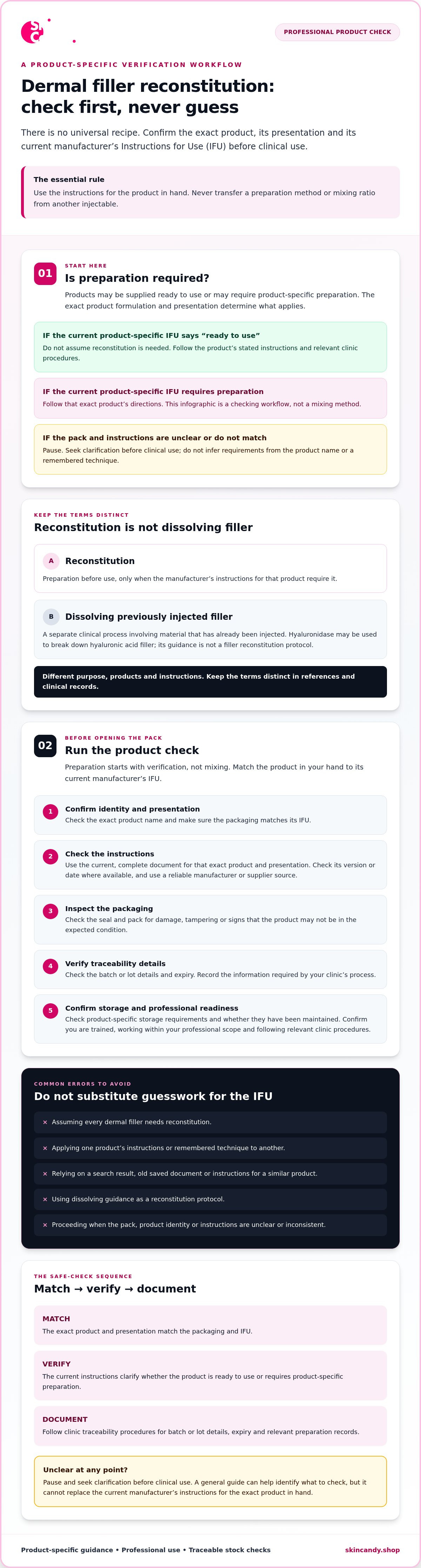
Compare product presentations and avoid common reconstitution mistakes
Products may arrive ready to use, or their instructions may require preparation. In some cases, the pack alone may not make the requirements clear. These are practical categories, not fixed classifications by brand or filler type. Check the exact product and presentation against its current manufacturer instructions every time. A dermal filler reconstitution guide can organise that check, but it can’t provide one recipe for every product.
| Product presentation | What to do |
|---|---|
| Ready to use | Confirm the instructions identify the product as ready for use. Don’t add preparation steps that aren’t specified. |
| Preparation required | Confirm the exact product instructions direct preparation, then follow only the specified method and materials. |
| Needs clarification | Pause if the pack and instructions don’t match or preparation requirements are unclear. Seek product-specific clarification before proceeding. |
Check the presentation, not the brand assumption
Familiarity with a brand doesn’t confirm the requirements for every product or presentation. Verify the product name and documentation together. General market overviews may provide broader context, but they aren't a substitute for product-specific preparation instructions. Use the current manufacturer documentation to establish what applies to the product in hand.
Common errors a guide should help prevent
- Transferring directions between products: Don’t reuse another product’s materials, quantities or preparation method, even if the products seem similar.
- Using outdated or unofficial guidance: Check that instructions are current, complete and matched to the exact presentation. Don’t fill gaps with online discussion or memory.
- Assuming every filler needs preparation: Some products may be supplied ready to use. Don’t introduce a preparation step unless the relevant instructions call for it.
- Confusing preparation with dissolution: Reconstitution, where required, concerns preparation before use. Hyaluronidase-led dissolution relates to previously injected filler and isn’t a reconstitution method or a substitute for complication-management protocols.
If the product presentation or instructions don’t give a clear answer, don’t guess. Set the product aside and seek clarification from an appropriate manufacturer or supplier contact. Clinics sourcing professional aesthetic products can browse Skin Candy’s product range and check product-specific information before ordering or preparation.
Build a reliable dermal filler workflow with verified products and supply
A dependable workflow makes product checks part of routine clinic operations, rather than a last-minute task. Use the same sequence for each stock item: verify documentation when it arrives, file it with the product record, review stock regularly, then recheck the pack and current instructions before clinical use. This supports traceability and helps prevent uncertainty from leading to an improvised substitution.
Keep product information and stock traceable
Set up clinic procedures so current product instructions are accessible alongside the relevant stock records. Record batch details, expiry checks and storage information in line with your documentation process. When stock arrives, match the delivered product to its packaging and available documentation. Before use, check the identity, condition, expiry and storage history again. If anything doesn’t match or can’t be verified, pause and follow your clinic’s escalation process.
Plan stock rotation and replenishment before supplies run low. Keeping a clear view of stock on hand, expiry dates and expected use can help reduce pressure to substitute a product at short notice. For practical ideas on rotation and ordering, see this just-in-time clinic procurement guide. Keep preparation decisions separate from procurement: the current product-specific instructions remain the source for how a product must be handled.
Choose a supplier that supports informed procurement
Before ordering, check that the product identity and supplied presentation are clear, and find out how to access relevant product documentation. Review the ordering terms and confirm current delivery options directly with the supplier rather than relying on assumptions. A supplier can support product sourcing, but it doesn’t replace manufacturer instructions, clinic procedures or professional clinical judgement.
Skin Candy is a UK-wide professional aesthetic product wholesaler supplying clinics and practitioners. Its range includes dermal fillers, skin boosters, chemical peels, polynucleotides, exosomes and fat dissolving agents. Confirm product details through the relevant documentation and professional channels, rather than relying on a supplier to determine patient suitability or preparation requirements. A well-organised dermal filler reconstitution guide workflow combines considered sourcing with checks at receipt and before use, while keeping clinical decisions in the right hands.
Once your documentation and stock checks are in place, eligible practitioners can explore professional aesthetic supplies from Skin Candy. Check product information and ordering terms for the specific items you’re considering.
Make product-specific checks part of every preparation
A reliable dermal filler reconstitution guide starts with one rule: never assume one product’s instructions apply to another. Confirm whether the exact presentation requires preparation, follow its current manufacturer instructions and document the product and relevant checks. If the packaging, product identity or directions are unclear, pause and seek clarification rather than guessing.
Build these steps into your clinic’s stock and preparation workflow. Skin Candy is a UK-wide wholesale supplier of professional aesthetic products for clinics and practitioners. Check product documentation and ordering terms before purchase, and confirm current delivery options and applicable terms directly with the supplier.
Ready to review your supply options? Explore professional aesthetic supplies at Skin Candy. Check the information for each product you’re considering and confirm its preparation requirements in the current manufacturer instructions.
Frequently Asked Questions
Does every dermal filler need to be reconstituted?
No. Some dermal fillers are supplied ready to use, while others may require preparation according to their product-specific instructions. The presentation and formulation determine what applies, so don’t infer preparation needs from the product category or brand. Check the packaging and current manufacturer’s Instructions for Use for the exact product. If they don’t clearly confirm the required handling, pause and seek clarification before clinical use.
What is the difference between reconstituting and dissolving dermal filler?
Reconstitution means preparing a product before use when its instructions direct that preparation. Dissolving is a separate clinical procedure involving filler that has already been injected. Hyaluronidase may be used to break down hyaluronic acid filler, but that isn’t the same process as product preparation. Keep the relevant instructions and clinical protocols separate. Guidance for dissolution doesn’t provide a reconstitution method.
Can I use one dermal filler reconstitution method for different brands?
No. Don’t transfer preparation methods, materials or quantities from one product to another, even if they appear similar or come from the same brand. The current instructions for the exact product and presentation must guide any preparation. A dermal filler reconstitution guide can help structure your checks, but it can’t provide a universal recipe. If the product and instructions don’t match, stop and seek clarification.
Where can practitioners find the correct reconstitution instructions?
Use the current manufacturer’s Instructions for Use supplied with, or made available for, the exact product. Match the document to the product name and presentation on the packaging, and check that it’s current and complete. If you can’t locate the instructions, contact the manufacturer or supplier for clarification. Don’t rely on instructions for another product, an old saved copy or informal online advice.
What should I check before preparing a dermal filler?
Confirm the product identity and presentation, then check its instructions to establish whether preparation is required. Inspect the packaging and seal, verify batch details and expiry, and confirm storage conditions against the product’s requirements. Follow your clinic’s traceability and documentation procedures. Also ensure you’re appropriately trained, working within your professional scope and following relevant clinic protocols. Don’t proceed if any key detail is uncertain.
What should I do if a product’s instructions are missing or unclear?
Pause and don’t prepare or use the product until the uncertainty is resolved. Check that you have the instructions for the exact product and presentation, then seek clarification from the manufacturer or supplier if they’re missing, ambiguous or inconsistent with the packaging. Escalate clinical questions through appropriate professional channels. Don’t fill gaps with remembered methods, instructions for another product or online guesswork.
Can hyaluronidase be used to reconstitute dermal filler?
Don’t treat hyaluronidase as a dermal filler reconstitution ingredient. It’s an enzyme used in the clinical management of previously injected hyaluronic acid filler, not a general preparation material for filler products. For product preparation, use only the materials and method specified in that product’s current instructions. Hyaluronidase use must be guided by its own product information and appropriate clinical protocols.