Choosing Polynucleotides: 2026 Practitioner Guide
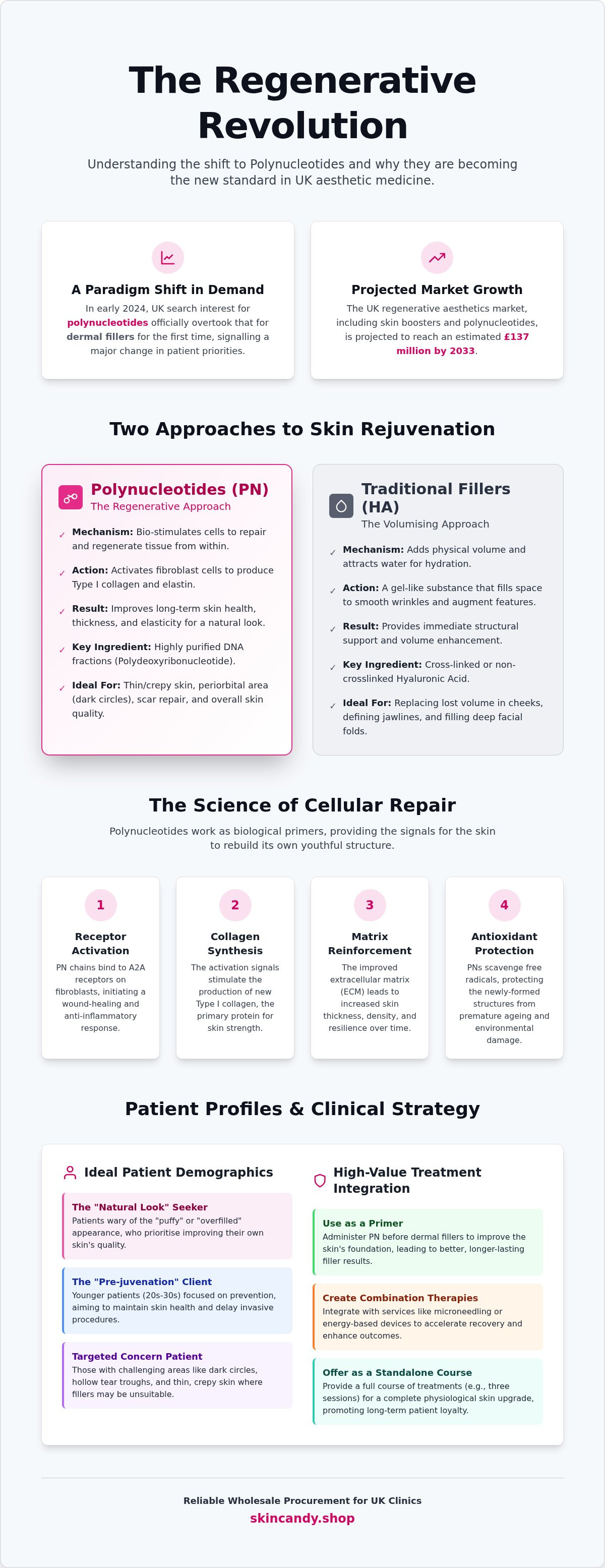
In early 2024, UK search volume for polynucleotides officially overtook dermal fillers for the first time. This wasn't a temporary trend; it was the start of a regenerative revolution that is now the industry standard. You likely recognise that patients are pivoting away from artificial volume in favour of cellular repair, but the transition creates new operational hurdles. Between distinguishing PN from traditional skin boosters and managing supply chain reliability, choosing polynucleotides for your clinic requires more than just clinical skill.
It's understandable if you feel the pressure to keep pace while ensuring your procurement doesn't fail you at the last minute. This guide will help you master the clinical, operational, and commercial strategies needed to turn regenerative treatments into a core revenue driver. We'll explore the technical distinctions of PN formulations, provide a clear framework for patient education, and demonstrate how a streamlined wholesale partnership ensures you never miss a treatment window due to delivery delays.
Key Takeaways
- Understand why DNA-derived polynucleotides are replacing traditional fillers as the primary driver for cellular regeneration and long-term skin health.
- Master the clinical framework for choosing polynucleotides for your clinic by distinguishing their bio-stimulatory effects from standard HA skin boosters.
- Learn to integrate PN with existing aesthetic services, such as dermal fillers, to create high-value combination treatments that improve patient outcomes.
- Implement standardised injection protocols and profitable pricing models specifically tailored for the competitive UK aesthetic market.
- Streamline your procurement process using just-in-time inventory strategies and reliable next-day delivery to maintain clinic cash flow.
Understanding Polynucleotides: The Regenerative Shift in 2026
The UK aesthetic market has undergone a fundamental transformation. In 2026, the focus has shifted from immediate volume replacement to long-term cellular health. Patients are increasingly wary of the "puffy" appearance associated with excessive filler use; they now demand treatments that make their skin work harder. Polynucleotides are the engine of this shift. These highly purified DNA fractions, typically derived from salmon or trout sperm, act as biological primers. When considering What is a Polynucleotide? in a clinical context, it is best defined as a biostimulator that promotes fibroblast proliferation and collagen synthesis to restore skin quality from within.
This isn't just a trend. The UK skin booster and regenerative market is projected to reach £137 million by 2033. Practitioners who ignore this shift risk losing patients to clinics offering more natural, regenerative outcomes. Polynucleotides are now the primary indication for periorbital rejuvenation, improving skin elasticity, and accelerating scar repair. They provide a physiological solution to ageing rather than a purely structural one. Successfully choosing polynucleotides for your clinic allows you to capture this growing demand for "invisible" aesthetics.
The Mechanism of Action: Why DNA Fractions Matter
Understanding the science is vital for patient conversion. Polynucleotides contain Polydeoxyribonucleotide (PDRN) chains that activate A2A receptors. This specific pathway triggers a cascade of wound healing and anti-inflammatory responses. While traditional hydration methods like non-crosslinked HA provide temporary moisture, PN changes the cellular environment. It offers significant antioxidant properties, scavenging free radicals that cause premature ageing. By improving the extracellular matrix (ECM), PN ensures the skin’s structural foundation remains robust and resilient over time.
Patient Demographics for Regenerative Aesthetics
The "natural look" seeker is your primary demographic. These patients often avoid Lumifil dermal fillers because they fear looking "done," even though PN actually works better when used as a primer for such treatments. You should target patients concerned with dark circles, hollow troughs, or thin, crepy skin where traditional fillers might look heavy.
Don't overlook the preventative market. Younger patients in their 20s and 30s are using polynucleotides to "pre-juvenate." They want to maintain their current skin quality and delay the need for more invasive procedures. Positioning PN as a skin-health essential allows you to build long-term loyalty with a demographic that values biology over botox. Choosing polynucleotides for your clinic enables you to meet these diverse patient needs with a single, versatile product category.
The Clinical Science: How DNA Fractions Drive Cellular Repair
Polynucleotides function as metabolic catalysts rather than inert space-fillers. When choosing polynucleotides for your clinic, understanding the cellular impact is the first step toward successful patient consultations. High-purity DNA fractions signal both fibroblasts and osteoblasts to accelerate tissue repair. This process is highly biocompatible because the fragments are recognised by the body as natural building blocks. Unlike synthetic materials, these fractions are fully resorbed, leaving behind a reinforced dermal structure.
The hydration mechanism is equally distinct. Polynucleotides possess a high capacity for water molecule binding through their phosphate groups. This creates an "isoshaped" hydration effect that improves skin turgor without the oedema often seen with hydrophilic Hyaluronic Acid. This makes the treatment particularly safe for the periorbital region. According to Current Practices in Polynucleotide Treatments, the ability to modulate the inflammatory environment is a primary reason for their success in post-procedure recovery.
Fibroblast Activation and Collagen Synthesis
You must be able to explain the "biological stretch" to your patients. Traditional fillers rely on mechanical tension to stimulate cells. In contrast, PN chains provide the chemical signals necessary for the production of Type I collagen. This leads to a measurable increase in skin thickness and dermal density over a course of three sessions. It's a physiological upgrade rather than a temporary disguise. The results appear gradually, peaking around the three-month mark as the new collagen matrix matures. You can browse our range of high-purity PN products to find the right concentration for your patients' needs.
Addressing Periorbital Concerns and Scarring
The delicate under-eye area is where PN truly outperforms traditional injectables. It addresses dark circles and fine lines without the risk of Tyndall effect or chronic swelling. Clinical evidence also supports its use in acne scar management. By stimulating the extracellular matrix, PN helps "fill" atrophic scars from the bottom up. In a clinical setting, combining these DNA fractions with microneedling or energy-based devices creates a synergistic effect. The PN acts as a recovery primer, reducing downtime whilst enhancing the final regenerative outcome. Choosing polynucleotides for your clinic allows you to offer these targeted solutions for complex indications that fillers often struggle to resolve.
Strategic Integration: Polynucleotides vs Traditional Aesthetic Injectables
Choosing polynucleotides for your clinic requires a clear understanding of how they sit within your existing injectable portfolio. They aren't a direct replacement for dermal fillers or traditional skin boosters. Instead, they represent a distinct category of regenerative medicine. In the 2026 market, practitioners must articulate these differences to manage patient expectations and maximise clinical outcomes. According to Polynucleotides in Aesthetic Medicine: A Review, the primary value lies in tissue biostimulation rather than temporary volumisation.
Whilst Lumifil dermal fillers provide immediate structural support and contouring, polynucleotides focus on the health of the overlying skin. Using them together is the gold standard. PN prepares the dermal environment, ensuring that fillers sit in healthy, hydrated tissue. This reduces the risk of the filler appearing unnatural. The debate regarding Exosomes vs Polynucleotides often confuses practitioners, but the choice is simple: exosomes act as rapid signalling messengers, whereas PN provides the actual DNA building blocks for cellular repair.
Polynucleotides vs Skin Boosters: The Core Differences
Skin boosters like Lumi Meso are excellent for immediate hydration. They use non-crosslinked Hyaluronic Acid to pull moisture into the skin. Polynucleotides work differently. They trigger cellular regeneration that lasts far longer than a standard HA boost. A typical skin booster provides a glow for 4 to 6 weeks. A course of PN repair can offer results that persist for 6 to 9 months. For the clinic owner, the cost-per-treatment is slightly higher for PN, but the patient retention and perceived value of biological repair allow for significantly higher treatment margins.
Synergistic Treatment Planning
Don't view PN as a standalone service. Successful clinics use it to prime the skin 2 to 4 weeks before administering fillers or thread lifts. This ensures the skin is robust enough to support the mechanical tension of the primary treatment. PN is also the ideal post-treatment protocol for chemical peels or microneedling. It calms the inflammatory response and accelerates healing. Creating tiered Regenerative Packages, combining PN with Lumi Meso or Lumifil, increases patient lifetime value and ensures superior aesthetic results. Choosing polynucleotides for your clinic is ultimately about building a more resilient, multi-layered treatment menu.
Operational Implementation: Pricing, Protocols, and Patient Consultations
Moving from clinical theory to operational reality is where many clinics stumble. Choosing polynucleotides for your clinic is a strategic business decision that requires standardised protocols to ensure safety and profitability. You must decide between needle and cannula techniques based on the target area. For precise periorbital work, a 30G or 32G needle allows for controlled, small-volume blebs. For broader facial rejuvenation or neck treatments, a 25G or 27G cannula provides a more comfortable experience with reduced bruising and fewer entry points.
Establishing a pricing structure is the next critical step. In the UK market, individual polynucleotide sessions typically range from £200 to £450, whilst a full course of three treatments often commands between £500 and £1,200. These figures vary based on your clinic's location and the specific product concentration used. To maintain high margins without overstocking, order your polynucleotide supplies from a reliable UK wholesaler that offers next-day delivery and competitive bulk pricing.
Marketing Polynucleotides to Your Existing Database
Your existing patients are your best prospects. They already trust your clinical judgement but might be hesitant about "DNA-based" treatments. Use email marketing to simplify the science. Describe polynucleotides as "biological primers" that repair skin from within rather than just masking age. Social media demonstrations are highly effective here. Show the procedure in real-time to demystify the process. Focus your messaging on the biocompatible nature of the product, appealing to the growing demographic that prioritises health-conscious aesthetics. High-quality before-and-after imagery should highlight improvements in skin texture and luminosity rather than just volume.
The Consultation Framework
Mastering the consultation is vital for managing patient expectations. You must qualify the right candidate; polynucleotides are for those seeking skin quality improvement, not those requiring significant structural lifting. Explain the course-based nature of the treatment immediately. Most patients require a programme of three sessions spaced 2 to 4 weeks apart to see optimal results. Be transparent about the gradual onset of repair; it isn't an overnight fix. Address the salmon-derived origin early to screen for fish allergies and explain that the purification process ensures high safety and low downtime. Most patients experience mild swelling or small papules that typically resolve within 24 to 48 hours.
Scaling Your Service: Reliable Wholesale Procurement with Skin Candy
Clinical expertise is only half the battle. If your fridge is empty when a patient walks in, your revenue stops. Choosing polynucleotides for your clinic requires a logistical partner that understands the high-pressure environment of a busy aesthetic practice. You can't afford to wait weeks for international shipping or deal with customs delays. A reliable UK wholesale partner provides the infrastructure you need to scale without the headache of stock management.
Skin Candy acts as the logistical engine for your business. By leveraging just-in-time inventory, you can maintain healthy cash flow. You don't need to tie up thousands of pounds in sitting stock. Instead, order what you need for the coming week and trust our next-day delivery to keep your treatment rooms running. This agility is a significant competitive advantage in the fast-paced UK market.
Streamlining Your Aesthetic Supply Chain
Efficiency comes from consolidation. Managing multiple suppliers for fillers, boosters, and polynucleotides is an operational drain. We allow you to consolidate your orders, reducing administrative time and delivery costs. You can manage stock levels for high-demand regenerative products with total confidence. Our UK-wide fulfilment ensures that whether you're a single-room clinic or a multi-site operation, your consumables arrive on time and in perfect condition.
Authenticity is non-negotiable. Every product we supply meets rigorous high-grade standards for patient safety. When you buy from an established wholesaler, you eliminate the risks associated with grey-market sourcing. This protects your professional reputation and ensures your patients receive the high-purity DNA fractions they expect. Safety and reliability are the foundations of patient trust.
Why Skin Candy is the Preferred Partner for UK Clinics
We provide direct access to the industry's leading brands. Whether you're looking for Aesossa, Regenovue, or Teofil, our inventory is curated for professional practitioners. We don't just sell products; we support your commercial success through logistical excellence. Our team understands the technical requirements of polynucleotide therapy and the urgency of clinic procurement. We act as the silent engine behind your business growth.
Don't let supply chain issues throttle your growth. Secure your stock and start offering high-demand regenerative services with absolute certainty. Stock your clinic with professional polynucleotides from Skin Candy today.
Future-Proofing Your Aesthetic Practice with Polynucleotides
Integrating regenerative medicine isn't just about clinical technique; it's about shifting your business model to meet the 2026 demand for long-term skin health. You've mastered the science of DNA-based repair and the strategic value of combining biostimulators with traditional fillers. Successfully choosing polynucleotides for your clinic allows you to move beyond temporary volumisation and offer the biological results that modern patients prioritise. It's a transition that builds both patient loyalty and superior clinical outcomes.
Scaling these advanced services depends on a seamless supply chain. As an official wholesale distributor for leading aesthetic brands, Skin Candy provides the logistical reliability required for a high-volume practice. We're already trusted by thousands of UK practitioners to deliver high-purity consumables without delay. Don't let inventory gaps stall your clinic's growth or interrupt your patient treatment plans.
Explore our range of wholesale polynucleotides for professional clinics and benefit from reliable next-day delivery across the UK. Your transition into the future of regenerative aesthetics starts with a dependable partner. We're ready to support your commercial success.
Frequently Asked Questions
How do I explain the difference between polynucleotides and skin boosters to my patients?
Explain that skin boosters provide immediate hydration using Hyaluronic Acid, whereas polynucleotides are regenerative treatments that use DNA fractions to repair skin at a cellular level. Boosters act like a moisturiser from within, whilst polynucleotides work as biological primers to stimulate collagen and elastin. This distinction is vital when choosing polynucleotides for your clinic because it helps patients understand they are investing in long-term skin health rather than a temporary glow.
Can polynucleotides be used in conjunction with dermal fillers?
Yes, polynucleotides are excellent when used alongside dermal fillers like Lumifil or Aesossa. They act as a primer by improving the quality and thickness of the dermis, which provides a better foundation for structural fillers. Many practitioners administer polynucleotides two weeks before filler injections to ensure the tissue is healthy and hydrated. This combination approach often leads to more natural-looking results and improved patient satisfaction across your treatment menu.
What is the typical profit margin for a polynucleotide treatment course?
Profit margins for polynucleotide treatments are generally high because they are positioned as premium regenerative services. Whilst exact margins depend on your specific overheads and wholesale procurement costs, most UK clinics charge between £200 and £450 per individual session. Since patients typically require a course of three treatments, the total revenue per patient is significant. Using a wholesale partner for bulk purchasing can further enhance your clinic's profitability by reducing the cost-per-syringe.
Are there any specific contraindications for salmon-derived polynucleotides?
The most significant contraindication is a known allergy to fish or salmon, as the DNA fractions are derived from these sources. Other standard contraindications include pregnancy, breastfeeding, active skin infections at the injection site, and certain autoimmune conditions. Because these products are highly purified, they have an excellent safety profile and are highly biocompatible. Always conduct a thorough medical history during the consultation to ensure your patient is a suitable candidate for the procedure.
How many sessions are required before a patient sees visible results?
Most patients require a course of three sessions, spaced two to four weeks apart, to see meaningful clinical results. Polynucleotides work through biological stimulation rather than immediate volumisation, so the effects are gradual. Visible improvements in skin texture and elasticity typically appear after the second session, with peak results manifesting approximately three months after the final injection. This timeline is an essential factor to communicate when choosing polynucleotides for your clinic to manage patient expectations.
Why is next-day delivery critical for polynucleotide procurement?
Next-day delivery allows you to operate a just-in-time inventory model, which is essential for maintaining clinic cash flow. It ensures you don't have to tie up capital in large amounts of sitting stock. If a patient books a last-minute course of treatment, you can order the consumables and have them ready for the appointment. This logistical reliability prevents missed revenue opportunities and ensures your treatment rooms remain fully operational throughout the working week.
What training is required to integrate polynucleotides into my clinic services?
Practitioners must be qualified medical professionals or aesthetic practitioners with advanced injectable training. Whilst the injection techniques, such as the use of needles or cannulas, are similar to other boosters, specific knowledge of the product's rheology and biological mechanism is necessary. You should ensure you have completed a recognised course that covers the specific protocols for periorbital and full-face rejuvenation. Skin Candy provides the consumables, but you must maintain your own clinical certifications.
Can polynucleotides be used for hair restoration services?
Yes, polynucleotides are increasingly used for hair restoration because they stimulate the follicular cells and improve the scalp's microcirculation. They work by prolonging the anagen phase of the hair growth cycle and strengthening the hair shaft from the root. This makes them a versatile addition to your clinic, allowing you to treat thinning hair alongside facial rejuvenation. They are often used as a standalone treatment or in combination with other scalp therapies.