Calculating ROI for Aesthetic Treatments to Set Profitable Prices
A full diary doesn’t guarantee a profitable clinic. Calculating ROI for aesthetic treatments means comparing the profit they generate with the costs of delivering them. For an aesthetic device, divide its net profit by its total investment cost and express the result as a percentage. This shows whether revenue leaves a worthwhile return after costs.
It’s easy to focus on the menu price, but consumables, practitioner time, room use, overheads, discounts and payment fees all affect what you keep. This guide explains how to calculate realistic treatment costs, set prices around your target margin and measure realised profit, including the effects of cancellations and package offers. You’ll also learn how to allocate overheads consistently and use the results to make clearer pricing and investment decisions.
Key Takeaways
- Build a complete cost per treatment by accounting for consumables, practitioner and room time, equipment costs and clinic overheads.
- Set prices from your delivery costs and target margin, then account for transaction fees and VAT where applicable.
- Measure realised profit after treatments are delivered, including payment costs, discounts and other associated expenses.
- Allocate overheads using completed appointments as well as available slots, so unused capacity doesn’t distort your cost per treatment.
- Track the effect of package discounts and cancellations on revenue to see whether headline prices translate into profitable bookings.
1. Calculating full treatment delivery costs and overheads
Start with the cost of delivering one completed appointment, not its menu price. Include consumables, practitioner time, treatment-room time, allocated overheads and any device costs. The practitioner figure uses a £60 hourly rate. These amounts show how separate inputs shape the total, rather than setting a price for your clinic.
Separate direct costs from indirect costs. Direct costs rise with each treatment, such as the product and disposable consumables used. Indirect costs include rent, utilities, booking systems and other shared clinic expenses. Use completed appointments in your calculation, so quiet periods don’t make expected costs look artificially low.
For an aesthetic device, record the full initial investment, not just the purchase price. Include installation fees and any necessary staff training. Then list ongoing operating costs, including consumables, maintenance, calibration and staff salaries. A device can generate treatment revenue, but its profit contribution depends on these recurring expenses and how often it is used.
Account carefully for monthly device payments. Record the payment schedule as a cash-flow commitment, then calculate the device’s total cost over the agreement, including applicable charges. Don’t count the same purchase cost twice: distinguish the investment used to assess ROI from monthly cash outflows used to manage affordability. Include service and maintenance costs separately if they aren’t part of the payment.
Regulatory and professional costs also affect how much remains as profit. Budget for insurance and ongoing professional development alongside operating costs. In the UK, purely cosmetic services are standard-rated for VAT; registration as a healthcare professional doesn’t automatically make every service exempt. If your clinic is VAT-registered, distinguish VAT collected from treatment revenue when assessing income available to cover costs.
Build the calculation in a consistent order: direct treatment inputs, practitioner and room time, allocated clinic overheads, then equipment and compliance costs. Keep one-off setup costs separate from recurring monthly expenses. This makes treatments easier to compare and helps reveal whether a device adds revenue after its full operating costs.
Review the figures quarterly as supplier prices or overheads change. Update consumables, staff costs, device servicing and appointment volumes, then recalculate the cost per completed treatment. A reliable cost base gives you a firm starting point for pricing decisions.
2. Pricing to preserve a target profit or margin
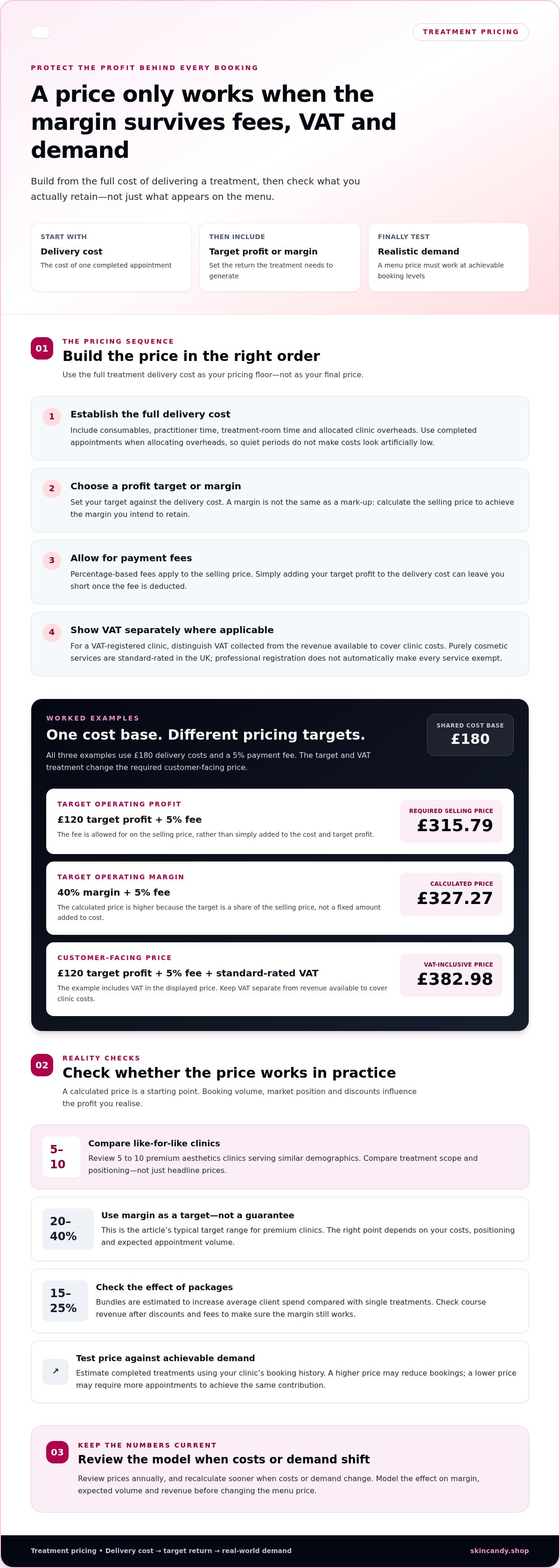
Use the full delivery cost from the previous calculation as your pricing floor, not your final price. When calculating ROI for aesthetic treatments, start by adding your target profit, then account for percentage-based payment fees. For example, with £180 in delivery costs, a £120 target operating profit and a 5% fee, the required selling price is £315.79. The fee applies to the selling price, so simply adding £120 to £180 would fall short.
Set your target as a margin, not a mark-up. A 20% to 40% profit margin is described as a typical target for premium clinics, but the suitable point depends on costs, positioning and expected appointment volume. If delivery costs are £180, a 5% fee applies and the target operating margin is 40%, the calculated price is £327.27. Compare the result with achievable demand before adopting it.
VAT changes the customer-facing figure. In the example using £180 delivery costs, £120 target profit, a 5% merchant fee and standard-rated VAT, the calculated VAT-inclusive price is £382.98. Treat VAT separately from revenue available to cover clinic costs. Your pricing model should show both the amount charged and the amount retained after applicable fees and VAT.
Demand affects revenue as much as the menu price. Estimate how many treatments you can realistically complete, then multiply that volume by net revenue per appointment. Device revenue depends on treatment pricing, client numbers and treatment frequency. A higher price may reduce bookings; a lower price may mean more appointments are needed to achieve the same contribution. Test your assumptions against your clinic’s booking history.
For market context, compare your treatment with 5 to 10 premium aesthetics clinics that target similar demographics. Compare like with like, including treatment scope and positioning, rather than copying a competitor’s headline price. Use the comparison to understand your market position, then let your cost base and target margin determine whether the price works. This comparison is one input when calculating ROI for aesthetic treatments, not a substitute for your own cost and demand analysis.
Tiered prices can distinguish treatment options, whilst packages can encourage multiple appointments. Bundles are estimated to increase average client spend by 15% to 25% compared with single treatments, but discounting still needs a margin check. Calculate the net revenue for the whole course after its discount and fees. A promotion or launch marketing campaign may enhance awareness, but measure whether bookings convert at a profitable level.
Review prices annually, and recalculate sooner when costs or demand shift. Before changing a menu price, model the effect on margin, expected volume and revenue. For clinics updating product inputs, aesthetic treatment consumables can be included in the same cost review.
3. Measuring realised profit and finance conversion
Compare treatments and equipment using the same measures: net profit, total investment, payback period and ROI over the same timeframe. For each option, calculate profit after associated costs. For a device, divide net profit by its total investment cost and express the result as a percentage. This gives you a consistent basis for comparing a procedure with a device investment.
How do you compare ROI across different aesthetic treatments and equipment investments? Use the same review period and include all relevant costs, then compare net profit, ROI and payback period. For devices, factor in utilisation and operating expenses; for treatments, include the cost of each completed appointment.
Keep gross margin separate from net profit. Gross margin is revenue less the cost of goods sold, expressed as a percentage of revenue. Net profit subtracts all associated costs, including operating expenses and depreciation. A treatment can have a strong gross margin but contribute less after rent, staff time, payment fees or equipment costs.
Use realised figures, not just menu prices or forecasts. Record the payment method and its fee against each completed sale.
Finance conversion affects the amount retained from monthly revenue. If 30% of sales value incurs a 5% finance fee and 70% incurs a 1% payment fee, the weighted payment cost is 2.2%. If 60% attracts a 5% fee and 40% a 1% fee, it becomes 3.4%. Apply the actual sales mix when projecting monthly profit.
Build projections from completed treatment volume, revenue per treatment and device utilisation. Separate expected bookings from delivered appointments, then compare forecasts with actual results each month. For a device, the payback period indicates how long it may take for its returns to cover the initial investment. A shorter payback means the investment is recovered sooner, but costs still determine its profit contribution.
Track client retention alongside revenue. Packages and memberships can encourage repeat sessions, while treatment volume and client satisfaction help assess performance. Compare repeat bookings and contribution per client across procedures, including marketing and acquisition costs. Training and staff time also affect capacity: an investment requiring more practitioner input may limit appointment volume and change the return.
Use a monthly dashboard to track completed appointments, revenue, payment fees, associated costs and net profit. Compare the figures with the forecast for the same period. This reveals whether a price change, finance option or device is improving realised returns, rather than simply increasing headline revenue.
4. Allocating clinic overheads per treatment
Start with monthly clinic overheads, then choose a clear allocation basis. Rent, utilities and shared administration support multiple services, so allocate them consistently. Use the same calculation period for both figures, then review whether the result reflects actual activity.
Appointment capacity and completed volume are not interchangeable. Allocating £3,000 across 200 available slots assigns £15 per slot, but half the slots remaining empty can leave a shortfall. For treatment pricing, divide overheads by completed appointments when assessing the cost of delivered care. Track unused capacity separately, because empty slots still leave fixed costs to cover.
Choose an allocation basis that reflects how each treatment uses the clinic. Practitioner time, room time and device usage can help distinguish a short procedure from a longer appointment. If an offering uses more room time or staff input, an equal split may understate its share. Record your chosen basis and apply it consistently.
Then compare the allocated amount with direct treatment costs and revenue. The allocation sits alongside product costs, consumables and practitioner time, rather than replacing them. Use the breakdown to identify which cost categories drive the total and where pricing may need adjustment.
Equipment adds another layer. Include the purchase price and ongoing operating costs when assessing a device-led service. Allocate shared servicing or calibration costs according to use, rather than assigning the full expense to an unrelated procedure. This makes treatment comparisons more useful and shows whether the device remains profitable after clinic costs.
Financial analysis is only one part of an equipment decision. Assess clinical efficacy alongside revenue potential, because inconsistent results or a high failure rate could damage the clinic’s reputation. Consider patient comfort, safety, ease of use and suitability across skin types. A device that looks profitable on paper may not suit your patients or service standards.
Review overhead allocation as treatment volumes change. Compare completed appointments with available slots, and update the cost per treatment when volume shifts. If demand falls, the same fixed overhead is spread across fewer delivered appointments. If an offering uses more capacity, measure its actual contribution rather than assuming every new booking improves profit.
Keep a monthly record of overheads, completed appointments, treatment mix and device utilisation. Compare these figures with treatment revenue and allocated costs. This gives you a practical view of which procedures support the business, how unused capacity affects costs, and whether your allocation method still reflects how care is delivered.
5. Accounting for package discounts and cancellations
How can clinics account for downtime, cancellations, complications and treatment risks in ROI? Record completed appointments separately from cancellations, then include lost capacity and related follow-up costs in the calculation. Assess clinical performance alongside revenue, since inconsistent outcomes can affect reputation as well as profitability.
A package discount changes the income earned per course, even when it secures bookings upfront. The discount and fee together reduce the original price by 14.5%. Calculate the net amount first, then deduct the cost of delivering every included session.
Don’t assess the first appointment as if it represents the whole package. Divide net course revenue by the number of sessions delivered, then compare the result with the cost of each session. Include consumables, staff time and allocated overheads across the course. A discount may attract clients, but the contribution must still cover delivery costs and leave the intended profit.
Cancellations affect both revenue and capacity. Track cancelled appointments, whether they were rebooked and whether the slot remained empty. Compare completed bookings with available appointment capacity, because unused slots still carry overheads. Use these records to understand the effect on monthly contribution instead of treating every scheduled appointment as earned revenue.
For downtime, record how many appointments the affected room, practitioner or device could not support. Include the resulting lost contribution and any direct costs of restoring service. For complications or additional care, record associated staff time, consumables and other costs against the original treatment. Keep clinical and financial records distinct, then use cost data to assess profitability without reducing care decisions to revenue alone.
Practices can use introductory pricing or package deals to raise awareness of a treatment and attract bookings. Compare each promotion with the standard price, the actual fee charged and the cost of all sessions delivered. Review repeat bookings and client retention too: an offer supports profitability only if the resulting course of care generates adequate contribution.
Review cancellation and discount results monthly alongside treatment volume and realised profit. If a package is paid upfront, match its revenue against the sessions delivered and costs incurred, rather than assuming the full payment is profit. This gives you a clearer view of outstanding treatment commitments and the course’s financial performance.
For clinics reviewing the product inputs behind treatment costs, browse professional aesthetic products as part of your purchasing review.
Skin Candy: Lumi Meso
Skin Candy supplies Lumi Meso for clinics assessing product costs and procurement needs alongside treatment profitability. Use this guide’s cost framework to evaluate how product inputs fit your treatment plan, including consumables, staff time and allocated overheads. This brings purchasing decisions into the same commercial analysis as pricing and realised profit.
Skin Candy also supplies Polynucleotides, Fat Dissolving Agents and Chemical Peels. Consider these product categories when reviewing what your clinic uses and the treatments it provides, then assess each against your costs, expected demand and service mix.
Explore Skin Candy’s product range and choose options that fit your clinic’s purchasing needs.
Make your next purchasing decision with confidence
Make calculating ROI for aesthetic treatments a regular part of your clinic’s purchasing decisions. Before adding a product category, consider how it fits your treatment mix, patient demand and procurement priorities. Then use your own cost and booking records to assess its commercial role over time. This keeps purchasing aligned with the services your clinic intends to provide, rather than treating procurement as a separate task.
Skin Candy supplies premium dermal fillers, mesotherapy products and polynucleotides for professional aesthetic practices. Consider how these product categories fit your clinic’s requirements and financial framework. A clear view of costs and demand can help you plan purchases more effectively.
Ready to discuss your clinic’s product requirements? Contact Skin Candy to discuss your clinic and take the next step with a focused purchasing plan.
Frequently Asked Questions
Why Calculate ROI?
Calculate ROI to decide whether a treatment or equipment investment uses clinic resources effectively. It gives you a financial basis for comparing options with different costs, appointment demand and staff input. For example, a treatment with higher revenue may still contribute less after delivery expenses. Reviewing ROI alongside clinical suitability helps you decide what to retain, adjust or expand in your service mix.
What costs should be included when calculating aesthetic treatment ROI?
Include costs that arise before, during and after delivery. Alongside product inputs and staff time, account for payment processing, appointment administration, equipment depreciation, servicing and consumables that expire or go unused. Include follow-up work if it uses practitioner time or supplies. Reconcile treatment records with supplier invoices and payroll so routine expenses don’t disappear from the calculation.
How do you estimate revenue and profit per aesthetic treatment?
Estimate revenue from completed, paid appointments, not bookings or advertised menu prices. Subtract direct costs, allocated overheads and payment charges to calculate the treatment’s contribution; deduct remaining operating costs to calculate net profit. Keep figures on a consistent basis, especially if VAT applies. Then compare the result with the price charged to see whether the procedure contributes enough to support the clinic’s wider costs.
How do you calculate the break-even point for an aesthetic treatment or device?
Divide the fixed investment or cost to recover by the contribution from each completed treatment. For a device, use its initial investment as the amount to recover, and subtract per-treatment consumables and other variable costs from treatment revenue. The result is the number of treatments needed to break even. If the contribution is zero or negative, additional bookings won’t recover the investment without a change in costs or pricing.
How should repeat visits, treatment packages, and client lifetime value affect ROI?
Assess repeat visits using the client’s total contribution across delivered appointments, not just the first booking. For a package, match income to sessions completed and include the costs of every session. Client lifetime value can help compare acquisition spending with contribution from repeat care, but base it on actual booking and payment records. Packages or memberships may support retention, yet discounts and delivery commitments still affect profitability.
How do UK VAT rules affect aesthetic treatment pricing and ROI?
Purely cosmetic services are standard-rated for VAT in the UK, and professional healthcare registration doesn’t automatically exempt every service. For example, a VAT-registered clinic’s £360 standard-rated sale includes £60 VAT, leaving £300 as revenue before other costs. Build VAT into the pricing model where applicable, and distinguish the tax collected from the income available to cover treatment delivery and overheads.
What legal, insurance, and practitioner training costs should UK aesthetic clinics include?
Consider applicable compliance, insurance and professional development expenses in the clinic’s financial planning. Record insurance premiums and development expenses in the period they cover, and include staff training time when it affects appointment capacity. Keep these costs distinct from product and procedure inputs, so your analysis shows both treatment-level contribution and the wider expense of operating the clinic.