
Aesthetic Distributor vs Manufacturer: The 2026 Practitioner’s Procurement Guide
The "direct-from-source" price advantage often vanishes when you factor in the operational cost of waiting three weeks for a shipment stuck in customs. While many practitioners assume direct sourcing is the gold standard for margins, the reality of the 2026 UK market suggests otherwise. Deciding on an aesthetic distributor vs manufacturer requires a cold analysis of your total procurement costs, including the hidden drain of high minimum order quantities and administrative bloat. You need a supply chain that supports your clinical agility rather than one that anchors your capital in excess inventory.
You likely feel the strain of managing dozens of individual brand accounts just to keep your treatment rooms stocked with essential dermal fillers and polynucleotides. This guide provides a professional framework to manage the UK’s evolving regulatory landscape, including the new licensing requirements for non-surgical procedures. We promise to show you how to transition from a fragmented buying process to a streamlined, next-day delivery model. We will compare the critical differences in logistical reliability, batch tracking, and portfolio diversity to ensure your practice remains both compliant and competitive in a high-growth industry.
Key Takeaways
- Master the trade-offs between an aesthetic distributor vs manufacturer to reduce lead times and eliminate the administrative burden of managing multiple accounts.
- Learn how to implement a Just-in-Time procurement strategy to maximise clinic space and free up capital by moving from bulk stockpiling to responsive ordering.
- Use our professional audit framework to verify authorised distributor status and ensure full regulatory compliance for high-demand aesthetic brands.
- Identify how to assess a supplier's technical expertise in advanced bio-stimulators, specifically for the procurement of polynucleotides and exosomes.
- Calculate the "Total Cost of Procurement" to understand why unit price is often secondary to logistical speed and stock reliability in a busy UK clinic.
Understanding the Aesthetic Supply Chain UK in 2026
The UK aesthetics market is valued at approximately £3.2 billion in 2026. This scale has created a sophisticated but often confusing hierarchy of suppliers. To maintain a lean, profitable clinic, you must distinguish between the three primary tiers of the Understanding the Aesthetic Supply Chain: manufacturers, authorised distributors, and independent wholesalers. While manufacturers create the formulas, authorised distributors like Skin Candy provide the logistical engine that keeps your treatment rooms operational. Choosing between an aesthetic distributor vs manufacturer isn't just about the unit price; it's about how much capital you're willing to lock away in a stockroom.
The modern aesthetic supply chain UK practitioners rely on has shifted dramatically toward high-speed distribution. This is driven by the need for "Just-in-Time" procurement. Practitioners no longer want to act as their own warehouse managers. They require a partner who can handle the administrative burden of regulatory compliance and batch tracking while offering a diverse portfolio of brands under a single professional account.
The Manufacturer: Innovation and Primary Sourcing
Manufacturers are the bedrock of the industry. They own the research, development, and primary production facilities for products like Lumifil or Regenovue. Buying direct gives you access to brand-specific technical data and the latest R&D insights. However, this route often presents significant barriers for individual clinics. High minimum order quantities (MOQs) are standard. You might be forced to purchase fifty boxes of a single filler SKU just to open an account. In 2026, international shipping remains a bottleneck. Customs duties apply to consignments above £135, and administrative delays at the border can leave your clinic without stock for weeks. For most practitioners, the rigid account opening processes of global manufacturers don't align with the need for clinical flexibility.
The Distributor: Logistical Agility and Portfolio Breadth
Authorised distributors provide the agility that manufacturers lack. By consolidating brands like Volifil, Aesossa, and various polynucleotides into one catalogue, they eliminate the need for you to manage twenty different supplier relationships. Localised stockholding is a clinical lifesaver. UK-based warehouses ensure that "out of stock" doesn't mean "cancelled appointments."
- Next-day access: Orders placed today arrive tomorrow, reducing the need for large on-site inventory.
- Regulatory safety: Authorised distributors manage MHRA-compliant batch tracking and ensure products are stored in temperature-controlled environments.
- Financial efficiency: Lower MOQs allow you to test new treatments, such as exosomes or chemical peels, without a massive upfront investment.
A professional distributor acts as your outsourced logistics department. They handle the customs paperwork and the bulk import risks, allowing you to focus entirely on patient outcomes and the upcoming 2026 licensing requirements.
Aesthetic Distributor vs Manufacturer: A Strategic Comparison
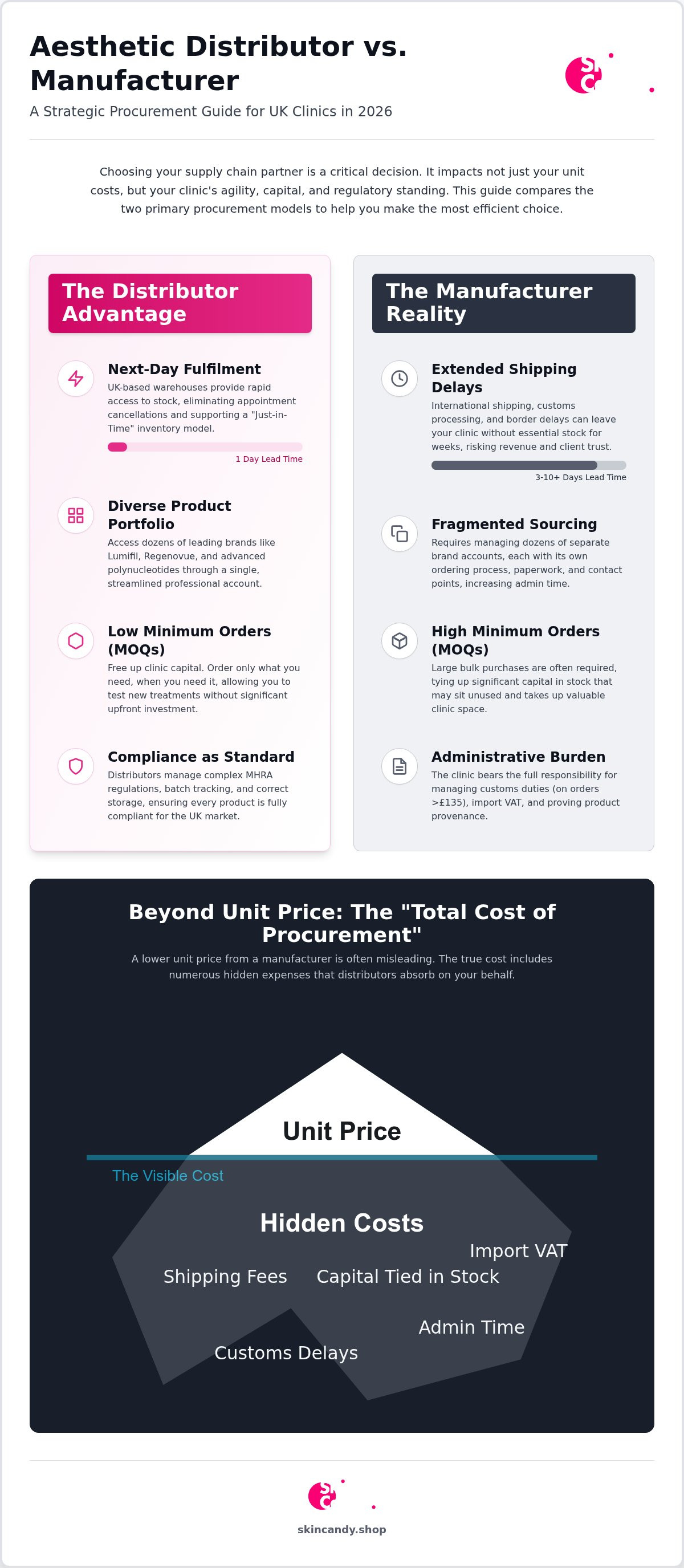
Successful clinic management requires looking beyond the invoice unit price. While a manufacturer might offer a lower base cost per syringe, the "Total Cost of Procurement" (TCOP) often tells a different story. TCOP includes shipping fees, import VAT, customs processing time, and the cost of capital tied up in excess stock. When evaluating an aesthetic distributor vs manufacturer, you must weigh these hidden expenses against your clinic's monthly turnover. A lower unit price is irrelevant if the product arrives three days after a fully booked clinic day.
The UK market operates under a strict UK regulatory framework managed by the MHRA. Authorised distributors absorb the complexity of these regulations on your behalf. They manage the logistics of batch tracking and ensure that every item in their warehouse meets local standards. This allows you to focus on clinical excellence rather than supply chain compliance. For most high-volume clinics, the reliability of a specialist wholesale partner outweighs the marginal savings of direct sourcing.
Lead Times and Fulfilment Speed
Speed is the primary currency of modern aesthetics. Manufacturers typically operate on international timelines, often requiring 3 to 10 working days for dispatch and delivery to the UK. This lag creates a "dead zone" where you cannot reliably book patients for specific treatments. In contrast, UK-based distributors set the gold standard with next-day delivery. This agility allows you to accept last-minute bookings for popular treatments like Lumifil or polynucleotides without the risk of an empty cupboard. If you can't get the product within 24 hours, you're losing revenue to more agile competitors.
Minimum Order Quantities (MOQ) and Cash Flow
Direct manufacturer accounts often demand high MOQs to justify the shipping and administrative costs. Stockpiling fifty boxes of a single filler SKU might lower your unit price, but it traps your liquid cash in a cupboard. This is a significant financial risk. If patient trends shift or a new product like Aesossa gains traction, you're stuck with depreciating inventory. Distributors offer the flexibility to buy single units or smaller, mixed-brand bundles. This improves your clinic's liquidity, allowing you to reinvest profits into marketing or new equipment rather than sitting on a mountain of boxes.
Brand exclusivity is another factor. Manufacturers want you to buy their entire range, even the slower-moving SKUs. A distributor allows you to cherry-pick the best-performing products from multiple brands. This hybrid approach ensures your portfolio remains diverse and responsive to patient demands. You get the benefit of variety without the administrative burden of managing twenty different manufacturer accounts.
The 2026 Aesthetic Procurement Checklist
Choosing between an aesthetic distributor vs manufacturer is a decision that defines your clinic’s operational maturity. To move beyond ad-hoc ordering, you need a strategic procurement framework. This ensures your supply chain is a source of competitive advantage rather than a logistical liability. Use the following four-step audit to evaluate your current or prospective partners and ensure they align with the 2026 UK standards.
First, verify the supplier's authorised status for key brands like Lumifil. Authorised partners like Skin Candy provide a direct line of accountability back to the manufacturer, ensuring product authenticity and support. Second, assess their technical expertise in advanced polynucleotides for clinics. As regenerative medicine dominates the 2026 landscape, you need a partner who understands the specific indications and storage requirements of bio-stimulators.
Third, review their cold chain and storage protocols, especially for exosomes. These high-performance products require strict temperature control to maintain efficacy from the warehouse to your treatment room. Finally, evaluate the digital ordering interface. A professional aesthetic distributor vs manufacturer comparison often highlights the superior user experience of distribution platforms. You should have access to real-time stock levels and automated tracking to reduce your administrative burden.
Regulatory and Safety Compliance
Safety is non-negotiable in the UK’s tightening regulatory environment. Every injectable product must carry the necessary UKCA or CE markings to be legally administered. Transparent batch tracking is equally vital for clinical safety. In the event of a manufacturer recall, you must be able to identify every patient who received a specific lot. This level of traceability is often missing with unverified "grey market" sellers who masquerade as legitimate distributors. These entities often bypass UK tax and safety laws, potentially voiding your professional insurance and putting patients at risk.
Portfolio Depth: Traditional vs. Regenerative
Your procurement partner should offer more than just a single brand. A versatile range of HA fillers, including Regenovue and Aesossa, allows you to tailor treatments to individual patient anatomy. However, the 2026 practitioner must also look toward regenerative solutions to stay competitive. Finding a specialist for mesotherapy products wholesale UK is essential for clinics offering holistic skin rejuvenation. Future-proofing your business means consolidating your sourcing. You should be able to procure skin boosters, chemical peels, and fat-dissolving agents like Volifil from one reliable source. This consolidation reduces shipping costs and simplifies your accounting processes.
Just-in-Time Logistics: Optimising Your Clinic Inventory
The "Just-in-Time" (JIT) philosophy is a strategy designed to eliminate waste and maximise clinical space. In the context of a high-volume UK clinic, it means receiving products exactly when you need them rather than storing them for months. When you weigh up the benefits of an aesthetic distributor vs manufacturer, the primary operational difference is how they influence your inventory levels. Manufacturers often force you into a stockpiling mindset through rigid volume requirements. A professional distributor supports a responsive ordering rhythm that keeps your shelves lean and your cash flow liquid.
Transitioning to a JIT model requires a reliable logistical partner. Next-day delivery acts as your operational safety net. It allows you to respond to sudden patient demand without carrying the financial risk of excess stock. By using your order history, you can predict seasonal peaks, such as the pre-holiday rush for dermal fillers and skin boosters. This data-driven approach ensures you are never overstocked during quiet periods or caught short during high-demand months.
Financial Benefits of the JIT Model
Capital is the lifeblood of your business. Don't lock it away in a stockroom. Moving from bulk procurement to a JIT model frees up thousands of pounds that you can reinvest into clinic marketing or equipment upgrades. High inventory turnover also dramatically reduces the risk of product expiry. Injectables like polynucleotides and exosomes represent a significant investment; letting them sit on a shelf until they expire is a direct hit to your bottom line. Furthermore, boutique clinics often operate in premium locations where every square foot of storage is expensive. Minimising your physical inventory allows you to reclaim that space for additional treatment rooms or patient consultation areas.
Setting Up Your Procurement Cycle
Efficiency starts with a systematic audit. Establish a weekly review of your essential consumables to identify exactly what has been used. You must determine "reorder points" for high-turnover items like Regenovue or fat-dissolving agents. For example, if you know you use ten boxes of filler a week and your distributor offers next-day delivery, your reorder point might be three boxes. This ensures you never reach zero stock but also never hold more than necessary.
Leveraging a distributor’s digital interface is the final step in optimising your cycle. Professional platforms offer "one-click" reordering based on your previous purchases, cutting the administrative time spent on procurement by half. To start building a more responsive and profitable supply chain, browse our full range of medical-grade consumables and experience the speed of authorised UK distribution.
Why Skin Candy is the Preferred Distribution Partner for UK Practitioners
Skin Candy acts as the silent engine behind the UK’s most successful aesthetic clinics. We understand that your reputation depends on the reliability of your supply chain. When you evaluate an aesthetic distributor vs manufacturer, you are choosing between logistical freedom and administrative burden. We provide a professional framework that allows you to bypass the constraints of direct manufacturing whilst maintaining the highest standards of clinical safety. By centralising your procurement, you eliminate the friction of managing multiple accounts and focus entirely on patient care.
Our authorised partnerships with industry leaders including Lumifil, Regenovue, Volifil, and Aesossa guarantee that you are injecting genuine, MHRA-compliant products. We don't just stock traditional fillers. We lead the UK market in regenerative aesthetics, offering a curated selection of polynucleotides and exosomes that are essential for the modern 2026 practitioner. Consolidating these high-performance brands into a single professional account simplifies your accounting and ensures your portfolio remains at the cutting edge of the industry.
The Efficiency of Next-Day Delivery
Treatment rooms shouldn't sit empty because of shipping delays or customs bottlenecks. Our national fulfilment network is designed for speed and precision. We have established robust courier partnerships that prioritise the safe handling of medical-grade consumables. Every order includes real-time tracking, giving you total visibility over your inventory's journey. This dependability allows you to book patients with confidence, knowing your stock will arrive exactly when needed. We support the UK aesthetic community by removing the uncertainty of international lead times, ensuring your clinic remains operational and profitable.
Uncompromising Quality and Support
We never compromise on batch integrity or storage standards. Every product in our warehouse, from Plla's to chemical peels, is managed according to strict medical protocols. This commitment to quality ensures that your clinic remains fully compliant with the evolving UK regulatory requirements. Beyond logistics, we provide the technical support necessary to integrate advanced products like Lumi Meso or fat-dissolving agents into your treatment menu. Join the growing network of UK practitioners who prioritise logistical excellence. Secure your supply chain today and experience the peace of mind that comes with a dependable distribution partner.
Future-Proof Your Clinic's Supply Chain
Your procurement strategy is the foundation of your clinic's profitability. By shifting from rigid bulk orders to a responsive, Just-in-Time model, you protect your cash flow whilst ensuring your treatment rooms remain fully stocked. The choice between an aesthetic distributor vs manufacturer ultimately comes down to whether you want to manage international logistics or focus on patient outcomes. Consolidating your sourcing through an authorised partner provides the safety of batch tracking and the agility of next-day fulfilment.
As an authorised distributor for Lumifil, Regenovue, and Aesossa, Skin Candy provides the specialist infrastructure your practice requires. We lead the UK market in advanced regenerative consumables, including polynucleotides and exosomes, ensuring you stay ahead of 2026 trends. Stop letting capital sit idle in your stockroom and start leveraging a supply chain built for speed and compliance. Our national fulfilment network and technical expertise are designed to support your growth without the administrative burden of direct manufacturing accounts.
Register for a Professional Account and Optimise Your Procurement today to secure your clinical future. We're ready to act as the silent engine behind your business success.
Frequently Asked Questions
What is the main difference between an aesthetic distributor and a manufacturer?
Manufacturers are the primary producers responsible for research, development, and large-scale manufacturing of products like dermal fillers. Distributors act as the bridge between these global producers and your clinic, managing local stockholding and logistics. While manufacturers focus on production, distributors focus on rapid fulfilment and practitioner support, making them the primary point of contact for daily procurement needs.
Why do many UK practitioners prefer distributors over buying direct from manufacturers?
Practitioners generally prefer distributors for their logistical agility and portfolio diversity. A distributor allows you to purchase multiple brands under one professional account, which eliminates the administrative burden of managing dozens of separate manufacturer relationships. They also offer significantly lower minimum order quantities, protecting your clinic's liquid capital and preventing the financial risk of excessive stockpiling.
How can I verify if an aesthetic wholesaler is an authorised distributor?
Check the manufacturer’s official website for a list of approved partners or request an authorisation certificate directly from the wholesaler. Reputable partners maintain transparent relationships with brands such as Lumifil and Regenovue. Verifying this status ensures you receive genuine, medical-grade products that are backed by manufacturer warranties and full technical support, which is critical for patient safety.
Is it more cost-effective to bulk buy fillers or use a just-in-time model?
A Just-in-Time model is usually more cost-effective because it prevents capital from being locked in inventory. While bulk buying might offer a lower unit price, it increases the risk of product expiry and requires expensive storage space. Using a distributor’s next-day delivery service allows you to maintain a lean inventory and reinvest your savings into clinic marketing or new equipment.
What are the risks of buying from unverified aesthetic suppliers?
Unverified suppliers often sell "grey market" goods that bypass UK tax and safety regulations. These products might be counterfeit or stored in sub-optimal conditions, compromising patient safety and potentially voiding your professional indemnity insurance. Choosing a verified aesthetic distributor vs manufacturer direct account ensures that every syringe is traceable and meets the strict UKCA or CE standards required for legal administration.
Can I buy advanced products like polynucleotides and exosomes through a distributor?
Yes, specialist distributors are the primary source for advanced regenerative consumables. They curate portfolios of bio-stimulators from various manufacturers, providing a single point of access for clinical innovations. This consolidation is essential for clinics looking to future-proof their treatment menus with high-performance regenerative solutions without the stress of opening dozens of separate, high-MOQ manufacturer accounts.
What should I look for in a distributor’s delivery and returns policy?
Prioritise distributors that offer guaranteed next-day delivery and a transparent process for handling damaged goods. A professional policy should include real-time tracking and temperature-controlled shipping for sensitive products like exosomes. You should also verify the cut-off times for same-day dispatch, as this directly impacts your ability to manage last-minute patient bookings and clinical emergencies.
How does a distributor help with clinic batch tracking and compliance?
Distributors automate the batch tracking process by recording every lot number against your professional account history. This simplifies compliance with MHRA regulations and ensures you can quickly identify patients in the event of a product recall. A reliable partner acts as your outsourced compliance department, maintaining the rigorous documentation necessary for clinic licensing and mandatory insurance audits.