Aesossa vs Lumifil for Practitioners: The 2026 Head-to-Head Comparison
Choosing between two market-leading HA fillers often feels like a coin toss, but the wrong decision can quietly erode your clinic's profitability and patient trust. When evaluating Aesossa vs Lumifil for practitioners, the choice isn't just about the price per syringe. It's about how the rheology matches your specific injection technique and tissue depth requirements. You're likely facing the dual pressure of rising consumable costs and patients who demand results that last well beyond the six-month mark. It's frustrating when a reliable supply chain feels like a luxury rather than a standard for your business.
This guide delivers a definitive technical and clinical comparison between Aesossa and Lumifil to help you optimise your filler selection and streamline your procurement. We'll examine the 2026 data on HA concentrations, G' prime values, and clinical longevity to identify which brand deserves the "workhorse" spot in your treatment room. By the end of this analysis, you'll have the technical certainty needed to maximise patient satisfaction while protecting your bottom line through smarter stocking decisions.
Key Takeaways
- Compare G-prime and cohesivity data to ensure your filler selection matches the specific tissue depth and dynamic requirements of each treatment zone.
- Evaluate the clinical nuances of Aesossa vs Lumifil for practitioners to determine which range provides the best balance of tissue integration and structural support.
- Optimise your clinic's profitability by analysing the cost-per-syringe and the logistical advantages of a streamlined UK supply chain.
- Review the 2026 longevity benchmarks for both brands to improve patient satisfaction and manage long-term treatment plans more effectively.
- Gain a definitive decision-making framework to select the ideal "workhorse" filler for your practice's specific patient profile.
The Monophasic HA Landscape: Why Aesossa and Lumifil Lead in 2026
Monophasic gels have become the industry standard for practitioners who value consistency. Unlike older technologies, hyaluronic acid injectable fillers using monophasic cross-linking offer a smooth, homogeneous structure. This results in a more predictable degradation profile and easier extrusion. In the debate of Aesossa vs Lumifil for practitioners, both brands stand out because they offer this advanced monophasic architecture at a price point that respects clinic margins. They've earned their status as "workhorse" fillers. These are the reliable, everyday products you reach for because you know exactly how they'll behave in the tissue.
The Evolution of HA Technology
The shift from biphasic to monophasic technology has changed the clinical game. Biphasic fillers contain macroscopic beads of cross-linked HA suspended in a non-cross-linked carrier. This often led to uneven results or "lumpy" integration. Modern monophasic gels, like those found in the Aesossa and Lumifil ranges, feature a uniform particle size. This uniformity ensures a smoother injection experience and more natural-looking results for the patient. Both ranges integrate 0.3% lidocaine. This is essential for patient comfort during high-volume procedures. Practitioners can focus on precision without the distraction of patient distress.
Market Trends for UK Practitioners
Efficiency is the primary driver for UK clinics in 2026. You need products that perform like premium brands but don't carry the inflated marketing overhead. Balancing brand reputation with procurement speed is vital. Skin Candy supports this by providing next-day delivery for both Aesossa and Lumifil, ensuring your inventory remains lean but never empty. We're also seeing a significant trend in combination therapies. Many clinics now use these HA fillers alongside regenerative treatments. Understanding polynucleotide indications for aesthetic clinics allows you to prep the skin quality before adding structural volume. This synergistic approach maximises patient outcomes and clinic revenue.
Safety remains non-negotiable. Both Aesossa and Lumifil carry full CE-certification, providing the legal and clinical security required for UK practice. In an era of increasing regulatory scrutiny, using verified, medical-grade consumables is the only way to protect your professional license. These brands offer a high safety profile with low BDDE residue, reducing the risk of delayed inflammatory reactions. When deciding between Aesossa vs Lumifil for practitioners, this baseline of safety allows you to focus entirely on the rheological differences that define each product's clinical performance.
Technical Comparison: Rheology, Cohesivity, and Handling
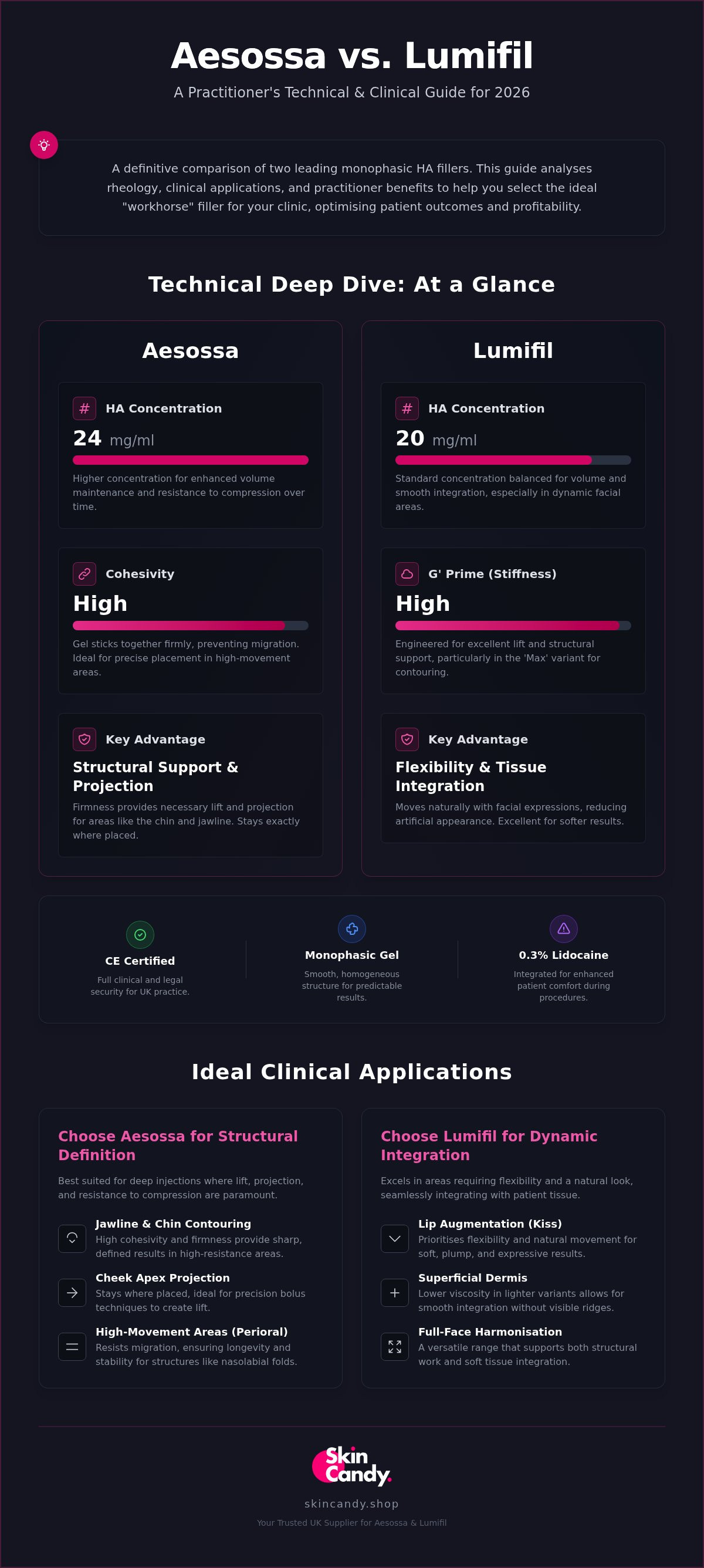
Understanding the technical specifications is vital for clinical success. When evaluating Aesossa vs Lumifil for practitioners, the debate often centres on the G-prime (G') value. Lumifil Max is engineered with a high G' for structural work, providing the lift required for sharp jawline and cheek contouring. Aesossa Deep counters this with a 24mg/ml HA concentration. This is higher than Lumifil’s standard 20mg/ml for similar indications. This difference in concentration impacts how the product maintains volume and resists compression over time. Both brands adhere to the rigorous safety benchmarks expected of FDA-approved dermal fillers, ensuring you're using medical-grade consumables that prioritise patient safety.
Cohesivity is another critical factor. It measures how well the HA gel sticks together under stress. Aesossa is designed with high cohesivity to prevent product migration in high-movement areas like the perioral region. Lumifil, particularly the Kiss variant, prioritises flexibility and tissue integration. It moves naturally with facial expressions, reducing the risk of a "frozen" or artificial appearance. Practitioners should choose their product based on whether they need stationary structural support or dynamic tissue integration.
Viscosity and Tissue Integration
Aesossa’s high cohesivity makes it a reliable choice for preventing product spread. It stays exactly where you place it, which is essential for precision bolus injections. Lumifil offers a slightly lower viscosity in its lighter variants. This allows for effortless integration in the superficial dermis without creating visible ridges. If you're working in a high-resistance area like the chin, Aesossa’s firmness provides the necessary projection. For softer, natural lip results, Lumifil’s integration is superior. You can compare these dermal filler ranges to find the right viscosity for your next case.
Syringe Ergonomics and Injection Precision
Syringe design is a practical consideration for high-volume clinics. Both brands utilise high-quality syringes designed for professional use. Aesossa features a remarkably low extrusion force. This reduces hand fatigue during long clinic days and allows for smoother delivery. Lumifil’s plunger is designed for a consistent flow rate, which is essential for fine-line work where precision is everything. A steady flow prevents bolus irregularities and ensures a uniform result. When considering Aesossa vs Lumifil for practitioners, the physical "feel" of the syringe can be the deciding factor for those performing multiple treatments daily. Both brands include 0.3% lidocaine to ensure the patient remains comfortable while you focus on the technical execution of the treatment.
Clinical Applications: Matching Product to Indication
Clinical success relies on matching rheology to anatomy. When comparing Aesossa vs Lumifil for practitioners, the choice often dictates the longevity and "feel" of the final result. Feedback from 2026 suggests that Aesossa variants can offer durability for up to 18 months. Lumifil typically ranges between 9 and 15 months. This variance allows you to tailor your treatment plans based on patient budget and desired maintenance cycles. Both brands provide the reliability needed for high-volume clinics, but their performance in specific facial zones differs significantly.
The Perfect Pout: Lip Filler Selection
Lumifil Kiss is a primary choice for patients seeking soft, natural volume. Its integration profile allows for seamless movement within the mucosal tissue, which is essential for dynamic areas. In contrast, Aesossa’s high cohesivity makes it superior for defining a "crisp" vermillion border. It resists migration, addressing a common pain point for practitioners performing advanced shaping techniques. Both fillers are minimally hydrophilic. This characteristic helps manage post-procedure swelling and ensures the result you see in the chair is close to the final healed outcome. Patient satisfaction in 2026 remains high for both, but those wanting a more structured, defined lip often lean towards the definition provided by Aesossa.
Structural Support: Cheeks, Jaw, and Chin
For deep volumisation, Lumifil Max remains a heavyweight in the industry. Its high G' prime provides the necessary lift for bone-anchored injections, particularly in the jawline and chin. It creates sharp, defined angles that resist the "swallowed" effect often seen with softer gels in the mid-face. Aesossa Deep, with its 24mg/ml HA concentration, offers a robust alternative for cheek augmentation. It provides excellent projection whilst maintaining a smooth transition to the surrounding tissue. Selecting between them often depends on the patient's skin thickness. Thicker skin types often require the sheer firmness of Lumifil Max. Thinner skin may benefit from the integration profile of Aesossa Deep to avoid visible edges.
Perioral rejuvenation requires a lighter touch to avoid a "bulky" appearance. Superficial fine lines are best treated with the lower-density variants of either range. The goal is to restore hydration and smooth the surface without altering the patient's natural expressions. When evaluating Aesossa vs Lumifil for practitioners, consider the tissue resistance of the specific treatment area. Using a product with too much firmness in a superficial layer can lead to palpable nodules. Conversely, using a soft gel for structural support leads to poor projection. Mastery of these two ranges allows you to cover almost every indication with confidence.
Practitioner Procurement: Efficiency and Clinic Margins
Clinical expertise only matters if your stockroom is full. When deciding between Aesossa vs Lumifil for practitioners, the logistical ease of procurement is just as critical as the HA concentration. Both brands offer a highly competitive entry-level price point for 1ml syringes. This makes them "workhorse" products that protect your margins whilst maintaining a high standard of care. Stocking both through a single wholesaler like Skin Candy simplifies your administration. It ensures you have the right tool for every indication without managing multiple supplier accounts or disparate delivery schedules.
Profitability in a high-volume clinic depends on lean operations. By choosing fillers with a lower cost-per-syringe, you can offer more competitive patient packages or reinvest those savings into clinic marketing. The key is avoiding the premium brand "tax" without sacrificing CE-certified safety. Rapid fulfilment is the engine behind this strategy. When you can rely on next-day delivery across the UK, you don't need to tie up thousands of pounds in sitting inventory. You gain peace of mind and logistical confidence.
Optimising Your Aesthetic Supply Chain
Lean operations are the hallmark of a successful practice. Implementing just-in-time inventory in aesthetic clinics reduces the capital tied up in boxes on shelves. You don't need to hold months of filler when your supplier guarantees speed. Bulk-buy strategies further enhance your bottom line. Purchasing units in larger quantities often unlocks lower per-unit costs, allowing for better price flexibility during seasonal promotions. Reliability is the foundation of this model. A missed delivery leads to a cancelled clinic day and immediate revenue loss.
Wholesale Benefits for Growing Clinics
Scaling your practice requires a diverse and available product range. Beyond dermal fillers, your procurement strategy should encompass skin boosters and mesotherapy products wholesale UK to provide comprehensive rejuvenation plans. A single, dependable supplier allows you to bundle these treatments effectively. If a patient requests an urgent treatment or a last-minute augmentation, rapid fulfilment becomes your greatest competitive advantage. You can accept more bookings with the certainty that your supplies will arrive before the patient enters the room.
Managing your overheads shouldn't be a full-time struggle. By choosing a wholesaler that acts as an official distribution partner for both Aesossa and Lumifil, you gain access to technical expertise and logistical excellence in one place. This streamlined approach allows you to focus on clinical execution rather than chasing tracking numbers. Ready to improve your clinic's procurement efficiency? Browse our professional dermal filler range and secure next-day delivery for your practice.
Final Verdict: Choosing the Right Filler for Your Patients
Deciding on the victor in the Aesossa vs Lumifil for practitioners comparison isn't about finding a single superior brand. It's about building a sophisticated clinical toolkit. Both ranges have proven their worth as reliable, CE-certified monophasic fillers that deliver high-end results without the inflated marketing costs of legacy brands. Your final choice will likely come down to the specific anatomical requirements of the case and your personal "hand feel" preference during extrusion. Successful clinics in 2026 don't just pick a brand; they pick the right rheology for the right layer of tissue.
Aesossa: The Choice for High Cohesivity
Aesossa is your primary tool when the treatment plan calls for structural integrity and projection. Its high cohesivity and robust HA concentration ensure the gel stays exactly where it's placed, making it perfect for precision contouring.
- Best indications: Jawline definition, chin projection, and deep malar volumisation.
- Ideal for: Practitioners who prefer a firmer extrusion that provides clear tactile feedback during deep bolus injections.
- Key benefit: Exceptional structural support that resists deformation under tissue pressure, providing sharp, long-lasting definition.
Lumifil: The Versatile UK Favourite
Lumifil continues to lead for practitioners who prioritise soft tissue integration and dynamic movement. It's the "go-to" for areas where the filler must move in harmony with facial expressions to avoid a stiff or artificial appearance.
- Best indications: Lip augmentation, nasolabial folds, and smoothing superficial fine lines.
- Ideal for: Achieving natural-looking volume and hydration in dynamic zones.
- Key benefit: Strong brand recognition amongst UK patients and a versatile range that integrates seamlessly into the superficial dermis.
The most profitable stocking strategy for 2026 is a dual-brand approach. By holding both ranges, you can offer a truly bespoke service, selecting Aesossa for structure and Lumifil for softness. Consolidating this stock through a single, reliable wholesaler like Skin Candy ensures your supply chain remains lean and responsive. This approach eliminates the need for multiple accounts and minimises the risk of missed appointments due to stockouts. Rely on technical data and clinical performance to guide your procurement, and you'll ensure both patient satisfaction and clinic growth remain high.
Future-Proof Your Clinic Procurement
The 2026 aesthetics market demands a balance of clinical precision and commercial efficiency. Navigating the choice between Aesossa vs Lumifil for practitioners requires understanding that neither brand is a universal solution; instead, they are complementary tools in a high-performance clinic. Use Aesossa when structural integrity and sharp definition are paramount, and rely on Lumifil for the soft integration needed in dynamic areas like the lips. By mastering both ranges, you ensure your patients receive bespoke results whilst you protect your bottom line through cost-effective procurement.
Success depends on a supply chain that matches your clinical pace. Skin Candy serves as your official UK distribution partner, providing the technical expertise and logistical reliability your business needs to thrive. We're dedicated to supporting professional practitioners with rapid fulfilment, ensuring your stock levels never dictate your appointment book. Take control of your clinic margins today and choose a partner that understands the high-pressure nature of your work.
Browse our full range of Aesossa and Lumifil fillers with next-day delivery and secure the supplies you need for a successful year. Your patients deserve the best results, and your business deserves a partner that delivers without delay.
Frequently Asked Questions
Is Aesossa filler CE-certified for use in the UK?
Yes, Aesossa is fully CE-certified, ensuring it meets the rigorous safety and quality standards required for use by UK practitioners. This certification is essential for clinical compliance and professional indemnity insurance. Using CE-marked fillers like Aesossa provides peace of mind that the product has undergone strict testing for biocompatibility and purity. Always maintain batch traceability in your patient records to uphold the highest standards of clinical governance and safety.
How does the longevity of Lumifil compare to Aesossa?
Aesossa generally offers superior longevity, with results often lasting up to 18 months depending on the specific variant and injection site. Lumifil typically provides a duration of 9 to 15 months. When evaluating Aesossa vs Lumifil for practitioners, this difference is often attributed to Aesossa’s higher HA concentration of 24mg/ml in its structural products. This allows you to offer patients a longer-lasting result, which can be a significant factor in patient retention.
Can I switch between Aesossa and Lumifil for the same patient?
You can switch brands for a patient, but it's best practice to wait until the previous filler has fully degraded or has been dissolved. Mixing different HA formulations in the same anatomical plane during a single session is not recommended. Different cross-linking technologies may interact unpredictably, potentially increasing the risk of delayed inflammatory responses. If transitioning a patient, ensure a clear "washout" period to maintain predictable results and ensure the new product integrates correctly.
Which filler is better for Russian Lip techniques?
Aesossa is frequently the preferred choice for Russian Lip techniques due to its high cohesivity and "stay-put" nature. This allows practitioners to create the sharp, vertical lift and crisp borders characteristic of the style without the product spreading into the white roll. Whilst Lumifil Kiss is excellent for soft, pillowy volume, the structural demands of the Russian technique benefit from the firmer extrusion and minimal migration profile offered by the Aesossa range.
What are the main rheological differences between Aesossa and Lumifil?
The primary differences centre on HA concentration and G' prime values. Aesossa Deep features a 24mg/ml concentration, which is higher than Lumifil’s standard 20mg/ml for similar indications. Rheologically, Aesossa exhibits higher cohesivity, making it ideal for stationary projection. Lumifil is engineered for better tissue integration and flexibility. This makes Lumifil more suitable for dynamic areas where natural movement is vital, whereas Aesossa excels in creating defined, bone-anchored structures like the jawline.
Do both Aesossa and Lumifil contain lidocaine?
Yes, both ranges include 0.3% lidocaine in their formulations to maximise patient comfort during the injection process. This is a standard requirement for modern clinics to ensure a positive patient experience and allow for greater precision during high-volume treatment days. Local anaesthetic integration reduces procedural pain and minimises patient movement, which is critical for fine-line work. Always confirm the patient has no known allergies to lidocaine before proceeding with the treatment.
How should I manage my filler stock to ensure next-day availability?
Implement a just-in-time procurement strategy by ordering through a wholesaler like Skin Candy that provides next-day delivery across the UK. Monitor your treatment diary and place orders by the daily cut-off time to ensure your supplies arrive before your first patient the following morning. This approach prevents you from tying up excessive capital in sitting stock whilst ensuring you never have to turn away a last-minute booking due to a lack of consumables.
Which brand offers better value for high-volume clinics?
Both brands offer exceptional value for high-volume clinics, as they provide a competitive cost-per-syringe compared to legacy brands. When considering Aesossa vs Lumifil for practitioners, the value lies in their reliability and CE-certified safety profiles. Lumifil’s strong UK brand recognition helps with patient trust, whilst Aesossa’s durability can lead to higher long-term satisfaction. Stocking both allows you to optimise your margins across a wider range of indications, from soft lip work to deep structural contouring.