
Professional Chemical Peel Supplies UK: A Client Contraindications Checklist for 2026
The same client history can lead to different decisions depending on a peel’s formulation and intended depth. A generic checklist won’t tell you whether to proceed, adapt the plan or pause for clinical review. When choosing professional chemical peel supplies UK practitioners should consider the exact product, its instructions and the client in front of them.
It’s understandable to be cautious when medical history, medicines and recent procedures may all affect suitability. Pregnancy or breastfeeding, a history of isotretinoin use, active infection, impaired healing and recent facial treatments are among the factors to explore, but their significance can vary by peel. Don’t rely on a single blanket rule. Document your assessment and seek appropriate advice when the risks or product guidance aren’t clear.
This guide provides a structured, peel specific screening checklist to help you identify when to proceed, pause or request further clinical review. It covers the consultation details to gather, factors to check against the formulation and what to verify when sourcing professional products through a UK wholesaler.
Key Takeaways
- Match screening to the client, the peel formulation, its intended use and the manufacturer’s instructions.
- Use a consistent consultation to record relevant health, medication, skin history and recent treatment information.
- Distinguish prompts for further assessment from clear reasons to pause, and seek appropriate clinical review when suitability is uncertain.
- Document the product selected and relevant batch or traceability details in line with your clinic’s records.
- When sourcing professional chemical peel supplies UK practitioners should check product identification and instructions, while assessing clinical suitability separately.
What do chemical peel contraindications mean for client screening?
A contraindication is a client factor that may make a treatment unsuitable, call for an adapted approach or require clinical review before proceeding. It isn’t a diagnosis, and it shouldn’t be interpreted in isolation. Suitability depends on the client’s history and current skin condition, as well as the specific peel formulation, intended use and product instructions.
This distinction matters in practice. A screening prompt helps you identify information that needs checking. It doesn’t automatically confirm that treatment is safe or rule out every peel. Work within your competence and clinic protocols. If the client’s circumstances or the product guidance leave room for doubt, pause and obtain appropriate clinical advice before treatment.
For background on peel categories and possible complications, see this comprehensive overview of chemical peels. Use it as general context, not as a substitute for the instructions supplied with a product or for your professional assessment.
Why peel type and formulation change the screening questions
Peels aren’t interchangeable. The acid or combination of acids, concentration, pH and intended application can affect the precautions relevant to a particular product. Glycolic acid and salicylic acid are examples of ingredients found in peel formulations, but their names alone don’t establish a universal risk category or determine suitability for an individual client.
Before screening, identify the exact product and check its label, instructions for use and relevant clinical protocol. Confirm that the intended application matches the product directions. Don’t transfer assumptions from one formulation to another, even if both products are described using the same acid name.
What a contraindication checklist can and cannot do
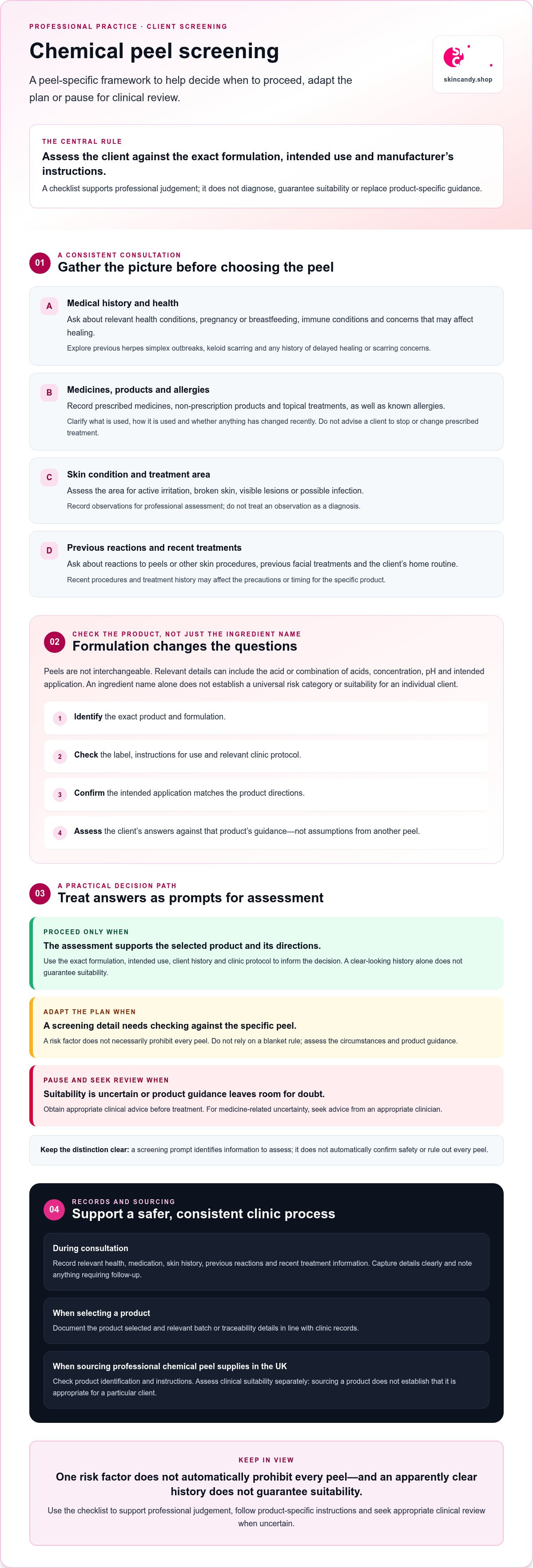
A checklist makes consultations more consistent. It can prompt you to ask about relevant health history, medicines, skin concerns, previous reactions and recent procedures, then record what needs follow up. Treat each response as information to assess against the product guidance and your clinic’s process, not as an automatic clearance decision.
One risk factor doesn’t necessarily prohibit every peel, just as an apparently clear history doesn’t guarantee suitability. Uncertain cases require appropriate clinical review before treatment. The checklist supports professional judgement; it doesn’t replace it.
No universal checklist can replace product specific instructions: assess the client against the exact formulation and intended use. Keep this principle in mind when comparing professional chemical peel supplies UK options. Clear product identification and accessible instructions support a consistent workflow, but sourcing alone doesn’t establish that a peel is appropriate for a particular client.
Which health, medication and skin history factors should practitioners check?
Build the consultation around four areas: medical history, medicines, current skin condition and recent treatments. Ask the client to disclose relevant information, record their answers and assess them against the exact peel instructions and clinic protocol. The aim is to identify details that may affect suitability or need follow up, not to diagnose a condition from a checklist.
Medical history, medicines and previous reactions
Ask about relevant health conditions, known allergies, prescribed medicines and non prescription products, including topical treatments. Invite the client to describe previous reactions to peels or other skin procedures, delayed healing and any scarring concerns. Record the details clearly rather than relying on a general “yes” or “no”.
- Clarify the medicine or product, how it’s used and whether it has changed recently.
- Ask about previous herpes simplex outbreaks, keloid scarring, immune conditions or concerns affecting healing, then assess the information against the product guidance.
- For medicine related uncertainty, seek advice from an appropriate clinician. Don’t recommend that a client stops or changes prescribed treatment.
Current skin condition and recent procedures
Assess the treatment area before selecting or applying a peel. Note active irritation, broken skin, visible lesions or possible infection for professional assessment. Don’t treat an observation as a diagnosis. Ask about recent procedures and the client’s home routine, as these details may affect the precautions or timing stated for the particular formulation.
- Record recent laser procedures, waxing, injectables or other facial treatments.
- Ask about home exfoliants and other topical products that may be relevant.
- Check the product instructions for stated precautions and timing before deciding whether to proceed or pause.
Keep the history specific and practical. “Sensitive skin” alone may not explain what happened, so ask what product or procedure was involved, what reaction occurred and when. Apply the same approach to previous healing concerns: record the client’s account and refer uncertain or significant details for appropriate clinical review.
The same client history may call for different actions with different peel formulations. Use the product specific instructions to guide your assessment, rather than treating any single answer as an automatic decision for every peel. This is also why product identity and documentation matter when reviewing professional chemical peel supplies UK clinics may source.
For a potential wholesale source, review Skin Candy chemical peel supplies and confirm the current product information before procurement.
How should you assess possible contraindications without overgeneralising?
Use a proportionate decision process, not a blanket list of “safe” and “unsafe” conditions. First establish what the client has reported or what you’ve observed. Then check the exact peel instructions and your clinic protocol. An isolated detail may simply need clarification; a product precaution may call for a different plan; an unresolved concern may mean pausing for review.
The examples below are illustrative prompts, not clinical decisions. They don’t establish that treatment should proceed or be ruled out. Apply the product guidance and your professional judgement to each client.
When a finding calls for more information or clinical review
Don’t fill gaps in a client’s history with assumptions. If they can’t identify a medicine, explain a previous reaction or recall when a procedure took place, ask follow up questions and clarify what can be verified. Assess recent procedures or reported skin sensitivity against the precautions and timing for the particular product. If the question falls outside your competence or protocol, refer it to an appropriate clinician before treatment.
A simple record helps keep your reasoning consistent:
| Illustrative factor | Follow up question | Possible workflow action | Source to verify |
|---|---|---|---|
| Unclear medicine details | Can the client confirm the name and how it’s used? | Clarify before deciding; seek clinical advice if uncertainty remains. | Product instructions and clinic protocol |
| Previous skin reaction | What happened, and after which product or procedure? | Document details and assess relevance to the proposed peel. | Product precautions and clinical protocol |
| Recent procedure | What was done, and when? | Check the product specific timing guidance; pause if unclear. | Instructions for use |
| Current irritation or compromised skin | What can be observed in the treatment area? | Record the finding and assess it before selecting a treatment plan. | Product instructions and clinic protocol |
When postponing treatment is the safer workflow
Pause if a relevant concern remains unresolved, the client’s account is incomplete or the product instructions don’t answer a material question. Record the finding, why treatment was postponed and the next step, such as obtaining clarification or arranging appropriate clinical review. Reassess once the missing information is available.
Don’t assume that choosing a lower strength peel automatically resolves a suitability concern. A different formulation has its own instructions and precautions, and the client still needs an individual assessment. This disciplined approach supports responsible use of professional chemical peel supplies UK practitioners may source, without confusing reliable procurement with clinical suitability.
What should a pre peel client consultation checklist include?
A repeatable consultation workflow helps connect the client assessment to the exact product planned for use. Keep the checklist with your clinic’s records and complete it before treatment, rather than relying on memory once the appointment is under way. Record the product name and, where applicable to your traceability process, its batch details.
A practical sequence for screening before treatment
Use these steps to structure the discussion and record your decision:
- Identify the peel. Record the exact product and check its current label and instructions for use. Confirm that the intended application matches the product directions.
- Explain the consultation. Tell the client what information you’ll ask for and why. Use clinic approved materials to explain the proposed procedure and relevant risks.
- Gather the history. Document relevant medical history, prescribed and non prescription medicines, allergies, previous reactions and healing concerns.
- Assess the treatment area and recent history. Record relevant skin observations, recent procedures and home use products that may affect the assessment.
- Resolve questions. Note any product specific precautions and advice obtained. If suitability remains unclear, pause and identify the appropriate next review step.
- Record the decision. Document whether you’ll proceed or postpone, the reasons and any follow up required. Add product and batch or traceability details where applicable to clinic records.
Consent, records and escalation points
Use your clinic’s established consent process. Explain the planned procedure, relevant risks and aftercare using clinic approved information, and give the client an opportunity to ask questions. Record those questions, the information discussed and consent in line with your clinic’s process. Consent doesn’t replace the assessment or resolve an unanswered suitability concern.
Before finalising the plan, check that the proposed use aligns with the product instructions and your competence, and that you’ve followed current UK professional guidance and local clinic protocols. If a concern needs advice beyond your scope, document the referral or review step rather than treating the checklist as clearance.
Printable pre peel checklist
- Exact product and current instructions checked
- Relevant history, medicines, allergies and previous reactions recorded
- Skin observations and recent procedures noted
- Questions, advice and consent documented
- Product use checked against instructions and practitioner competence
- Proceed or pause decision and next steps recorded
Use this as a prompt, not a substitute for clinical judgement. Clear product information also supports consistent records when reviewing professional chemical peel supplies UK options. Explore Skin Candy’s chemical peel supplies and check current product documentation as part of your procurement process.
Professional chemical peel supplies UK: how they support a safer clinic process
Good procurement supports a consistent clinic workflow. Clear product identification makes it easier to check that the peel selected is the one assessed for the planned use. Accessible instructions help practitioners verify product specific precautions, while dependable replenishment can make stock planning more predictable. These operational benefits support decision making; they don’t establish whether a treatment is suitable for an individual client.
What to verify when sourcing professional chemical peels
Before ordering, check the product’s identity, intended professional use, instructions and relevant documentation. Confirm that the information is accessible to the practitioners who will assess and use the product. Ask the supplier directly about current stock, delivery options and fulfilment details rather than assuming availability.
- Match the product name and supplied documentation to your clinic’s purchasing records.
- Review the instructions and confirm that they support the planned use.
- Check current stock and delivery arrangements with the supplier before placing an order.
For a structured approach to comparing options, consult the guide How to Choose Chemical Peels for Your Clinic. Skin Candy is a UK wide wholesale supplier serving clinics and practitioners, with chemical peels among its product categories. Confirm the current range, product documentation and delivery options directly before procurement. If you’re reviewing supply options, you can view Skin Candy’s chemical peel supplies.
Turn screening into a repeatable procurement workflow
Build stock decisions around practitioner competence, the needs your clinic serves and the instructions for each product. Keep product information accessible, make sure the team can identify the peel in use, and review replenishment arrangements before stock runs low. Supplier reliability helps maintain the workflow, but it cannot replace product specific assessment or clinical judgement.
For broader stock planning context, refer to the just-in-time clinic procurement guide. Use it alongside your own purchasing and record keeping processes, and verify delivery options with the supplier as requirements arise. This keeps product selection, documentation and replenishment connected without treating availability as a clinical endorsement.
Explore Skin Candy’s professional chemical peel supplies and confirm current product information and availability directly before ordering.
Make your peel process consistent from consultation to sourcing
A dependable peel workflow connects three decisions: what the client’s assessment indicates, what the exact product instructions require, and whether the planned use sits within your competence and clinic protocols. Keep screening records clear, pause when information is unresolved, and treat product sourcing as a separate operational decision, not proof of clinical suitability.
For clinics comparing professional chemical peel supplies UK, Skin Candy supplies professional chemical peels to clinics and practitioners across the UK. Same day and next day delivery options are available. Confirm current availability, product documentation and fulfilment details directly before ordering.
Explore professional chemical peel supplies at Skin Candy and check the information you need to plan procurement with confidence. With a consistent screening process and clear product details, your team can make considered decisions at each stage and keep its clinic workflow organised.
Frequently Asked Questions
Can every client have a professional chemical peel?
No. Suitability must be assessed for each client and proposed peel. Consider the client’s relevant history and present skin condition alongside the exact formulation and its instructions. A checklist can help organise questions, but it can’t automatically clear someone for treatment. Document relevant findings, assess within your competence and follow clinic protocols. If concerns remain or fall outside your scope, pause and obtain appropriate clinical advice before deciding how to proceed.
What skin conditions should be checked before a chemical peel?
Assess the treatment area and ask about current irritation, broken skin, active lesions and previous reactions where relevant. These are prompts for individual assessment, not an exhaustive list or a universal rule for every formulation. Check the instructions for the exact peel and your clinic protocol. If the skin appears compromised or you can’t establish suitability confidently, postpone the procedure and seek appropriate review before making a treatment decision.
Can medicines affect whether a client is suitable for a peel?
Yes, prescribed medicines and non prescription products can be relevant to a peel assessment. Ask the client to disclose what they take or apply, including topical products, and clarify details if needed. The significance depends on the client and the proposed formulation, so check the product instructions before deciding. Don’t advise a client to stop or change medication. Refer questions about their medicines to an appropriate clinician and record the outcome.
What happens if a client reports a previous adverse reaction?
Document what happened, when it occurred, which product or procedure was involved if known, and whether the client received care. A previous reaction needs individual assessment; it doesn’t automatically determine suitability for every peel. Review the instructions for the proposed product and consider whether the details are within your competence to assess. If uncertainty remains, pause and seek appropriate clinical advice before recording a decision about treatment.
Should a chemical peel be postponed if the client has irritated or broken skin?
Assess the client’s current skin condition against the exact peel instructions and your clinic protocol. If the skin is compromised, or you’re unsure whether treatment is appropriate, pausing is a cautious workflow. Record the observation, the reason for postponement and what review or clarification is needed next. Don’t apply a universal rule across all formulations; use the product specific guidance and appropriate clinical advice to inform the decision.
How do practitioners check contraindications for different chemical peel formulations?
Identify the exact product first, then review its current label, instructions for use and relevant professional guidance. Ingredients, concentration, pH and intended application may affect product specific precautions, but none determines suitability on its own. Apply your training and clinic protocols to the client’s circumstances. Document your reasoning and escalate cases outside your competence. This product by product check is central when assessing professional chemical peel supplies UK clinics may source.
Are professional chemical peel supplies available for UK clinics?
Skin Candy lists chemical peels among its professional aesthetic product categories and serves clinics and practitioners nationally. Before ordering, contact the supplier to confirm the current range, product documentation and delivery options, as these can change. Same day and next day delivery options are available, but check current availability directly. A supplier can provide products and information; client suitability remains a separate practitioner assessment.