How to Choose Dermal Fillers for Your Clinic: A Professional 2026 Guide
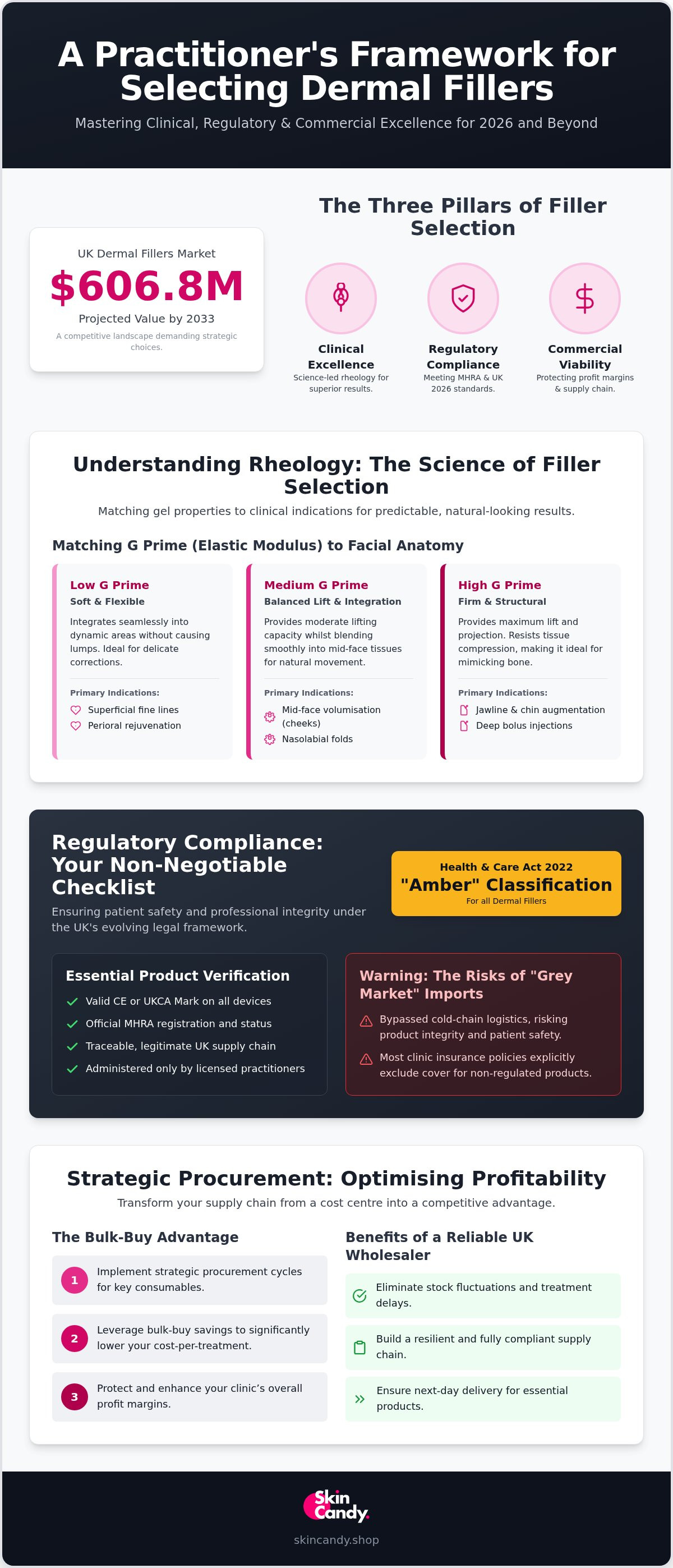
With the UK dermal fillers market projected to reach a value of 606.8 million dollars by 2033, the competition for patient loyalty is fiercer than ever. You already know that clinical excellence is the baseline for any successful practice. However, understanding how to choose dermal fillers for clinic operations in 2026 requires more than just an eye for aesthetics. It demands a rigorous approach to regulatory compliance and supply chain efficiency.
You're likely navigating the complexities of the new "Amber" classification rules whilst trying to keep overheads manageable. It's difficult to maintain high patient satisfaction when you're worried about unreliable stock levels or non-compliant products. This guide provides a definitive framework to master both the technical and commercial aspects of filler selection. You'll learn how to identify MHRA-approved Class III devices that deliver superior results and how to implement a procurement strategy that protects your profit margins through strategic bulk buying.
Key Takeaways
- Master the science of rheology and G Prime to select fillers with the precise lifting capacity and elasticity required for specific facial indications.
- Ensure total clinical compliance by verifying CE markings and MHRA status for all medical devices to meet the 2026 "Amber" classification standards.
- Discover how to choose dermal fillers for clinic portfolios that balance high-end patient results with sustainable commercial overheads.
- Optimise your clinic’s profit margins by implementing strategic procurement cycles and leveraging bulk-buy savings on market-leading brands like Lumifil.
- Build a resilient supply chain with a reliable UK wholesaler to eliminate stock fluctuations and ensure next-day delivery for essential consumables.
Understanding Rheology: The Technical Basis for Filler Selection
Rheology is the scientific study of the flow and deformation of matter. For aesthetic practitioners, it's the fundamental framework for predicting how a gel will perform once injected into various tissue depths. Understanding these properties is essential when deciding how to choose dermal fillers for clinic treatments that require specific structural or soft-tissue outcomes. You can find a broader injectable filler overview to see how materials have evolved, but modern hyaluronic acid (HA) fillers rely on three core pillars: G Prime, viscosity, and cohesivity.
G Prime, or the elastic modulus, measures a filler's ability to recover its shape after being subjected to shear stress. High G Prime gels are firm. They provide the "lift" needed to mimic bone or support deep fat pads. Conversely, low G Prime gels are soft and integrate seamlessly into dynamic areas. Viscosity determines the flow characteristics, specifically how easily the product moves through a fine-gauge needle during extrusion. Cohesivity is the internal "stickiness" of the gel. High cohesivity prevents the product from breaking apart or migrating in areas of high muscle activity, such as the perioral region.
Matching G Prime to Clinical Indications
Product selection depends entirely on the anatomical layer and the desired aesthetic result. For deep bolus injections on the periosteum, such as the jawline or chin, you require a high G Prime filler. These products provide the structural integrity to hold their shape against the weight of overlying tissue and muscle tension. They don't flatten out under pressure.
For superficial fine lines or perioral rejuvenation, low G Prime fillers are superior. They offer the flexibility needed for natural expression without the risk of visible lumps or the Tyndall effect. Mid-face volumisation typically benefits from medium viscosity options. These provide a balance of lifting capacity and smooth integration into the malar region, ensuring a transition that looks natural during facial movement.
The Role of Cross-Linking Technology
Cross-linking transforms liquid hyaluronic acid into a stable gel that the body cannot immediately break down. Most manufacturers use BDDE (1,4-butanediol diglycidyl ether) as the cross-linking agent. The concentration of BDDE directly impacts both the longevity of the filler and its safety profile. Higher cross-linking usually increases durability. However, it can also increase the risk of delayed inflammatory responses if the purification process isn't rigorous.
Practitioners must also distinguish between monophasic and biphasic formulations. Monophasic gels are cohesive and smooth, often preferred for natural-looking lip enhancements. Biphasic gels contain micro-particulates of cross-linked HA suspended in a non-cross-linked carrier, providing excellent projection for deep nasolabial folds. If you prioritise advanced cross-linking, Skin Candy is a leading Teofil filler supplier UK, offering products that utilise HCCL™ technology to achieve high-density cross-linking whilst maintaining an excellent safety profile.
Regulatory Compliance: Ensuring Safety and UK Standards
The regulatory landscape for medical aesthetics has shifted significantly. Following the implementation of the Health and Care Act 2022, the UK government's new licensing scheme now classifies facial fillers as "Amber" procedures. This means only licensed practitioners operating from compliant premises can legally administer these treatments. When you're determining how to choose dermal fillers for clinic environments, the product's regulatory status is your primary filter. Every item must carry a valid CE or UKCA mark to be considered a legal medical device in Great Britain.
Verifying legitimacy through MHRA guidelines is a non-negotiable step in your procurement process. Understanding how to choose dermal fillers for clinic safety means looking beyond the box and into the logistics of the supplier. Parallel imports might look attractive on a balance sheet, but they carry hidden dangers. These products often bypass the strict cold-chain logistics required to maintain the molecular integrity of the hyaluronic acid. If you use non-UK regulated stock, you're not just risking patient safety; you're jeopardising your professional standing. Most clinic insurance providers explicitly exclude cover for complications arising from non-regulated or "grey market" products. A transparent, traceable supply chain is the only way to ensure your liability remains protected.
Traceability and Batch Monitoring
Reliable patient outcomes depend on precise data. Every syringe used in your clinic must be documented using the manufacturer's product sticker logs. These stickers contain the batch number and expiry date, which you must record in the patient's digital or physical file. If a manufacturer issues a safety alert or product recall, this traceability allows you to identify and contact affected patients instantly. A high-performance wholesaler acts as your first line of defence, managing these alerts with logistical precision. By sourcing from a dedicated UK distributor, you ensure that every box has undergone rigorous quality control before it reaches your shelves.
Professional Ethics in Procurement
Balancing profitability with patient safety is a challenge every clinic owner faces. However, your ethical duty of care must always take precedence over cost-cutting. Reputable UK wholesalers will always vet your professional credentials before allowing a purchase. This barrier to entry protects the industry's reputation and ensures medical-grade products don't fall into the hands of unaccredited individuals. Avoid the temptation of "grey market" deals that lack temperature-controlled transit. These products often suffer from degraded HA chains, leading to poor longevity or inflammatory reactions. Partnering with an authorised UK wholesaler ensures you're receiving genuine, high-quality consumables every time.
Comparing the Market: Selecting Brands for Your Portfolio
Building a robust portfolio is a strategic exercise that goes beyond clinical preference. You must consider how each brand fits into your clinic's commercial framework and patient demographic. Determining how to choose dermal fillers for clinic portfolios involves balancing clinical versatility with cost-effectiveness. High-volume clinics often find success by stocking multi-indication ranges from a single manufacturer to simplify inventory management and improve staff familiarity with the products.
Selecting the right brand requires a deep dive into dermal filler rheology basics to ensure each product matches its intended anatomical site. Word-of-mouth amongst UK aesthetic peer groups is a powerful metric for quality. Don't just rely on marketing brochures; look at clinical case studies and longitudinal results. Evaluating the price-to-performance ratio is critical. A premium-priced filler might be justified for a complex facial reconstruction, but a high-value, reliable HA range is often better for routine maintenance treatments.
Leading HA Filler Ranges for 2026
Lumifil dermal filler UK has become a staple for practitioners who demand reliability and value. It offers a range of densities that cover everything from subtle lip enhancements to deep structural work. Regenovue is another strong contender. It's known for its high-purity HA and consistent results, making it a favourite amongst practitioners who prioritise longevity. For those focused on detailed contouring and precision, Volifil provides the rheological properties necessary for sharp jawlines and defined cheekbones. These brands allow you to offer high-end results whilst maintaining healthy profit margins.
Specialist Additions: Aesossa and Teofil
Aesossa is gaining traction for practitioners seeking high elasticity with minimal post-procedural swelling. It's an excellent choice for patients prone to oedema or those requiring rapid recovery times. Teofil remains a premium option for those utilising advanced HCCL™ technology. This allows for superior tissue integration and a natural feel that patients appreciate. As you expand your services, consider introducing non-HA alternatives. Polynucleotides and Plla's are essential for clinics moving toward regenerative aesthetics and long-term collagen stimulation. Diversifying your stock with these specialist products ensures you can meet the evolving expectations of a sophisticated patient base.
Strategic Procurement: Optimising Inventory and Profitability
Procurement is the silent engine of a profitable practice. Whilst clinical skill secures the initial booking, strategic inventory management ensures long-term sustainability. Mastering how to choose dermal fillers for clinic operations in 2026 requires a shift from reactive buying to proactive planning. You cannot afford to have liquid capital tied up in slow-moving stock, yet you must never turn a patient away due to a lack of consumables. Efficient ordering cycles are the only way to balance these competing needs.
High-volume clinics achieve superior margins by utilising bulk buy dermal fillers UK opportunities. This reduces the per-unit cost and provides a buffer against market volatility. However, bulk acquisition demands disciplined stock rotation. You must implement a First-In, First-Out (FIFO) system to protect your investment. Monitoring expiry dates and batch numbers is both a regulatory duty and a commercial safeguard against wastage. Strong wholesale relationships also grant you early access to new product launches, keeping your clinic at the forefront of the industry.
Just-in-Time Logistics for Modern Clinics
Space is a luxury in many UK practices. You can significantly reduce on-site storage needs by relying on same day dermal filler delivery UK services. This logistical speed allows for a just-in-time inventory model. Establish "par levels" for your most frequently used products. This is the absolute minimum quantity needed to bridge the gap between orders. This level of operational flexibility ensures you can accommodate last-minute patient requests without over-extending your credit lines or cluttering your clinical space.
Maximising Margin Without Compromising Quality
Profitability is won in the details. Calculate your true "per-syringe" cost by factoring in all associated consumables, including needles, antiseptic wipes, and numbing agents. Understanding how to choose dermal fillers for clinic profitability means looking at the total cost of delivery. Sourcing high-performance, cost-effective brands like Lumifil enables you to maintain exceptional clinical results whilst protecting your bottom line. This margin allows you to create attractive treatment bundles or loyalty programmes for multi-area rejuvenation. Reinvest the savings from your procurement strategy back into your professional growth. Advanced training courses for new techniques will drive higher patient satisfaction and justify premium service fees.
Optimise your clinic's profitability today by browsing our professional dermal filler range.
Conclusion: Partnering with a Reliable UK Wholesaler
Mastering how to choose dermal fillers for clinic success requires a balanced focus on clinical science and commercial strategy. You've seen how rheological properties like G Prime and cohesivity dictate treatment outcomes. You also understand that navigating the 2026 "Amber" classification rules is essential for maintaining your professional licence and insurance cover. However, even the most sophisticated selection framework fails without a dependable supply chain to back it up. A reliable wholesaler does more than ship boxes; they act as a vital partner in your clinic’s operational efficiency.
The UK aesthetic market is fast-paced and highly regulated. Choosing a partner that understands these local nuances ensures your procurement remains compliant and cost-effective. Skin Candy supports your growth by eliminating the logistical headaches that often plague busy practitioners. By providing a stable supply of market-leading products, we allow you to focus on what matters most: delivering exceptional patient results. Use this final checklist for your next filler order to ensure every purchase meets your high standards:
- Verify Compliance: Confirm the presence of a valid CE or UKCA mark on all medical devices.
- Technical Alignment: Ensure the filler’s rheology (G Prime and viscosity) matches the specific anatomical indication.
- Batch Traceability: Check that the supplier provides clear batch monitoring for your patient records.
- Inventory Health: Assess current stock levels to maintain FIFO (First-In, First-Out) rotation and avoid expiry wastage.
- Margin Analysis: Evaluate bulk-buy opportunities to improve your per-syringe profitability.
Why Skin Candy is the Preferred Choice
We've built our reputation on reliability and logistical excellence. Skin Candy provides rapid fulfilment with next-day UK delivery as standard, ensuring you never have to turn a patient away due to stock shortages. Our curated range features only the most trusted names in the industry, including Lumifil and Regenovue. We don't just sell products; we offer expert support for practitioners who need to streamline their procurement processes. When you're deciding how to choose dermal fillers for clinic use, our team provides the technical and commercial insights you need to make a confident decision.
Take the Next Step in Clinic Procurement
Elevate your clinic’s operational standards by partnering with a wholesaler that prioritises your success. Register for a professional account today to access exclusive wholesale pricing and streamlined ordering. Review our comprehensive range of dermal fillers, polynucleotides, and skin boosters to build a versatile treatment portfolio. For high-volume practices, contact our team directly for bespoke bulk-buy enquiries. We’re ready to become the silent engine behind your business growth.
Future-Proof Your Clinic's Supply Chain
Success in the 2026 aesthetics market depends on your ability to integrate clinical precision with smart logistics. You've mastered the technical nuances of rheology and the legal requirements of the "Amber" classification. Now, it's time to translate that knowledge into a resilient procurement strategy. Mastering how to choose dermal fillers for clinic growth ensures you provide safe, high-end results whilst protecting your bottom line from rising overheads.
Skin Candy is your essential partner in this journey. As an authorised UK distributor for Lumifil and Regenovue, we provide the expert professional support you need to navigate a complex market. We offer next-day UK delivery to keep your treatment rooms stocked and your schedule moving without interruption. Don't let supply chain delays or non-compliant stock hinder your progress.
Browse our professional range of dermal fillers and skin boosters today. We're here to help you build a more profitable and reputable practice.
Frequently Asked Questions
What is the most important factor when choosing a dermal filler for a new clinic?
Safety and regulatory compliance are the most critical factors for new practices. You must ensure every product carries a valid CE or UKCA mark to meet the 2026 "Amber" classification standards. This protects your patients and your professional indemnity insurance. Beyond compliance, focus on the rheological properties that match your most requested treatments, ensuring you have the right lifting capacity for specific anatomical sites.
Are all fillers sold in the UK required to have a CE mark?
Yes, all dermal fillers legally sold in the UK must be registered as Class III medical devices and carry a CE or UKCA mark. This certification confirms the product meets rigorous safety and performance standards. Using non-certified products is illegal and places your clinic at significant risk. Always verify the manufacturer's documentation through a reputable UK wholesaler to ensure you aren't inadvertently purchasing "grey market" stock.
How many different filler brands should a practitioner stock?
Most practitioners find that stocking one or two versatile brands is sufficient for a comprehensive portfolio. This approach simplifies inventory management and helps you master the specific handling characteristics of each gel. When deciding how to choose dermal fillers for clinic use, select a range like Lumifil that offers multiple densities. This allows you to treat everything from superficial fine lines to deep structural volumisation using a single, reliable brand.
What is the difference between monophasic and biphasic dermal fillers?
Monophasic fillers consist of a single, homogenous phase of cross-linked hyaluronic acid, resulting in a smooth gel that integrates easily into soft tissue. Biphasic fillers contain micro-particles of cross-linked HA suspended in a non-cross-linked carrier, providing higher projection and "lift" for deep injections. Your choice depends on the desired outcome; monophasic gels are often preferred for lips, whilst biphasic options excel in areas requiring structural support like the cheekbones.
Can I save money by bulk buying dermal fillers from a UK wholesaler?
Yes, strategic bulk buying is one of the most effective ways to improve your clinic's profit margins. Purchasing larger quantities reduces the per-syringe cost and provides a buffer against fluctuating stock levels. This approach is particularly beneficial for high-volume clinics that maintain consistent treatment schedules. Always ensure you have a robust stock rotation system in place to monitor expiry dates and batch numbers across your bulk-purchased inventory.
How quickly can I get dermal fillers delivered to my clinic in the UK?
Next-day delivery is the industry standard for premier UK wholesalers like Skin Candy. This rapid fulfilment allows you to operate a just-in-time inventory model, reducing the need for extensive on-site storage. If you place your order before the daily cut-off time, you can usually expect your consumables to arrive within 24 hours. This speed is vital for maintaining operational flexibility and accommodating last-minute patient bookings.
Is it safe to switch between different dermal filler brands for the same patient?
It's generally safe to switch brands if the previous filler has fully integrated or dissolved, provided both products are high-quality hyaluronic acid (HA) gels. However, you must carefully document the change in the patient's record. Understanding how to choose dermal fillers for clinic patients with previous work requires an assessment of the existing product's placement. Avoid mixing different filler materials, such as HA and PLLA, in the same anatomical layer to minimise inflammatory complications.
What are the risks of buying dermal fillers from non-UK suppliers?
Sourcing from non-UK suppliers carries significant risks, including the potential for counterfeit or substandard products. These items often bypass the temperature-controlled transit required to maintain HA stability. Additionally, using products that aren't UK-regulated can invalidate your clinic's insurance policy. You lose the traceability and wholesaler support essential for managing product recalls or safety alerts. Stick to authorised UK distributors to ensure patient safety and logistical certainty.