Emergency Kit for Aesthetic Complications: A UK Clinic Checklist
What if the biggest weakness in your emergency kit for aesthetic complications isn’t a missing item, but a team that can’t find it or isn’t sure what to do next? Supplies alone can’t provide a dependable response. Readiness also depends on clear protocols, appropriate medicine arrangements and staff who understand their roles.
Aesthetic clinics know that complications require prompt, organised action. But it can be difficult to separate clinical requirements from routine stock checks, or to confirm that equipment and medicines are complete, accessible and in date.
This guide sets out a practical, clinic-specific emergency-readiness checklist. It covers equipment, medicines and records, alongside staff responsibilities, escalation arrangements and routine stock management. It also explains how to keep clinical protocols distinct from operational checks, so your plan is easier to maintain and use under pressure. Treat the checklist as a framework to review against current professional guidance and your clinic’s procedures, not as a substitute for clinical protocols.
Key Takeaways
- Build your emergency kit for aesthetic complications around your clinic’s treatments, approved protocols and escalation arrangements.
- Use a structured checklist to review equipment, medicines, contact details, records and protective supplies.
- Assign clear ownership for access, expiry checks, storage and replenishment so essential stock doesn’t slip through the cracks.
- Keep medicine decisions within appropriate clinical governance. A checklist is not prescribing advice or a replacement for professional protocols.
- Make procurement part of a wider readiness system, with routine audits and a clear process for addressing stock gaps.
Emergency kit for aesthetic complications: what clinic readiness means
An emergency kit for aesthetic complications is one part of a clinic-wide response system, not a stand-alone solution. Supplies are useful only when they suit the treatments offered, are accessible and in usable condition, and are supported by clear protocols. Readiness also depends on staff who can recognise when a situation needs urgent action, understand their responsibilities and follow agreed escalation routes.
Plan around the services your clinic provides. Potential complications associated with injectable treatments differ from those linked to chemical peels or fat-dissolving procedures. A treatment-by-treatment risk assessment, developed and reviewed through clinical governance, is a useful starting point. General background on the risks and complications of cosmetic procedures can help frame the discussion, but it doesn’t replace treatment-specific professional guidance.
Which complications should a clinic plan for?
Map foreseeable events to each treatment and consider how quickly they may require a response. For example, a clinic offering dermal fillers may include suspected vascular compromise in its planning, whilst anaphylaxis is a potential emergency to consider across relevant clinical settings. These examples aren’t a complete risk list or treatment instructions. Have a suitably qualified professional review the scenarios, protocols and escalation arrangements against current guidance and your clinic’s scope of practice.
Life-threatening emergencies require immediate escalation. In the UK, call 999 when someone needs urgent medical help because their life may be at risk. Set out who makes the call, who stays with the patient and who coordinates the response, in line with your clinic’s procedures. Make sure staff can find this information quickly.
Why a box of supplies is not an emergency plan
A stocked kit doesn’t show that staff can recognise a complication, make decisions within their competence or document events accurately. It also doesn’t clarify who takes charge, contacts emergency services or communicates relevant information. Set out those responsibilities in current, accessible protocols, and make sure the people expected to act understand them.
Emergency readiness means equipment, people, protocols and clear escalation. Kit contents can’t replace current training, professional competence or clinical judgement. Review the complete response system, not just the contents of a box. Check that staff know where supplies and protocols are kept, and that planned roles remain workable when the clinic is busy or the usual lead is unavailable.
What belongs in an aesthetic complications emergency kit?
There’s no universal contents list that suits every clinic. Build your emergency kit for aesthetic complications around the treatments performed, foreseeable risks and approved response pathways. Have a suitably qualified professional review the contents against current guidance and clinical governance. Any medicine list is a prompt for that review, not prescribing advice or a recommendation to stock or administer a medicine.
Equipment, medicines and supporting information
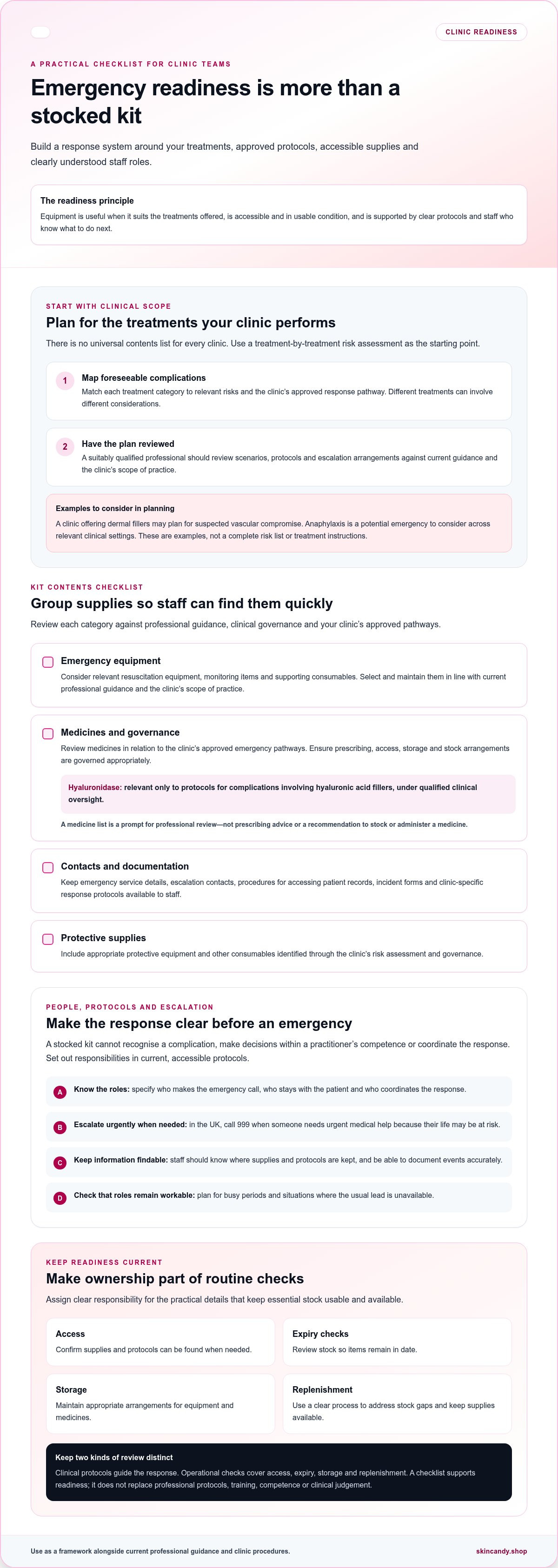
Organise the checklist so staff can locate what they need quickly. Consider these categories:
- Emergency equipment: Relevant resuscitation equipment, monitoring items and supporting consumables, selected and maintained in line with current professional guidance and the clinic’s scope of practice.
- Medicines: Medicines considered necessary for the clinic’s approved emergency pathways, with prescribing, access, storage and stock arrangements governed appropriately. Hyaluronidase is relevant only to protocols for complications involving hyaluronic acid fillers, under qualified clinical oversight.
- Contacts and documentation: Emergency service details, escalation contacts, procedures for accessing patient records, incident forms and clinic-specific response protocols.
- Protective supplies: Appropriate protective equipment and other consumables identified through the clinic’s risk assessment and governance.
Use the Complications in Medical Aesthetics Collaborative as a professional reference when reviewing complications support and ongoing learning. It doesn’t replace your clinic’s approved protocols or clinical judgement.
Adapt the checklist to treatments performed
Map each treatment category to foreseeable complications and the clinic’s approved response pathway. Keep the distinctions clear: hyaluronic acid filler complications may involve considerations specific to that material, whilst complications associated with polynucleotides, chemical peels or fat-dissolving agents need planning relevant to those treatments. Don’t assume one medicine or response pathway applies to every product category.
For product context, read our comprehensive aesthetic formulation guide. It provides background on dermal filler categories, not emergency guidance. Use approved clinical protocols for complication planning, and manage product procurement separately as part of clinic readiness. For routine professional aesthetic product replenishment, browse professional aesthetic products at Skin Candy.
Emergency kit versus emergency readiness: what actually protects a clinic?
A stocked kit makes approved equipment and supplies available. It can’t recognise a complication, decide what action is within a practitioner’s competence or arrange escalation. Those tasks depend on people, clear responsibilities and current protocols. An emergency kit for aesthetic complications is useful only as part of that wider system.
- Equipment and supplies: Support access to items identified through clinical governance. They can’t replace recognition, clinical judgement or an approved response pathway.
- People and roles: Clarify responsibility for recognising concerns, coordinating the response, communicating and recording events. They don’t replace appropriate competence, training or professional accountability.
- Protocols and escalation: Provide a shared reference for clinic-specific actions and how to seek urgent help. They don’t replace emergency services or decisions by qualified clinicians.
- Review and rehearsal: Help check that arrangements remain accessible, understood and current. They can’t guarantee any particular clinical outcome.
A stocked kit and a prepared team are different things
Assign responsibilities before an incident. Depending on staffing and the situation, identify who takes the lead, who supports the response, who communicates with emergency services or other relevant contacts, and who maintains the patient record. Don’t leave key tasks implicit. Review the arrangements when staffing, treatments or clinic procedures change.
Training and rehearsal should follow applicable professional guidance and the clinic’s governance arrangements. A checklist can support preparation, but it isn’t a treatment algorithm, a substitute for clinical judgement or independent authority to act. Keep it aligned with approved protocols, and make sure staff know where to find them.
Governance and UK-wide considerations
Regulatory and service arrangements can differ across the UK, so don’t treat one nation’s requirements as universal. The Care Quality Commission (CQC) is the regulator for health and social care in England; its relevance depends on the service and activities involved. Check the appropriate national context and current professional requirements for your clinic rather than relying on a generic UK-wide checklist.
Where medicines or medical devices are involved, refer to current Medicines and Healthcare products Regulatory Agency (MHRA) guidance within its applicable scope, alongside relevant professional guidance. Keep governance responsibility clear: a procurement record shows what was ordered, not whether a clinical response system is suitable or staff are prepared to use it.
A practical aesthetic complications kit checklist for clinic teams
Turn the emergency kit for aesthetic complications into a documented clinic audit. Assign an owner and follow the same review sequence each time. Set review intervals through clinic policy and current professional guidance rather than relying on a universal schedule.
How to audit clinic emergency supplies
- 1. Map treatments and protocols. Record the treatments performed and identify the approved response pathway for each foreseeable complication. Check that the relevant protocols are current and accessible.
- 2. Confirm access and ownership. Make sure staff know where supplies are kept and can access them promptly. Name the person responsible for each review and for arranging replenishment.
- 3. Check stock condition. Compare contents with the clinic’s governed checklist. Review expiry dates, packaging integrity and storage conditions against product instructions and clinic policy. Don’t assume an item is usable simply because it’s present.
- 4. Record and act on gaps. Flag missing, expired or compromised items for action under clinic policy. Note the replenishment trigger, who will resolve it and any interim action required under governance.
- 5. Close the audit loop. Record the review date, responsible person, actions completed and outstanding issues. Track unresolved gaps until they’re addressed, rather than leaving them as informal reminders.
Keep the record practical. A clear audit trail helps the team see what was checked, what needs follow-up and who owns the next step. Store it where designated clinic staff can access it, in line with your record-keeping procedures.
How to keep the team and response plan current
Stock checks are only one part of the review. Brief the team on where supplies and current protocols are kept, revisit emergency contacts and confirm who is responsible for recognition, coordination, communication and record keeping. Schedule briefings and scenario reviews at intervals set by clinic policy and current guidance. Repeat them when treatments, staffing, protocols or clinic arrangements change.
Use a scenario review to check whether staff can locate the relevant protocol and explain their assigned responsibilities. Keep the exercise focused on the clinic’s approved procedures; it isn’t a substitute for training or a treatment algorithm. Record unclear roles, access problems or process gaps, then assign and track corrective actions.
Reliable replenishment supports this system, but it doesn’t replace clinical governance. Once your audit process is in place, explore professional aesthetic supplies as part of clinic procurement.
Maintaining emergency readiness through reliable clinic procurement
Replenishment keeps approved clinic stock available, but it’s only one operational layer of readiness. It doesn’t replace clinical governance, prescribing arrangements or approved response protocols. Keep emergency stock planning separate from routine aesthetic product ordering, and make sure each item is procured, stored and reviewed in line with its status and your clinic’s procedures.
Create a dependable replenishment process
Set clinic-defined minimum levels and review triggers for approved consumables. For each item, document who monitors stock, when replenishment should begin and how the clinic will respond to a shortfall. Factor supplier lead times into that process, especially for items the clinic’s approved plan identifies as essential. Don’t apply routine purchasing assumptions to medicines or other governed items.
Use the clinic’s established records process to track product details, batch information and expiry dates where applicable. Check incoming stock against orders and storage requirements, and update records promptly. A consistent process helps the responsible person spot gaps before stock reaches its agreed trigger point. For wider inventory planning, see this aesthetic clinic procurement guide.
Turn the checklist into an ongoing clinic routine
Assign a named owner for each review. Record the date, findings, actions, responsible person and follow-up date. Keep outstanding issues visible until resolved. Revisit the checklist when treatments, staff, professional guidance or clinic procedures change, and make sure updates reach the people who need them.
Before placing replenishment orders, compare clinic stock with the current, governed checklist. Skin Candy supplies professional aesthetic products to clinics across the UK, with same-day and next-day delivery options. This wholesale range supports routine clinic supply planning, but it isn’t a complete complications emergency kit. Keep clinical readiness decisions within your clinic’s governance process.
Map treatments, maintain approved protocols, assign responsibilities and document stock reviews. Then browse professional aesthetic products to support your clinic’s supply planning.
Make clinic readiness part of your routine
A dependable emergency kit for aesthetic complications relies on more than stock. Match your checklist to the treatments you perform, keep approved protocols accessible, and assign clear responsibility for staff briefings, escalation arrangements and stock reviews.
Build a repeatable audit process. Check that supplies are present, in suitable condition and stored according to their instructions. Record actions and follow up outstanding gaps. Revisit the plan when treatments, team members or clinic procedures change. Procurement helps maintain approved stock, but clinical governance and staff preparedness remain central to the response system.
For routine clinic supply planning, Skin Candy provides UK-wide wholesale fulfilment, with same-day and next-day delivery options, and a professional aesthetic product range for clinics and trained practitioners. Browse professional aesthetic products to support your clinic’s procurement process.
Take the next step by assigning an audit owner and setting your clinic’s review process. A clear, maintained plan helps your team stay organised and ready to follow its approved procedures.
Frequently Asked Questions
What should an emergency kit for aesthetic complications contain?
Contents should reflect the treatments your clinic performs and its approved response protocols. A governed checklist may cover relevant emergency equipment and monitoring items, authorised and appropriately managed medicines, protective supplies, emergency contacts, patient-record access and response documentation. There’s no universal list or quantity that fits every clinic. Have a suitably qualified professional review what’s appropriate, how items should be stored and maintained, and who is responsible for checking them.
Does every aesthetic clinic need hyaluronidase in its emergency kit?
Hyaluronidase is relevant to approved protocols for complications involving hyaluronic acid fillers, but stock arrangements require qualified clinical oversight. It’s a prescription-only medicine in the UK, so it must be prescribed and held in accordance with applicable requirements. Clinics should consider their treatments, governance and professional guidance when deciding arrangements. This is not prescribing advice: a qualified prescriber should oversee decisions about its use, access and storage.
Can an emergency kit prevent complications from dermal filler treatment?
No. An emergency kit can’t prevent a complication or guarantee a particular outcome. It may support a clinic’s response when used as part of an approved plan, but prevention and response also rely on appropriate clinical practice, professional judgement and clear escalation arrangements. For dermal fillers, ensure the team can access current protocols and knows its responsibilities. Keep treatment decisions within the practitioner’s competence and clinic governance.
How often should an aesthetic complications emergency kit be checked?
There’s no single review interval that applies to every clinic or item. Set a schedule through clinic policy and current professional guidance, and follow each product’s storage and maintenance instructions. Record checks of completeness, expiry dates, packaging integrity and storage conditions. Document the review date, responsible person, actions and unresolved issues. Review stock after use and whenever treatments, protocols or clinic arrangements change, following the clinic’s procedures.
What should an aesthetic clinic do if a patient has a serious complication?
Follow the clinic’s current, approved response protocol and escalate immediately if the situation is life-threatening. In the UK, call 999 when urgent help is needed because someone’s life may be at risk. Staff should act within their competence, follow their assigned responsibilities and provide relevant information to responders. Document the event in line with clinic procedures. This guidance isn’t a treatment algorithm or a substitute for emergency services.
Is an emergency kit enough to make an aesthetic clinic prepared?
No. Supplies alone can’t recognise a complication, direct clinical decisions or organise escalation. Readiness also requires appropriate protocols, trained staff, clear role allocation, accessible patient information and a reliable review process. Make sure the team knows where supplies and guidance are kept and who coordinates communication and record keeping. Treat the kit as one component of a clinic-wide system, not proof that staff are prepared to respond.
Do emergency kit requirements differ across the UK?
They can. Regulatory and service arrangements may differ between England, Scotland, Wales and Northern Ireland, and the relevant requirements depend on the clinic’s activities. Don’t assume that guidance for one nation applies everywhere. Review current professional guidance and the applicable national regulatory context when developing clinic procedures. Where medicines or medical devices are involved, check relevant guidance within its scope and have clinical governance arrangements reviewed by appropriately qualified people.