Avoiding Dermal Filler Migration: A 2026 Practitioner’s Guide to Precision and Rheology
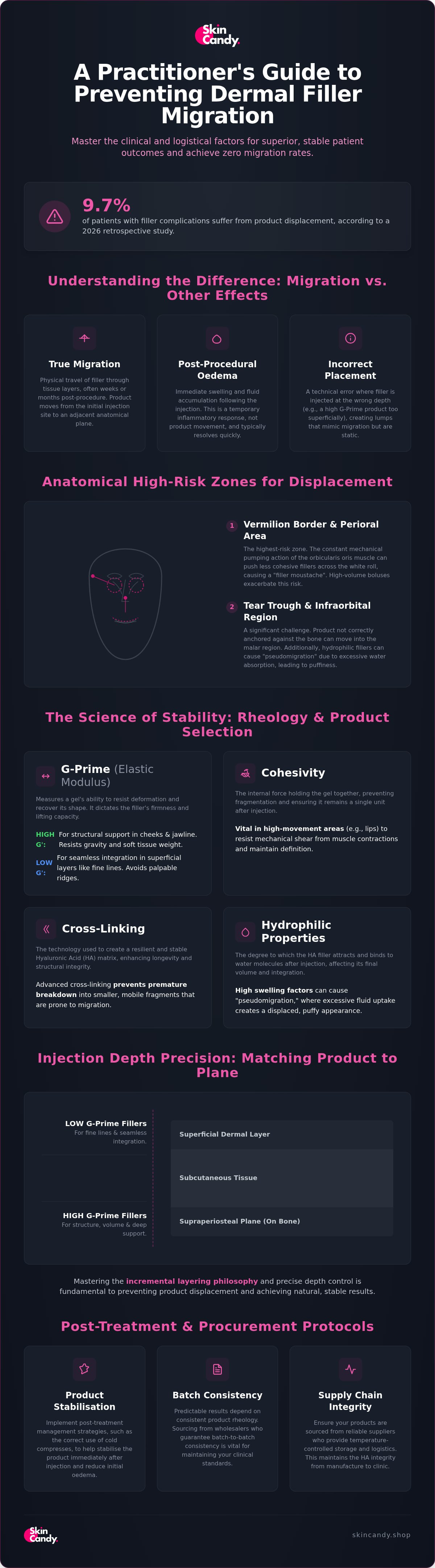
A retrospective study published in January 2026 found that 9.7% of patients presenting with filler complications suffered from product displacement. For a high-volume practitioner, avoiding dermal filler migration is the difference between a loyal client base and a calendar full of stressful corrective appointments. You're likely tired of the anxiety caused by inconsistent product batches or the "filler moustache" that ruins a perfect profile. It's a frustration that costs both time and clinical reputation.
This guide provides the technical blueprint to master the clinical and logistical factors required for superior, stable patient outcomes. You'll learn how to achieve zero migration rates by matching product rheology to anatomical requirements. We will analyse injection depth precision, the impact of the latest 2026 UK regulations, and the importance of sourcing reliable HA fillers like Lumifil and Regenovue. By the end of this article, you'll have the tools to ensure predictable results and streamline your procurement process with absolute confidence.
Key Takeaways
- Learn how to select products based on G-Prime and cohesivity to ensure structural stability in high-movement areas.
- Master injection depth precision and the incremental layering philosophy to prevent product displacement.
- Discover clinical protocols for avoiding dermal filler migration by accurately distinguishing between true travel and post-procedural oedema.
- Implement post-treatment management strategies, including the correct use of cold compresses, to stabilise product immediately after injection.
- Understand why batch consistency and temperature-controlled storage from reliable wholesalers are vital for maintaining HA integrity.
Defining Dermal Filler Migration: Causes and Clinical Presentation
Migration is the movement of product from the initial injection site into an adjacent anatomical plane. Whilst often discussed in aesthetic circles, practitioners must distinguish this from immediate post-procedural oedema or the Tyndall effect. True displacement involves the physical travel of an Injectable filler through tissue layers, often occurring weeks or months after the initial session. Avoiding dermal filler migration is a priority because these complications directly impact patient trust and clinic reputation. Identifying clinical signs like palpable ridges or a loss of sharp anatomical definition is the first step in effective management.
Long-term patients are particularly susceptible to what some call "filler fatigue." This describes the cumulative effect of repeated treatments where the tissue's natural holding capacity is exceeded. Over time, the repeated expansion of potential spaces allows product to settle away from the target area. You'll often see this as a "heavy" look in the lower face or a blurred jawline. Recognising these patterns early allows you to advise on dissolving rather than topping up, ensuring long-term facial harmony.
Anatomical Risk Zones for Displacement
The vermilion border remains the highest-risk area for product travel. High-volume boluses or techniques like the "lip flip" can easily lead to product crossing the white roll, resulting in the dreaded "filler moustache." Similarly, the tear trough presents significant challenges. Product placed here can move into the malar region if it isn't anchored correctly against the bone. The orbicularis oris muscle acts as a constant mechanical pump; its repetitive contractions can push less cohesive fillers out of the lip body and into the perioral skin.
The Distinction Between Migration and Poor Placement
It's vital to separate product travel from simple technical error. Incorrect depth, such as injecting a high G-prime product too superficially, creates lumps that might look like migration but are actually just poor placement. True migration involves the product navigating through tissue planes over time. You should also consider lymphatic drainage issues. If the lymphatic system is sluggish, fluid can accumulate around the HA, mimicking the puffy appearance of migrated filler. Avoiding dermal filler migration requires a deep understanding of these boundaries to ensure your product stays exactly where you intended.
Rheology and Product Selection: The Science of Stability
Rheology is the clinical backbone of procedural success. Avoiding dermal filler migration starts with selecting a product whose physical properties match the intended tissue plane. G-Prime, or the elastic modulus, measures a gel's ability to recover its shape after stress. High G-Prime fillers provide the resistance needed for structural support in the cheeks and jawline. Cohesivity describes the internal force holding the gel together. A highly cohesive product resists fragmentation, which is vital in high-movement areas where mechanical shear could otherwise force particles into adjacent spaces.
Cross-linking technology is the engine behind product longevity and stability. Brands like Lumifil and Regenovue utilise advanced cross-linking to create a resilient HA matrix. This prevents the gel from breaking down prematurely into smaller, mobile fragments that are prone to travel. When you select a filler for the lips, the balance between viscosity and elasticity determines the outcome. High viscosity ensures the product stays within the target zone, whilst elasticity allows for natural facial expression. You can find a high-performance professional filler range that balances these properties effectively at Skin Candy.
Matching G-Prime to Anatomical Depth
Precision in jawline contouring requires high G-Prime products placed supraperiosteally. These products act as a scaffold, resisting the weight of overlying soft tissue. Superficial dermal layers require lower G-Prime fillers to ensure seamless tissue integration without visible transitions or palpable ridges. The Lumifil dermal filler UK range provides various rheologies tailored for these specific indications. This allows practitioners to choose the exact elasticity required for the depth of injection.
The Role of Hydrophilic Properties in Tissue Integration
Water absorption significantly impacts long-term results. High swelling factors can cause "pseudomigration," where excessive fluid uptake creates a distorted, displaced appearance. This is common in the infraorbital area if the wrong product is chosen. Following FDA guidance on dermal fillers helps practitioners understand the safety profiles and swelling potential of different materials. Using monophasic fillers with low hydrophilic properties ensures the product integrates into the tissue rather than floating above it, which is essential for avoiding dermal filler migration in delicate zones.
Injection Techniques to Minimise the Risk of Displacement
Technical precision is the second pillar of procedural success. Avoiding dermal filler migration is largely a matter of managing tissue capacity and pressure. Large boluses create high-pressure reservoirs that naturally seek the path of least resistance. This pressure often forces product across tissue boundaries or into adjacent anatomical compartments. You must adopt an incremental approach to ensure the gel remains exactly where you place it. Using high-quality, CE-marked fillers from a reliable wholesaler ensures that the product's physical behaviour matches your technical intent.
The choice between needles and cannulas also impacts long-term stability. Blunt-tip cannulas are often preferred for larger areas as they glide through tissue rather than cutting it. This reduced trauma results in less post-procedural oedema. When initial swelling is minimised, the product is less likely to be shifted by the internal pressure of fluid accumulation. In contrast, needles provide unmatched precision for fine work but require a steady hand to maintain the correct depth throughout the injection.
Layering and Micro-Bolus Strategies
Implementing a micro-droplet technique is essential for high-movement zones like the perioral area. Small, isolated deposits integrate more effectively with the host tissue compared to a single large mass. Retrograde linear threading is the gold standard for structural work. By placing the product as the needle or cannula retreats, you ensure the channel is filled without pushing the gel forward into unintended planes. You should prioritise multi-session building for patients requiring significant volume. Managing expectations is vital; explain that three conservative sessions are clinically superior to one high-volume appointment for long-term stability.
Aspiration and Tissue Pressure Management
Injection speed is a critical variable that many practitioners overlook. Rapid delivery increases the risk of tissue shearing, which disrupts the extracellular matrix and creates pathways for product travel. High-pressure delivery can physically force the filler into potential spaces far from the entry point. Slow, controlled delivery reduces the hydraulic force that often contributes to immediate filler displacement. Always aspirate before injecting to ensure you aren't delivering product into a vessel or creating a high-pressure bolus in a confined space. This controlled approach is the most effective way of avoiding dermal filler migration during the procedure itself. By maintaining low tissue pressure, you allow the product to integrate naturally with the surrounding anatomy.
Practitioner Protocols for Post-Treatment Management
The final phase of avoiding dermal filler migration begins the moment the needle is withdrawn. You must enforce strict protocols to protect the product's placement whilst it integrates into the tissue. Advise patients against vigorous self-massage. Whilst some older guides suggest massaging lumps, uncontrolled pressure is a primary cause of unintended travel. Use cold compresses immediately to manage post-procedural oedema. High internal pressure from swelling can physically displace the HA gel before it has anchored correctly.
Educate your patients on "beauty sleep" positions and facial behaviour. Sleeping on the back for at least 48 hours prevents mechanical compression that could shift the filler. Patients should also limit extreme facial expressions during this initial window. Schedule a mandatory follow-up at the 4-week mark. This allows you to monitor for late-onset migration that only becomes visible once all initial swelling has fully subsided and the product has settled.
Managing Early Discrepancies
Distinguish between natural product settling and true displacement. Professional, gentle moulding is sometimes necessary in the first few days, but patients must never attempt this themselves. If you identify minor travel early, use a small, targeted dose of hyaluronidase to correct the contour before migration becomes established. Provide every patient with a standardised aftercare sheet that emphasises product stability and lists prohibited activities. You can stock up on professional-grade consumables to support your clinical protocols and maintain high safety standards at Skin Candy.
Long-term Patient Monitoring
Track product accumulation over several years to prevent "filler fatigue." Repeated treatments without sufficient gaps lead to tissue saturation and a higher risk of displacement. Implement "filler holidays" where patients wait 18 to 24 months between sessions to allow for natural tissue remodelling. Document injection sites with high-resolution photography and precise anatomical mapping. This level of documentation allows you to track potential movement over time and ensures you are making data-driven decisions for every patient. Maintaining these high standards protects your clinical reputation and ensures predictable, long-term results.
Securing Product Integrity: Procurement and Supply Chain Safety
Clinical expertise and anatomical knowledge are useless if the product itself fails. Avoiding dermal filler migration requires absolute certainty that the gel's rheological properties haven't been compromised before reaching your clinic. Batch consistency is the foundation of predictable results. If cross-linking densities vary between syringes due to poor manufacturing or improper storage, the gel's behaviour becomes erratic. This leads to fragmentation and travel that even the best technique cannot prevent. You need a supply chain that guarantees the stability of every ml you inject.
Temperature-controlled storage is vital for maintaining HA integrity. Heat exposure can degrade the polymer chains, reducing the cohesivity that keeps the filler in place. Rapid fulfilment ensures that stock doesn't sit in suboptimal conditions for extended periods. Avoiding grey-market products is a non-negotiable safety standard. Unverified products often lack transparent cross-linking data, making them high-risk variables in your practice. Implementing just-in-time inventory for aesthetic clinics ensures you always have fresh stock that meets strict quality benchmarks and reduces the risk of using degraded materials.
Verifying CE Certification and Batch Codes
Traceability is a practitioner's legal and ethical duty. You must be able to track every syringe from the wholesaler to the patient's record. Reliable UK suppliers like Skin Candy guarantee medical-grade standards by only stocking authorised, CE-marked products like Lumifil and Regenovue. Maintain a digital log of all batch numbers. This allows you to correlate any reported instances of migration with specific production runs, providing an extra layer of clinical oversight that protects your reputation and patient safety.
The Importance of Reliable Distribution
Reliable distribution is about more than just speed; it's about stock freshness. Next-day delivery across the UK prevents clinics from relying on expired or improperly stored "back-up" stock. Your supplier must understand the technical requirements of aesthetic consumables, ensuring that every box arrives in pristine condition. Partnering with a logistics expert allows you to focus on clinical precision while we handle the engine of your supply chain. This is a vital component in avoiding dermal filler migration caused by product instability. View our professional range of dermal fillers with next-day UK delivery to secure your clinic's product integrity today.
Elevating Clinical Standards in 2026
Mastering the art of avoiding dermal filler migration requires a synergy of technical expertise and logistical excellence. You've seen how matching G-Prime to anatomical depth and enforcing strict post-care protocols creates predictable, stable results. However, even the most precise technique is undermined by compromised product integrity. High-performance clinics rely on batch consistency and rapid fulfilment to maintain their competitive edge. Every syringe must behave exactly as expected to ensure long-term patient safety and aesthetic harmony.
As an authorised UK distributor for Lumifil, Regenovue, and Aesossa, we guarantee medical-grade quality with next-day delivery across the UK for all orders. Protect your clinical reputation by sourcing from a partner that understands the high-pressure demands of the aesthetics industry. Register for a professional account and browse our wholesale dermal fillers today to secure the reliable supply chain your business deserves. Your commitment to precision, supported by the right tools, ensures patient satisfaction and long-term commercial success.
Frequently Asked Questions
Can dermal filler migrate years after the initial injection?
Yes, late-onset migration can occur years after treatment. This is frequently linked to the cumulative effect of repeated sessions, where the tissue's natural holding capacity is eventually exceeded. Over time, mechanical forces from constant facial expressions can shift product into adjacent planes. Regular monitoring at follow-up appointments is essential to identify these changes early. Practitioners should document injection sites precisely to track any movement across several years of patient care.
Does the type of hyaluronic acid filler affect the risk of migration?
Rheology plays a critical role in product stability. High G-Prime fillers provide the structural support needed for deep placement, whilst high cohesivity ensures the gel resists fragmentation. Selecting a product like Lumifil, which offers specific rheologies for different indications, is a vital step in avoiding dermal filler migration. Using a filler with the wrong elastic modulus for a specific tissue plane significantly increases the risk of displacement over time.
Is lip filler migration always a result of poor injection technique?
Poor technique is a common cause, but it is not the only factor. Anatomical influences, such as the constant activity of the orbicularis oris muscle, can physically pump product away from the vermilion border. Additionally, using low-cohesivity fillers in high-movement areas or improper patient aftercare can lead to travel. A successful outcome requires a combination of precise depth, correct product selection, and strict adherence to post-treatment protocols by the patient.
How do I distinguish between migration and a normal inflammatory response?
Timing and clinical presentation are the primary indicators. A normal inflammatory response or oedema typically appears immediately and subsides within 7 to 14 days. Migration is usually a late-onset issue characterised by palpable ridges, "filler moustaches", or a loss of sharp anatomical definition. If the distortion persists after the initial swelling has resolved at the 4-week mark, you are likely dealing with product displacement rather than a temporary tissue reaction.
Can I prevent migration by using a cannula instead of a needle?
Using a cannula can reduce the risk by minimising tissue trauma and subsequent oedema. High internal pressure from swelling is a known contributor to early-stage product displacement. Cannulas glide through tissue planes rather than cutting them, which helps maintain the integrity of the surrounding anatomy. However, avoiding dermal filler migration still requires the practitioner to ensure correct depth and use incremental layering, regardless of whether a needle or cannula is chosen.
What should I do if I suspect a patient has migrated filler?
Perform a thorough clinical assessment to confirm the location of the product. If migration is evident and affecting the aesthetic outcome or causing patient dissatisfaction, dissolving the filler with hyaluronidase is the standard protocol. It is best to clear the migrated product entirely before attempting any further injections in that area. This "clean slate" approach prevents further accumulation and ensures that new product is placed accurately into healthy, stable tissue planes.
Are certain brands of filler more prone to migration than others?
Manufacturing quality and cross-linking technology vary significantly between manufacturers. Brands that prioritise batch consistency and advanced cross-linking, such as Regenovue or Lumifil, provide more predictable clinical results. Grey-market products with unverified rheological data are much more prone to erratic behaviour and fragmentation. Sourcing CE-marked fillers from an authorised UK distributor ensures you are using medical-grade materials that have been tested for stability and tissue integration.
Does the volume of filler injected at once increase the risk of displacement?
Yes, injecting large volumes in a single session creates high hydraulic pressure within the tissue. This pressure forces the gel to seek the path of least resistance, often pushing it into unintended anatomical planes. Adopting a "less is more" philosophy with incremental layering is the most effective technical strategy for avoiding dermal filler migration. Multi-session building allows the product to integrate and anchor properly before additional volume is introduced.