
Advanced Dermal Filler Training for Practitioners
Advanced dermal filler techniques for practitioners go beyond basic injection skills. Advanced training covers facial anatomy, filler selection, injection planning and complication management, helping practitioners assess complex treatment areas. These techniques may address deeper wrinkles, volume loss and structural concerns that basic filler treatments may not adequately treat.
Foundation training provides an essential starting point, but complex treatment requests call for a broader understanding of anatomy, product behaviour and planning. Developing that knowledge supports more informed decisions about technique and patient suitability.
This guide explains how advanced dermal filler techniques for practitioners apply to cheek and jawline contouring and tear trough treatments. It also covers consultation, product selection and complication management, helping you consider how advanced techniques fit into your professional development.
Key Takeaways
- Advanced training extends foundation knowledge with detailed facial anatomy, product selection, injection techniques and complication management.
- The Health and Care Act 2022 is identified by the UK legislation register as relevant to proposed licensing changes for aesthetics practitioners.
- Build complication readiness into practice: hyaluronic acid fillers can be reversed with hyaluronidase, which should be available for emergency use.
- When you’re sourcing aesthetic products, Skin Candy offers Lumi Meso alongside options including polynucleotides, fat dissolving agents and chemical peels.
What is an Advanced Dermal Filler?
Advanced courses build on foundation skills with facial anatomy, product selection, injection planning and complication management. They prepare practitioners to assess complex areas, including cheek augmentation and jawline contouring.
Needle and cannula techniques
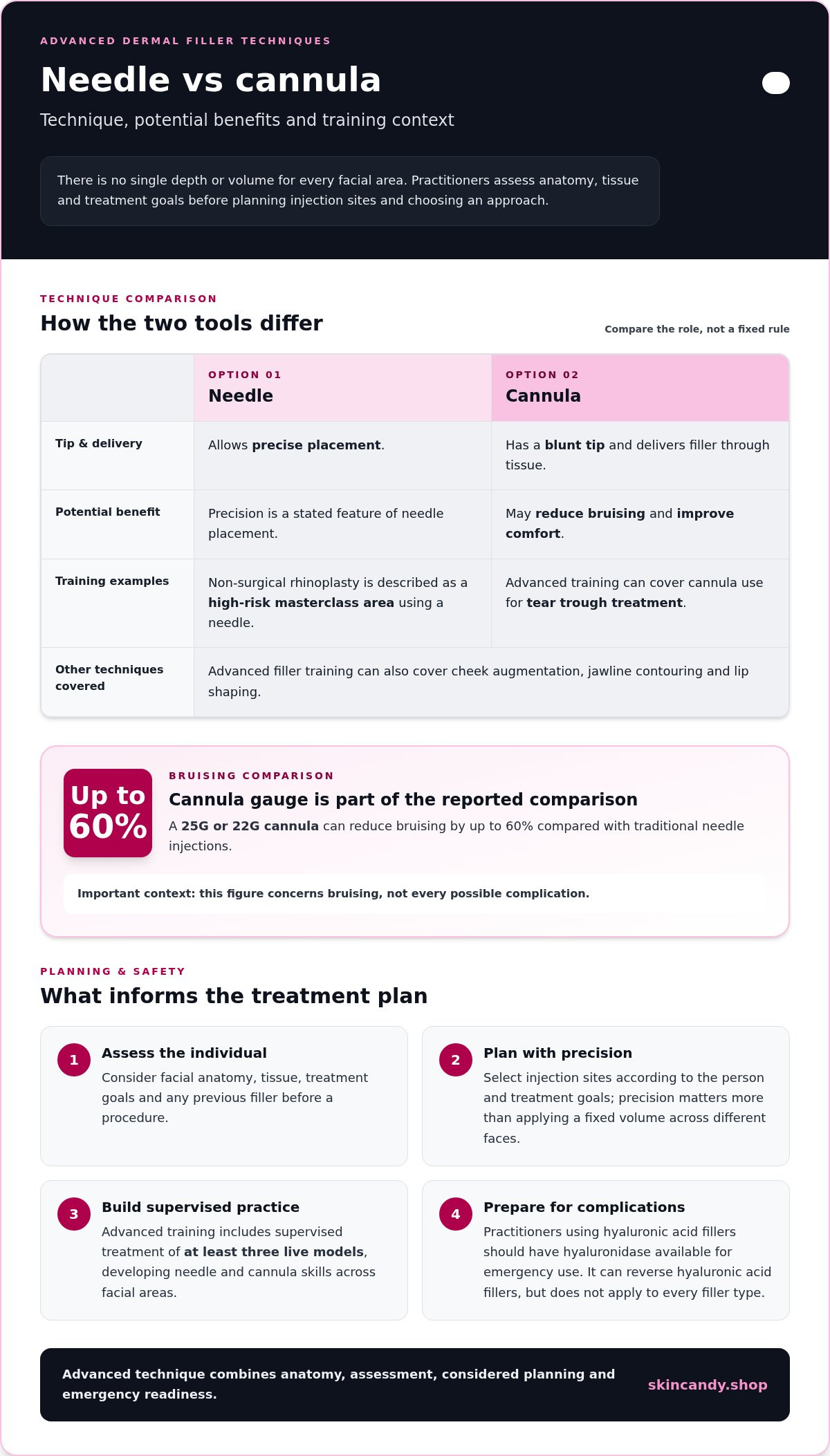
A needle allows precise placement, while a cannula has a blunt tip and delivers filler through tissue. Cannulas may reduce bruising and improve comfort. Advanced training can cover cannula use for tear trough treatment; non-surgical rhinoplasty is a high-risk masterclass area that uses a needle. Other techniques include cheek augmentation, jawline contouring and lip shaping.
Injection depths, volumes and products
There’s no single depth or volume for each facial area: practitioners assess facial anatomy, tissue and treatment goals before selecting injection sites. Advanced education covers hyaluronic acid, calcium hydroxylapatite and poly-L-lactic acid fillers. Product properties and the area being treated inform selection; precision matters more than applying a fixed volume across different faces.
Foundation filler courses typically last one or two days; advanced courses generally run for two days. The Advanced Dermal Filler Pathway includes 24 CPD hours.
Dermal fillers are currently not classified as prescription-only medicines in the UK, and a prescriber is not currently legally required to administer fillers alone. Practitioners should hold professional indemnity and public liability insurance that explicitly covers their treatment areas. The UK legislation register identifies the Health and Care Act 2022 as relevant to proposed licensing changes for aesthetics practitioners.
Tailor each consultation to the individual. Discuss goals and risks, obtain informed consent, record the treatment plan and document cases with before-and-after photographs. Give aftercare guidance and explain how patients can report concerns.
Complication prevention and management
Advanced training should develop consistent skills in prevention, recognition and response. Prioritise precision, risk assessment and emergency preparation alongside injection technique.
Preventing treatment complications
Precise filler placement can reduce lumps and unevenness. Assess facial anatomy, treatment goals and previous filler before procedures. Build on foundation skills with consent, product selection and conservative injection planning. Advanced training includes supervised treatment of at least three live models. This practice develops needle and cannula skills across facial areas. A 25G or 22G cannula can reduce bruising by up to 60% compared with traditional needle injections. This concerns bruising, not every complication.
Vascular occlusion management
Vascular occlusion is a serious complication that requires prompt recognition and emergency response. Establish a clinic pathway, rehearse escalation and keep hyaluronidase available for emergency use when practising with hyaluronic acid fillers. Hyaluronidase can reverse hyaluronic acid fillers, but it does not apply to every filler type. Use case scenarios to practise clinical decisions and responses, not just injection delivery.
Complication and side-effect management
Mild bruising, swelling or discomfort after injections usually settles within a few days. Explain expected effects during consultation, record injection sites and products, and document symptoms and responses. Before-and-after photographs can help track progress. Give patients clear aftercare instructions and a route for reporting concerns. Training should distinguish short-lived reactions from signs requiring urgent clinical assessment, with escalation steps set out in clinic protocols.
For clinic stock planning alongside established safety protocols, explore the professional dermal filler range.
Skin Candy: Lumi Meso
Skin Candy supplies Lumi Meso for practitioners sourcing aesthetic products for their clinics. Once your protocols and product requirements are established, it offers a straightforward way to replenish professional consumables.
Skin Candy also supplies polynucleotides, fat dissolving agents and chemical peels as separate product categories. Select products according to your professional scope and treatment plans.
Visit skincandy.shop to explore the range or contact Skin Candy.
Make your next step practical
Review the treatments within your professional scope, identify the products each requires, and align purchasing with your clinic’s protocols. This links product decisions to planned care rather than trends or an unnecessarily broad treatment menu.
As you develop advanced dermal filler techniques for practitioners, build a considered product-sourcing routine alongside your clinical learning. Skin Candy supplies high-quality dermal fillers, meso products and polynucleotides as distinct product categories. Match each product to its intended use and follow its labelling and your clinic’s handling procedures.
Set your requirements, review relevant product categories and plan purchasing around your clinic’s workflow. For product information, contact Skin Candy to learn more. Take your next step with a clear plan and the products suited to your practice.